
Tubular member made of fluororesin
a tubular member and fluororesin technology, applied in the field of fluororesin tubular members, can solve the problems of reducing gas permeability, unable to use countermeasures such as establishing a multi-layered, and affecting the gas flow rate, so as to reduce gas leakage and condensation on the tube surfa
Patent Information
- Authority / Receiving Office
- US · United States
- Patent Type
- Applications(United States)
- Current Assignee / Owner
- Publication Date
- 2005-03-03
- Estimated Expiration
- Not applicable · inactive patent
Smart Images
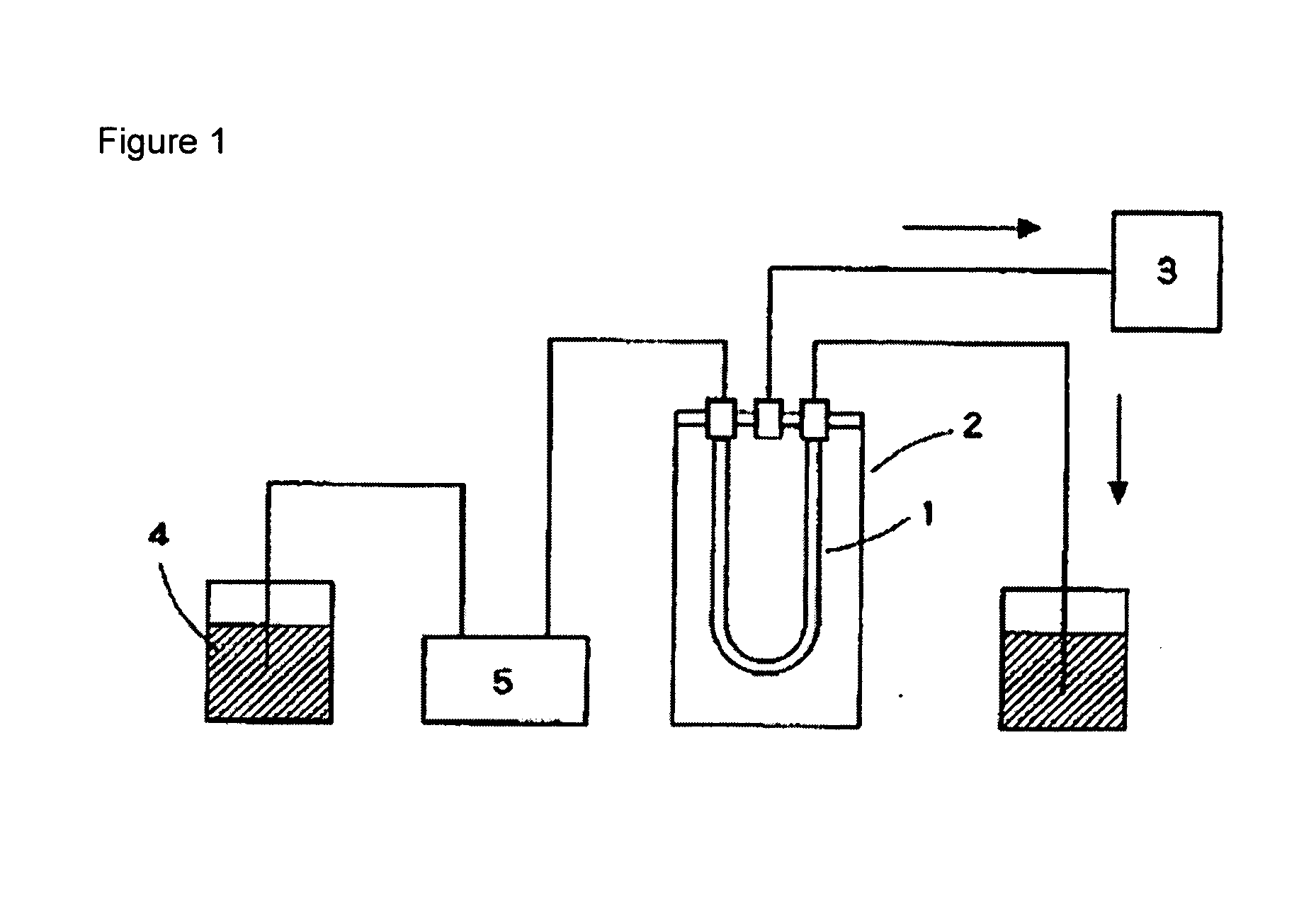
Figure 1
Abstract
Description
FIELD OF THE INVENTION
[0001] The present invention relates to a fluororesin tubular member, and, when used as a hose, tube, or other means to convey fluids or the like, relates to a fluororesin tubular member having exceptional gas-barrier properties with minimal gas permeability. BACKGROUND OF THE INVENTION
[0002] Materials made of fluororesins are extensively used in applications ranging from semiconductor manufacturing processes to those wherein chemical resistance is required. For example, hoses, tubes, and other tubular members manufactured from fluororesin materials by means of extrusion molding are employed in pipework used for fluids.
[0003] However, tubular members made of fluororesins have the characteristic of being highly gas-permeable, so that films and tubes made from tetrafluoroethylene-fluoroalkyl vinyl ether copolymer (PFA), tetrafluoroethylene-hexafluoropropylene copolymer (FEP), and polytetrafluoroethylene (PTFE), which are extensively used fluororesins, may be e...
Examples
##ventive example 1
INVENTIVE EXAMPLE 1
[0029] A tube having an inside diameter of 13.4 mm and an outside diameter of 17.9 mm was fabricated as a result of passing tetrafluoroethylene-fluoroalkyl vinyl ether copolymer (PFA451HP-J; manufactured by Du Pont-Mitsui Fluorochemicals Co., Ltd.) from a single-screw extruder having a die temperature of 380° C. through a former.
[0030] The tube was subsequently stretched 600% at a temperature of 280° C., a travelling speed of 0.17 m / min, and a pulling speed of 1.0 m / min, whereupon an annealing treatment was performed at a temperature of 220° C., a travelling speed of 0.60 m / min, and a pulling speed of 0.50 mm / min, and a 20% shrinkage treatment was performed.
TEST METHOD
[0031] As shown in FIG. 1, the flow rate of a metering pump 5 was varied to feed oxygen-saturated purified water 4 at a temperature of 25° C. to a 1080 mm sample tube 1, which was attached to a decompression vessel 2. The oxygen concentration was 8.1 ppm. In this configuration, the decompression v...
##ventive example 2
INVENTIVE EXAMPLE 2
[0034] A tube having an inside diameter of 12.2 mm and an outside diameter of 16.3 mm was fabricated as a result of passing tetrafluoroethylene-hexafluoropropylene copolymer (FEP NP-20; manufactured by Daikin Industries Ltd.) from a single-screw extruder having a die temperature of 380° C. through a former.
[0035] The tube was subsequently stretched 500% at a temperature of 230° C., a travelling speed of 0.20 m / min, and a pulling speed of 1.0 m / min, whereupon an annealing treatment was performed at a temperature of 180° C., a travelling speed of 0.60 m / min, and a pulling speed of 0.50 mm / min, and a 20% shrinkage treatment was performed.
[0036] The gas permeability of Inventive Example 2 (length: 1090 mm) was measured in the same manner as in Inventive Example 1. The results for Inventive Example 2 are displayed in Table 2.
##ventive example 3
INVENTIVE EXAMPLE 3
[0039] A tube having an inside diameter of 13.4 mm and an outside diameter of 17.9 mm was fabricated as a result of passing tetrafluoroethylene-fluoroalkyl vinyl ether copolymer (950HP-plus; manufactured by Du Pont-Mitsui Fluorochemicals Co., Ltd.) from a single-screw extruder having a die temperature of 380° C. through a former.
[0040] The tube was subsequently stretched 600% at a temperature of 280° C., a travelling speed of 0.15 m / min, and a pulling speed of 0.9 m / min, whereupon an annealing treatment was performed at a temperature of 200° C., a travelling speed of 0.60 m / min, and a pulling speed of 0.50 mm / min, and a 20% shrinkage treatment was performed.
[0041] The gas permeability of Inventive Example 3 (length: 1100 mm) was measured in the same manner as in Inventive Example 1. The results for Inventive Example 3 are displayed in Table 3.