
Stabiliser composition for halogen-containing polymers
Patent Information
- Authority / Receiving Office
- US · United States
- Current Assignee / Owner
- Publication Date
- 2006-01-05
- Estimated Expiration
- Not applicable · inactive patent
Smart Images
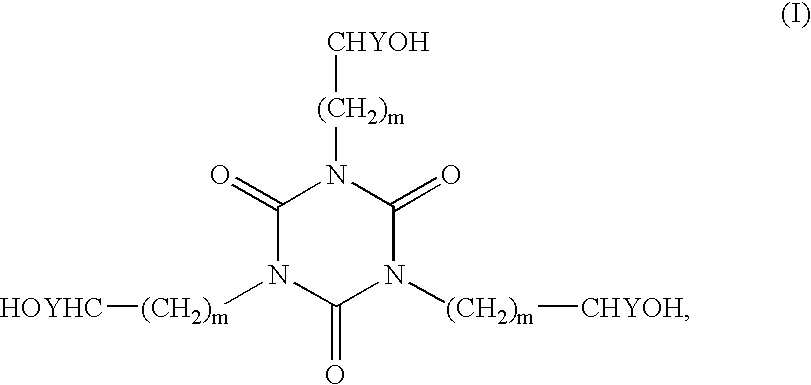
Figure 1 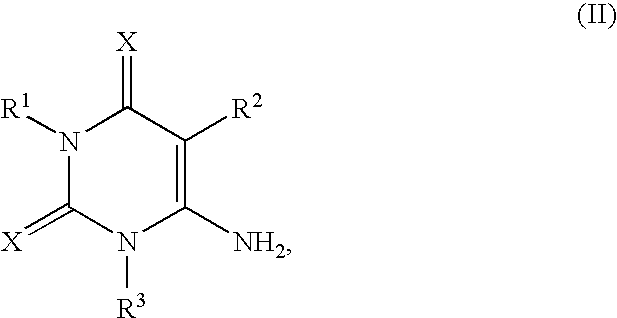
Figure 2 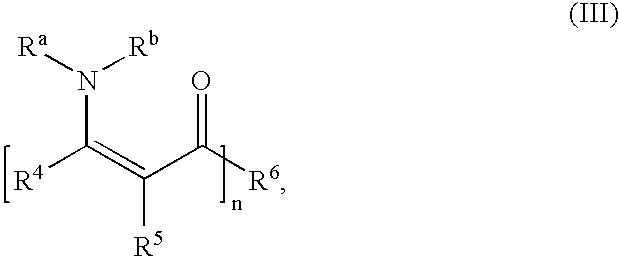
Figure 3
Abstract
Description
CROSS-REFERENCE TO RELATED APPLICATIONS
[0001] This is a continuation application of PCT / EP2003 / 013257, filed Nov. 25, 2003, which is incorporated herein by reference in its entirety, and also claims the benefit of German Priority Application No. 102 55 154.5, filed Nov. 26, 2002.FIELD OF THE INVENTION
[0002] The present invention relates to a stabiliser composition for foams of halogen-containing polymers. The present invention relates also to a process for the preparation of a stabiliser composition for foams of halogen-containing polymers and also to the use of a composition for stabilising a foam of halogen-containing polymers. In accordance with a further aspect, the present invention relates also to a moulded article produced from a foam of at least one halogen-containing polymer stabilised in accordance with the invention. BACKGROUND OF THE INVENTION
[0003] It is known that halogen-containing plastics have a tendency to undergo undesirable decomposition and breakdown reaction...
Examples
example 1
Preparation of the Perchlorate
[0164] 7.14 g of an aqueous solution of 70% by weight sodium perchlorate in water were reacted with a mixture of 6.66 g of calcium oxide (particle size D50: 14.5 μm) and 36.2 g of calcium hydroxide (particle size D50: 6.5 μm) (combination 1). An electron microscopic examination of the mixture did not demonstrate any definite crystallites of sodium perchlorate. An X-ray diffractogram exhibited no reflection at 2 θ=25.14°, demonstrating the absence of crystalline sodium perchlorate having a crystallite size of more than 5 nm.
example 2
Preparation of Polymer Compositions According to the Invention and Comparison Compositions Without Perchlorate or Without Blowing Agent
[0165] The mixtures listed in Table 1 were prepared from polyvinyl chloride (Solvic 258 RB), a mixture of Baerorapid 30 FD (processing aid, acrylate-based), zeolite, Ceasit SW (calcium stearate), Ca(OH)2, paraffin wax, PE wax, oxidised PE wax and the perchlorate prepared according to Example 1, with the use in some cases of four different additional blowing agents:
Raw material12345678910Solvic1100100100100100100100100100100Chalk10101010101010101010SKR24.354.354.354.354.354.354.354.354.354.35Perchlorate30.100.100.100.100.10ADCA40.140.140.140.14Blowing0.140.14agentZinc0.200.200.200.200.200.20BGAC50.200.200.200.20
1= Polyvinyl chloride
2= Composition comprising the following:
1 part by weight Baerorapid 30 FD (processing aid, acrylate-based)
0.75 part by weight zeolite
0.6 part by weight Ceasit SW (calcium stearate)
0.2 part by weight Ca(OH)2
0.7 part ...
example 3
Investigation of the Compositions of Example 2
[0166] The polymer compositions listed in Example 2 were investigated using a metal block thermostat (Liebisch). Three test pieces having a mass of (50±5) mg were produced per composition and investigated in respect of their thermal stability according to DIN VDE 0472 part 614 (HCL test) at a test temperature of (200±0.5)° C. Table 2 gives the resulting individual values for the stability times as well as the average values of the stability times of the three test pieces.
AverageSpecimenStability timeStability timeStability timevalueNo:1 [min]2 [min]3 [min][min]11313131329999311111111415151515511123126121313137131313113891010109181818181016161716