
Decoloration method in process for preparing biodiesel from waste cooking oil
A technology of catering waste oil and biodiesel, which is applied in the field of decolorization, can solve the problem of high temperature required, and achieve the effects of improved color, low decolorization temperature and short decolorization time
Patent Information
- Authority / Receiving Office
- CN · China
- Current Assignee / Owner
- Publication Date
- 2016-07-06
- Estimated Expiration
- Not applicable · inactive patent
Smart Images
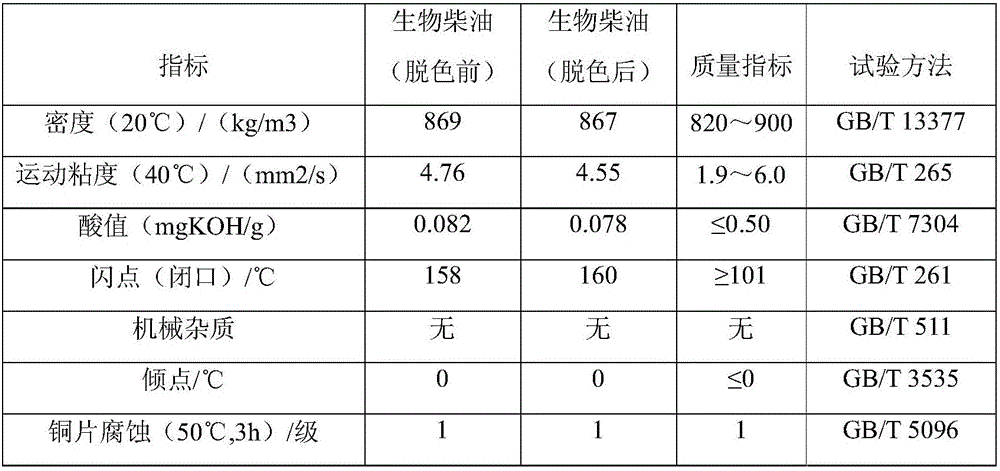
Figure 1
Abstract
Description
1. Technical field
[0001] The invention discloses a decolorization method, in particular to the decolorization method in the process of preparing biodiesel from waste cooking oil. 2. Background technology
[0002] Waste cooking oil (WCO) generally includes: gutter oil, hog water oil, frying waste oil, oil condensed and recovered from range hoods, waste oil produced by food companies and related companies [Yao Yaguang, Ji Wei, Zhang Chuanlong, etc. Waste oil in the catering industry Recycling and recycling management [J]. Renewable Energy, 2006, (2): 62-64.]. The quality of WCO is poor, the peroxide value, acid value, moisture, etc. are seriously exceeded, and contain a large number of spoilage factors, and some oils have been used repeatedly at high temperatures for a long time, and in contact with oxygen in the air, complex reactions such as hydrolysis, oxidation, and polymerization occur. As a result, the viscosity of the oil increases and the color deepens. The main com...
Examples
Embodiment 1
[0028] In a 100mL conical flask, add 40g of filtered catering waste oil (absorbance A 0 is 1.257), heated to 70°C, firstly added 1.2g of hydrogen peroxide, stirred at 20rpm for 10min, then used a separatory funnel to stand for liquid separation, took the upper liquid, and then added 4g of kaolin with a pore size of 2 to 50nm and 2g of a pore size of 0.5-40nm activated carbon, stirred at 80°C and 20rpm for 30min, took out the decolorized waste catering oil, filtered it with low-speed filter paper immediately, and tested the filtrate with a 722E visible spectrophotometer to measure the absorbance A of the decolorized catering waste oil 1 It is 0.136, and the decolorization rate reaches 89.2%.
[0029] The comparison of various performance indicators of waste cooking oil before and after decolorization is shown in Table 1.
[0030] Table 1 Comparison of properties of waste catering oil before and after decolorization
[0031] Performance
Before bleaching
After...
Embodiment 2
[0040] In this embodiment, the same filtered waste catering oil is decolorized in the same manner as in Example 1, except that the hydrogen peroxide decolorization temperature is changed to 65°C.
[0041] After testing, the absorbance A of waste catering oil after decolorization 1 was 0.155, and the decolorization rate was 87.7%.
Embodiment 3
[0043] In this embodiment, the same filtered waste catering oil is decolorized in the same manner as in Example 1, except that the hydrogen peroxide decolorization time is changed to 8 minutes.
[0044] After testing, the absorbance A of waste catering oil after decolorization 1 It is 0.150 in turn, and the decolorization rate is 88.1% in turn.