
Specific binding molecules for scintigraphy, conjugates containing them and therapeutic method for treatment of angiogenesis
a technology of specific binding molecules and scintigraphy, which is applied in the field of specific binding molecules for scintigraphy, conjugates containing them and the therapeutic method for treating angiogenesis, can solve the problems of tumour infarction and collapse, reagents unsuitable for tumour targeting, imaging, etc., and achieve the effect of promoting the apoptosis of the corresponding endothelial cells
Patent Information
- Authority / Receiving Office
- US · United States
- Patent Type
- Applications(United States)
- Current Assignee / Owner
- Publication Date
- 2007-08-16
- Estimated Expiration
- Not applicable · inactive patent
Smart Images
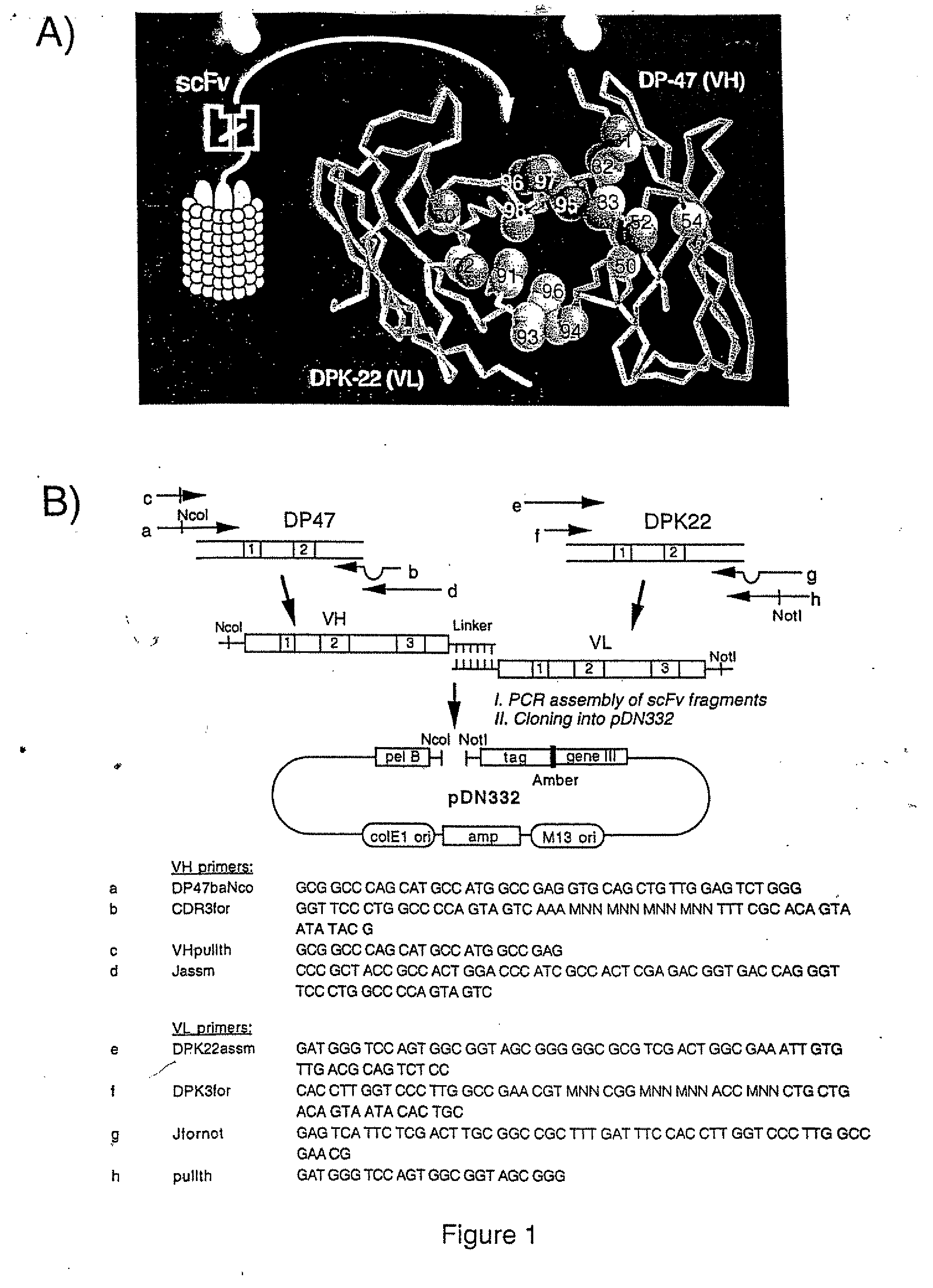
Figure 1 
Figure 2 
Figure 3
Abstract
Description
FIELD OF THE INVENTION
[0001] The present invention relates to antibodies with sub-nanomolar affinity specific for a characteristic epitope of the ED-B domain of fibronectin, a marker of angiogenesis. It also relates to the use of radiolabeled high-affinity anti-ED-B antibodies for detecting new-forming blood vessels in vivo and a diagnostic kit comprising said antibody.
[0002] Moreover, the invention refers to conjugates comprising the above said antibodies and a suitable photoactive molecule (e.g., a photosensitizer) and to their use in the detection and / or coagulation of new blood vessels. BACKGROUND OF THE INVENTION
[0003] Tumours cannot grow beyond a certain mass without the formation of new blood vessels (angiogenesis), and a correlation between microvessel density and tumour invasiveness has been reported for a number of tumours (Folkman (1995). Nature Med., 1, 27-31). Moreover, angiogenesis underlies the majority of ocular disorders which result in loss of vision [Lee et al....
Examples
example 1
Isolation of Human scFv Antibody Fragments Specific for the ED-B Domain of Fibronectin from a Antibody Phage-Display Library
[0068] A human antibody library was cloned using VH (DP47; Tomlinson et al. (1992). J. Mol. Biol., 227, 776-798.) and Vk (DPK22; Cox et al. (1994). Eur. J. Immunol., 24, 827-836) germline genes (see FIG. 1 for the cloning and amplification strategy). The VH component of the library was created using partially degenerated primers (FIG. 1) in a PCR-based method to introduce random mutations at positions 95-98 in CDR3. The VL component of the library was generated in the same manner, by the introduction of random mutations at positions 91, 93, 94 and 96 of CDR3. PCR reactions were performed as described (Marks et al. (1991). J. Mol. Biol., 222, 581-597). VH-VL scFv fragments were constructed by PCR assembly (FIG. 1; Clackson et al. (1991). Nature , 352, 624-628), from gel-purified VH and VL segments. 30 μg of purified VH-VL scFv fragments were double digested wi...
example 2
Isolation of a Human scFv Antibody Fragment Binding to the ED-B with Sub-Nanomolar Affinity
[0076] ScFv(E1) was selected to test the possibility of improving its affinity with a limited number of mutations of CDR residues located at the periphery of the antigen binding site (FIG. 1A). We combinatorially mutated residues 31-33, 50, 52 and 54 of the antibody VH, and displayed the corresponding repertoire on filamentous phage. These residues are found to frequently contact the antigen in the known 3D-structures of antibody-antigen complexes. The resulting repertoire of 4×10⁸ clones was selected for binding to the ED-B domain of fibronectin. After two rounds of panning, and screening of 96 individual clones, an antibody with 27-fold improved affinity was isolated (H10; Tables 1 and 2). Similarly to what others have observed with affinity-matured antibodies, the improved affinity was due to slower dissociation from the antigen, rather than by improved kon values (Schier et al. (1996). G...
example 3
Taretng Tumours with a High-Affinity Radiolabeled scFv Specific for the ED-B Dormain of Fibronectin
[0080] Radioiodinated scFv(L19) or scFv(D1.3) (an irrelevant antibody specific for hen egg lysozyme) were injected intravenously in mice with subcutaneously implanted murine F9 teratocarcinoma, a rapidly growing aggressive tumour. Antibody biodistributions were obtained at different time points (FIG. 4). ScFv(L19) and scFv(D1.3) were affinity purified on an antigen column (Neri et al. (1997, Nature Biotechnol. 15, 1271-1273) and radiolabeled with iodine-125 using the lodogen method (Pierce, Rockford, Ill., USA). Radiolabeled antibody fragments retained>80% immunoreactivity, as evaluated by loading the radiolabeled antibody onto an antigen column, followed by radioactive counting of the flow-hrough and eluate fractions. Nude mice (12 weeks old Swiss nudes, males) with subcutaneously-implanted F9 murine teratocarcinoma (Neri et al. (1997) Nature Biotechnol. 15, 1271-1273) were injected...