
Capsules containing a substance in powder form from which a beverage, preferably espresso coffee, is to be extracted
a technology of capsules and powders, which is applied in the field of capsules containing a substance in powder form, can solve the problems of the length of the manufacturing time of capsules, observed in known capsules, and achieve the effect of reducing manufacturing times and costs
Patent Information
- Authority / Receiving Office
- US · United States
- Patent Type
- Applications(United States)
- Current Assignee / Owner
- Publication Date
- 2008-01-31
Smart Images
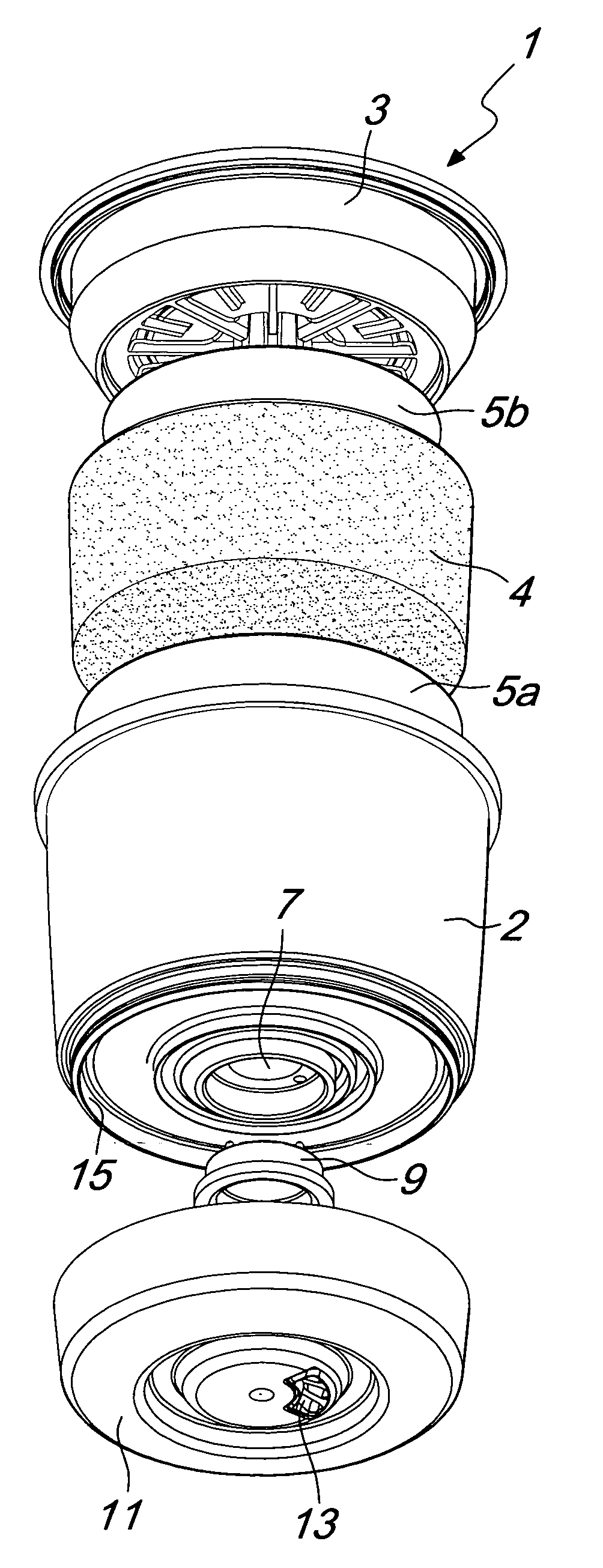
Figure 1 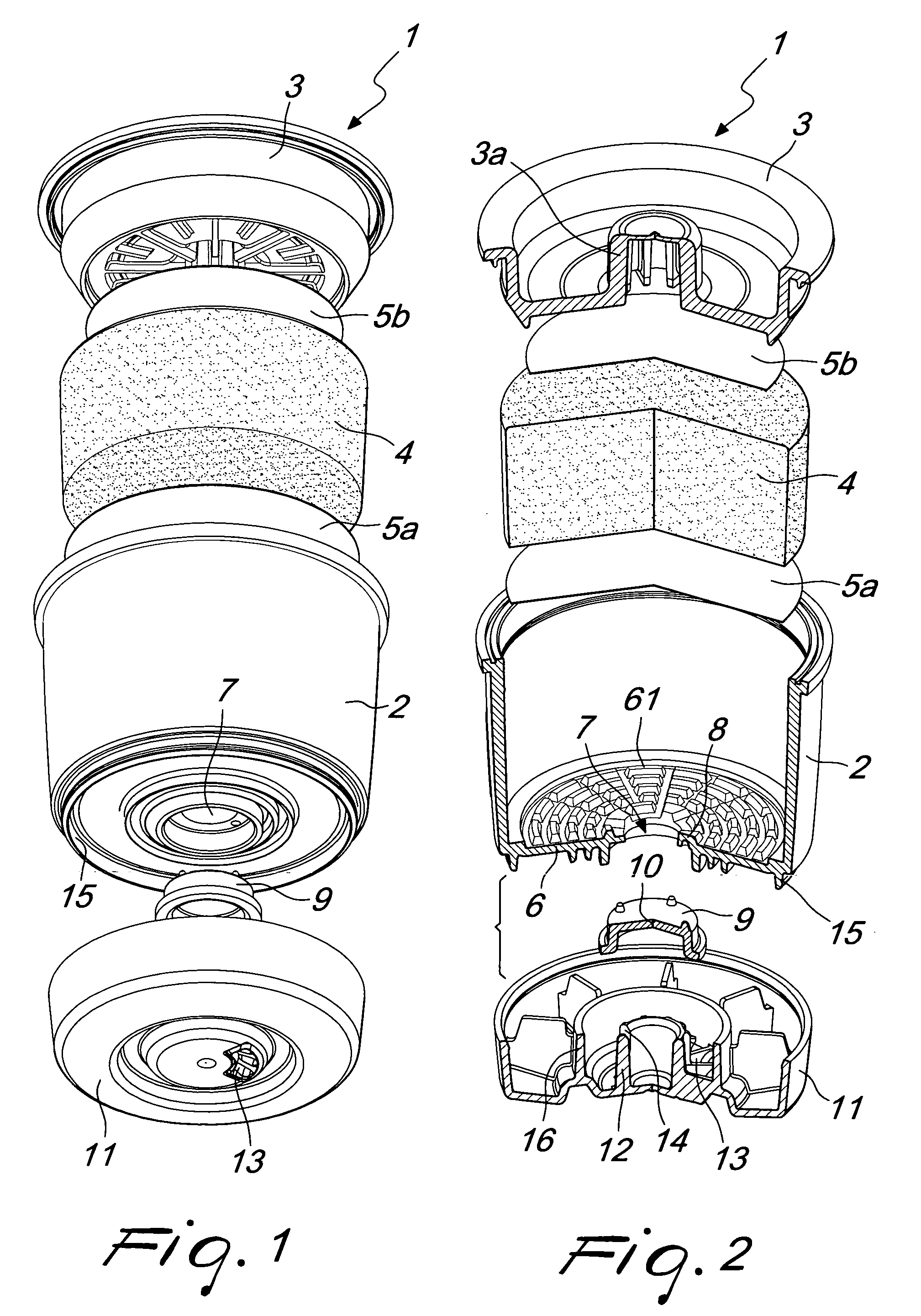
Figure 2 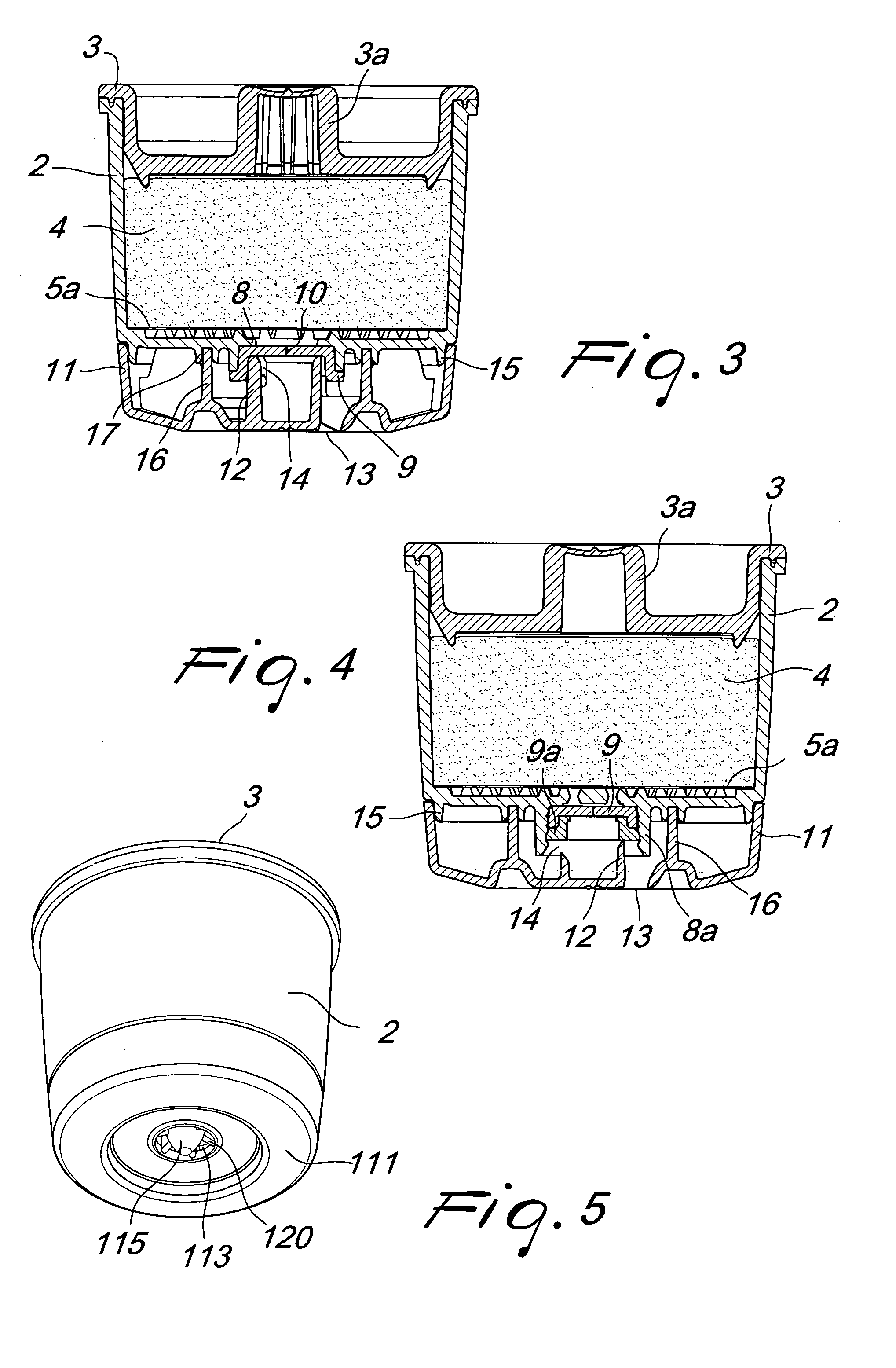
Figure 3
Abstract
Description
BACKGROUND OF THE INVENTION
[0001] The present invention relates to improvements to capsules containing a substance in powder form from which a beverage, preferably espresso coffee, is to be extracted.
[0002] It is known that machines for preparing espresso coffee, typically used in bars and restaurants, require a dose of roasted and ground coffee to be placed in an extraction chamber provided with a filtering container. This container may be part of the so-called filter basket holder, which is filled by hand with the dose of ground coffee (typically 7±1 g for each cup to be dispensed) and subsequently mounted on the machine in order to proceed with the extraction of the beverage.
[0003] Machines for preparing espresso coffee are provided internally with a boiler for heating the water drawn from a tank or other source and a pump for sending to the delivery duct hot water at a selected pressure.
[0004] The traditional method for extracting the beverage by means of known machines consists typ...
Examples
second embodiment
[0038]The safety lid 11 is provided with a shoulder 12 which is engaged on the septum 9 and is adapted to retain the septum 9 against the output port 7 provided in the base 6, so as to prevent the septum from being accidentally expelled from the capsule due to the high pressures reached during beverage extraction. In the capsule, shown in FIG. 4, the shoulder 12 engages the rigid annular support 9a of the septum, which is locked inside the protruding cylindrical rim 8a of the output port 7.
[0039]The shoulder 12 can have at least a passage 14 in order to allow the beverage to exit from the capsule 1 by passing through the safety lid 11. For this purpose, the lid 11 comprises at least an output opening 13, which in the particular embodiment of FIGS. 1 to 4 is laterally displaced with respect to the central axis of the output port 7 or with respect to the axis of symmetry of the capsule 1.
[0040]The passage 14 on the shoulder 12 and the output opening 13 of the lid 11 are arranged advan...
third embodiment
[0042]As an alternative, as shown in FIGS. 5 and 6, the safety lid 111 used in the invention can comprise an output opening 113 which is substantially annular and substantially coaxial to the output port 7 of the box-like body of the capsule and is adapted to allow the beverage to exit from the capsule in a direction which practically coincides with the axis of the capsule, differently from the embodiments of FIGS. 1-4, in which the flow is displaced laterally with respect to the axis.
[0043]The annular opening 113 is defined in a through hole of the lid 111 between the rim of the through hole and an ogive-shaped element 115, which is supported by the lid 111 by means of supporting arms 120 and is arranged in the through hole.
[0044]The ogive-shaped element is provided with a shoulder 112 which is similar to the shoulder 12 of FIGS. 1 to 4, i.e., it is engaged on the elastic septum 9 in order to retain the septum against the rim of the output port 7. In the capsule of FIGS. 5 and 6 al...