
Designer Organisms for Photobiological Butanol Production from Carbon Dioxide and Water
a technology of carbon dioxide and carbon dioxide, which is applied in the field of biosafety-guarded biofuel energy production technology, can solve the problems of reducing the production of butanol by fermentation, the cost of cornstarch butanol production process could also be nearly as much energy, and the roadblocks to the cost-effective conversion of lignocellulosic biomass to fermentable sugars, etc., to achieve higher solar-to-butanol energy conversion efficiency and power-ph ratio ratio
Patent Information
- Authority / Receiving Office
- US · United States
- Current Assignee / Owner
- Publication Date
- 2010-12-30
Smart Images
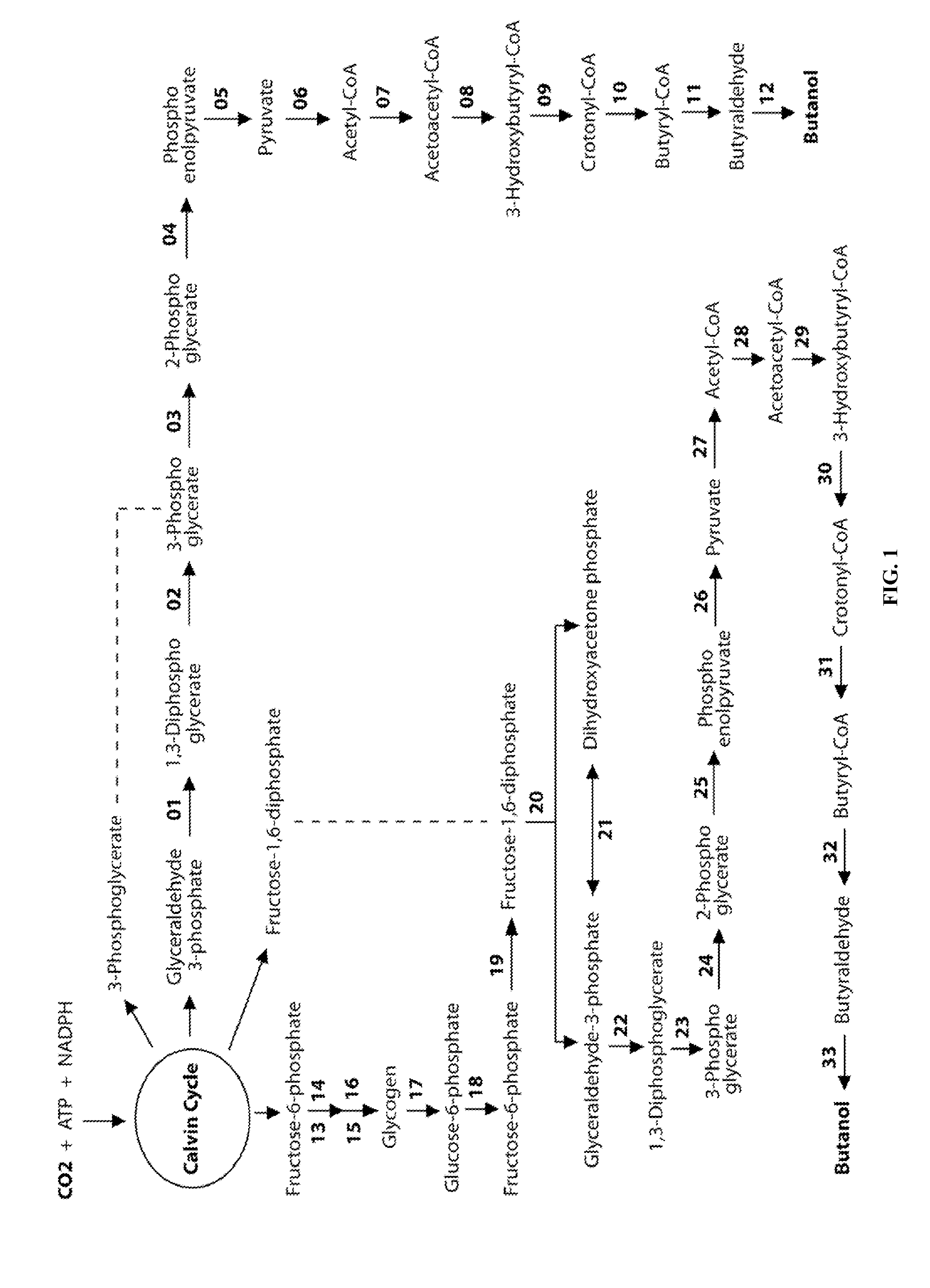
Figure 1 
Figure 2 
Figure 3
Abstract
Description
CROSS-REFERENCE TO RELATED APPLICATIONS
[0001] This application claims the benefit of U.S. Provisional Application Numbers US61 / 066,845 and US61 / 066,835 filed on Feb. 23, 2008. The entire disclosure of both of these applications is incorporated herein by reference.FIELD OF THE INVENTION
[0002] The present invention generally relates to biosafety-guarded biofuel energy production technology. More specifically, the present invention provides a photobiological butanol production methodology based on designer transgenic plants, such as transgenic algae, blue-green algae (cyanobacteria and oxychlorobacteria), or plant cells that are created to use the reducing power (NADPH) and energy (ATP) acquired from the photosynthetic process for immediate synthesis of butanol (CH3CH2CH2CH2OH) directly from carbon dioxide (CO2) and water (H2O).BACKGROUND OF THE INVENTION
[0003] Butanol (CH3CH2CH2CH2OH), a four-carbon alcohol, can be used as a liquid fuel to run engines such as cars. Butanol can replace ga...
Examples
Embodiment Construction
[0039]The present invention is directed to a photobiological butanol production technology based on designer photosynthetic organisms such as designer transgenic plants (e.g., algae and oxyphotobacteria) or plant cells. The designer plants and plant cells are created using genetic engineering techniques such that the endogenous photosynthesis regulation mechanism is tamed, and the reducing power (NADPH) and energy (ATP) acquired from the photosynthetic water splitting and proton gradient-coupled electron transport process can be used for immediate synthesis of butanol (CH3CH2CH2CH2OH) directly from carbon dioxide (CO2) and water (H2O) according to the following process reaction:
4CO2+5H2O→CH3CH2CH2CH2OH+6O2 [2]
The photobiological butanol-production methods of the present invention completely eliminate the problem of recalcitrant lignocellulosics by bypassing the bottleneck problem of the biomass technology. As shown in FIG. 1, the photosynthetic process in a designer organism effect...