
Apparatus and method for microphone positioning based on a spatial power density
Patent Information
- Authority / Receiving Office
- US · United States
- Current Assignee / Owner
- Publication Date
- 2013-06-06
Smart Images
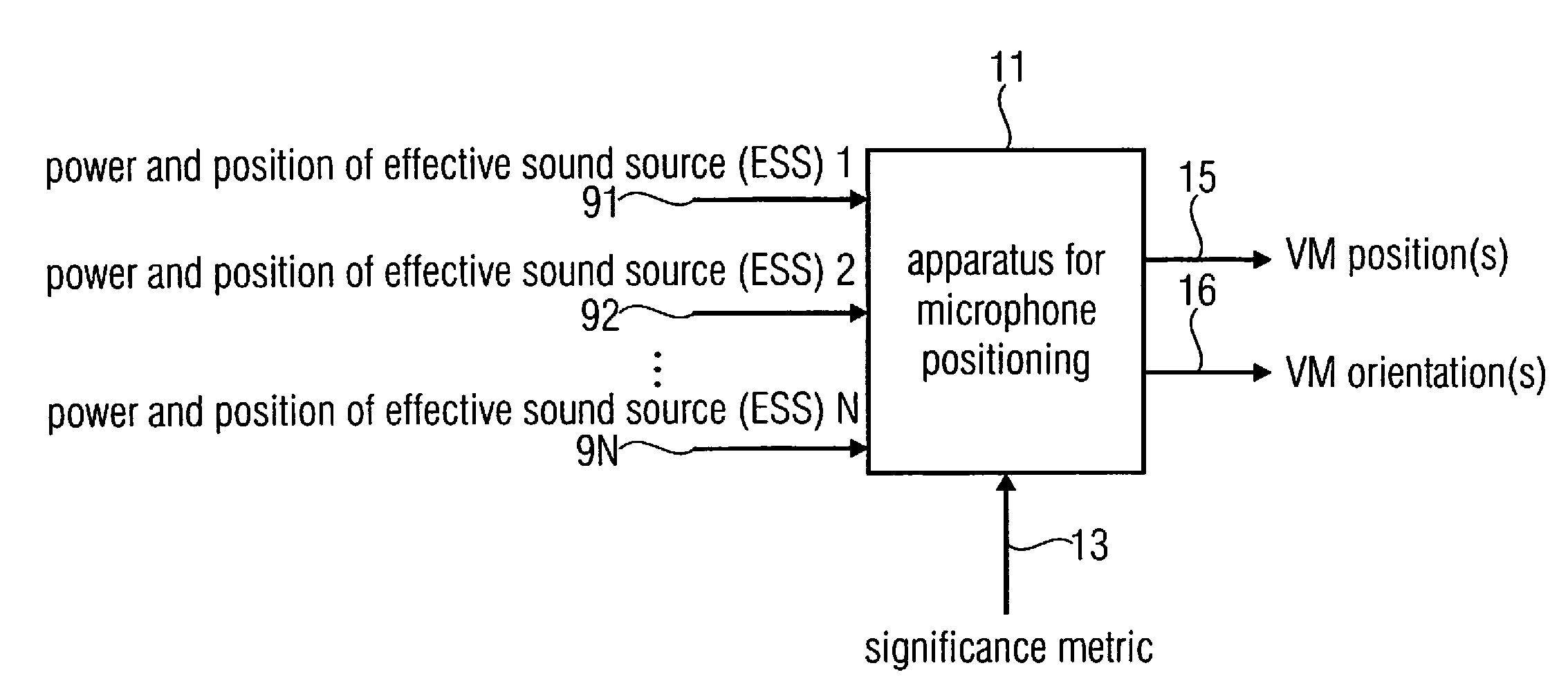
Figure 1 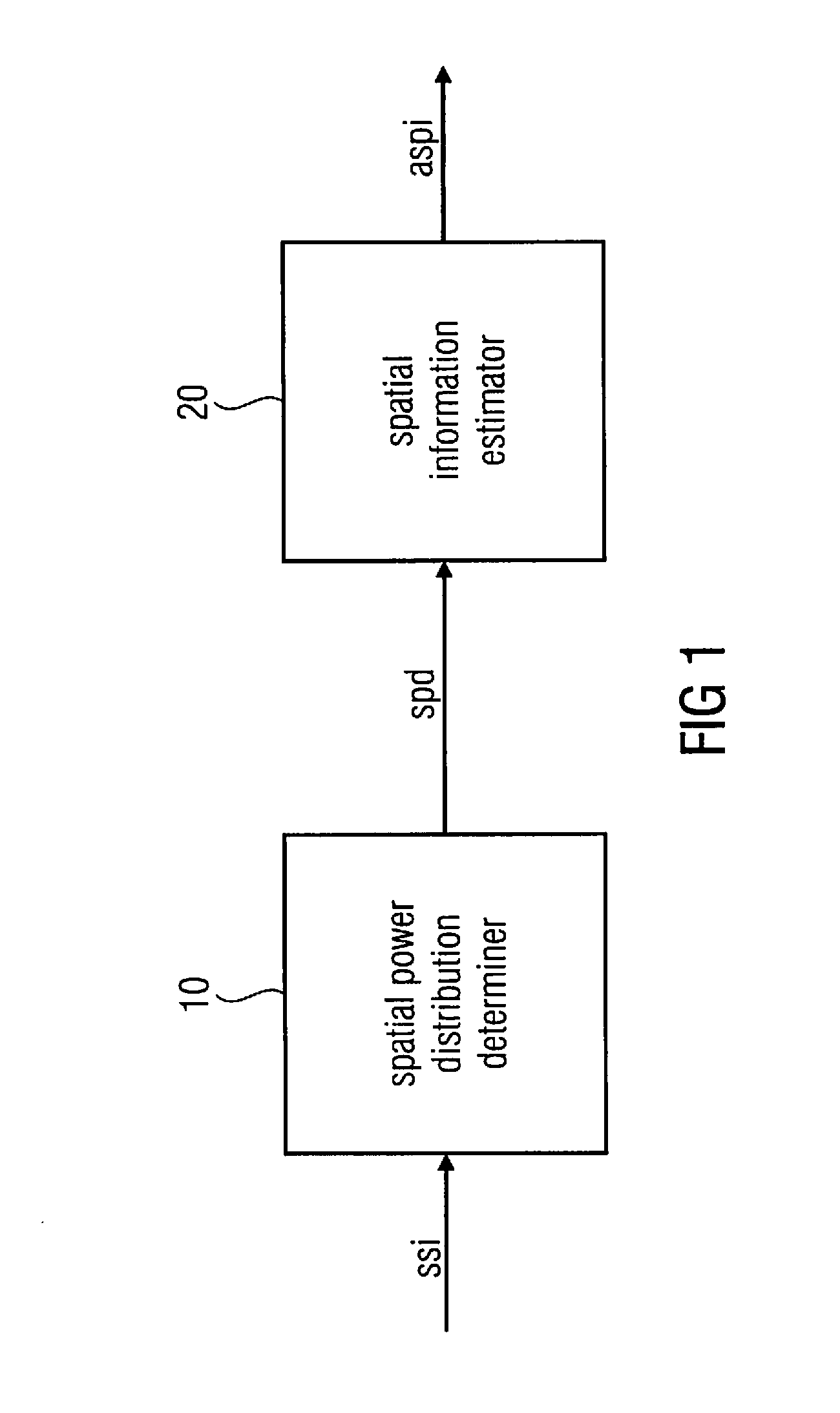
Figure 2 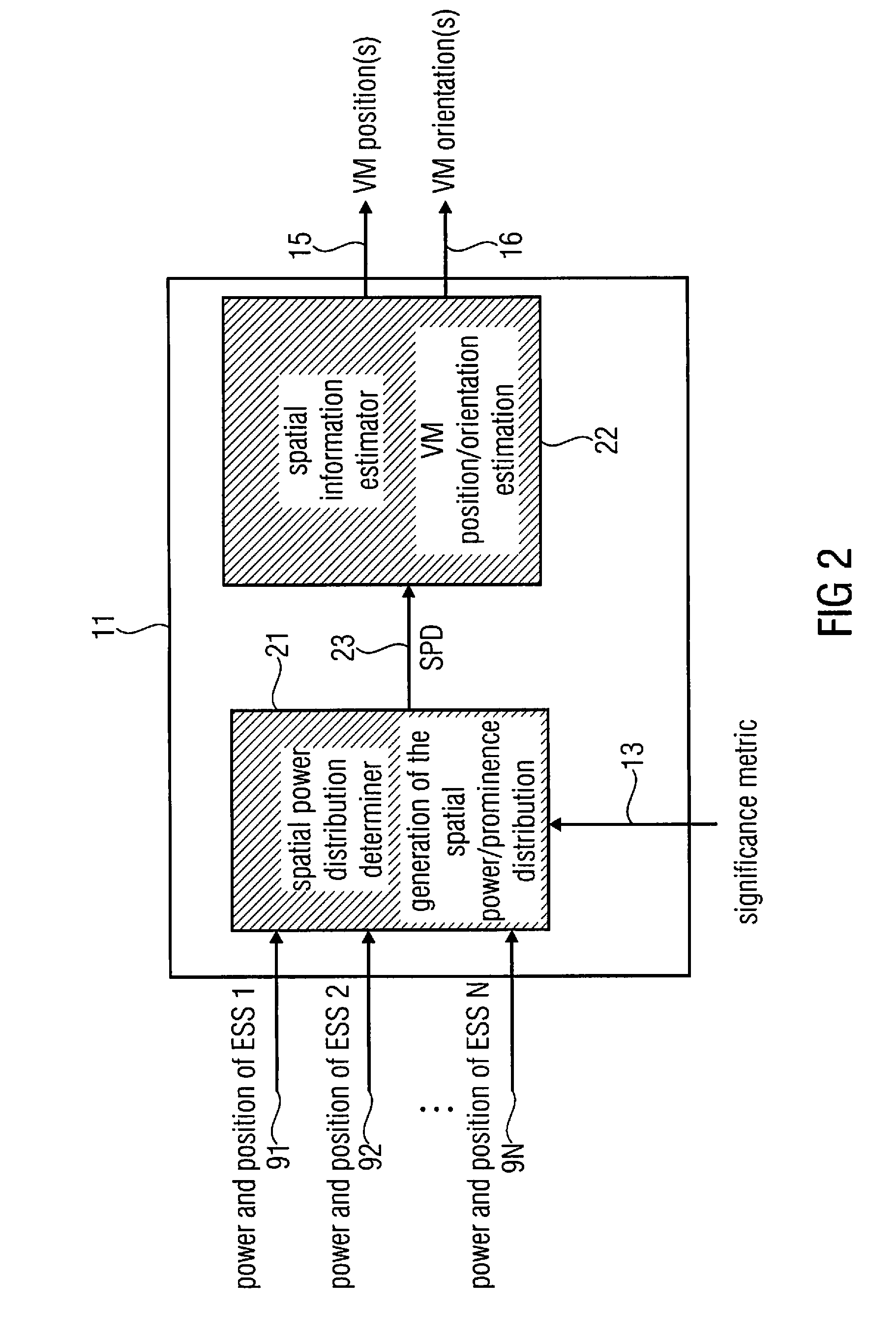
Figure 3
Abstract
Description
CROSS-REFERENCE TO RELATED APPLICATIONS
[0001] This application claims priority from European Patent Application No. EP11191828.0, which was filed on Dec. 2, 2011 and is incorporated herein in its entirety by reference.
[0002] The present invention relates to audio signal processing and, in particular, an apparatus and a method for automatic microphone positioning.BACKGROUND OF THE INVENTION
[0003] Audio signal processing becomes more and more important. In particular, spatial sound recording is employed in a plurality of applications. Spatial sound recording aims at capturing a sound field with the help of multiple microphones such that at the reproduction side, a listener perceives the sound image as it was at the recording location.
[0004] Standard approaches for spatial sound recording usually involve spaced, omnidirectional microphones (e.g., AB stereophony) coincident directional microphones (e.g., in intensity stereophony), or more sophisticated microphones, such as a B-format microp...
Examples
first embodiment
[0097]According to a first concept of a first embodiment, the center of the sound scene is obtained by computing the center of gravity of the SPD Γ(x,y,z). The value of Γ(x,y,z) may be s interpreted as the existing mass at point (x,y,z) in space.
second embodiment
[0098]According to a second concept of a second embodiment, the position in space with a minimum time dispersion of the channel shall be found. This is achieved by considering the root mean squared (RMS) delay spread. At first, for each point in space p=(x0, y0), a power delay profile (PDP) Ap(τ) is computed based on the SPD Γ(x, y, z), for instance using
Ap(τ)=∫x∫yΓ(x,y)·δ(t-τ)yx
where τ=√{square root over ((x−x0)2+(y−y0)2)}{square root over ((x−x0)2+(y−y0)2)} / c
[0099]From Ap(τ), the RMS delay is then calculated using the following equation:
τRMS,p=∫0∞(τ-τ_s)2Ap(τ)τ∫0∞Ap(τ)τ,
where Ts represents the mean delay of Ap(τ). The position for which the mean delay TRMS,p is minimum will represent the center of the sound scene.
third embodiment
[0100]According to a third concept of a third embodiment, which may be employed as an alternative to sound scene center estimation, a “circle-integration” is proposed. For example, in the 2D case, the SPD Γ(x, y) is convolved with a circle C(r,o), according to the following formula:
g(x,y)=Γ(x,y)*C(r,o)(x,y),
wherein r is the radius of the circle, and wherein o defines the center of the circle. The radius r may either be constant or may vary depending on the power value in the point (x,y). For example, high power in the point (x,y) may correspond to a large radius, whereas low power may correspond to a small radius. Additional dependencies on the power may also be possible. One such example would be to convolve the circle with a bivariate Gaussian function before using it for constructing function g(x, y). According to such an embodiment, the covariance matrix of the bivariate Gaussian function becomes dependent on the power in the position (x,y), i.e., high power corresponds to low v...