
Belt conveyor
a belt conveyor and belt technology, applied in the direction of conveyors, conveyor parts, cleaning, etc., can solve the problems of wasteful seed or grain loss, waste of seed or grain, and high cost of prior art belt conveyors, and achieve the effect of minimizing or eliminating the risk of residual seeds or grains contaminating different hybrids
Patent Information
- Authority / Receiving Office
- US · United States
- Patent Type
- Applications(United States)
- Current Assignee / Owner
- Publication Date
- 2014-02-27
Smart Images
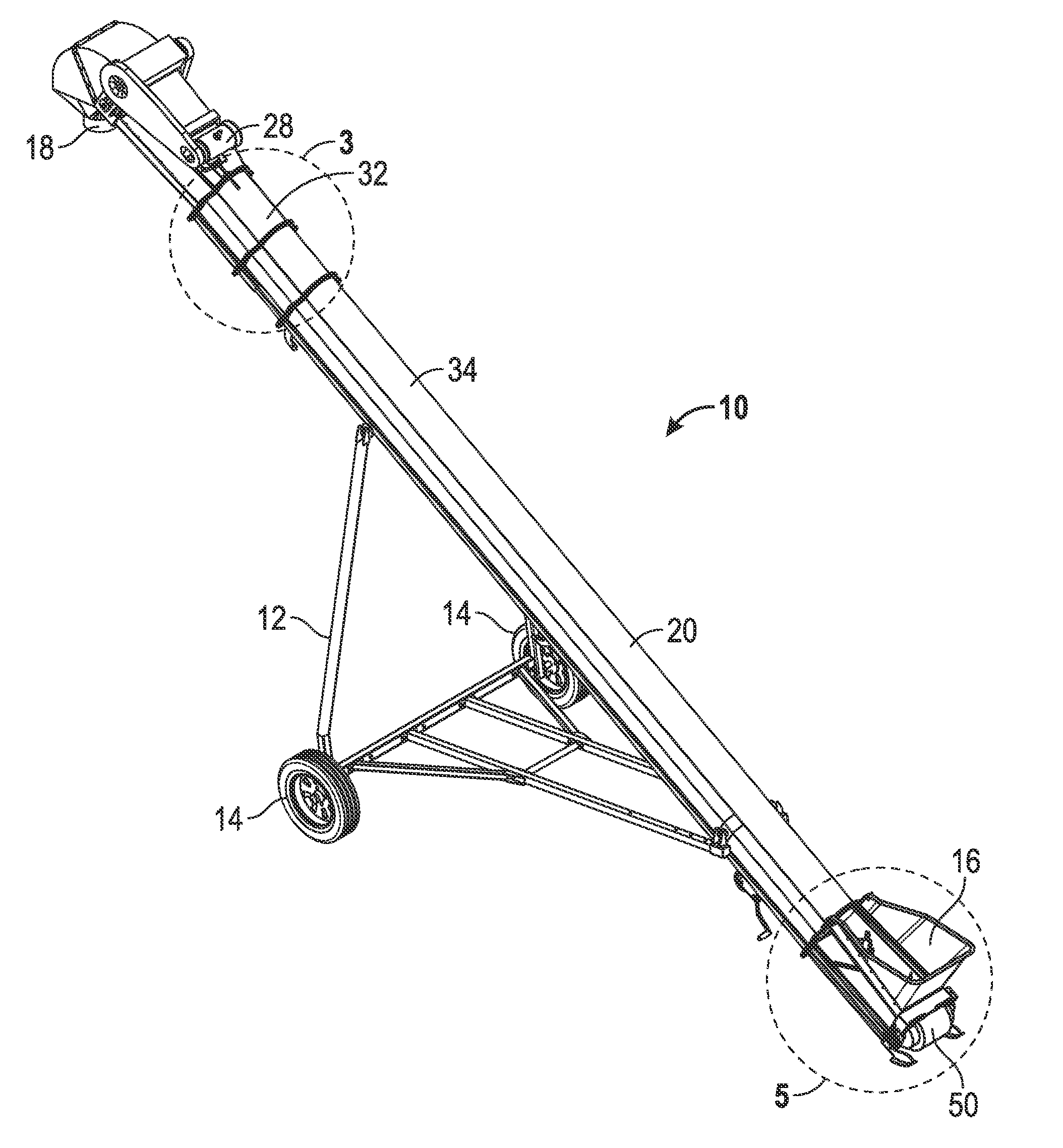
Figure 1 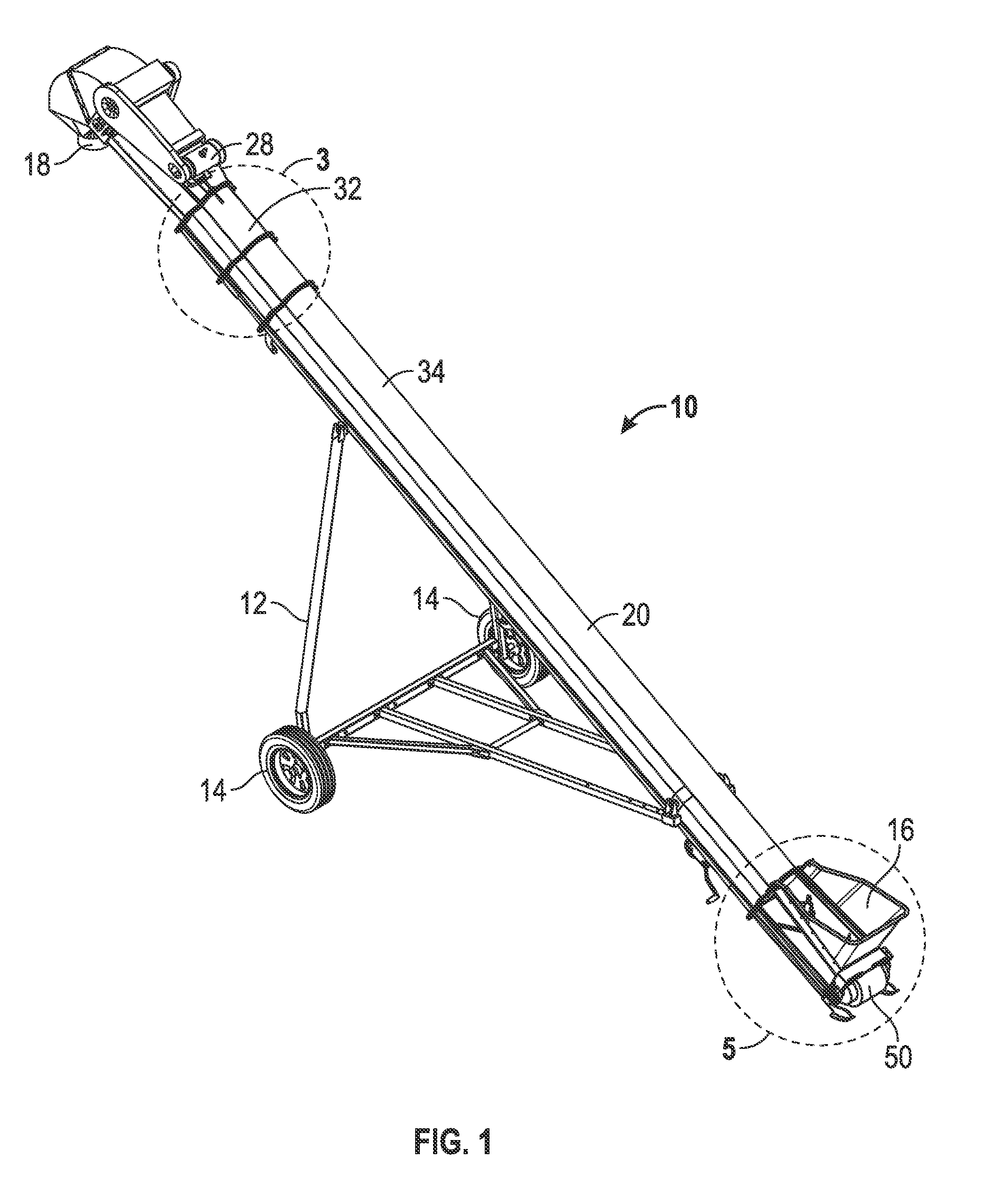
Figure 2 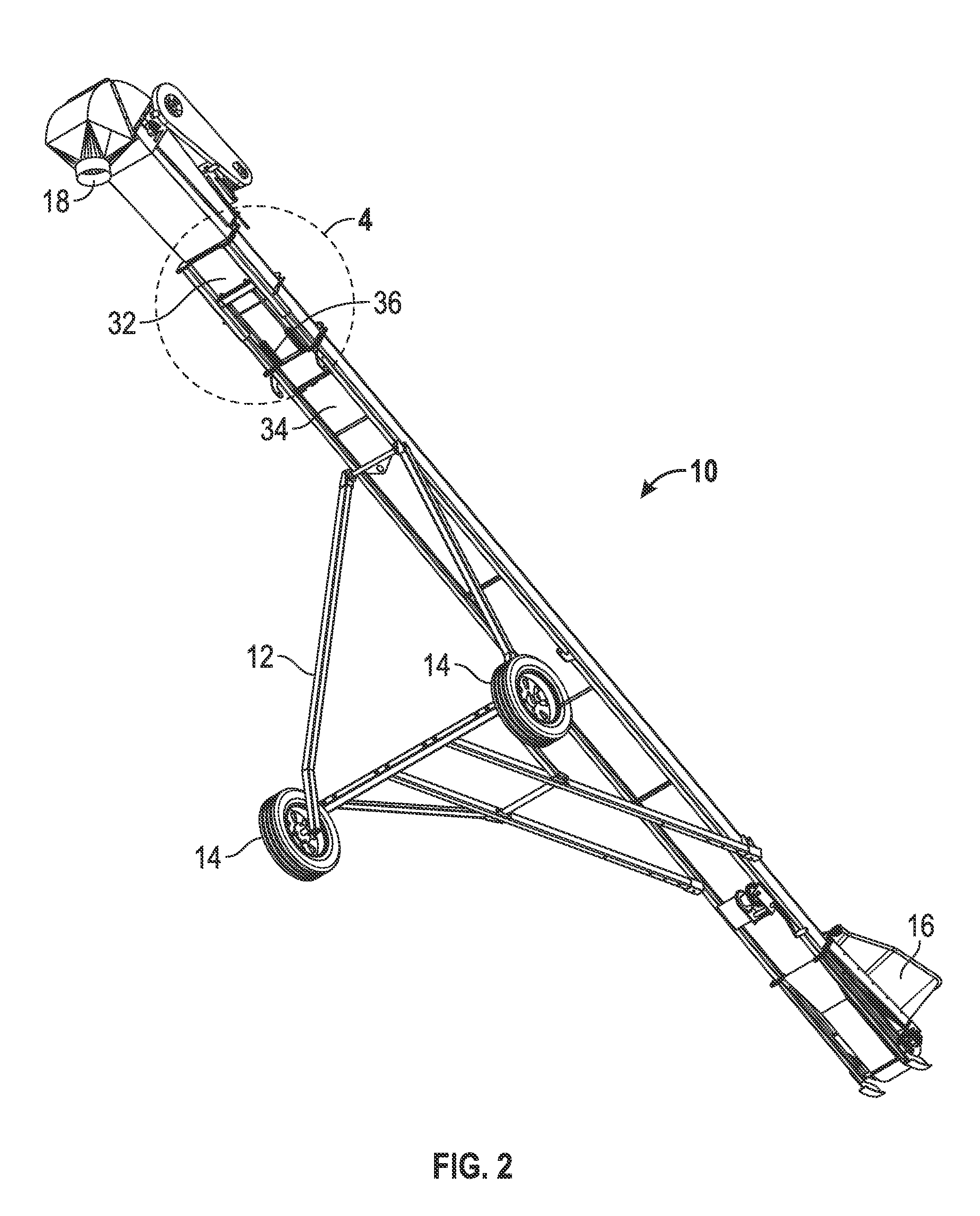
Figure 3
Abstract
Description
BACKGROUND OF THE INVENTION
[0001] Conveyors are often used for handling particulate material, for example, in the agricultural industry wherein seed or grain is being transferred. Portable agricultural conveyors generally include a tubular housing with an auger or conveyor belt extending therethrough to convey the seed or grain.
[0002] Prior art belt conveyors have several problems. First, the belts may stretch or become elongated due to high ambient temperatures or due to wear. Conventional belt conveyors typically include a slotted housing for adjustably mounting one of the belt pulleys so that the distance between the pulleys can be changed to accommodate such change in the belt length. However, such slots provide an opening through which seed or grain can leak or escape. Such loss of seed or grain is wasteful and costly.
[0003] Also, seed or grain often vibrates off the belt during operation of the conveyor, then slides down to reside in gaps or corners where it gets caught. These se...
Examples
Embodiment Construction
[0026]A belt conveyor assembly, according to the present invention, is generally designated by the reference numeral 10 in the drawings. The conveyor assembly 10 includes a base 12 with wheels 14 such that the assembly 10 is portable. The conveyor assembly 10 includes an inlet hopper 16 for receiving particulate material, such as seed or grain, and an outlet 18 for discharging the material from the conveyor assembly 10.
[0027]The conveyor assembly 10 also includes an elongated housing 20 through which a conveyor belt 22 extends. Pulleys are rotatably supported at the inlet and outlet ends of the housing 20. The belt 22 is trained about the pulleys, with one of the pulleys being driven by a motor 28. Each pulley is rotatably mounted on an axle 30, which is fixed relative to the respective inlet and outlet ends of the housing 20, as best seen in FIGS. 5, 6, and 10.
[0028]The housing 20 includes an upper section 32 and a lower section 34 which are telescopically coupled so that at least ...