
Offset printing composition, printing method using same, and pattern comprising offset printing composition
a technology of offset printing and composition, which is applied in the direction of printing, printing circuits, inks, etc., can solve the problems of increasing manufacturing costs, complicated manufacturing process, and large amount of harmful chemical wastes to the environment, and achieves excellent adhesion, reduce residues, and improve the effect of transfer characteristics
Patent Information
- Authority / Receiving Office
- US · United States
- Patent Type
- Applications(United States)
- Current Assignee / Owner
- Publication Date
- 2016-11-24
Smart Images
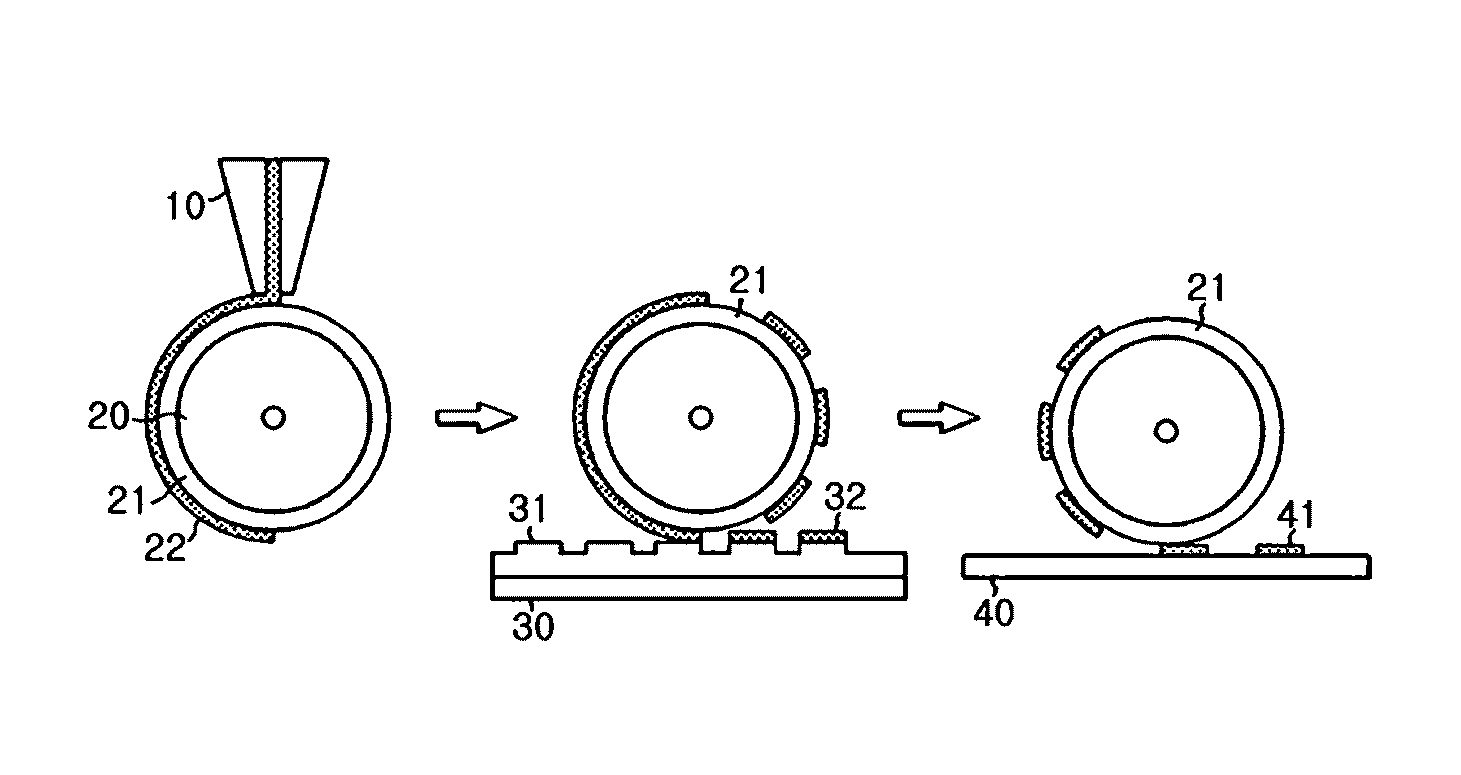
Figure 1 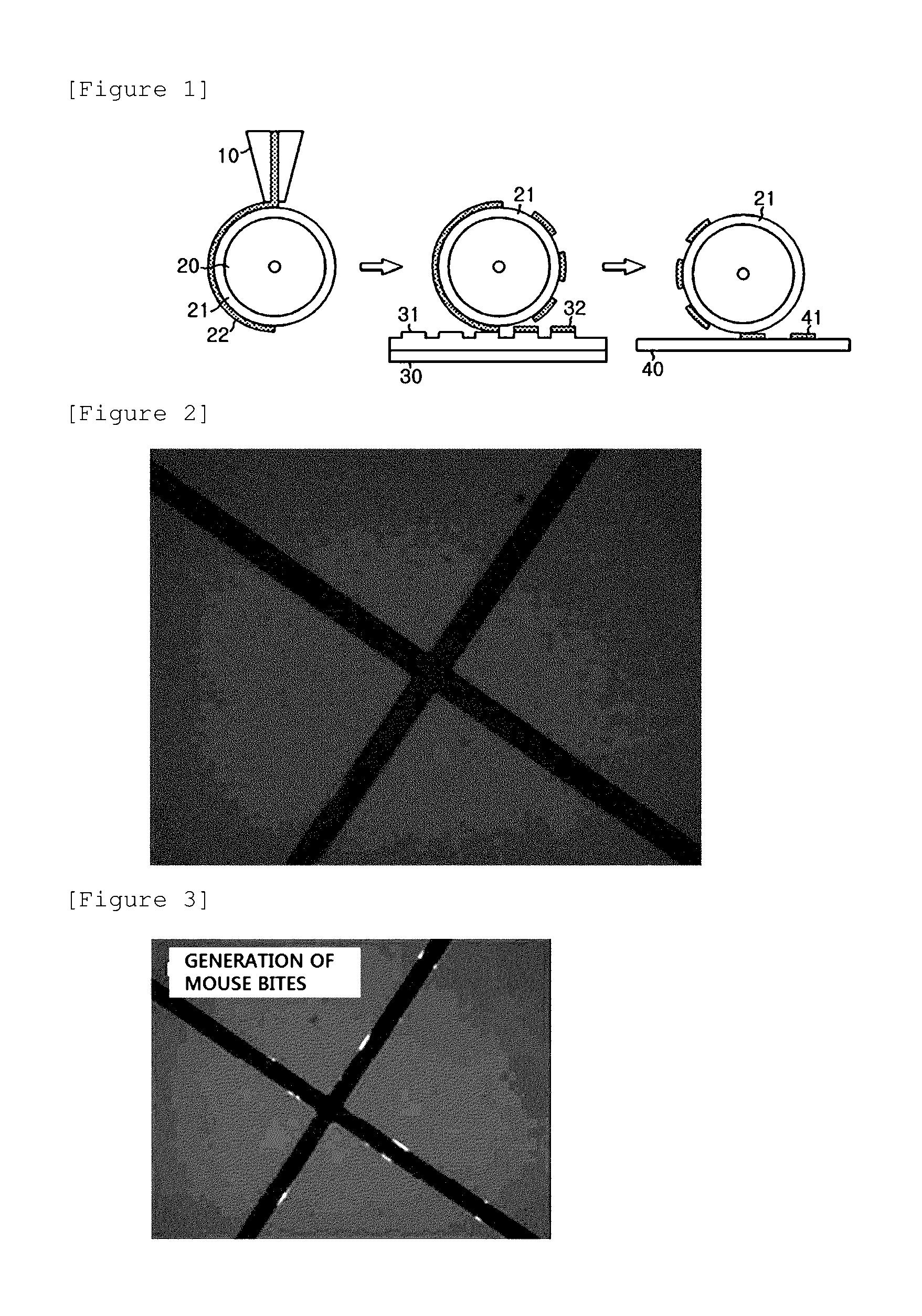
Figure 2 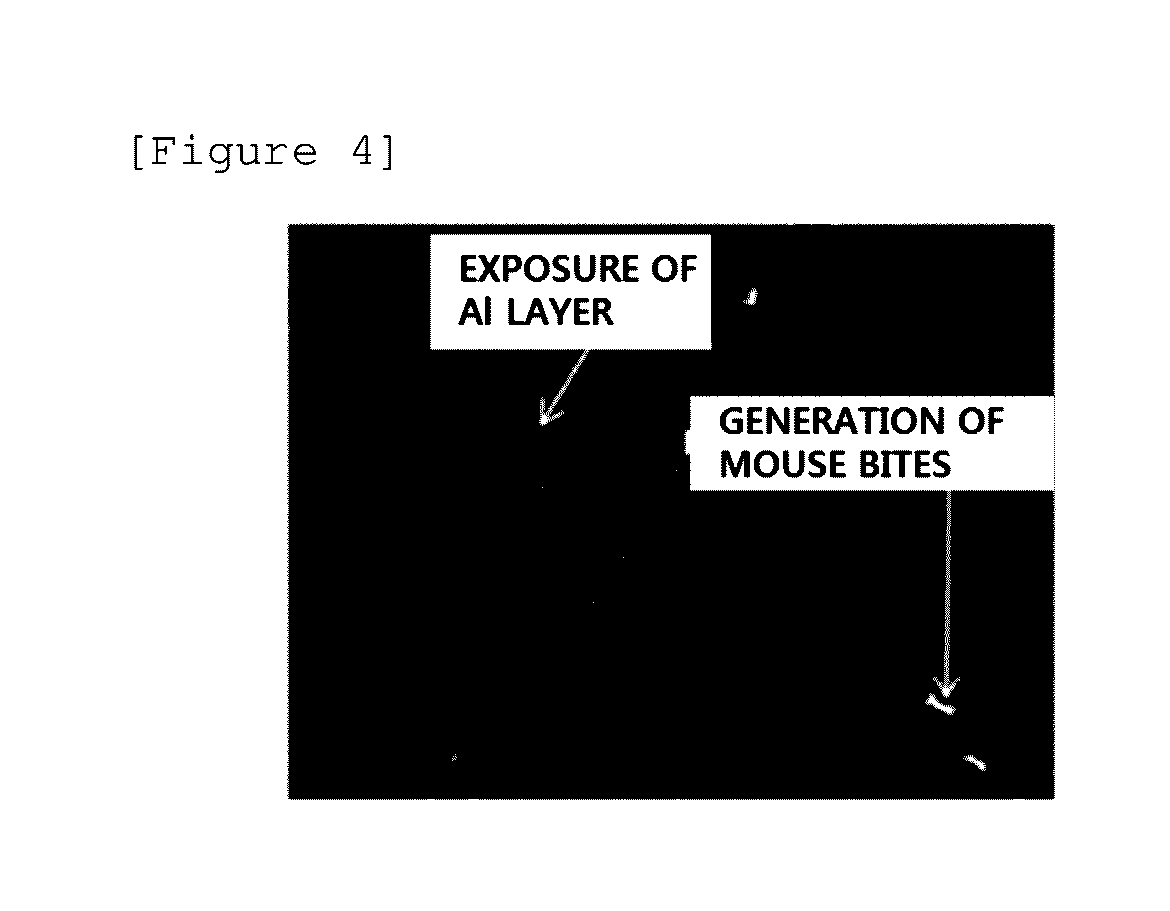
Figure 3
Abstract
Description
TECHNICAL FIELD
[0001] This application claims priority to and the benefit of Korean Patent Application No. 10-2014-0026775 filed in the Korean Intellectual Property Office on Mar. 6, 2014, the entire contents of which are incorporated herein by reference.
[0002] The present specification relates to an offset printing composition, a printing method using the same, and a pattern including the offset printing composition.BACKGROUND ART
[0003] In general, electronic devices such as a liquid crystal display device and a semiconductor device are manufactured by forming patterns of multiple layers on a substrate. In order to form these patterns, a photolithography process has been usually used up to now. However, the photolithography process has problems in that the manufacturing process is complicated, and a large amount of chemical wastes harmful to the environment are generated because predetermined pattern masks need to be manufactured and chemical etching and stripping processes need to be...
Examples
example 1
[0083]A printing composition was prepared by dissolving 10 g of a novolac resin having a polystyrene-converted weight average molecular weight of 4,000 prepared by mixing m-cresol and p-cresol at a weight ratio of 5:5, 1 g of a transfer and adhesion improving agent pyrogallol, and 0.4 g of a surfactant in 83.6 g of a low-boiling point solvent ethanol and 5 g of a high-boiling point solvent 1,4-butanediol, and then filtering the resulting mixture with a filter having an aperture of 1 μm. For the prepared printing composition, the measurement of front transfer rate, the evaluation of residue generation, the evaluation of etching, the measurement of pattern precision, and the evaluation of continuous printing characteristics were performed by the methods of the following Experimental Examples 1 to 5.
example 2
[0084]A printing composition was prepared by dissolving 10 g of a novolac resin having a polystyrene-converted weight average molecular weight of 4,000 prepared by mixing m-cresol and p-cresol at a weight ratio of 5:5, 1 g of a transfer and adhesion improving agent 5-methylpyrogallol, and 0.4 g of a surfactant in 83.6 g of a low-boiling point solvent ethanol and 5 g of a high-boiling point solvent 1,4-butanediol, and then filtering the resulting mixture with a filter having an aperture of 1 μm. For the prepared printing composition, the measurement of front transfer rate, the evaluation of residue generation, the evaluation of etching, the measurement of pattern precision, and the evaluation of continuous printing characteristics were performed by the methods of the following Experimental Examples 1 to 5.
example 3
[0085]A printing composition was prepared by dissolving 10 g of a novolac resin having a polystyrene-converted weight average molecular weight of 4,000 prepared by mixing m-cresol and p-cresol at a weight ratio of 5:5, 1 g of a transfer and adhesion improving agent 5-ethylpyrogallol, and 0.4 g of a surfactant in 83.6 g of a low-boiling point solvent ethanol and 5 g of a high-boiling point solvent 1,4-butanediol, and then filtering the resulting mixture with a filter having an aperture of 1 μm. For the prepared printing composition, the measurement of front transfer rate, the evaluation of residue generation, the evaluation of etching, the measurement of pattern precision, and the evaluation of continuous printing characteristics were performed by the methods of the following Experimental Examples 1 to 5.