

Multivalent recombinant avian herpes viruses and vaccines for immunizing avian species
a multivalent, herpes virus technology, applied in the direction of dsdna viruses, viral antigen ingredients, biochemistry apparatus and processes, etc., can solve the problems of unstable rhvts expressing multiple foreign genes, unstable multivalent virus vectors cannot be used as efficient vaccines
Patent Information
- Authority / Receiving Office
- US · United States
- Patent Type
- Applications(United States)
- Current Assignee / Owner
- Publication Date
- 2018-09-13
Smart Images
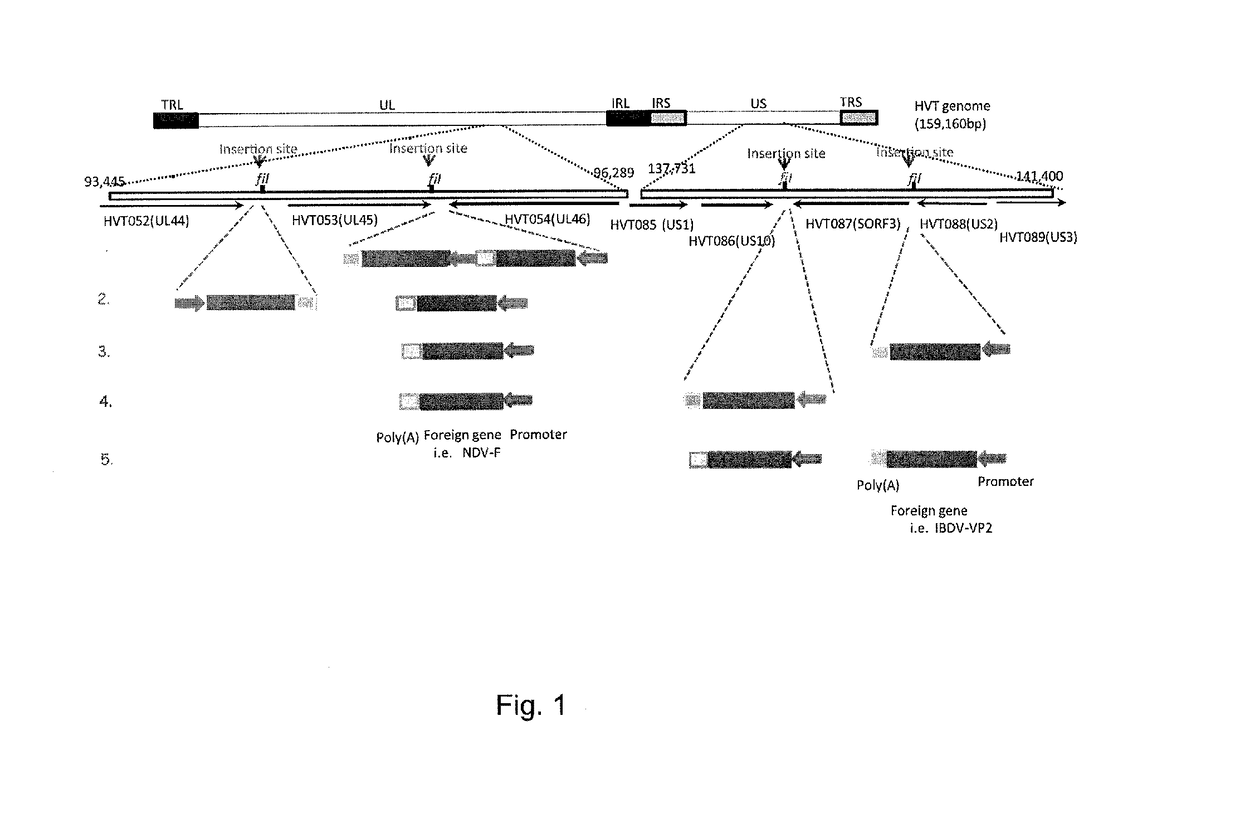
Figure 1 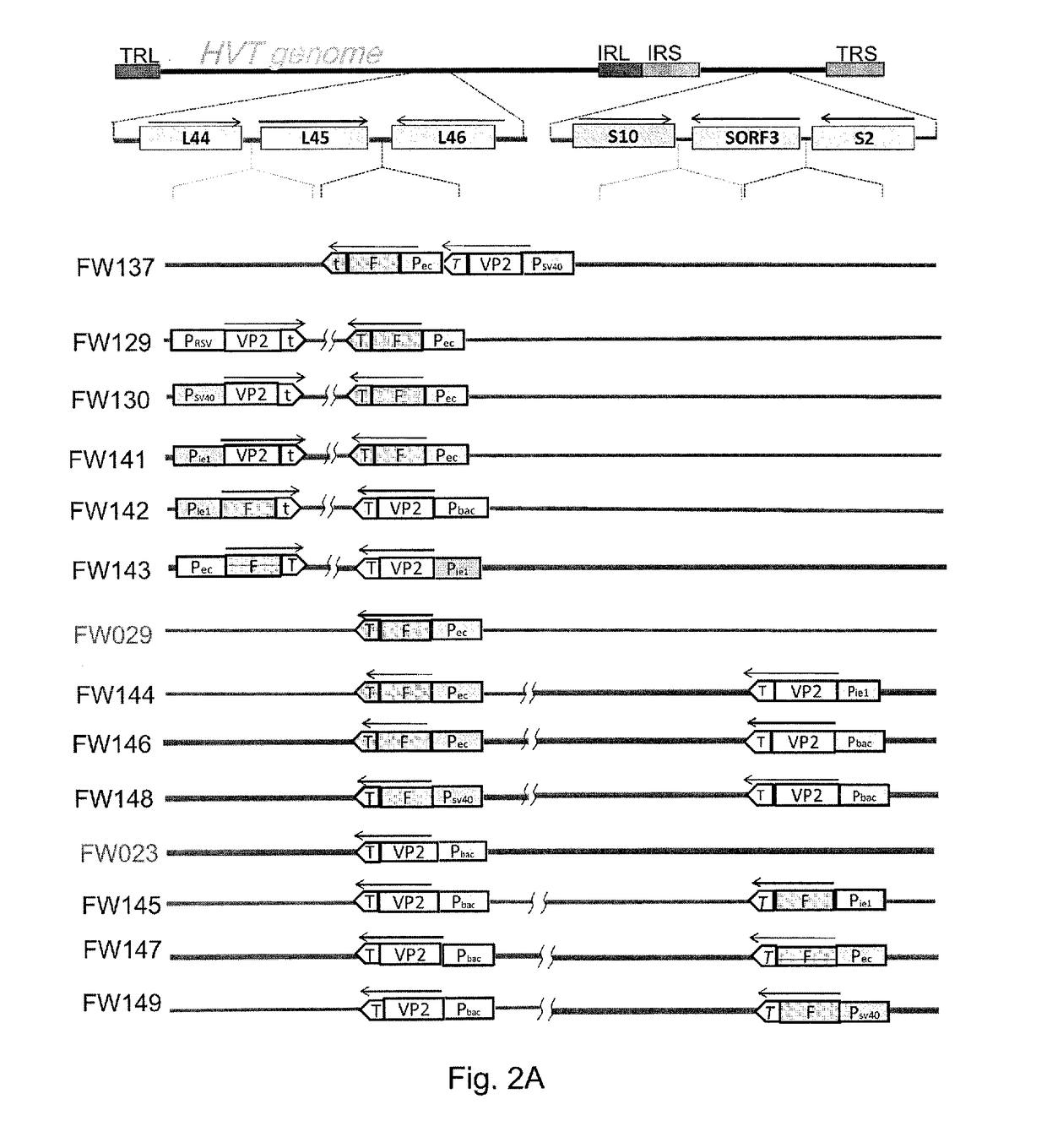
Figure 2 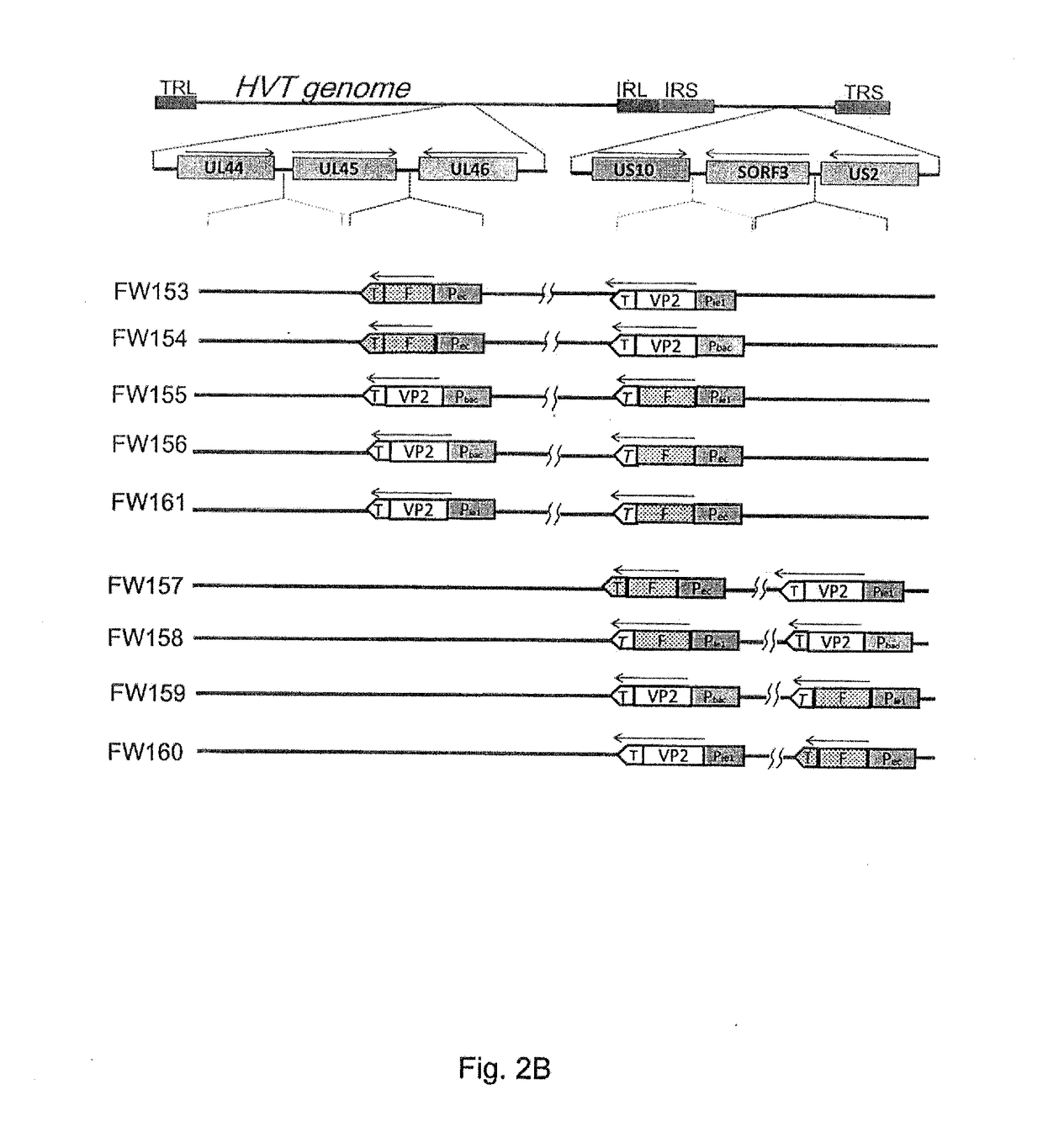
Figure 3
Abstract
Description
CROSS-REFERENCE TO RELATED APPLICATIONS
[0001] This application is a continuation of U.S. application Ser. No. 14 / 388,268, filed Sep. 26, 2014, which is the national stage application of International Patent Application No. PCT / EP2013 / 056839, filed Mar. 29, 2013.
[0002] The Sequence Listing for this application is labeled “Seq-List.txt” which was created on Sep. 19, 2014 and is 12 KB. The entire contents of the sequence listing is incorporated herein by reference in its entirety.FIELD OF THE INVENTION
[0003] The present invention relates generally to the field of vaccine preparations. The present invention specifically relates to multivalent recombinant herpes viruses in which at least two foreign genes have been inserted, and their uses for simultaneously inducing a protective immunity against a plurality of avian diseases.BACKGROUND OF THE INVENTION
[0004] Poultry meat and eggs are important food sources, whose consumption increases continually due to the growth of the human population an...
Examples
experiment 1
of Homology Vectors
[0127]The plasmid construction was essentially performed by the standard molecular biology techniques (Molecular Cloning: A Laboratory Manual, 3rd Edition, Cold Spring Harbor Laboratory, Cold Spring Harbor, N.Y. 2001). DNA restriction fragments were electrophoresed on agarose gels and purified with the Plasmid Plus Midi Kit (QIAGEN, Cat #12945).
Construction of p44 / 45d46Sfi
[0128]Based on the information of the gC homologue (gCh) gene of MDV serotype 1 (Coussens et al., J. Virol. 62:2373-2379, 1988) and its adjacent BamHI-B fragment (Japanese Unexamined Patent Publication No. H6-292583), a DNA fragment having an SfiI site between two ORFs, UL44h and UL45h, was prepared by PCR and cloned into pUC18. First, HVT DNA was prepared from CEF cells infected with the HVT FC126 strain according to the method of Lee et al. (J. Gen. Virol., 51:245-253, 1980). Using the obtained HVT DNA as a template, PCR was performed with two pairs of primers.
[0129]The first pair was SEQ ID NO...
experiment 2
combinant HVT in CEF Transfected with Each Transfer Vector
[0145]Viral DNA of the HVT wild type, FC126 strain (wt-HVT) was prepared as described by Morgan et al. (Avian Diseases, 34:345-351, 1990). Viral DNAs of FW029 (rHVT / 45-46PecF) and FW023 (rHVT / 45-46BacVP2) were prepared in the similar method. The first double rHVT pattern was that the CEF cells were transfected with the prepared wt-HVT DNA and p45 / 46sv40VP2 PecF (ex. FW137). The second pattern was that the CEF cells were transfected with the prepared FW029 DNA and p44 / 45 mCMV IE1 VP2 (ex. FW141). The third pattern was that the CEF cells were transfected with the prepared FW023 DNA and p44 / 45 mCMV IE1 F (ex. FW142). The fourth pattern was that the CEF cells were transfected with the prepared FW029 DNA and pHVT87-88Bac VP (ex. FW144). The fifth pattern was that the CEF cells were transfected with the prepared FW023 and pHVT87-88Pec F (ex. FW145). These resulting recombinant viruses were plaque purified by staining plaques with t...
experiment 3
n of Two Proteins in CEF Infected with Double Recombinant HVTs
[0151]2 ml containing 2×10⁵ CEF cells was infected with recombinant HVTs, and incubated at 37° C. in 5% CO2 for 3 days.
[0152]Then the culture was centrifuged at 300 g for 3 minutes, and the precipitated cells were resuspended in 100 ul. Laemmli buffer (100 ul) was added to the cell suspension. The resultant mixture was then boiled for 5 min and 5 ul of them was subjected to 10% SDS-polyacrylamide gel electrophoresis. The electrophoresed proteins were transferred from SDS-GEL to a PVDF membrane (Immobilon-P, Millipore), which was blocked in 1% w / v non-fat milk powder in PBS at room temperature for one hour.
[0153]For F detection (FIG. 4A), the treated membrane was then reacted with the anti-F rabbit antiserum #35 in 500-fold dilution at room temperature for one hour, washed three times with PBS, and incubated for one hour with the biotinylated anti-rabbit goat anti serum.
[0154]For VP2 detection (FIG. 4B), the treated membra...