
Server and battery lending method
a battery and server technology, applied in the control arrangement of batteries/fuel cells, instruments, transportation and packaging, etc., can solve the problems of battery deterioration, affecting the convenience of the vehicle for the user, and the battery deterioration in the calculation of the lending fee, so as to reduce the battery lending fee, improve the user experience, suppress the effect of battery deterioration
Patent Information
- Authority / Receiving Office
- US · United States
- Patent Type
- Applications(United States)
- Current Assignee / Owner
- Publication Date
- 2020-10-22
- Estimated Expiration
- Not applicable · inactive patent
Smart Images
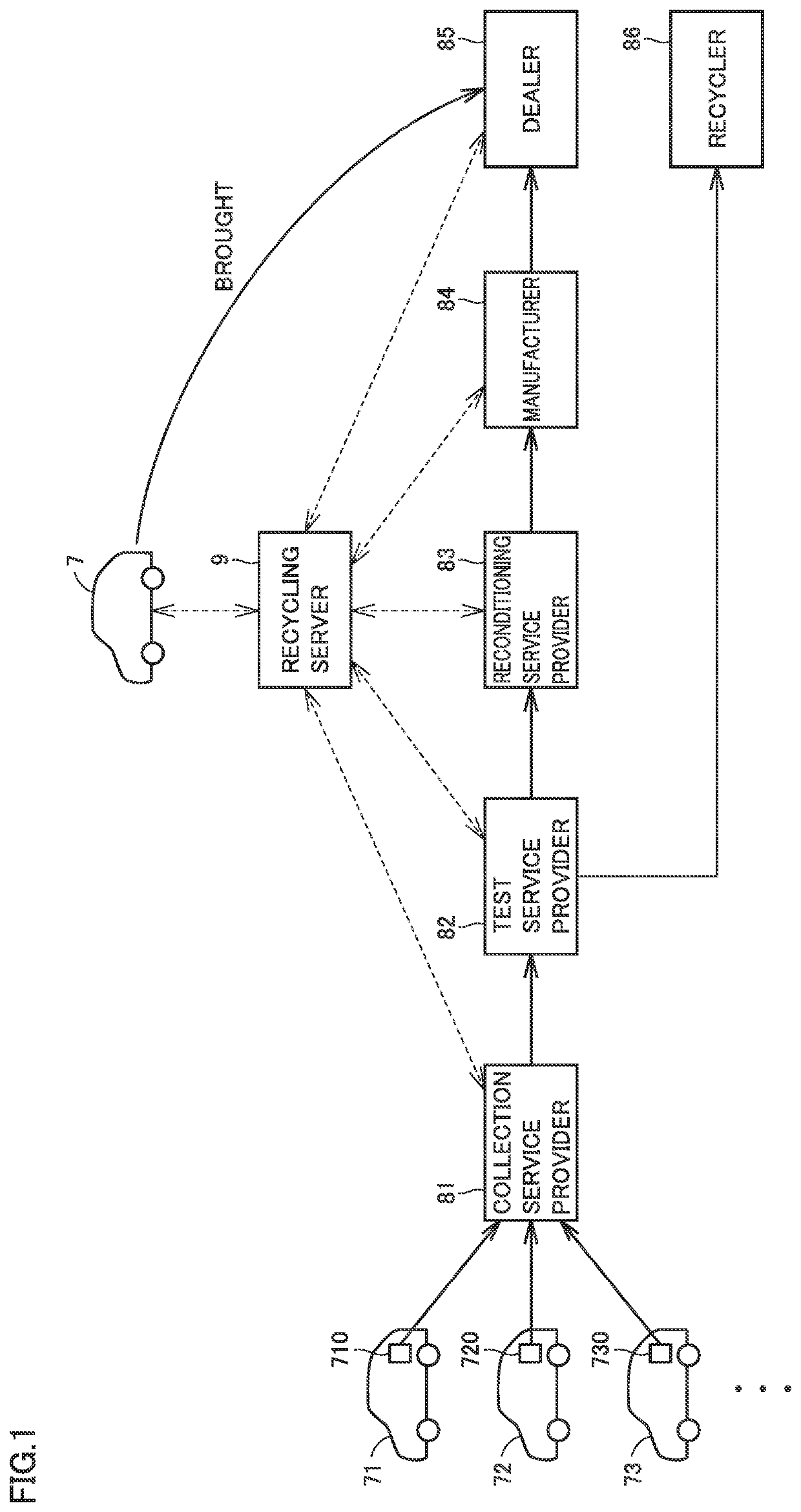
Figure 1 
Figure 2 
Figure 3
Abstract
Description
[0001] This nonprovisional application is based on Japanese Patent Application Nos. 2019-080792 and 2020-030411 filed on Apr. 22, 2019 and Feb. 26, 2020, respectively, with the Japan Patent Office, the entire contents of which are hereby incorporated by reference.BACKGROUNDField
[0002] The present disclosure relates to a server and a battery lending method, and more particularly to a technique for lending a battery mounted on a vehicle for traveling.Description of the Background Art
[0003] It is conceivable to lend to a user a battery mounted on a vehicle for traveling. Only a battery may be lent to a user who owns a vehicle, or a battery may be lent to a user together with a vehicle (a portion other than the battery).
[0004] For example, according to a method disclosed in Japanese Patent Laying-Open No. 2002-291110, an amount of electric power charged to a battery (an amount of commercial power consumed for charging the battery) or an amount of electric power discharged from the battery i...
Examples
first embodiment
[0047]
[0048]FIG. 1 is a view showing a battery distribution model in an embodiment. Referring to FIG. 1, in the battery distribution model, used batteries 710 to 730 mounted on vehicles 71 to 73, respectively, are collected. Collected batteries 710 to 730 are recycled through a process handled by a collection service provider 81, a test service provider 82, a reconditioning service provider 83, a manufacturer 84, and a dealer 85 (or a recycler 86). In this process, a variety of information about the batteries is managed by a recycling server 9. Then, a battery mounted on a vehicle 7 of a certain user is replaced with a recycled battery.
[0049]More specifically, collection service provider 81 collects used batteries 710 to 730 from vehicles 71 to 73. It should be noted that, although FIG. 1 shows only three vehicles due to space restriction, batteries are actually collected from a larger number of vehicles. Collection service provider 81 disassembles the collected batteries and takes ...
second embodiment
[0127]A second embodiment will describe a configuration of providing information about when lease unit price U of battery 15 will be changed and information for increasing an EV distance of vehicle 1, from fee charging server 2 to vehicle 1 (user).
[0128]FIG. 16 is a flowchart showing processing related to lease of the battery in the second embodiment. Referring to FIG. 16, this flowchart is different from the flowchart in the first embodiment (see FIG. 13) in that it further includes an information providing process performed in S405 and a process (S304) for displaying a result of the information providing process. Since the processings other than that are the same as the corresponding processings in the first embodiment, the description thereof is not repeated.
[0129]In S302, vehicle 1 calculates capacity retention ratio Q of battery 15, and transmits the result of calculation to fee charging server 2. Fee charging server 2 obtains capacity retention ratio Q of battery 15 (S403). Fu...