
Method for performing processing on gas sensor
a gas sensor and processing method technology, applied in the direction of liquid/fluent solid measurement, material electrochemical variables, instruments, etc., can solve the problems of increasing the resistance between the outer and the inner electrical impedance (resistance), poor responsiveness of the sensor element, and simple omission of the pump reference processing itself, etc., to achieve the effect of suppressing the progress of oxidation
Patent Information
- Authority / Receiving Office
- US · United States
- Patent Type
- Applications(United States)
- Current Assignee / Owner
- Publication Date
- 2015-09-17
Smart Images
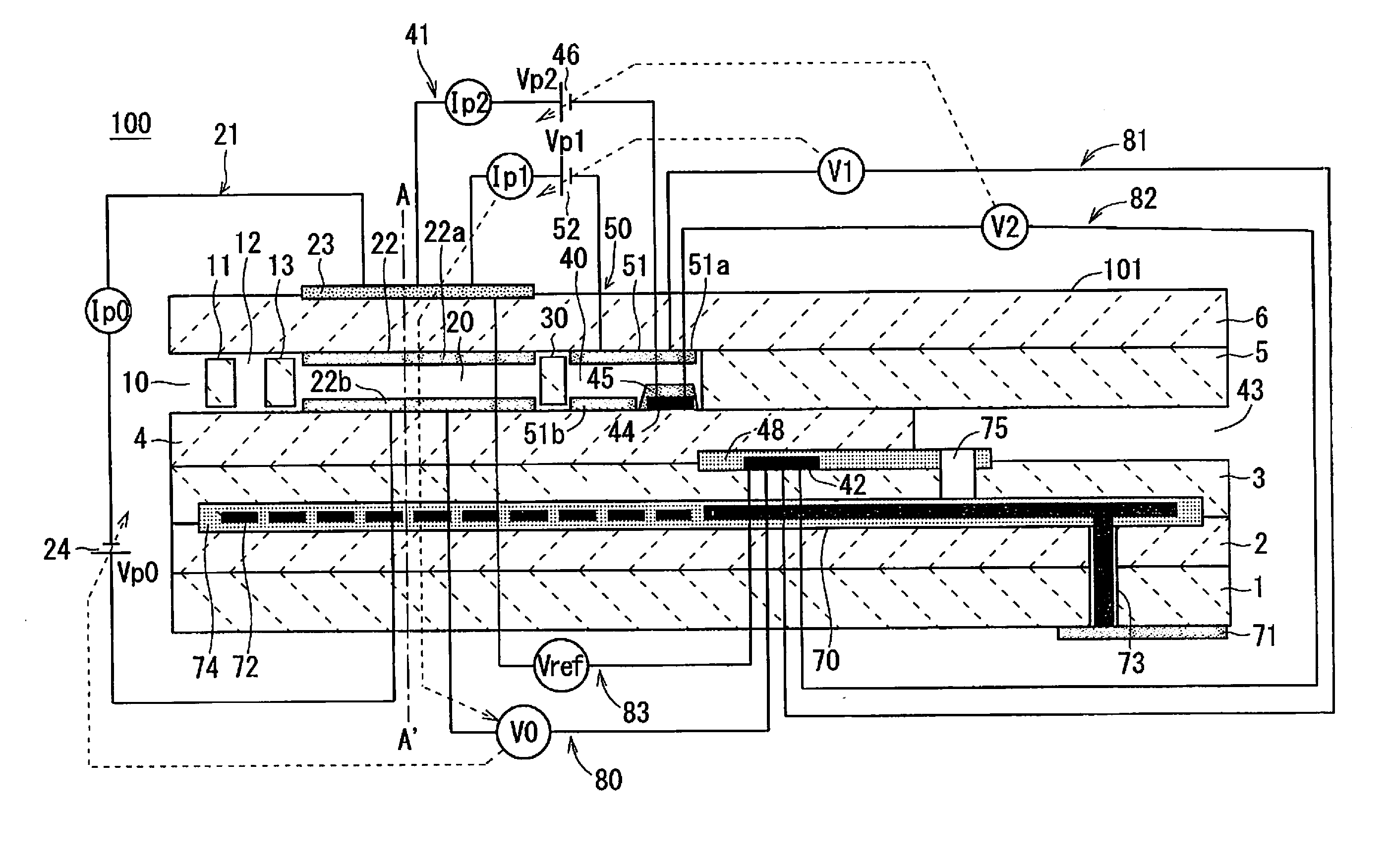
Figure 1 
Figure 2 
Figure 3
Abstract
Description
BACKGROUND OF THE INVENTION
[0001] 1. Field of the Invention
[0002] The present invention relates to processing to suppress progress of oxidation of a reference electrode performed on a gas sensor and, in particular, on a sensor element for use in the gas sensor.
[0003] 2. Description of the Background Art
[0004] Various gas sensors have been used to obtain the concentration of a desired gas component in a measurement gas. For example, as a device for measuring a NOx concentration in a measurement gas such as a combustion gas, a NOx sensor including a sensor element formed of an oxygen ion conductive solid electrolyte, such as zirconia (ZrO2), is known (see, for example, Japanese Patent Application Laid-Open No. 2006-284223 and Japanese Patent No. 3537983).
[0005] A sensor element of a gas sensor, including the NOx sensors disclosed in Japanese Patent Application Laid-Open No. 2006-284223 and Japanese Patent No. 3537983, obtains the concentration of a measurement-target gas component (target ...
Examples
example 1
[0107]A total of 60 gas sensors 100 were prepared through the steps S1 to S9 of FIG. 4, the reverse voltage application processing was performed on the gas sensors 100 on different applied voltage and application time conditions, and the amount of change in impedance value (resistance value) between the outer pump electrodes 23 and the reference electrodes 42 after and before the processing was measured. Specifically, pulse-like voltages as shown in FIG. 5A were applied. The applied voltage (Va) was set to the following 10 different levels: 0.5 V, 1.0 V, 1.4 V, 1.5 V, 1.6 V, 1.7 V, 1.8 V, 2.0 V, 2.1 V, and 2.5 V. The processing time (Δta) was set to the following six different levels: 1 sec, 10 sec, 20 sec, 30 sec, 150 sec, and 1200 sec. The element temperature was set to 850° C.
[0108]Table 1 shows measurement results for each condition. In Table 1, a case where the amount of change in impedance value (resistance value) before and after the reverse voltage application processing was...
example 2
[0113]A total of five gas sensors 100 were prepared through the steps S1 to S9 of FIG. 4, the reverse voltage application processing was performed on the gas sensors 100 on different element temperature conditions, and the amount of change in impedance value (resistance value) between the outer pump electrodes 23 and the reference electrodes 42 after and before the processing was measured. The element temperature was set to the following five different levels: 650° C., 700° C., 820° C., 850° C., and 900° C. Pulse-like voltages as shown in FIG. 5A were applied, the applied voltage was set to 1.6 V, and the processing time was set to 30 sec.
[0114]Table 2 shows measurement results for each condition. In Table 2, the degree of change in impedance value is shown based on similar criteria to those in Table 1.
TABLE 2ELEMENT TEMPERATURE (° C.)650700820850900Δ◯⊚◯Δ⊚: PARTICULARLY LARGE RESISTANCE REDUCING EFFECTS◯: LARGE RESISTANCE REDUCING EFFECTSΔ: SMALL RESISTANCE REDUCING EFFECTS
[0115]As ...