
3D graphics rendering system for performing Z value clamping in near-Z range to maximize scene resolution of visually important Z components
Patent Information
- Authority / Receiving Office
- US · United States
- Current Assignee / Owner
- Publication Date
- 2003-09-09
- Estimated Expiration
- Not applicable · inactive patent
Smart Images
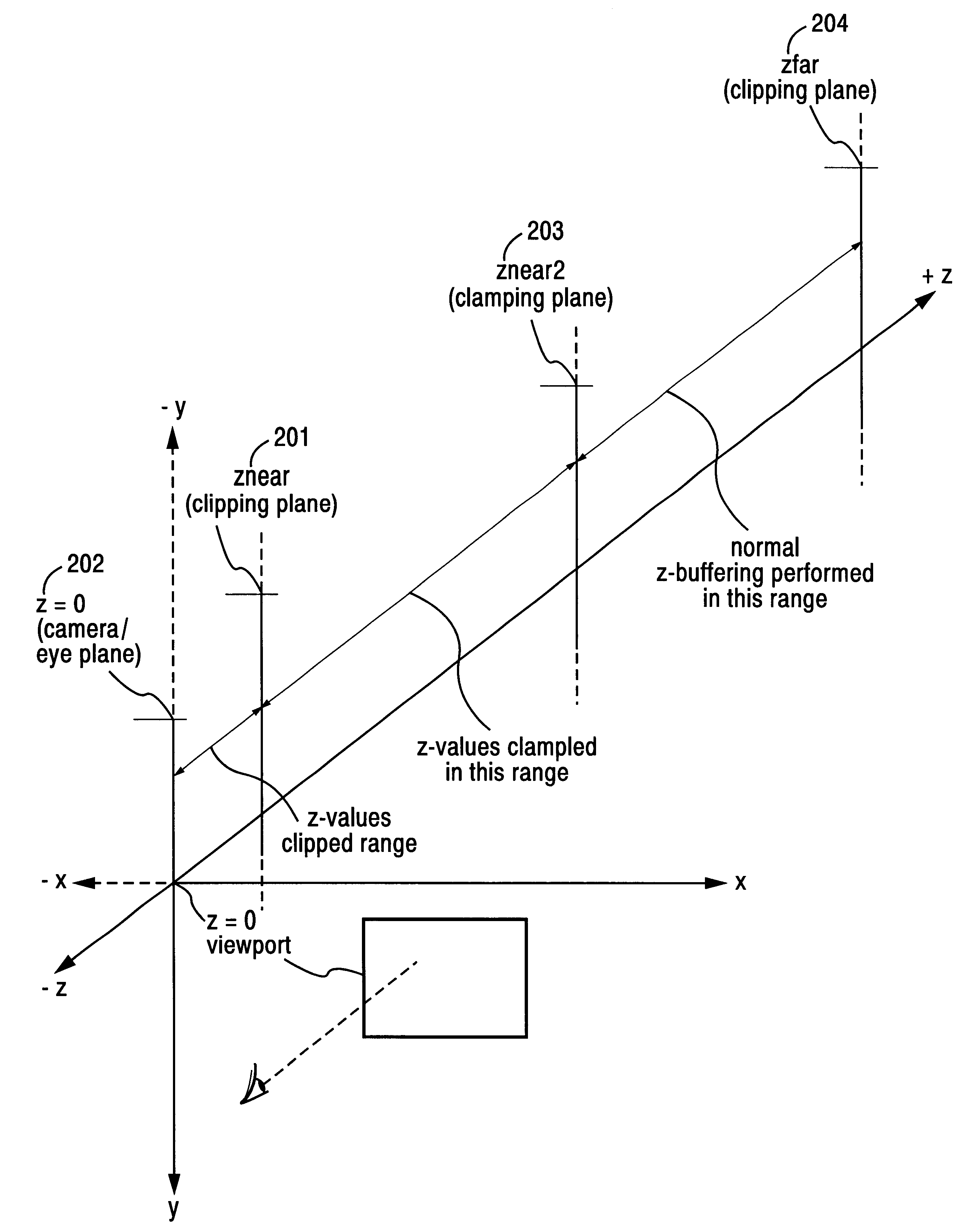
Figure 1 
Figure 2 
Figure 3
Abstract
Description
FIELD OF THE INVENTIONThe present invention relates to computer graphics, and more particularly to interactive graphics systems such as home video game platforms. Still more particularly this invention relates to Z-value clamping in the near-Z range when rendering anti-aliased scenes to maximize precision of visually important Z components and to avoid near-Z clipping.BACKGROUND AND SUMMARY OF THE INVENTIONMany of us have seen films containing remarkably realistic dinosaurs, aliens, animated toys and other fanciful creatures. Such animations are made possible by computer graphics. Using such techniques, a computer graphics artist can specify how each object should look and how it should change in appearance over time, and a computer then models the objects and displays them on a display such as your television or a computer screen. The computer takes care of performing the many tasks required to make sure that each part of the displayed image is colored and shaped just right based o...
Examples
example graphics
Pipeline
FIG. 4 shows a more detailed view of an example 3D graphics processor 154. 3D graphics processor 154 includes, among other things, a command processor 200 and a 3D graphics pipeline 180. Main processor 10 communicates streams of data (e.g., graphics command streams and display lists) to command processor 200. Main processor 110 has a two-level cache 115 to minimize memory latency, and also has a write-gathering buffer 111 for un-cached data streams targeted for the graphics and audio processor 114. The write-gathering buffer 111 collects partial cache lines into full cache lines and sends the data out to the graphics and audio processor 114 one cache line at a time for maximum bus usage.
Command processor 200 receives display commands from main processor 110 and parses them--obtaining any additional data necessary to process them from shared memory 112. The command processor 200 provides a stream of vertex commands to graphics pipeline 180 for 2D and / or 3D processing and rend...
example hardware implementation
In example graphics pipeline 180, Transform Unit 300 includes both clipping plane logic circuitry and Z-compression logic circuitry. Because processing anti-aliased pixels requires more data to be stored in a limited size Z-buffer (i.e., embedded Frame Buffer 702), the Z value compression is performed in this example embodiment only when full scene anti-aliasing is enabled. Such Z-compression circuitry normally operates to compress a computed 24 bit Z attribute value to a 16 bit value. FIG. 8A shows example hardware logic circuitry that may be used for providing Z compression without providing any clamping of Z values. This example Z compression circuit essentially comprises a priority encoder 320 and a shifter 322 which performs compression on four 24 bit Z values, converting them to 16 bit values.
In the example implementation of graphics pipeline 180, a compression algorithm performs a type of reverse floating point encoding. Whereas conventional floating point notation clumps mos...