
Extended wear ophthalmic lens
a technology of ophthalmology and lens, applied in the field of lenses and polymeric materials, can solve the problems of corneal swelling, inability to easily circumvent the lens, and undesirable growth of blood vessels in the cornea, and achieve the effects of high oxygen permeability, good corneal health, and high ion or water permeability
Patent Information
- Authority / Receiving Office
- US · United States
- Patent Type
- Patents(United States)
- Current Assignee / Owner
- Publication Date
- 2005-10-04
- Estimated Expiration
- Not applicable · inactive patent
Smart Images

Figure 1 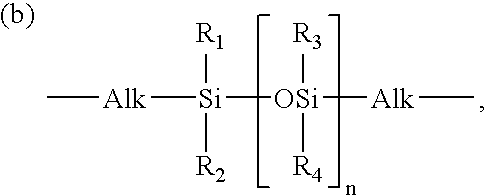
Figure 2 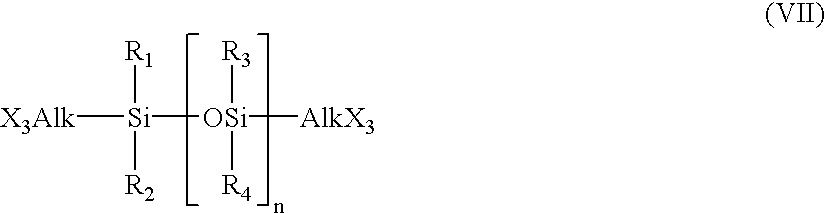
Figure 3
Abstract
Description
[0001] This application is a continuation of Ser. No. 09 / 262,542, filed Mar. 4, 1999 now abandoned, which is a continuation of Ser. No. 09 / 108,714, filed Jul. 1, 1998, now U.S. Pat. No. 5,965,631 which is a divisional of application Ser. No. 08 / 682,452, filed Jul. 17, 1996, now U.S. Pat. No. 5,849,811 which is a divisional of application Ser. No. 08 / 569,816, filed Dec. 8, 1995 now U.S. Pat. No. 5,760,100 which is a continuation-in-part of U.S. application Ser. No. 08 / 301,166, filed on Sep. 6, 1994 now abandoned. Priority is also claimed 119 for German Application No. 95810221.2 filed on Apr. 4, 1995 and Swiss Application No. 1496 / 95 filed on May 19, 1995.BACKGROUND OF THE INVENTION
[0002] 1. Field of the Invention
[0003] This invention relates broadly to lenses and polymeric materials useful in optic and ophthalmic arts. More specifically, this invention relates to polymeric materials and treatment processes useful in the manufacture of contact lenses. Still more specifically, this inven...
Examples
example a-1
[0490]A polysiloxane macromer is prepared by reacting, at room temperature (about 21 C.), one mole equivalent (about 100 grams) of poly(dimethylsiloxane) dialkanol (Shin Etsu Chemical Co., Tokyo, Japan) having hydroxyethyl propoxy end groups with 2 mole equivalents (about 21.2 grams) of isophorone diisocyanate (Aldrich Chemical Co., Milwaukee, Wis.) in the presence of about 0.2 grams dibutyltin dilaurate catalyst (Pfaltz & Bauer, Inc., Waterbury, Conn.). After about 48 hours reaction time, 2.02 mole equivalents (about 38.7 grams) of poly(ethylene glycol) (“PEG” about 610 g / mol Mn, Dow Chemical Corp., Midland, Mich.) and about 0.17 grams of dibutyltin dilaurate (about 0.43% by weight PEG) are added to 80 grams of the reaction product from the prior step. Sufficient chloroform (Aldrich Chemical Co.) is added to the mixture to make the mixture homogeneous. This mixture is stirred at room temperature for about 15 hours. Next, the mixture is stirred for about 8 hours at a temperature of ...
example a-2
[0494]A polysiloxane macromer is first prepared substantially in accordance with the procedure described in Example A-1.
[0495]A copolymer precursor solution is prepared by mixing about 180 grams polysiloxane-containing macromer, about 15 grams 3-methacryloxypropyltris (trimethylsiloxy) silane (Shin Etsu), about 4 grams 2-hydroxyethyl methacrylate (“HEMA”), about one gram ethylene glycol dimethacrylate (“EDGMA”), and about one gram DAROCUR® 1173 photoinitiator at room temperature for about 16 hours.
[0496]The copolymer precursor solution is then polymerized to form contact lenses. Polypropylene contact lens molds are filled with the copolymer precursor solution. Ultraviolet light (about 300 to 400 nm) at about 3-6 mW / cm2 is applied to the solution in the mold for about 3 hours at room temperature. The LV light causes polymerization, thereby allowing the solution to form a contact lens having the shape of the mold. The lens are extracted with isopropanol to remove remaining chloroform ...
example a-3
[0498]A contact lens is prepared substantially in accordance with the procedure described in Example A-2, but having the final composition of about 19.5 weight percent polysiloxane macromer, about 47% TRIS, and about 33.5% N,N-dimethylacrylamide. Fully hydrated contact lenses having this composition have a Dk of about 49 barrers, a water content of about 30 weight percent, and a modulus of elasticity of about 2.4 MPa.