
Method of increasing noise immunity during reception of signals from satellite navigational systems
a satellite navigational system and noise immunity technology, applied in the field of digital radio signal system reception, can solve the problems of low accuracy of receiver characteristics, distortion of signal parameters, multipath effect, etc., and achieve the effect of reducing the negative influence of noise level and avoiding distortion
Patent Information
- Authority / Receiving Office
- US · United States
- Current Assignee / Owner
- Publication Date
- 2007-04-17
- Estimated Expiration
- Not applicable · inactive patent
Smart Images
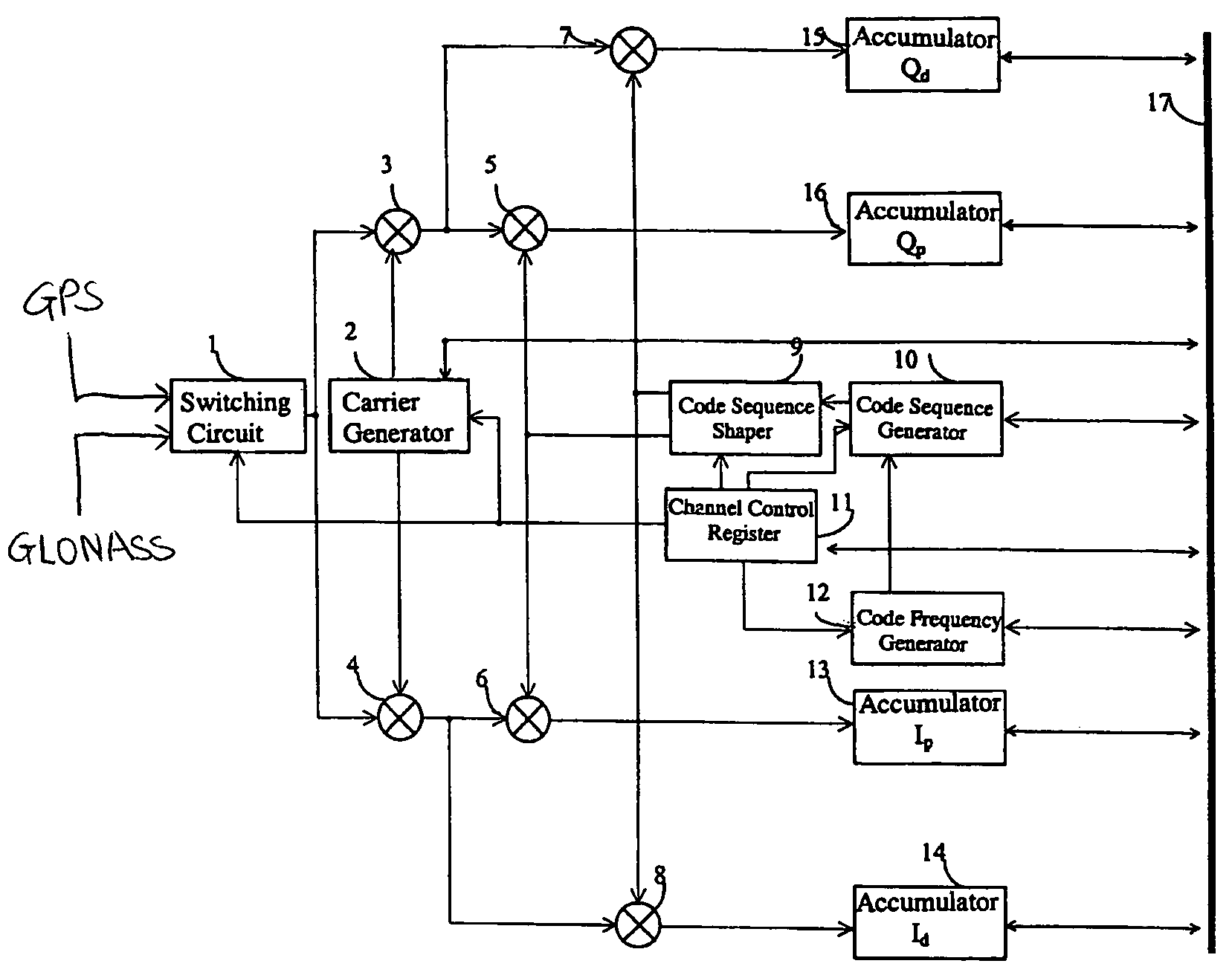
Figure 1 
Figure 2 
Figure 3
Abstract
Description
TECHNICAL FIELD
[0001] The present invention relates to systems of reception of digital radio signal coded by pseudonoise sequences, which in particular are used in the systems of global positioning GPS (USA) and GLONASS (Russia), and adapted for operation under distorted parameters of the received signal due to the multipath effect.BACKGROUND OF THE INVENTION
[0002] The passive receivers of pseudonoise signals transmitted by the satellites of global positioning systems GPS USA) and GLONASS (Global Navigational Satellite System, Russia) are now widely used and allow the user to accurately determine his coordinates (latitude, longitude, height) and time. The global positioning systems are described in the following references: “Global Navigational Satellite System—GLONASS”. The interface control document. KNIZ VKS, Russia, 1995, and also in “Global Position System. Standard Positioning Service. Signal Specification.” USA, 1993.
[0003] The known receivers of a pseudonoise signals (RPNS) ope...
Examples
Embodiment Construction
[0020]FIG. 1 shows a block diagram of the typical signal of the correlator used for tracing the frequency (phase) and code of the receiver of the GPS or GLONASS system or the combined GPS / GLONASS system. The figure represents a universal GPS / GLONASS correlator operating with an actual input signal after an analog-to-digital converter. Nevertheless, the offered approach is completely applicable to the case of operation with a pair of quadrature input signals (input in-phase component I and quadrature component Q of the signal). Usually a receiver has some single-type tracing channels to monitor the signals of several satellites simultaneously. Since this feature does not reflect the essence of the proposed invention, no detailed description of the radio engineering part of the digital receiver is given here. Such a system, as a rule, consists of a low-noise input amplifier, a high-frequency bandeaus filter, a mixer (or mixers) reducing the frequency which include a voltage-controlled...