
Methylated CpG island amplification (MCA)
Patent Information
- Authority / Receiving Office
- US · United States
- Current Assignee / Owner
- Publication Date
- 2010-04-20
- Estimated Expiration
- Not applicable · inactive patent
Smart Images
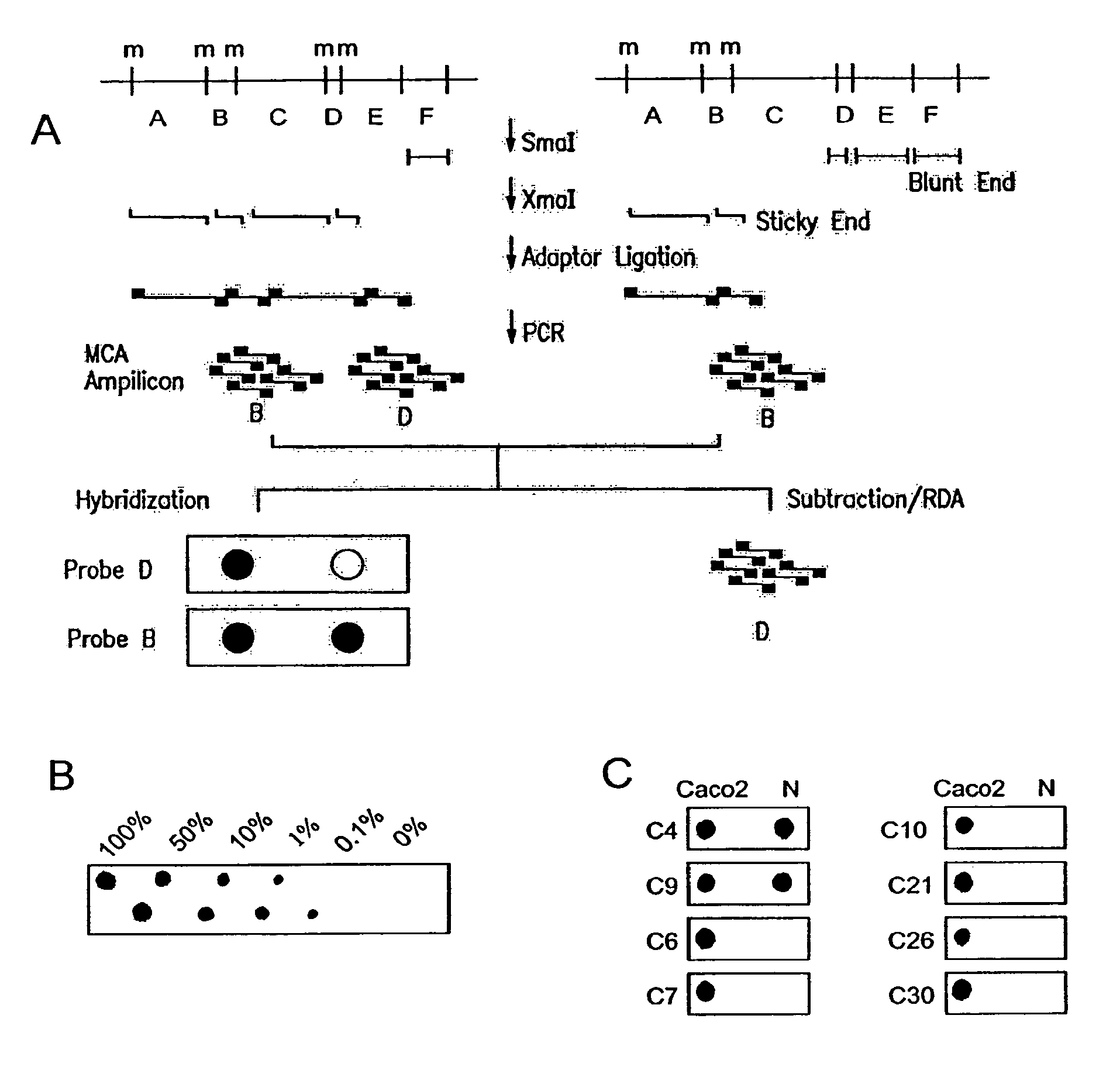
Figure 1 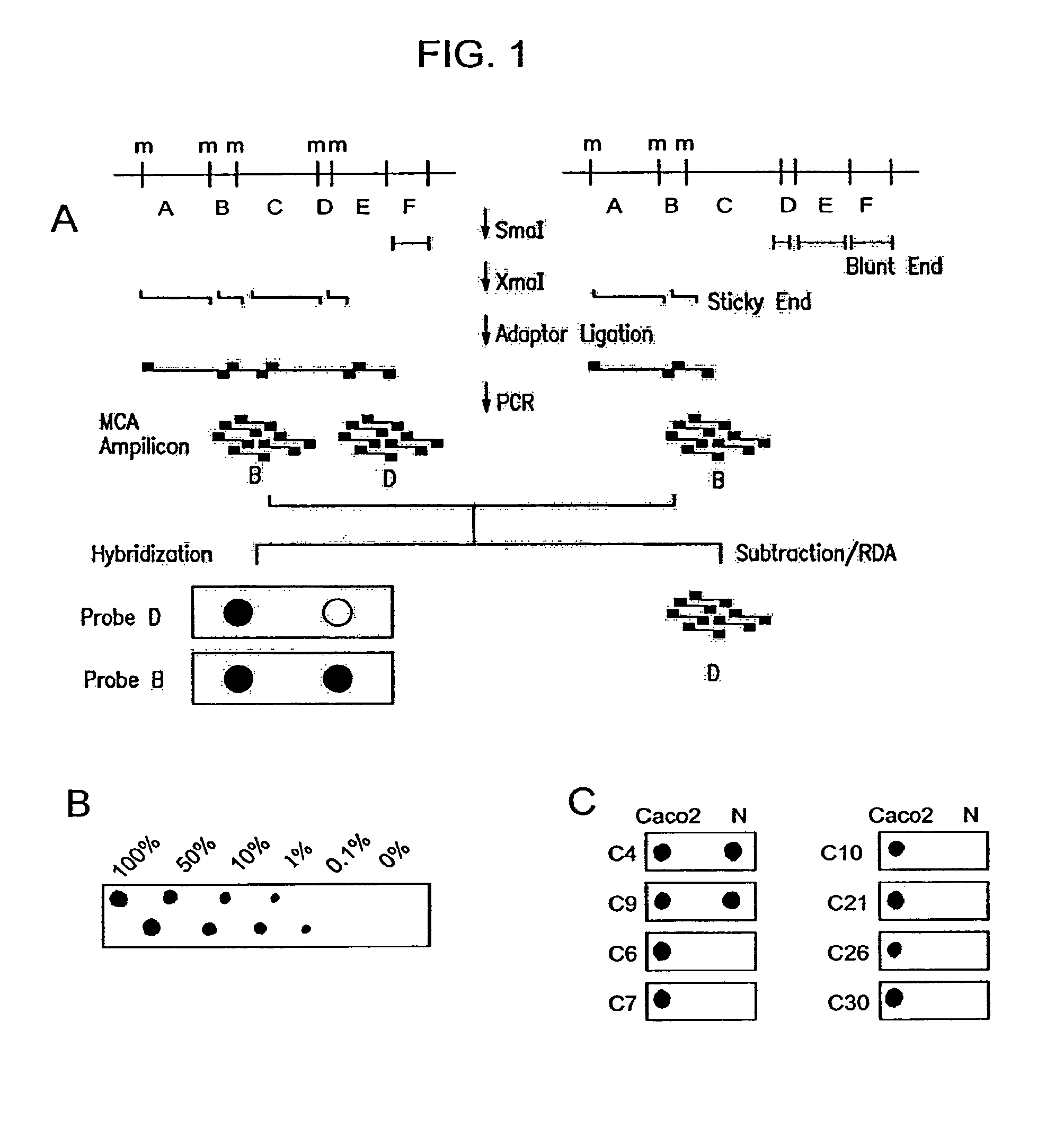
Figure 2 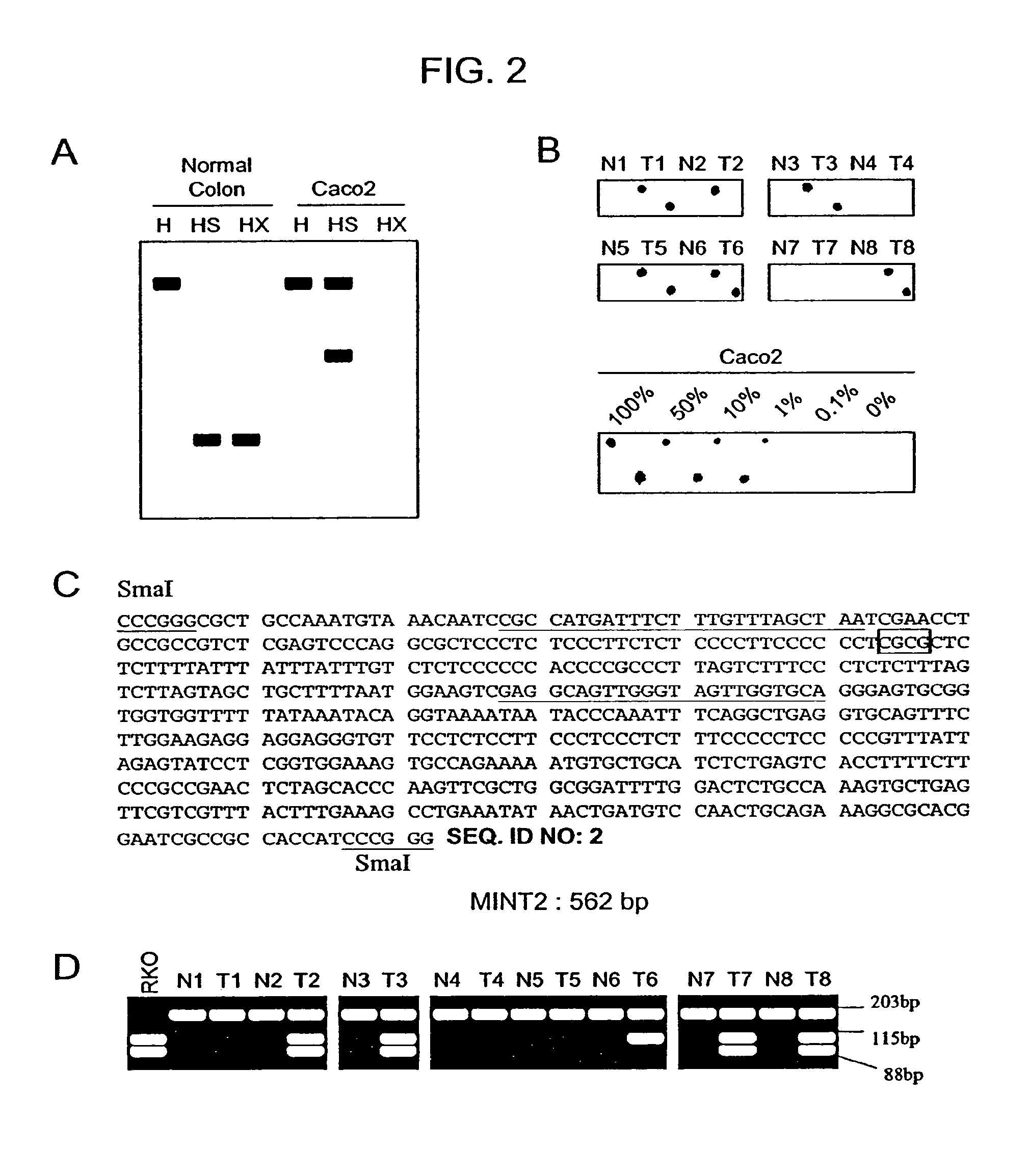
Figure 3
Abstract
Description
CROSS REFERENCE TO RELATED APPLICATION
[0001] This application claims priority under §119(e)(1) from U.S. Provisional Application Ser. No. 60 / 106,925, filed Nov. 3, 1998, herein incorporated by reference.STATEMENT AS TO FEDERALLY SPONSORED RESEARCH
[0002] This invention was made with Government support under Grant No. CA43318 and CA54396, awarded by the National Cancer Institute and Grant No. CA43318, a Colon Cancer Spore Grant. The government may have certain rights in the invention.FIELD OF THE INVENTION
[0003] The present invention relates generally to regulation of gene expression and more specifically to a method of determining the DNA methylation status of CpG sites in a given locus.BACKGROUND OF THE INVENTION
[0004] DNA methylases transfer methyl groups from the universal methyl donor S-adenosyl methionine to specific sites on the DNA. Several biological functions have been attributed to the methylated bases in DNA. The most established biological function for methylated DNA is the p...
Examples
example 1
Detection of Methylated CpG Islands Using MCA
[0081]The principle underlying MCA involves amplification of closely spaced methylated SmaI sites to enrich for methylated CGIs. The MCA technique is outlined in FIG. 1A. About 70 to 80% of CpG islands contain at least two closely spaced (<1 kb) SmaI sites (CCCGGG). Only those SmaI sites within these short distances can be amplified using MCA, ensuring representation of the most CpG rich sequences. Briefly, DNA is digested with SmaI, which cleaves only unmethylated sites, leaving blunt ends between the C and G. DNA is then digested with the SmaI isoschizomer XmaI, which does cleave methylated CCCGGG sites, and which leaves a 4 base overhang. Adaptors are ligated to this overhang, and PCR is performed using primers complementary to these adaptors. The amplified DNA is then spotted on a nylon membrane and can be hybridized with any probe of interest.
[0082]As a model experiment, amplification of the p16 gene CGI was examined because (1) hype...
example 2
Identification of Differentially Methylated CG in CRC by MCA / RDA
[0084]To identify novel CGIs aberrantly methylated in CRC, RDA was performed on MCA amplicons from the colon cancer cell line Caco2 as a tester, and a mixture of DNA from the normal colon mucosa of 5 different men (to avoid cloning polymorphic SmaI sites or inactive and methylated X chromosome genes from women) as a driver. Two separate experiments were conducted, one using a lower annealing temperature (72° C.), and the other using a higher annealing temperature (77° C.) and more GC rich primers. After two rounds of RDA, the PCR products were cloned, and colonies containing inserts were identified by PCR. Based on initial experiments, we expected most of the recovered clones to contain Alu repetitive sequences, which are CG rich and hypermethylated. All clones were therefore probed with an Alu fragment, and only non-hybridizing clones were analyzed further. Out of 160 non-Alu clones, 46 were independent clones and 33 o...
example 3
Silencing of the Versican Gene in CRC
[0091]To determine whether some of these clones truly represented genes silenced by methylation, we examined the versican gene in more detail. Versican is a secreted glycoprotein that appears to be regulated by the Rb tumor suppressor gene. MINT11 corresponds to part of exon 1 and part of intron 1 of the versican gene (FIG. 3A). Hypermethylation of the two SmaI sites in exon 1 and intron 1 in colon cancer cell lines was confirmed by both Southern blot analysis and MCA. In order to determine if this methylation was representative of the entire CGI, including the proximal promoter, PCR was performed on bisulfite-treated DNA using primers designed to amplify the region around the transcription start site of this gene. The PCR product was then digested with restriction enzymes that distinguish methylated from unmethylated DNA. The versican promoter was found to be completely methylated in the colon cancer cell lines, DLD1, LOVO, SW48 and SW837, and p...