
Reducing back-reflections in laser processing systems
a laser processing system and laser beam technology, applied in metal-working equipment, welding equipment, manufacturing tools, etc., can solve the problems of seed laser damage in high-power master oscillator, damage to output fiber and gain fiber, and large bulky seed laser, so as to reduce or prevent back-reflection
Patent Information
- Authority / Receiving Office
- US · United States
- Patent Type
- Patents(United States)
- Current Assignee / Owner
- Publication Date
- 2012-07-10
- Estimated Expiration
- Not applicable · inactive patent
Smart Images
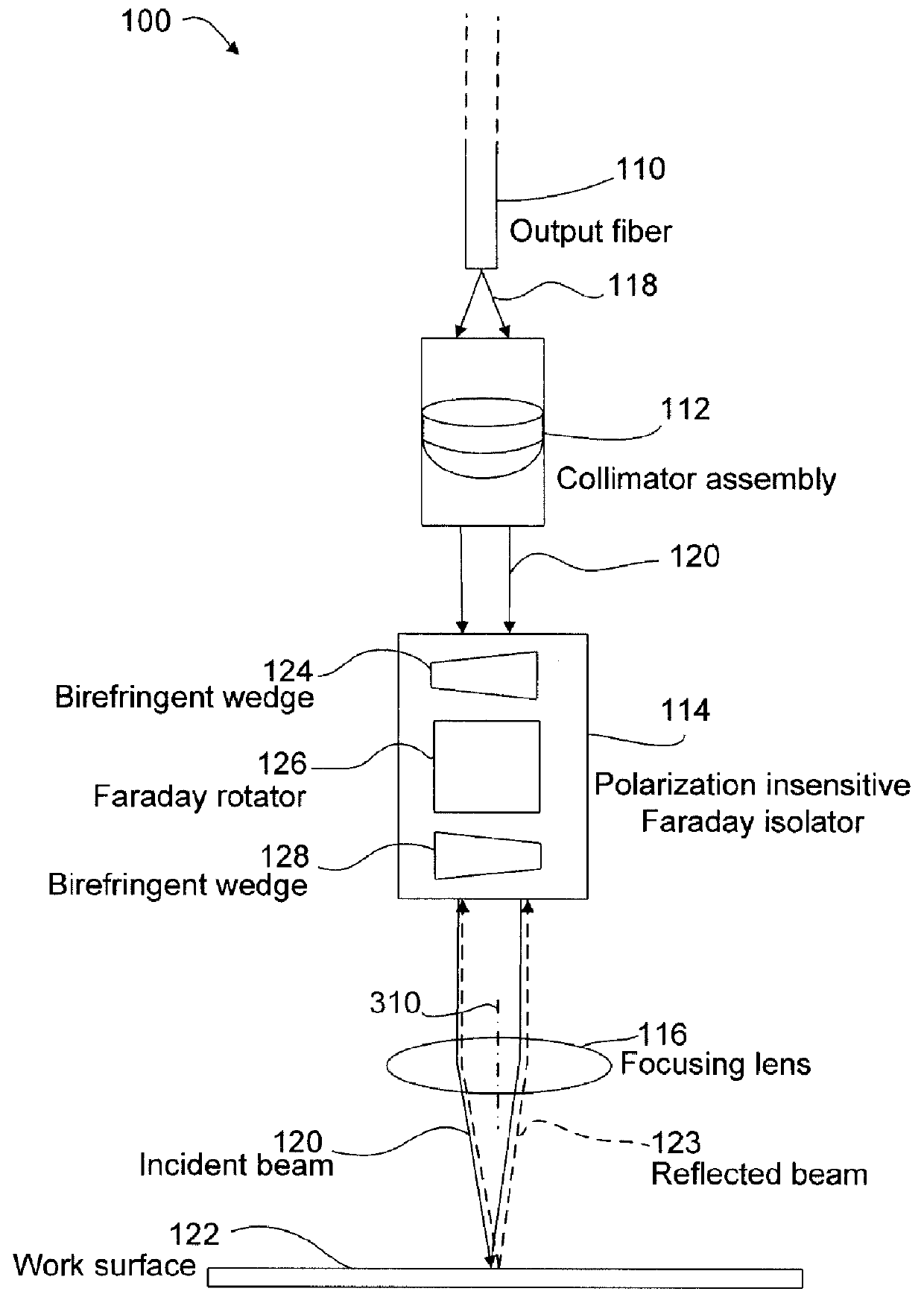
Figure 1 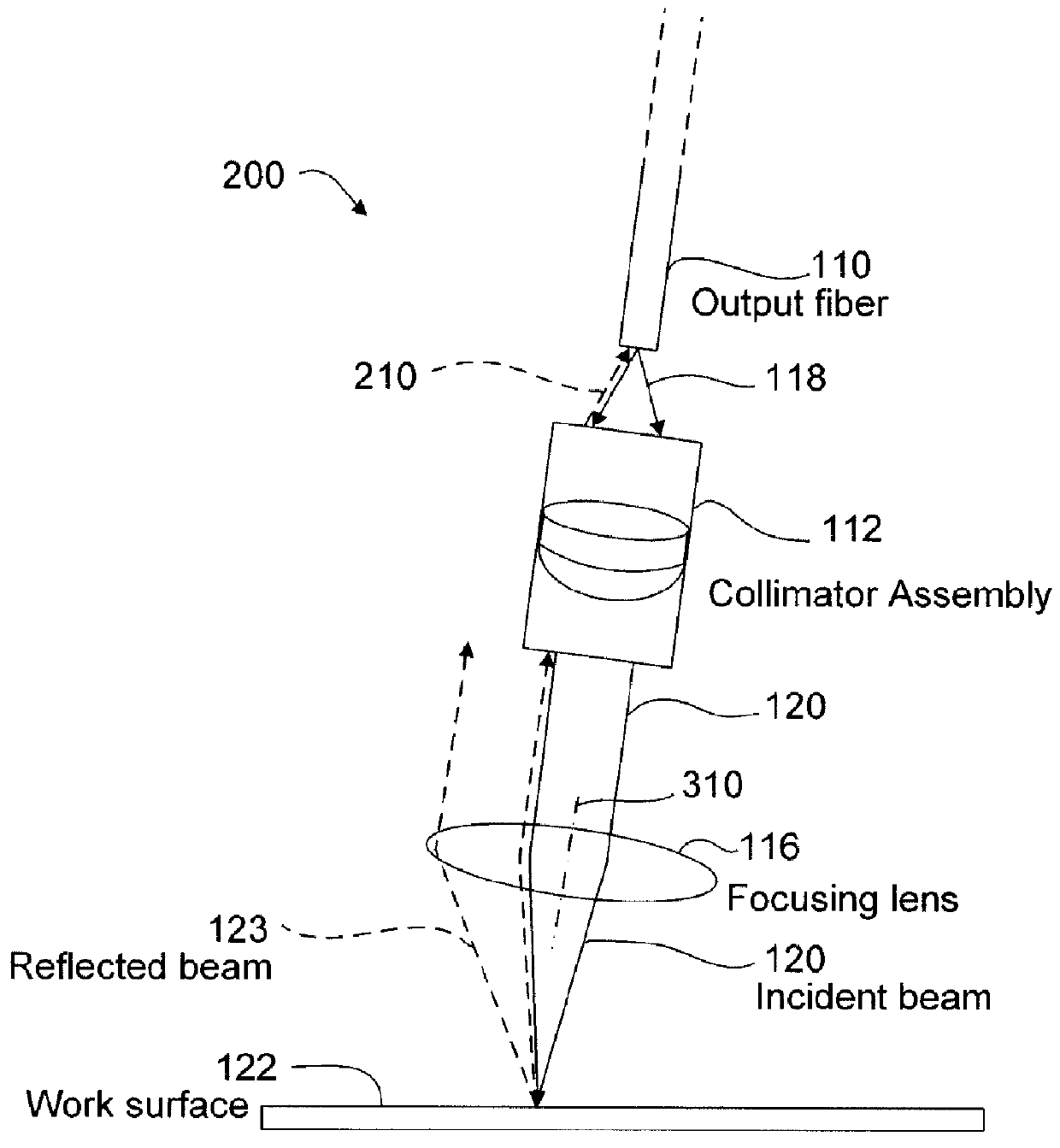
Figure 2 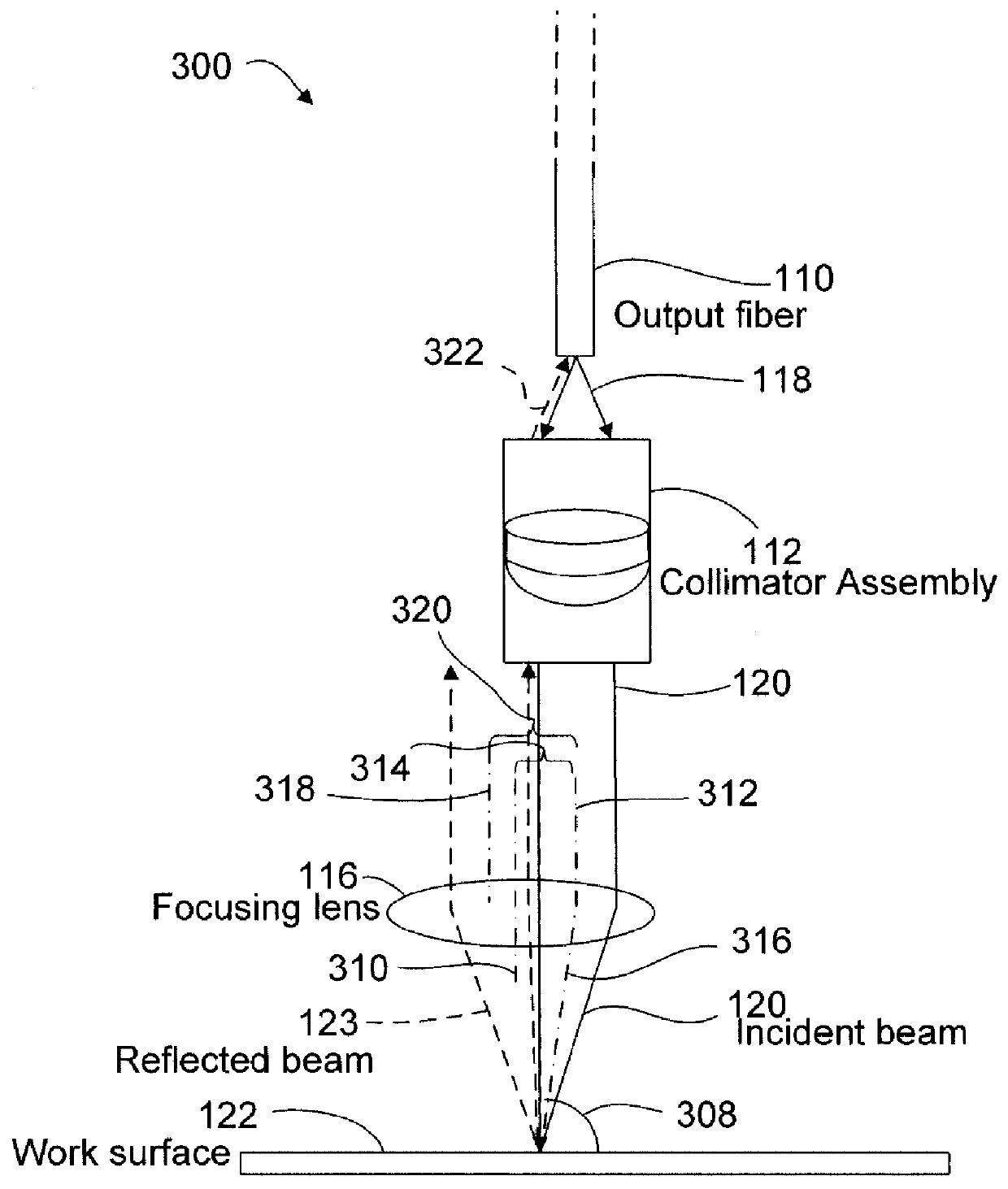
Figure 3
Abstract
Description
RELATED APPLICATION
[0001] This application claims the benefit under 35 U.S.C. §119(e) of U.S. Provisional Application No. 61 / 073,254, filed Jun. 17, 2008, which is hereby incorporated by reference herein in its entirety.TECHNICAL FIELD
[0002] This disclosure relates to processing materials with lasers. In particular, this disclosure relates to reducing laser beam back-reflection.BACKGROUND INFORMATION
[0003] Generally, certain lasers may be sensitive to optical feedback such as a laser beam reflected back to the laser from a work surface. For example, fiber lasers are typically very sensitive to back-reflections from a work surface. If such reflections are not properly blocked, e.g., if there is a return path for such reflections to couple back into an output fiber, it is possible that both the output fiber and gain fibers may be damaged. Further, a seed laser may be damaged in a high-power master oscillator fiber amplifier device by reflected light that is amplified on its way back to t...
Examples
Embodiment Construction
[0022]Various systems and methods disclosed herein reduce or prevent back-reflections from coupling into an output fiber of a laser processing system without using bulky and / or expensive isolators. In one embodiment, a focusing lens is placed in the beam path at an offset distance from the beam propagation axis so as to impart a non-vertical “angle-of-attack” to the incident beam with respect to the work surface. This provides a spatial separation between incident and reflected beam paths without tilting the entire beam delivery subsystem with respect to the work surface. In one embodiment, an aperture further blocks the laser beam from reaching the output fiber. In addition, or in another embodiment, a secondary beam positioner scans an incident laser beam across the focusing lens at an offset from the focusing lens's primary axis such that a scanning focal plane is substantially parallel to the work surface.
[0023]Reference is now made to the figures in which like reference numeral...