
Polymorphisms in the EGFR pathway as markers for cancer treatment
a cancer and egfr pathway technology, applied in the field of genetic polymorphisms, can solve the problems of limited cancer chemotherapy and the relatively poor overall survival of the 5-year period
Patent Information
- Authority / Receiving Office
- US · United States
- Patent Type
- Patents(United States)
- Current Assignee / Owner
- Publication Date
- 2012-10-02
- Estimated Expiration
- Not applicable · inactive patent
Smart Images
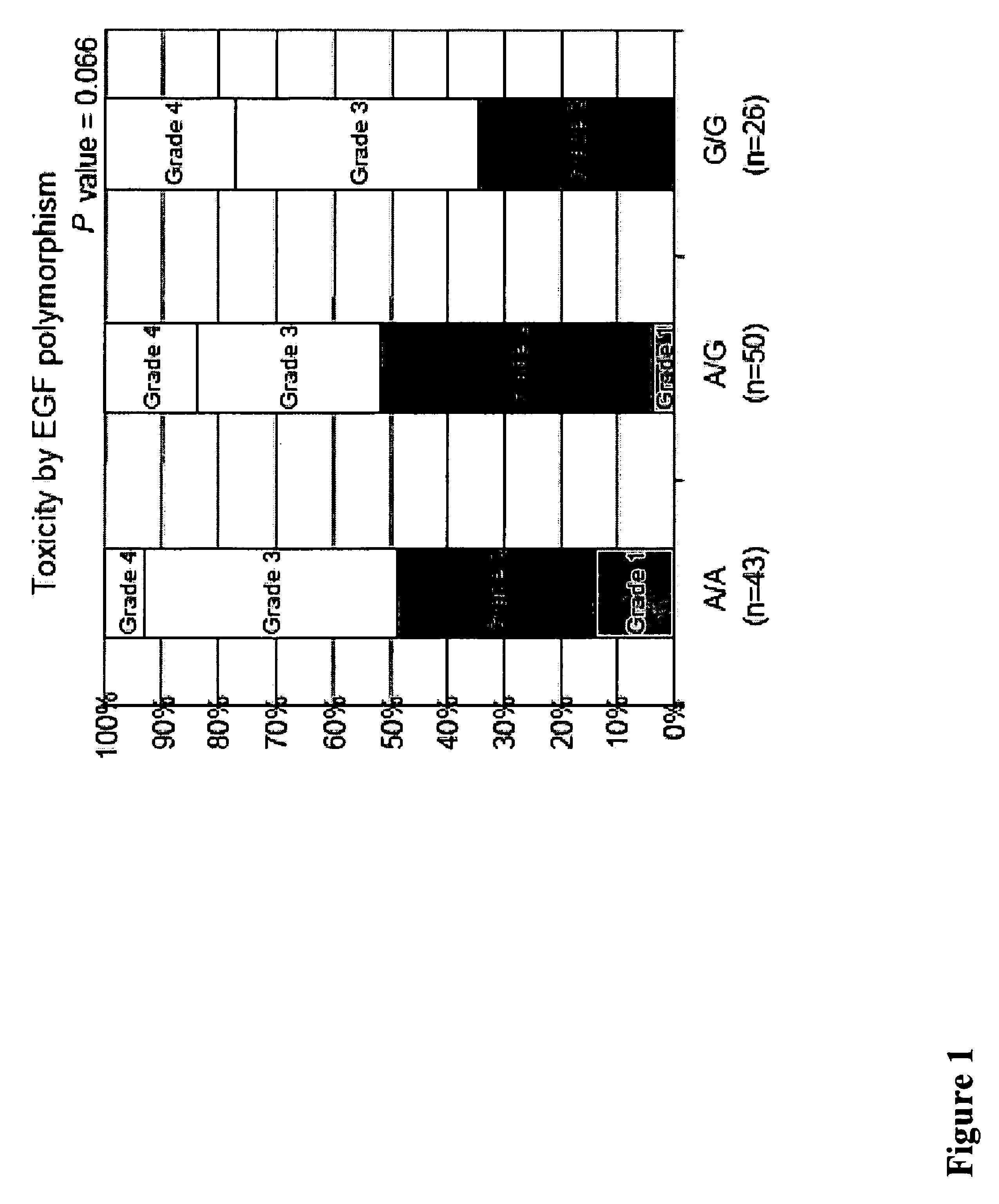
Figure 1 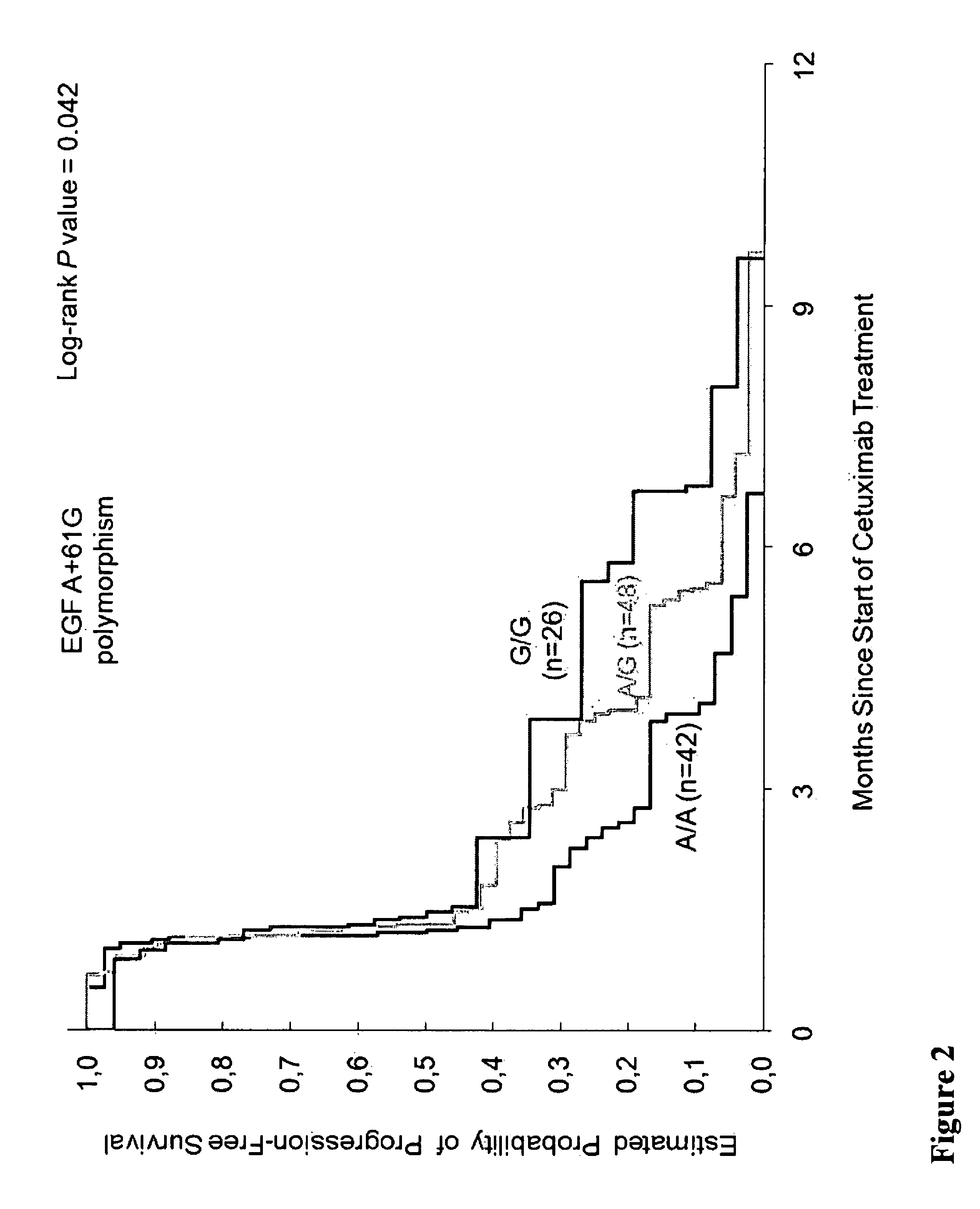
Figure 2 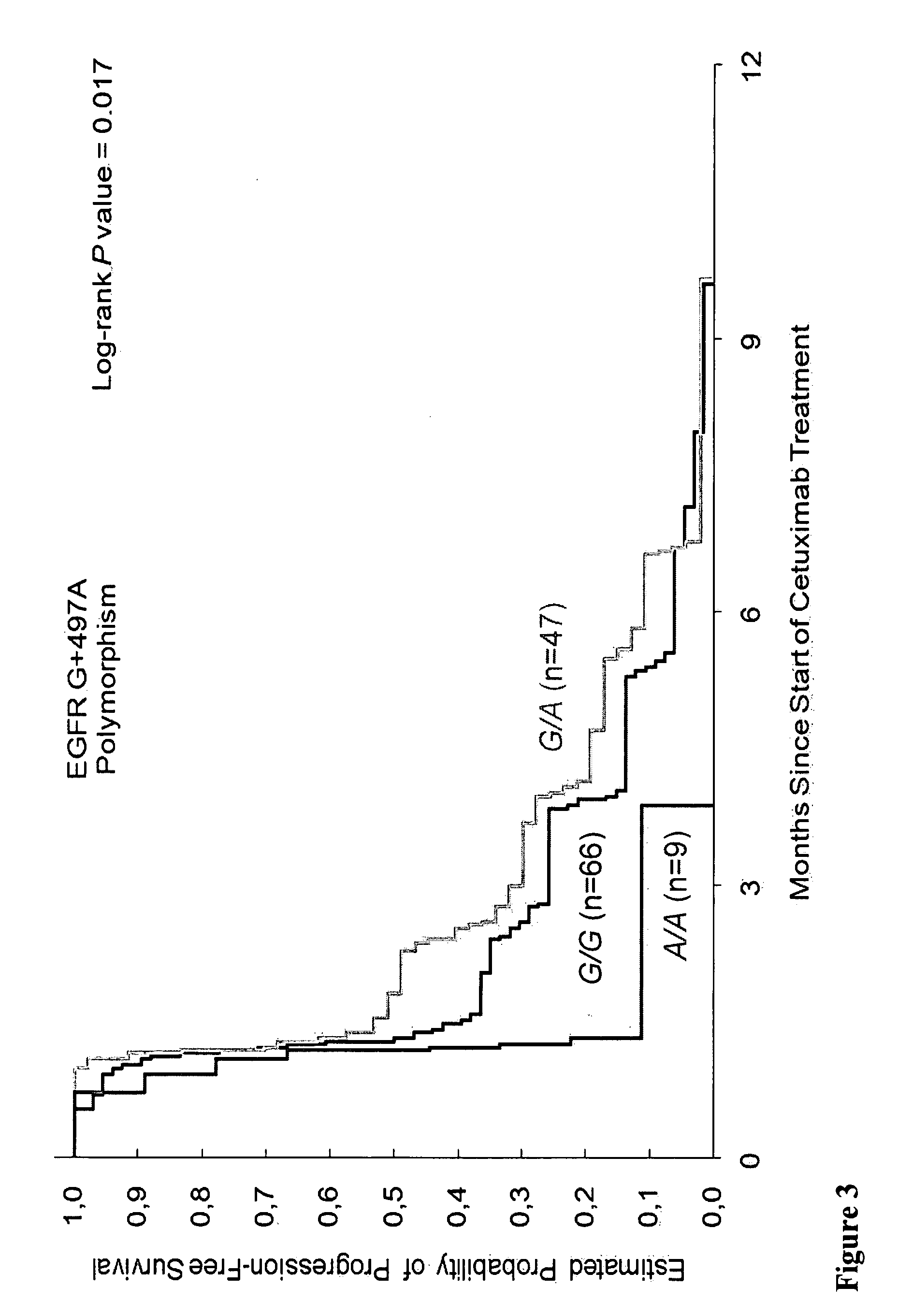
Figure 3
Abstract
Description
CROSS-REFERENCE TO RELATED APPLICATIONS
[0001] This application is a national stage application under 35 U.S.C. §371 of International Application No. PCT / US2008 / 000660, filed Jan. 17, 2008, which in turn claims the benefit under 35 U.S.C. §119(e) of provisional applications U.S. Ser. Nos. 60 / 885,601, filed on Jan. 18, 2007 and 60 / 915,551, filed on May 2, 2007. The contents of each of these applications are incorporated by reference into the present disclosure in their entirety.FIELD OF THE INVENTION
[0002] This invention relates to the field of pharmacogenomics and specifically to the application of genetic polymorphism(s) to diagnose and treat diseases.BACKGROUND OF THE INVENTION
[0003] In nature, organisms of the same species usually differ from each other in some aspects, e.g., their appearance. The differences are genetically determined and are referred to as polymorphism. Genetic polymorphism is the occurrence in a population of two or more genetically determined alternative phenotyp...
Examples
experimental examples
Example 1
[0228]Background: A phase II study of Cetuximab (IMCL-0144) has shown a response rate of 12% in patients with EGFR expressing metastatic colorectal cancer (mCRC). It was recently reported that polymorphisms in the EGFR pathway may be useful molecular markers to predict clinical outcome. In this larger study, polymorphisms in genes were tested for involvement in the EGFR and whether the angiogenesis pathway will be associated with clinical outcome.
[0229]Methods: 136 tissue samples from 346 mCRC patients enrolled in the phase II study of Cetuximab (IMCL-0144) were analyzed and 133 cases were informative. The response rate in these 133 patients was 10% with a median progression-free survival (PFS) of 1.3 months (95% CI, 1.2 to 1.5) and an overall survival time (OS) of 5.5 months (95% CI, 4.1 to 7.5). Gr3-4 toxicity was observed in 56%. Gene polymorphisms of EGFR, Cox-2, EGF, cyclin D1, fragment c γ receptor 2A (FCGR2A), FCGR3A, VEGF, IL-8 were assessed from gDNA extracted from...
example 2
[0231]In an extension of the experiment described in Example 1, Applicant provides the following Example 2
Materials and Methods:
Patients
[0232]One hundred and thirty patients with histopathologically confirmed metastatic colorectal carcinoma, who either failed at least two prior chemotherapy regimens or failed adjuvant therapy plus one chemotherapy regimen for metastatic disease, were included in this study. All patients took part in a phase II open-label multicenter study (ImClone-0144) of Cetuximab (C-225), which included a total of 346 patients. All available tissue samples from 130 mCRC patients enrolled were analyzed. The study was performed at the University of Southern California / Norris Comprehensive Cancer Center (USC / NCCC) and was approved by the Institutional Review Board of the University of Southern California for Medical Sciences. All patients provided their written informed consent for tissue and blood collection to allow study of molecular correlates.
Clinical Evaluatio...