

Applying Schmitt Trigger to Maintain Data Integrity
SEP 23, 20259 MIN READ
Generate Your Research Report Instantly with AI Agent
PatSnap Eureka helps you evaluate technical feasibility & market potential.
Schmitt Trigger Technology Background and Objectives
The Schmitt trigger, invented by Otto Schmitt in 1934, represents a fundamental electronic circuit design that has evolved significantly over decades. Initially developed for biological system simulations, this comparator circuit with hysteresis has become essential in modern digital systems where signal integrity is paramount. The technology's evolution has been marked by transitions from vacuum tubes to discrete transistors, and eventually to integrated circuit implementations, each iteration improving performance while reducing size and power consumption.
In contemporary digital systems, data integrity faces increasing challenges due to noise interference, voltage fluctuations, and signal degradation across transmission paths. These issues become particularly critical as operating frequencies increase and voltage margins decrease in advanced semiconductor processes. The Schmitt trigger's unique hysteresis characteristic provides a robust solution by establishing different threshold levels for rising and falling signals, effectively creating a "memory" of the previous state.
The primary technical objective in applying Schmitt trigger technology to data integrity is to develop optimized circuit configurations that can reliably convert noisy, slowly-changing input signals into clean digital outputs with well-defined transitions. This includes minimizing propagation delay while maintaining sufficient noise immunity across varying environmental conditions and process variations.
Secondary objectives include reducing power consumption in Schmitt trigger implementations, particularly for battery-powered and IoT applications where energy efficiency is crucial. Additionally, there is growing interest in developing adaptive Schmitt trigger designs that can dynamically adjust hysteresis levels based on real-time noise conditions, optimizing the balance between noise immunity and signal responsiveness.
From a system integration perspective, a key goal is to standardize Schmitt trigger implementations across different interface technologies, ensuring consistent behavior in mixed-signal environments. This standardization would facilitate more reliable data transmission between subsystems operating at different voltage levels or in varying noise environments.
Looking forward, emerging objectives include developing Schmitt trigger variants optimized for ultra-low voltage applications (sub-0.5V) to support next-generation energy harvesting systems, and exploring novel materials and structures that can provide hysteresis characteristics at nanoscale dimensions for future quantum computing interfaces and neuromorphic computing systems.
The technology continues to find new applications beyond traditional digital circuits, including sensor interfaces, power management systems, and timing circuits, highlighting its enduring relevance in maintaining signal integrity across diverse technological domains.
In contemporary digital systems, data integrity faces increasing challenges due to noise interference, voltage fluctuations, and signal degradation across transmission paths. These issues become particularly critical as operating frequencies increase and voltage margins decrease in advanced semiconductor processes. The Schmitt trigger's unique hysteresis characteristic provides a robust solution by establishing different threshold levels for rising and falling signals, effectively creating a "memory" of the previous state.
The primary technical objective in applying Schmitt trigger technology to data integrity is to develop optimized circuit configurations that can reliably convert noisy, slowly-changing input signals into clean digital outputs with well-defined transitions. This includes minimizing propagation delay while maintaining sufficient noise immunity across varying environmental conditions and process variations.
Secondary objectives include reducing power consumption in Schmitt trigger implementations, particularly for battery-powered and IoT applications where energy efficiency is crucial. Additionally, there is growing interest in developing adaptive Schmitt trigger designs that can dynamically adjust hysteresis levels based on real-time noise conditions, optimizing the balance between noise immunity and signal responsiveness.
From a system integration perspective, a key goal is to standardize Schmitt trigger implementations across different interface technologies, ensuring consistent behavior in mixed-signal environments. This standardization would facilitate more reliable data transmission between subsystems operating at different voltage levels or in varying noise environments.
Looking forward, emerging objectives include developing Schmitt trigger variants optimized for ultra-low voltage applications (sub-0.5V) to support next-generation energy harvesting systems, and exploring novel materials and structures that can provide hysteresis characteristics at nanoscale dimensions for future quantum computing interfaces and neuromorphic computing systems.
The technology continues to find new applications beyond traditional digital circuits, including sensor interfaces, power management systems, and timing circuits, highlighting its enduring relevance in maintaining signal integrity across diverse technological domains.
Market Applications and Demand Analysis
The market for Schmitt trigger applications in data integrity has witnessed substantial growth over the past decade, driven primarily by the increasing complexity of electronic systems and the growing demand for reliable data processing in noisy environments. Industries such as automotive electronics, industrial automation, telecommunications, and medical devices have emerged as key adopters of Schmitt trigger technology for maintaining signal integrity.
In the automotive sector, the proliferation of electronic control units (ECUs) and advanced driver assistance systems (ADAS) has created significant demand for robust signal conditioning solutions. These systems operate in electrically noisy environments where voltage fluctuations and electromagnetic interference can compromise data integrity. The automotive electronics market, valued at over $300 billion globally, continues to expand at approximately 8% annually, with signal integrity solutions representing a critical component.
Industrial automation represents another substantial market, where factory floor equipment must maintain reliable communication despite electrical noise from motors, actuators, and power systems. The industrial IoT revolution has accelerated this demand, as distributed sensor networks require dependable data transmission across potentially noisy channels. Market research indicates that industrial automation companies are increasingly prioritizing signal integrity in their component selection processes.
Telecommunications infrastructure presents unique challenges for data integrity, particularly in high-speed data transmission systems where signal degradation can lead to unacceptable bit error rates. The deployment of 5G networks has intensified the need for advanced signal conditioning technologies, including sophisticated implementations of Schmitt trigger circuits in receiver designs.
Medical device manufacturers have also emerged as significant consumers of data integrity solutions. Patient monitoring systems, diagnostic equipment, and implantable devices all require exceptionally reliable signal processing to ensure accurate readings and proper functionality. The consequences of data corruption in medical applications can be severe, driving stringent requirements for signal conditioning components.
Consumer electronics represents a volume-driven market for Schmitt trigger applications, with billions of devices requiring reliable input signal conditioning for user interfaces, sensor readings, and communication protocols. The trend toward miniaturization and lower power consumption has created demand for integrated Schmitt trigger solutions that maintain performance while reducing component footprint and energy requirements.
Market analysis reveals a growing preference for programmable hysteresis in Schmitt trigger implementations, allowing dynamic adjustment of noise immunity thresholds based on operating conditions. This trend aligns with the broader movement toward adaptive and configurable electronic systems that can optimize performance across varying environmental conditions.
In the automotive sector, the proliferation of electronic control units (ECUs) and advanced driver assistance systems (ADAS) has created significant demand for robust signal conditioning solutions. These systems operate in electrically noisy environments where voltage fluctuations and electromagnetic interference can compromise data integrity. The automotive electronics market, valued at over $300 billion globally, continues to expand at approximately 8% annually, with signal integrity solutions representing a critical component.
Industrial automation represents another substantial market, where factory floor equipment must maintain reliable communication despite electrical noise from motors, actuators, and power systems. The industrial IoT revolution has accelerated this demand, as distributed sensor networks require dependable data transmission across potentially noisy channels. Market research indicates that industrial automation companies are increasingly prioritizing signal integrity in their component selection processes.
Telecommunications infrastructure presents unique challenges for data integrity, particularly in high-speed data transmission systems where signal degradation can lead to unacceptable bit error rates. The deployment of 5G networks has intensified the need for advanced signal conditioning technologies, including sophisticated implementations of Schmitt trigger circuits in receiver designs.
Medical device manufacturers have also emerged as significant consumers of data integrity solutions. Patient monitoring systems, diagnostic equipment, and implantable devices all require exceptionally reliable signal processing to ensure accurate readings and proper functionality. The consequences of data corruption in medical applications can be severe, driving stringent requirements for signal conditioning components.
Consumer electronics represents a volume-driven market for Schmitt trigger applications, with billions of devices requiring reliable input signal conditioning for user interfaces, sensor readings, and communication protocols. The trend toward miniaturization and lower power consumption has created demand for integrated Schmitt trigger solutions that maintain performance while reducing component footprint and energy requirements.
Market analysis reveals a growing preference for programmable hysteresis in Schmitt trigger implementations, allowing dynamic adjustment of noise immunity thresholds based on operating conditions. This trend aligns with the broader movement toward adaptive and configurable electronic systems that can optimize performance across varying environmental conditions.
Current State and Technical Challenges
The global landscape of Schmitt trigger applications for data integrity presents a complex picture of technological advancement and persistent challenges. Currently, Schmitt triggers are widely implemented across various industries including telecommunications, automotive systems, industrial automation, and consumer electronics, where they effectively combat signal noise and maintain reliable data transmission.
In telecommunications infrastructure, Schmitt triggers have become standard components in signal conditioning circuits, though their implementation in high-speed data transmission systems above 10 Gbps remains problematic due to inherent switching delays. These delays, typically ranging from 5-20 nanoseconds depending on design parameters, create significant bottlenecks in ultra-high-speed applications.
The semiconductor industry has made substantial progress in miniaturizing Schmitt trigger circuits, with current designs achieving footprints below 50μm² in modern process nodes. However, this miniaturization introduces new challenges related to power consumption and thermal management. Recent research indicates that power efficiency decreases non-linearly as dimensions shrink below certain thresholds, creating a technical barrier for further integration in low-power applications.
Geographically, innovation in Schmitt trigger technology shows distinct patterns. North American and European research institutions focus predominantly on theoretical advancements and novel applications, while Asian manufacturers, particularly in Taiwan, South Korea, and China, lead in production optimization and integration techniques. This distribution creates both collaborative opportunities and competitive tensions in the global market.
A significant technical limitation facing current Schmitt trigger implementations is their adaptability to varying noise environments. Traditional designs feature fixed hysteresis thresholds, making them less effective in applications where noise characteristics change dynamically. Adaptive threshold systems exist but require additional circuitry that increases complexity, cost, and power consumption.
The integration of Schmitt triggers with modern digital signal processing systems presents another challenge. The analog nature of Schmitt trigger operation creates interface complications when implemented alongside highly digital systems, requiring additional conversion circuitry that can introduce latency and signal degradation.
Temperature sensitivity remains a persistent issue, with typical commercial Schmitt trigger circuits exhibiting threshold voltage variations of 2-5% across their operating temperature range. This variation can be critical in precision applications such as medical devices and scientific instrumentation, where data integrity requirements are exceptionally stringent.
In telecommunications infrastructure, Schmitt triggers have become standard components in signal conditioning circuits, though their implementation in high-speed data transmission systems above 10 Gbps remains problematic due to inherent switching delays. These delays, typically ranging from 5-20 nanoseconds depending on design parameters, create significant bottlenecks in ultra-high-speed applications.
The semiconductor industry has made substantial progress in miniaturizing Schmitt trigger circuits, with current designs achieving footprints below 50μm² in modern process nodes. However, this miniaturization introduces new challenges related to power consumption and thermal management. Recent research indicates that power efficiency decreases non-linearly as dimensions shrink below certain thresholds, creating a technical barrier for further integration in low-power applications.
Geographically, innovation in Schmitt trigger technology shows distinct patterns. North American and European research institutions focus predominantly on theoretical advancements and novel applications, while Asian manufacturers, particularly in Taiwan, South Korea, and China, lead in production optimization and integration techniques. This distribution creates both collaborative opportunities and competitive tensions in the global market.
A significant technical limitation facing current Schmitt trigger implementations is their adaptability to varying noise environments. Traditional designs feature fixed hysteresis thresholds, making them less effective in applications where noise characteristics change dynamically. Adaptive threshold systems exist but require additional circuitry that increases complexity, cost, and power consumption.
The integration of Schmitt triggers with modern digital signal processing systems presents another challenge. The analog nature of Schmitt trigger operation creates interface complications when implemented alongside highly digital systems, requiring additional conversion circuitry that can introduce latency and signal degradation.
Temperature sensitivity remains a persistent issue, with typical commercial Schmitt trigger circuits exhibiting threshold voltage variations of 2-5% across their operating temperature range. This variation can be critical in precision applications such as medical devices and scientific instrumentation, where data integrity requirements are exceptionally stringent.
Current Implementation Approaches
01 Schmitt trigger circuits for noise immunity and signal integrity
Schmitt trigger circuits are designed with hysteresis to improve noise immunity in digital systems. By implementing different threshold levels for rising and falling input signals, these circuits prevent false triggering caused by noise, ensuring data integrity in signal transmission. This hysteresis characteristic makes Schmitt triggers particularly valuable in environments with high electrical noise or when processing signals with slow transition times.- Schmitt trigger circuits for noise immunity and signal integrity: Schmitt trigger circuits are designed with hysteresis to improve noise immunity and maintain signal integrity in digital systems. The hysteresis provides different threshold levels for rising and falling input signals, preventing unwanted oscillations and false triggering due to noise. This design ensures reliable data transmission by rejecting noise that could otherwise cause data corruption, particularly in environments with electrical interference.
- Input buffer designs with Schmitt triggers for data reliability: Input buffer circuits incorporating Schmitt trigger functionality are used to enhance data reliability at system interfaces. These buffers clean up incoming signals by providing well-defined logic levels despite input signal degradation. The hysteresis characteristic of Schmitt triggers in these buffers ensures stable operation even with slowly changing input signals, preventing metastability issues that could lead to data corruption during signal level transitions.
- Power-efficient Schmitt trigger implementations for data processing: Advanced Schmitt trigger designs focus on power efficiency while maintaining data integrity. These implementations use modified circuit topologies to reduce power consumption without compromising the hysteresis characteristics essential for reliable data handling. Low-power Schmitt triggers are particularly important in battery-operated devices and IoT applications where maintaining signal integrity with minimal power usage is critical for overall system reliability.
- Schmitt triggers in clock and timing circuits for data synchronization: Schmitt triggers play a crucial role in clock generation and timing circuits to ensure proper data synchronization. By providing clean clock edges even from degraded input signals, these circuits help maintain timing integrity throughout digital systems. The hysteresis characteristic prevents timing jitter that could otherwise lead to synchronization errors and data corruption, ensuring that data sampling occurs at appropriate and consistent intervals.
- Integrated Schmitt trigger solutions for system-level data protection: System-level integration of Schmitt triggers provides comprehensive data protection across multiple interfaces and signal paths. These integrated solutions incorporate Schmitt triggers at critical points in the signal chain to maintain data integrity throughout complex systems. Advanced implementations may include programmable hysteresis levels that can be adjusted based on operating conditions, providing adaptive protection against varying noise environments and ensuring consistent data reliability across different operating scenarios.
02 Implementation of Schmitt triggers in memory and data storage systems
Schmitt triggers are integrated into memory and data storage systems to enhance data integrity during read and write operations. These circuits help maintain reliable data transfer by providing clean clock signals and stable control signals, reducing the risk of data corruption. The hysteresis property ensures that memory addressing and data lines remain stable even when subjected to voltage fluctuations, thereby preserving data integrity throughout storage and retrieval processes.Expand Specific Solutions03 Enhanced Schmitt trigger designs for improved performance
Advanced Schmitt trigger designs incorporate modifications to improve performance metrics such as speed, power consumption, and reliability. These enhancements include optimized threshold voltage settings, reduced propagation delays, and improved temperature stability. Such improvements directly contribute to better data integrity by ensuring more reliable signal detection and faster response times, which are critical in high-speed data transmission applications.Expand Specific Solutions04 Schmitt triggers in communication interfaces and signal conditioning
Schmitt triggers play a crucial role in communication interfaces by conditioning input signals before data processing. They are implemented in various communication protocols to ensure reliable data transfer by cleaning up noisy signals at interface boundaries. The hysteresis characteristic helps maintain signal integrity across different voltage domains and prevents data corruption due to ground bounce or power supply variations, making them essential components in maintaining data integrity across system interfaces.Expand Specific Solutions05 Low-power Schmitt trigger implementations for portable devices
Low-power Schmitt trigger designs are specifically developed for battery-operated and portable devices where power efficiency is critical. These implementations maintain data integrity while minimizing power consumption through techniques such as dynamic threshold adjustment and power-down modes. By ensuring reliable operation at lower supply voltages, these circuits help preserve data integrity in energy-constrained applications without compromising on noise immunity or signal quality.Expand Specific Solutions
Key Industry Players and Manufacturers
The Schmitt Trigger technology market for data integrity applications is in a growth phase, with increasing adoption across digital systems requiring reliable signal processing. The market size is expanding as data integrity becomes critical in IoT, telecommunications, and industrial automation sectors. In terms of technical maturity, established players like IBM, Intel, and Texas Instruments lead with advanced implementations, while Siemens, Micron Technology, and Huawei are developing innovative applications for emerging markets. Companies like ZTE and Hitachi are focusing on telecommunications-specific implementations, while Microsoft and Alibaba are integrating Schmitt Trigger concepts into cloud computing platforms. The competitive landscape shows a balance between hardware-focused companies developing physical components and software firms implementing digital equivalents for data validation systems.
Siemens AG
Technical Solution: Siemens has developed sophisticated Schmitt trigger implementations for industrial automation and control systems where signal integrity is critical. Their approach focuses on ruggedized Schmitt trigger circuits designed to operate reliably in harsh industrial environments with significant electromagnetic interference. Siemens' technology incorporates precision-engineered hysteresis windows that are carefully calibrated for specific industrial applications, ensuring optimal noise rejection while maintaining responsive signal detection. Their implementations feature galvanically isolated Schmitt trigger circuits that protect sensitive control systems from high-voltage transients common in industrial settings. Siemens has integrated these circuits into their SIMATIC industrial control systems, where they serve as robust input interfaces for sensor signals that may be corrupted by noise from nearby power equipment or motor drives[3]. Additionally, Siemens has developed temperature-compensated Schmitt trigger designs that maintain consistent switching thresholds across the wide temperature ranges encountered in industrial environments.
Strengths: Exceptional noise immunity in harsh industrial environments; robust protection against electrical transients; consistent performance across wide temperature ranges. Weaknesses: Higher cost compared to consumer-grade implementations; larger physical footprint due to isolation requirements; increased power consumption from isolation circuitry.
Intel Corp.
Technical Solution: Intel has implemented advanced Schmitt trigger circuits in their chipsets and I/O interfaces to maintain signal integrity across high-speed data buses. Their approach focuses on integrating Schmitt triggers at critical input stages of their processors and chipsets to ensure reliable data transmission even in electrically noisy environments. Intel's implementation features dynamically adjustable hysteresis thresholds that automatically adapt to changing noise conditions, optimizing the balance between noise immunity and switching speed. Their designs incorporate specialized low-capacitance input structures that minimize loading effects while maintaining the noise rejection benefits of Schmitt trigger operation. Intel has also developed specialized Schmitt trigger circuits for their memory controllers that help maintain data integrity during high-speed memory transfers by rejecting noise that could otherwise cause data corruption[2]. These implementations are particularly critical in server environments where data integrity is paramount.
Strengths: Excellent noise immunity in high-speed digital interfaces; adaptive hysteresis thresholds optimize performance across varying conditions; seamless integration with other signal conditioning circuits. Weaknesses: Increased design complexity compared to standard input buffers; potential for increased power consumption in high-frequency applications; requires careful characterization across process variations.
Core Patents and Technical Literature
High speed and low noise margin schmitt trigger with controllable trip point
PatentInactiveUS5489866A
Innovation
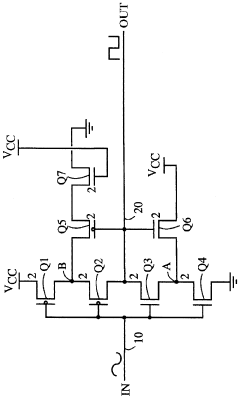
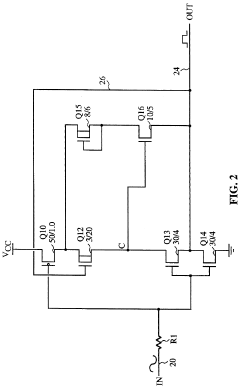
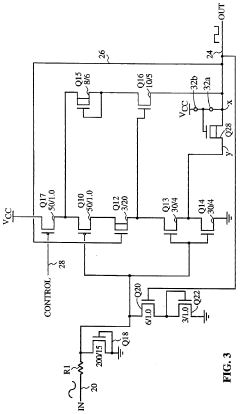
- A Schmitt trigger design incorporating a buffer with pull-up and pull-down devices, an N-channel depletion mode transistor for feedback, and control transistors for timing, along with electrostatic discharge protection and optional voltage control, to achieve a noise margin of 0.5 volts and improved response speed.
Schmitt trigger with current assistance circuit
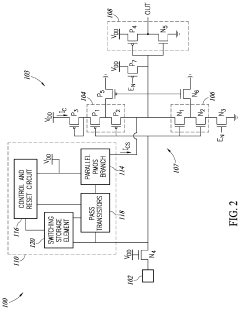
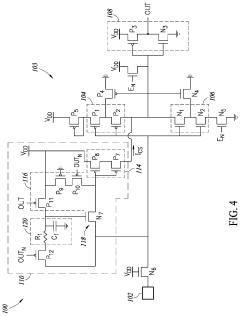
PatentActiveUS11901900B2
Innovation
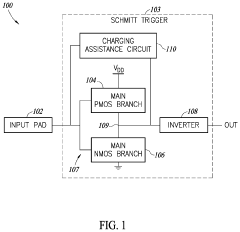
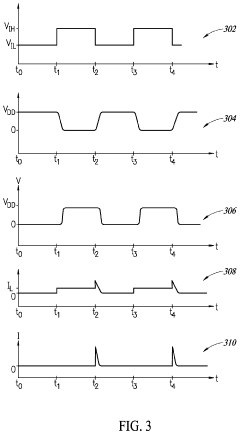
- Incorporating a charging assistance circuit that provides supplemental charging currents during transitions, contributing no static current consumption between transitions, thus enabling fast operation with minimal additional area consumption.
Noise Immunity Performance Metrics
Noise immunity performance metrics provide essential quantitative measures for evaluating how effectively Schmitt trigger circuits maintain data integrity in noisy environments. The primary metric is the hysteresis voltage (VH), defined as the difference between the upper threshold voltage (VT+) and lower threshold voltage (VT-). A larger hysteresis window directly correlates with improved noise immunity, as it prevents signal oscillation when input signals contain noise components near the switching threshold.
Signal-to-Noise Ratio (SNR) improvement serves as another critical performance indicator, measuring the circuit's ability to enhance the ratio of desired signal to unwanted noise. Schmitt triggers typically demonstrate SNR improvements of 10-20dB compared to conventional threshold detectors, with advanced implementations achieving up to 30dB improvement in particularly challenging environments.
Noise Margin (NM) metrics quantify the maximum amplitude of noise that can be superimposed on a signal without causing erroneous switching. For digital applications, High-state Noise Margin (NMH) and Low-state Noise Margin (NML) are separately evaluated, with ideal Schmitt trigger implementations maintaining noise margins of at least 40% of the supply voltage.
Propagation delay characteristics under noisy conditions represent another essential performance dimension. Standard Schmitt triggers exhibit propagation delays between 5-20ns, with this delay remaining relatively constant even with noise amplitudes up to 30% of the signal level, demonstrating their temporal stability in noisy environments.
Common Mode Rejection Ratio (CMRR) measures the circuit's ability to reject noise that appears simultaneously on both input terminals. High-performance Schmitt trigger implementations achieve CMRR values exceeding 80dB, significantly outperforming conventional comparators which typically offer 60-70dB rejection.
Temperature stability of noise immunity parameters must also be considered, as threshold voltages can drift with temperature variations. Premium Schmitt trigger designs maintain threshold stability within ±5% across industrial temperature ranges (-40°C to +85°C), with military-grade components achieving ±2% stability across extended ranges (-55°C to +125°C).
Power supply rejection performance quantifies how well the circuit maintains consistent noise immunity despite fluctuations in supply voltage. Modern Schmitt trigger implementations typically achieve power supply rejection ratios (PSRR) of 65-75dB, ensuring reliable operation even in systems with unstable power sources.
Signal-to-Noise Ratio (SNR) improvement serves as another critical performance indicator, measuring the circuit's ability to enhance the ratio of desired signal to unwanted noise. Schmitt triggers typically demonstrate SNR improvements of 10-20dB compared to conventional threshold detectors, with advanced implementations achieving up to 30dB improvement in particularly challenging environments.
Noise Margin (NM) metrics quantify the maximum amplitude of noise that can be superimposed on a signal without causing erroneous switching. For digital applications, High-state Noise Margin (NMH) and Low-state Noise Margin (NML) are separately evaluated, with ideal Schmitt trigger implementations maintaining noise margins of at least 40% of the supply voltage.
Propagation delay characteristics under noisy conditions represent another essential performance dimension. Standard Schmitt triggers exhibit propagation delays between 5-20ns, with this delay remaining relatively constant even with noise amplitudes up to 30% of the signal level, demonstrating their temporal stability in noisy environments.
Common Mode Rejection Ratio (CMRR) measures the circuit's ability to reject noise that appears simultaneously on both input terminals. High-performance Schmitt trigger implementations achieve CMRR values exceeding 80dB, significantly outperforming conventional comparators which typically offer 60-70dB rejection.
Temperature stability of noise immunity parameters must also be considered, as threshold voltages can drift with temperature variations. Premium Schmitt trigger designs maintain threshold stability within ±5% across industrial temperature ranges (-40°C to +85°C), with military-grade components achieving ±2% stability across extended ranges (-55°C to +125°C).
Power supply rejection performance quantifies how well the circuit maintains consistent noise immunity despite fluctuations in supply voltage. Modern Schmitt trigger implementations typically achieve power supply rejection ratios (PSRR) of 65-75dB, ensuring reliable operation even in systems with unstable power sources.
Integration with Modern Digital Systems
The integration of Schmitt trigger circuits into modern digital systems represents a critical advancement in ensuring data integrity across increasingly complex electronic environments. As digital systems continue to evolve with higher processing speeds and lower operating voltages, the vulnerability to noise-induced errors has become more pronounced. Schmitt triggers provide an elegant solution by implementing hysteresis-based threshold detection that effectively filters out noise and prevents false triggering in signal transitions.
Contemporary digital system architectures, including IoT devices, high-speed communication interfaces, and advanced microcontrollers, have begun incorporating Schmitt trigger elements at critical signal paths. This integration occurs at multiple levels - from on-chip implementations within integrated circuits to discrete components in signal conditioning stages. The implementation varies based on specific requirements, with CMOS-based Schmitt triggers dominating low-power applications while BJT variants remain relevant in high-performance scenarios.
System-on-Chip (SoC) designs have particularly benefited from embedded Schmitt trigger circuits at I/O interfaces, where they serve as robust buffers between external signals and sensitive internal logic. Modern FPGA platforms also leverage programmable Schmitt trigger thresholds within their I/O blocks, allowing designers to optimize noise immunity characteristics for specific application environments without additional external components.
The emergence of mixed-signal systems has further expanded Schmitt trigger applications, particularly at the analog-to-digital conversion boundaries. Here, they serve as pre-conditioning elements that clean up analog signals before digitization, significantly improving conversion accuracy and reliability in noisy industrial environments. This capability has proven especially valuable in automotive electronics and industrial automation systems where electromagnetic interference is prevalent.
Power management systems represent another critical integration point, with Schmitt triggers enabling precise voltage level detection for power sequencing, brownout protection, and battery monitoring functions. Their inherent stability across temperature variations makes them ideal for these applications, ensuring consistent operation across diverse environmental conditions.
Looking forward, the miniaturization trend in digital systems presents both challenges and opportunities for Schmitt trigger integration. While reduced silicon area constraints demand more efficient implementations, advanced semiconductor processes are enabling new variants with programmable hysteresis levels and ultra-low power consumption. These developments align perfectly with the requirements of emerging edge computing and wearable technology platforms, where power efficiency and signal integrity must coexist.
Contemporary digital system architectures, including IoT devices, high-speed communication interfaces, and advanced microcontrollers, have begun incorporating Schmitt trigger elements at critical signal paths. This integration occurs at multiple levels - from on-chip implementations within integrated circuits to discrete components in signal conditioning stages. The implementation varies based on specific requirements, with CMOS-based Schmitt triggers dominating low-power applications while BJT variants remain relevant in high-performance scenarios.
System-on-Chip (SoC) designs have particularly benefited from embedded Schmitt trigger circuits at I/O interfaces, where they serve as robust buffers between external signals and sensitive internal logic. Modern FPGA platforms also leverage programmable Schmitt trigger thresholds within their I/O blocks, allowing designers to optimize noise immunity characteristics for specific application environments without additional external components.
The emergence of mixed-signal systems has further expanded Schmitt trigger applications, particularly at the analog-to-digital conversion boundaries. Here, they serve as pre-conditioning elements that clean up analog signals before digitization, significantly improving conversion accuracy and reliability in noisy industrial environments. This capability has proven especially valuable in automotive electronics and industrial automation systems where electromagnetic interference is prevalent.
Power management systems represent another critical integration point, with Schmitt triggers enabling precise voltage level detection for power sequencing, brownout protection, and battery monitoring functions. Their inherent stability across temperature variations makes them ideal for these applications, ensuring consistent operation across diverse environmental conditions.
Looking forward, the miniaturization trend in digital systems presents both challenges and opportunities for Schmitt trigger integration. While reduced silicon area constraints demand more efficient implementations, advanced semiconductor processes are enabling new variants with programmable hysteresis levels and ultra-low power consumption. These developments align perfectly with the requirements of emerging edge computing and wearable technology platforms, where power efficiency and signal integrity must coexist.
Unlock deeper insights with PatSnap Eureka Quick Research — get a full tech report to explore trends and direct your research. Try now!
Generate Your Research Report Instantly with AI Agent
Supercharge your innovation with PatSnap Eureka AI Agent Platform!