

How Schmitt Trigger Elevates Noise Margin in Logic Circuits
SEP 23, 20259 MIN READ
Generate Your Research Report Instantly with AI Agent
PatSnap Eureka helps you evaluate technical feasibility & market potential.
Schmitt Trigger Evolution and Design Objectives
The Schmitt trigger, first introduced by Otto Schmitt in 1934, represents a significant milestone in electronic circuit design. Originally conceived as a means to study nerve propagation, this ingenious circuit has evolved into a fundamental component in modern digital systems. The evolution of Schmitt triggers has been closely aligned with the advancement of semiconductor technology, transitioning from vacuum tubes to discrete transistors, and eventually to integrated circuits.
In the 1950s and 1960s, with the emergence of solid-state electronics, Schmitt triggers gained prominence in industrial applications. The introduction of the first integrated circuit Schmitt triggers in the late 1960s, notably the 7414 TTL hex inverter, marked a turning point in their widespread adoption. By the 1970s, CMOS implementations further enhanced their utility by offering lower power consumption and improved noise immunity.
The primary design objective of Schmitt triggers has consistently been to enhance signal integrity in noisy environments. Unlike conventional logic gates that operate with a single threshold voltage, Schmitt triggers employ dual thresholds—creating hysteresis that effectively combats signal noise. This characteristic makes them particularly valuable in applications where input signals may contain unwanted fluctuations or slow transition rates.
Modern Schmitt trigger designs aim to optimize several key parameters: minimizing power consumption, reducing propagation delay, enhancing noise margin, and ensuring compatibility with various logic families. The trade-off between these parameters represents a significant engineering challenge that continues to drive innovation in this field.
Recent technological trends have pushed Schmitt trigger development toward lower operating voltages to accommodate battery-powered and energy-efficient devices. Additionally, there is growing interest in implementing Schmitt triggers in emerging technologies such as flexible electronics and organic semiconductors, where signal integrity under mechanical stress becomes a critical consideration.
The evolution of Schmitt triggers also reflects broader industry shifts toward miniaturization and system integration. Contemporary designs often incorporate programmable hysteresis thresholds, allowing dynamic adjustment based on operating conditions. This adaptability has expanded their application scope beyond traditional signal conditioning to include sensor interfaces, power management, and communication systems.
As digital systems continue to operate at higher frequencies and lower voltages, the role of Schmitt triggers in maintaining signal integrity becomes increasingly vital. Future development trajectories point toward enhanced integration with mixed-signal systems and adaptation to extreme operating environments, ensuring this seemingly simple circuit remains an essential component in advanced electronic designs.
In the 1950s and 1960s, with the emergence of solid-state electronics, Schmitt triggers gained prominence in industrial applications. The introduction of the first integrated circuit Schmitt triggers in the late 1960s, notably the 7414 TTL hex inverter, marked a turning point in their widespread adoption. By the 1970s, CMOS implementations further enhanced their utility by offering lower power consumption and improved noise immunity.
The primary design objective of Schmitt triggers has consistently been to enhance signal integrity in noisy environments. Unlike conventional logic gates that operate with a single threshold voltage, Schmitt triggers employ dual thresholds—creating hysteresis that effectively combats signal noise. This characteristic makes them particularly valuable in applications where input signals may contain unwanted fluctuations or slow transition rates.
Modern Schmitt trigger designs aim to optimize several key parameters: minimizing power consumption, reducing propagation delay, enhancing noise margin, and ensuring compatibility with various logic families. The trade-off between these parameters represents a significant engineering challenge that continues to drive innovation in this field.
Recent technological trends have pushed Schmitt trigger development toward lower operating voltages to accommodate battery-powered and energy-efficient devices. Additionally, there is growing interest in implementing Schmitt triggers in emerging technologies such as flexible electronics and organic semiconductors, where signal integrity under mechanical stress becomes a critical consideration.
The evolution of Schmitt triggers also reflects broader industry shifts toward miniaturization and system integration. Contemporary designs often incorporate programmable hysteresis thresholds, allowing dynamic adjustment based on operating conditions. This adaptability has expanded their application scope beyond traditional signal conditioning to include sensor interfaces, power management, and communication systems.
As digital systems continue to operate at higher frequencies and lower voltages, the role of Schmitt triggers in maintaining signal integrity becomes increasingly vital. Future development trajectories point toward enhanced integration with mixed-signal systems and adaptation to extreme operating environments, ensuring this seemingly simple circuit remains an essential component in advanced electronic designs.
Market Applications for Enhanced Noise Immunity Circuits
The Schmitt trigger technology with enhanced noise immunity finds extensive applications across multiple market sectors where signal integrity is paramount. In industrial automation and control systems, these circuits are deployed in environments with high electromagnetic interference (EMI) and radio frequency interference (RFI), ensuring reliable operation of programmable logic controllers (PLCs), distributed control systems, and factory automation equipment. The global industrial automation market, which heavily relies on noise-immune circuits, continues to expand as manufacturing facilities worldwide embrace Industry 4.0 principles.
Automotive electronics represent another significant application domain, with modern vehicles containing up to 150 electronic control units (ECUs) that must function reliably despite electrical noise from ignition systems, alternators, and other components. Schmitt trigger-based circuits are essential in safety-critical systems like anti-lock braking systems (ABS), electronic stability control, and advanced driver assistance systems (ADAS), where signal misinterpretation could have catastrophic consequences.
Medical equipment constitutes a critical application area where enhanced noise immunity is non-negotiable. Diagnostic devices such as electrocardiograms (ECGs), electroencephalograms (EEGs), and patient monitoring systems must accurately detect and process minute biological signals amid substantial ambient electrical noise. The precision offered by Schmitt trigger technology helps maintain diagnostic accuracy and patient safety in these sensitive applications.
In telecommunications infrastructure, noise-immune circuits are fundamental components in network switches, routers, and base stations. These environments often feature multiple high-frequency signals in close proximity, creating significant potential for interference. Schmitt trigger-based solutions help maintain signal integrity across these complex systems, supporting the reliability demands of modern communication networks.
Aerospace and defense applications leverage enhanced noise immunity circuits in radar systems, avionics, and satellite communications equipment. These applications operate in extreme environments and must maintain functionality despite cosmic radiation, temperature fluctuations, and electromagnetic interference from various sources. The robust noise rejection capabilities of Schmitt trigger technology make it particularly valuable in these mission-critical contexts.
Consumer electronics represent a volume-driven market for noise-immune circuits, with applications in smartphones, tablets, laptops, and smart home devices. As these products become increasingly compact with components in closer proximity, the risk of internal signal interference grows, making noise immunity technologies essential for maintaining product reliability and performance in everyday consumer devices.
Automotive electronics represent another significant application domain, with modern vehicles containing up to 150 electronic control units (ECUs) that must function reliably despite electrical noise from ignition systems, alternators, and other components. Schmitt trigger-based circuits are essential in safety-critical systems like anti-lock braking systems (ABS), electronic stability control, and advanced driver assistance systems (ADAS), where signal misinterpretation could have catastrophic consequences.
Medical equipment constitutes a critical application area where enhanced noise immunity is non-negotiable. Diagnostic devices such as electrocardiograms (ECGs), electroencephalograms (EEGs), and patient monitoring systems must accurately detect and process minute biological signals amid substantial ambient electrical noise. The precision offered by Schmitt trigger technology helps maintain diagnostic accuracy and patient safety in these sensitive applications.
In telecommunications infrastructure, noise-immune circuits are fundamental components in network switches, routers, and base stations. These environments often feature multiple high-frequency signals in close proximity, creating significant potential for interference. Schmitt trigger-based solutions help maintain signal integrity across these complex systems, supporting the reliability demands of modern communication networks.
Aerospace and defense applications leverage enhanced noise immunity circuits in radar systems, avionics, and satellite communications equipment. These applications operate in extreme environments and must maintain functionality despite cosmic radiation, temperature fluctuations, and electromagnetic interference from various sources. The robust noise rejection capabilities of Schmitt trigger technology make it particularly valuable in these mission-critical contexts.
Consumer electronics represent a volume-driven market for noise-immune circuits, with applications in smartphones, tablets, laptops, and smart home devices. As these products become increasingly compact with components in closer proximity, the risk of internal signal interference grows, making noise immunity technologies essential for maintaining product reliability and performance in everyday consumer devices.
Current Noise Margin Challenges in Digital Systems
Digital systems face increasingly complex noise margin challenges as technology advances toward higher speeds, lower power consumption, and miniaturization. Noise margin, the buffer zone that ensures reliable signal interpretation despite electrical noise, has become a critical design consideration in modern logic circuits. Traditional CMOS and TTL technologies struggle to maintain adequate noise immunity in environments with significant signal degradation.
Signal integrity issues manifest primarily through voltage fluctuations that can cause false triggering in logic circuits. These fluctuations originate from various sources including electromagnetic interference (EMI), power supply variations, ground bounce, crosstalk between adjacent signal lines, and thermal noise. As circuit densities increase and operating voltages decrease, the relative impact of these noise sources becomes more pronounced, shrinking the effective noise margin.
The miniaturization trend in semiconductor technology has led to reduced supply voltages, with many modern systems operating at 1.8V, 1.2V, or even lower. This reduction directly impacts noise margins, as the difference between logic high and logic low states becomes narrower. Consequently, even small noise perturbations can potentially cause logic interpretation errors, leading to system malfunctions or data corruption.
High-speed operation compounds these challenges by introducing transmission line effects, signal reflections, and increased susceptibility to transient noise. As clock frequencies push into the gigahertz range, signal rise and fall times become critical parameters affecting noise immunity. The reduced time window for stable signal evaluation makes circuits more vulnerable to momentary noise spikes.
IoT devices and mobile applications introduce additional constraints related to power efficiency, requiring circuits to operate reliably across wide voltage ranges and in varying environmental conditions. These applications often experience significant power supply variations as batteries discharge, creating scenarios where noise margins become dangerously thin during low-power states.
Traditional approaches to noise management, such as filtering and signal conditioning, add complexity, increase power consumption, and introduce propagation delays. Simple voltage threshold-based logic becomes increasingly unreliable as noise levels approach the diminishing noise margins of modern low-voltage systems.
The industry faces a fundamental challenge: maintaining robust noise immunity while simultaneously pursuing higher speeds, lower power consumption, and smaller form factors. This tension creates a significant design constraint that limits the advancement of digital systems in critical applications where reliability cannot be compromised, such as automotive safety systems, medical devices, and industrial controls.
Signal integrity issues manifest primarily through voltage fluctuations that can cause false triggering in logic circuits. These fluctuations originate from various sources including electromagnetic interference (EMI), power supply variations, ground bounce, crosstalk between adjacent signal lines, and thermal noise. As circuit densities increase and operating voltages decrease, the relative impact of these noise sources becomes more pronounced, shrinking the effective noise margin.
The miniaturization trend in semiconductor technology has led to reduced supply voltages, with many modern systems operating at 1.8V, 1.2V, or even lower. This reduction directly impacts noise margins, as the difference between logic high and logic low states becomes narrower. Consequently, even small noise perturbations can potentially cause logic interpretation errors, leading to system malfunctions or data corruption.
High-speed operation compounds these challenges by introducing transmission line effects, signal reflections, and increased susceptibility to transient noise. As clock frequencies push into the gigahertz range, signal rise and fall times become critical parameters affecting noise immunity. The reduced time window for stable signal evaluation makes circuits more vulnerable to momentary noise spikes.
IoT devices and mobile applications introduce additional constraints related to power efficiency, requiring circuits to operate reliably across wide voltage ranges and in varying environmental conditions. These applications often experience significant power supply variations as batteries discharge, creating scenarios where noise margins become dangerously thin during low-power states.
Traditional approaches to noise management, such as filtering and signal conditioning, add complexity, increase power consumption, and introduce propagation delays. Simple voltage threshold-based logic becomes increasingly unreliable as noise levels approach the diminishing noise margins of modern low-voltage systems.
The industry faces a fundamental challenge: maintaining robust noise immunity while simultaneously pursuing higher speeds, lower power consumption, and smaller form factors. This tension creates a significant design constraint that limits the advancement of digital systems in critical applications where reliability cannot be compromised, such as automotive safety systems, medical devices, and industrial controls.
Implementation Techniques for Schmitt Trigger Circuits
01 Noise margin enhancement in Schmitt trigger circuits
Schmitt trigger circuits can be designed with enhanced noise margins by optimizing the hysteresis characteristics. This involves carefully selecting resistor values and transistor parameters to create appropriate threshold voltage differences between the high and low switching points. The increased separation between these thresholds provides improved immunity to noise, preventing false triggering in noisy environments. These enhancements are particularly important in industrial and automotive applications where signal integrity can be compromised.- Noise margin enhancement in Schmitt trigger circuits: Schmitt trigger circuits can be designed with enhanced noise margins by optimizing the hysteresis characteristics. This involves carefully selecting resistor values and transistor parameters to create appropriate threshold voltage differences between the high-to-low and low-to-high switching points. The increased separation between these thresholds improves immunity to noise and prevents false triggering in noisy environments, making the circuit more reliable for signal conditioning applications.
- Hysteresis control techniques for improved noise immunity: Various techniques can be implemented to control the hysteresis width in Schmitt trigger circuits, directly affecting the noise margin. These include using feedback resistors, current mirrors, or voltage references to establish precise switching thresholds. Adjustable hysteresis allows designers to tailor the noise immunity characteristics to specific application requirements, balancing between noise rejection capability and response time to legitimate signal transitions.
- Low-power Schmitt trigger designs with optimized noise margins: Special design considerations are required to maintain adequate noise margins while reducing power consumption in Schmitt trigger circuits. This includes techniques such as adaptive biasing, dynamic threshold adjustment, and specialized transistor configurations that preserve hysteresis characteristics while minimizing current draw. These approaches are particularly important for battery-powered applications where both noise immunity and energy efficiency are critical requirements.
- Temperature and process variation compensation for stable noise margins: Schmitt trigger circuits can be designed with compensation techniques to maintain consistent noise margins across temperature variations and manufacturing process differences. These include bandgap references, proportional-to-absolute-temperature (PTAT) current sources, and self-adjusting threshold circuits. Such compensation ensures that the noise immunity characteristics remain stable under varying operating conditions, maintaining reliable operation in industrial and automotive environments.
- Integration of Schmitt triggers in complex systems with noise considerations: When integrating Schmitt trigger circuits into larger systems, special attention must be paid to system-level noise sources and their impact on trigger performance. This includes considerations for power supply noise rejection, ground bounce immunity, and interface with analog and digital subsystems. Proper integration techniques include strategic placement, shielding, filtering, and appropriate selection of noise margin parameters to ensure reliable operation within the complete system environment.
02 Hysteresis control techniques for optimizing noise margin
Various techniques can be implemented to control the hysteresis characteristics of Schmitt triggers, directly affecting the noise margin. These include adjustable threshold circuits, feedback resistor networks, and voltage reference generators. By providing precise control over the switching thresholds, these techniques allow designers to tailor the noise margin to specific application requirements. The ability to adjust hysteresis helps balance the trade-off between noise immunity and response time in different operating environments.Expand Specific Solutions03 Low-power Schmitt trigger designs with improved noise margins
Specialized Schmitt trigger designs focus on maintaining robust noise margins while reducing power consumption. These implementations often use modified feedback structures, complementary transistor arrangements, or adaptive biasing techniques. By optimizing the circuit topology and carefully sizing components, these designs achieve the desired noise immunity characteristics while minimizing static and dynamic power dissipation. These approaches are particularly valuable in battery-powered and energy-efficient applications where both noise immunity and power conservation are critical.Expand Specific Solutions04 Temperature and process variation compensation for stable noise margins
Advanced Schmitt trigger designs incorporate compensation techniques to maintain consistent noise margins across temperature variations and manufacturing process differences. These include bandgap reference circuits, self-adjusting threshold mechanisms, and proportional-to-absolute-temperature current sources. By implementing these compensation methods, the hysteresis window and resulting noise margin remain stable despite environmental and fabrication variations. This stability ensures reliable operation in extreme conditions and improves manufacturing yield by reducing sensitivity to process variations.Expand Specific Solutions05 Integration of Schmitt triggers in complex systems with noise margin considerations
When integrating Schmitt triggers into larger systems such as communication interfaces, sensor networks, or mixed-signal circuits, special considerations are needed to maintain adequate noise margins. These include buffer stages, level shifters, and isolation techniques to prevent noise coupling. System-level design approaches consider the interaction between the Schmitt trigger and surrounding circuitry to ensure that noise margins are preserved throughout the signal path. Proper integration techniques help maintain signal integrity in complex environments with multiple noise sources.Expand Specific Solutions
Leading Manufacturers and IC Designers in Schmitt Trigger Technology
The Schmitt Trigger market demonstrates moderate maturity within the logic circuit technology landscape, currently experiencing steady growth driven by increasing demand for noise-resistant digital systems. The global market size is estimated at approximately $1.2 billion, with projected annual growth of 5-7% through 2025 as applications expand in automotive electronics, industrial automation, and consumer devices. Leading players include Texas Instruments, NXP Semiconductors, and STMicroelectronics, who have established strong intellectual property portfolios and manufacturing capabilities. Emerging competitors like Renesas Electronics and MediaTek are gaining market share through specialized applications. The technology continues to evolve with miniaturization trends and integration into complex SoC designs, with recent innovations focusing on reduced power consumption and higher operating frequencies.
STMicroelectronics International NV
Technical Solution: STMicroelectronics has pioneered advanced Schmitt trigger implementations across their semiconductor portfolio, particularly in their STM32 microcontroller series. Their proprietary "dual-threshold" Schmitt trigger design incorporates adaptive hysteresis that automatically adjusts based on input signal characteristics and noise environment. ST's implementation features programmable hysteresis levels in certain product lines, allowing designers to optimize the noise margin versus speed tradeoff for specific applications. Their M74HC14 hex inverting Schmitt trigger IC demonstrates their expertise with guaranteed hysteresis of typically 0.9V at 5V operation, providing robust noise immunity. ST has also developed specialized low-power Schmitt trigger variants that maintain noise rejection capabilities while reducing power consumption by up to 40% compared to standard implementations.
Strengths: Programmable hysteresis levels in certain product lines; excellent noise immunity across wide voltage ranges; integration with advanced power management features. Weaknesses: Slightly higher cost than basic logic gates; increased silicon area requirements for the adaptive hysteresis circuitry.
Samsung Electronics Co., Ltd.
Technical Solution: Samsung has developed proprietary Schmitt trigger implementations for their semiconductor products, particularly focusing on mobile and consumer electronics applications where power efficiency and noise immunity must be balanced. Their approach incorporates adaptive threshold technology that dynamically adjusts hysteresis based on operating conditions, optimizing performance across varying noise environments. Samsung's implementation in their mobile application processors features ultra-low power Schmitt trigger input buffers that consume up to 35% less power than conventional designs while maintaining effective noise rejection. For their memory products, Samsung has developed specialized Schmitt trigger circuits that operate reliably at high frequencies (>1GHz) while providing sufficient noise margin to prevent false triggering. Their implementation includes temperature and process compensation techniques that ensure consistent hysteresis characteristics across manufacturing variations.
Strengths: Ultra-low power consumption suitable for battery-powered devices; adaptive hysteresis technology that optimizes performance across operating conditions; high-frequency operation capability. Weaknesses: Somewhat narrower hysteresis range compared to industrial-focused implementations; optimization for power efficiency sometimes comes at the cost of maximum noise immunity.
Core Innovations in Hysteresis Threshold Design
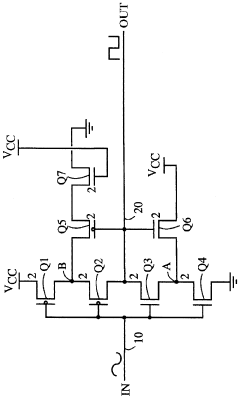
Low-swing schmitt triggers
PatentActiveUS20220200586A1
Innovation
- The implementation of a low-swing Schmitt trigger circuit with additional parallel paths for current sourcing and sinking, utilizing transistors and voltage sensors to enhance state transitions even when input voltages are near threshold levels, thereby reducing delay and increasing switching speed.
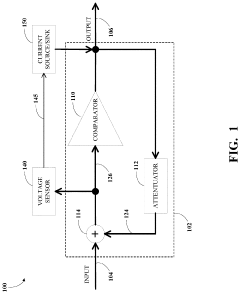
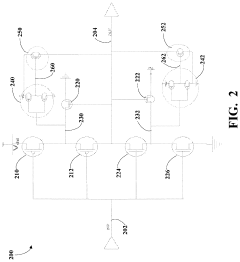
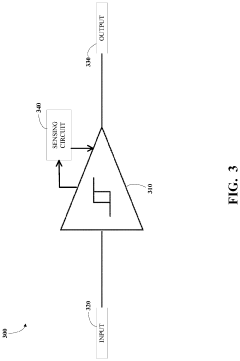
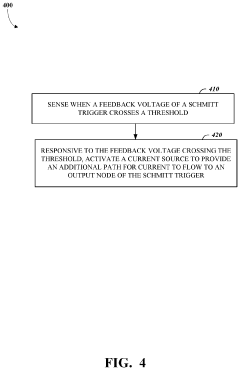
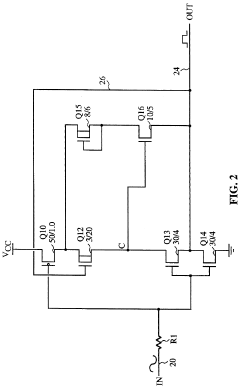
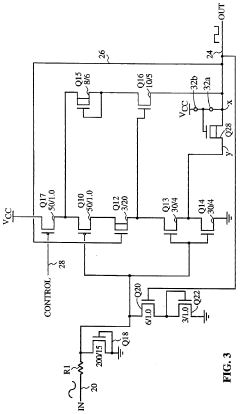
High speed and low noise margin schmitt trigger with controllable trip point
PatentInactiveUS5489866A
Innovation
- A Schmitt trigger design incorporating a buffer with pull-up and pull-down devices, an N-channel depletion mode transistor for feedback, and control transistors for timing, along with electrostatic discharge protection and optional voltage control, to achieve a noise margin of 0.5 volts and improved response speed.
Power Efficiency Considerations in Schmitt Trigger Applications
Power efficiency has become a critical consideration in modern electronic design, particularly in Schmitt trigger applications where the balance between reliable operation and energy consumption must be carefully managed. The hysteresis characteristic that makes Schmitt triggers excellent for noise immunity also introduces specific power consumption patterns that designers must address. When a Schmitt trigger operates near its threshold region, it can experience multiple transitions due to noise, potentially increasing dynamic power consumption through unnecessary switching activities.
In battery-powered and portable devices, the power efficiency of Schmitt triggers becomes especially significant. The additional transistors required to implement hysteresis in CMOS Schmitt trigger designs inherently consume more static power compared to conventional logic gates. This trade-off between noise immunity and power consumption necessitates careful circuit optimization, particularly in low-power applications such as IoT sensors and wearable devices.
Advanced design techniques have emerged to address these power concerns. Adaptive hysteresis mechanisms allow for dynamic adjustment of threshold levels based on operating conditions, optimizing power consumption without compromising noise immunity. When noise levels are low, the hysteresis window can be narrowed to reduce power consumption, while expanding during noisy conditions to maintain signal integrity.
Supply voltage scaling represents another approach to improving power efficiency in Schmitt trigger circuits. By designing Schmitt triggers that maintain reliable operation at lower supply voltages, significant power savings can be achieved since power consumption in CMOS circuits is proportional to the square of the supply voltage. However, this approach requires careful consideration of threshold voltage levels to maintain adequate noise margins.
Process technology selection also impacts power efficiency substantially. Implementation of Schmitt triggers in advanced process nodes with lower leakage currents can significantly reduce static power consumption. Additionally, techniques such as power gating can be employed to completely shut down Schmitt trigger circuits when not in use, particularly beneficial in systems with intermittent operation requirements.
The application context ultimately determines the optimal power-performance balance. In high-speed data communication interfaces, Schmitt triggers may prioritize switching performance over power efficiency, while in energy-harvesting systems, ultra-low power consumption becomes paramount even at the expense of reduced operating frequency. This context-dependent optimization highlights the importance of application-specific Schmitt trigger designs rather than one-size-fits-all approaches.
In battery-powered and portable devices, the power efficiency of Schmitt triggers becomes especially significant. The additional transistors required to implement hysteresis in CMOS Schmitt trigger designs inherently consume more static power compared to conventional logic gates. This trade-off between noise immunity and power consumption necessitates careful circuit optimization, particularly in low-power applications such as IoT sensors and wearable devices.
Advanced design techniques have emerged to address these power concerns. Adaptive hysteresis mechanisms allow for dynamic adjustment of threshold levels based on operating conditions, optimizing power consumption without compromising noise immunity. When noise levels are low, the hysteresis window can be narrowed to reduce power consumption, while expanding during noisy conditions to maintain signal integrity.
Supply voltage scaling represents another approach to improving power efficiency in Schmitt trigger circuits. By designing Schmitt triggers that maintain reliable operation at lower supply voltages, significant power savings can be achieved since power consumption in CMOS circuits is proportional to the square of the supply voltage. However, this approach requires careful consideration of threshold voltage levels to maintain adequate noise margins.
Process technology selection also impacts power efficiency substantially. Implementation of Schmitt triggers in advanced process nodes with lower leakage currents can significantly reduce static power consumption. Additionally, techniques such as power gating can be employed to completely shut down Schmitt trigger circuits when not in use, particularly beneficial in systems with intermittent operation requirements.
The application context ultimately determines the optimal power-performance balance. In high-speed data communication interfaces, Schmitt triggers may prioritize switching performance over power efficiency, while in energy-harvesting systems, ultra-low power consumption becomes paramount even at the expense of reduced operating frequency. This context-dependent optimization highlights the importance of application-specific Schmitt trigger designs rather than one-size-fits-all approaches.
Integration Strategies for Mixed-Signal Systems
The integration of Schmitt triggers into mixed-signal systems requires careful consideration of interface requirements between analog and digital domains. When implementing these noise-resistant components, designers must address the fundamental challenge of maintaining signal integrity across different voltage domains and noise environments. Schmitt triggers serve as robust interface elements that can effectively bridge these domains by providing enhanced noise immunity through hysteresis.
A primary integration strategy involves placing Schmitt triggers at critical boundary points between analog sensing circuits and digital processing elements. This placement creates a clean transition zone where noisy analog signals can be conditioned before entering the digital domain. The implementation typically requires careful selection of threshold voltages that align with the specific noise profiles of the surrounding system components.
Power management considerations are equally important when integrating Schmitt triggers. The additional current draw from these components must be factored into the overall power budget, particularly in battery-operated or energy-efficient designs. Modern integration approaches often incorporate power-gating techniques that activate Schmitt trigger circuits only when signal transitions are expected, thereby reducing static power consumption.
Layout strategies for mixed-signal integration must address potential cross-coupling issues. Schmitt triggers should be positioned to minimize parasitic effects that could compromise their noise margin advantages. This often involves creating guard rings, maintaining separation between sensitive analog traces and digital switching nodes, and implementing proper grounding schemes that prevent ground bounce from affecting threshold stability.
Timing considerations represent another critical aspect of integration. The inherent delay introduced by Schmitt triggers—a consequence of their hysteresis behavior—must be accounted for in the overall system timing budget. In high-speed applications, designers may need to implement compensation techniques or select specialized high-speed Schmitt trigger variants that minimize propagation delays while maintaining noise immunity benefits.
Scalability across different process technologies presents additional integration challenges. As systems migrate to smaller process nodes, the implementation of Schmitt triggers must adapt to reduced voltage headroom while maintaining effective hysteresis windows. This often requires innovative circuit topologies that can operate reliably at lower supply voltages while still providing meaningful noise margin improvements.
A primary integration strategy involves placing Schmitt triggers at critical boundary points between analog sensing circuits and digital processing elements. This placement creates a clean transition zone where noisy analog signals can be conditioned before entering the digital domain. The implementation typically requires careful selection of threshold voltages that align with the specific noise profiles of the surrounding system components.
Power management considerations are equally important when integrating Schmitt triggers. The additional current draw from these components must be factored into the overall power budget, particularly in battery-operated or energy-efficient designs. Modern integration approaches often incorporate power-gating techniques that activate Schmitt trigger circuits only when signal transitions are expected, thereby reducing static power consumption.
Layout strategies for mixed-signal integration must address potential cross-coupling issues. Schmitt triggers should be positioned to minimize parasitic effects that could compromise their noise margin advantages. This often involves creating guard rings, maintaining separation between sensitive analog traces and digital switching nodes, and implementing proper grounding schemes that prevent ground bounce from affecting threshold stability.
Timing considerations represent another critical aspect of integration. The inherent delay introduced by Schmitt triggers—a consequence of their hysteresis behavior—must be accounted for in the overall system timing budget. In high-speed applications, designers may need to implement compensation techniques or select specialized high-speed Schmitt trigger variants that minimize propagation delays while maintaining noise immunity benefits.
Scalability across different process technologies presents additional integration challenges. As systems migrate to smaller process nodes, the implementation of Schmitt triggers must adapt to reduced voltage headroom while maintaining effective hysteresis windows. This often requires innovative circuit topologies that can operate reliably at lower supply voltages while still providing meaningful noise margin improvements.
Unlock deeper insights with PatSnap Eureka Quick Research — get a full tech report to explore trends and direct your research. Try now!
Generate Your Research Report Instantly with AI Agent
Supercharge your innovation with PatSnap Eureka AI Agent Platform!