

Schmitt Trigger in Data Communication: Noise Reduction Focus
SEP 23, 20259 MIN READ
Generate Your Research Report Instantly with AI Agent
PatSnap Eureka helps you evaluate technical feasibility & market potential.
Schmitt Trigger Evolution and Objectives
The Schmitt trigger, first introduced by Otto Schmitt in 1934, represents a significant milestone in electronic circuit design. Originally conceived as a thermionic valve circuit, this innovation was designed to replicate the neural impulse propagation observed in squid nerves. The evolution of this technology has been remarkable, transitioning from vacuum tubes to discrete transistors, and eventually to integrated circuits, making it a fundamental component in modern electronic systems.
Throughout the 1950s and 1960s, the Schmitt trigger underwent substantial refinement with the advent of semiconductor technology. The introduction of transistor-based implementations marked a pivotal shift, significantly reducing power consumption and physical footprint while enhancing reliability. By the 1970s, the integration of Schmitt triggers into standard logic families such as TTL (Transistor-Transistor Logic) and CMOS (Complementary Metal-Oxide-Semiconductor) further solidified its position in electronic design.
In data communication systems, the Schmitt trigger's evolution has been closely aligned with the increasing demand for reliable signal processing in noisy environments. As data transmission rates escalated from kilobits to gigabits per second, the need for robust noise immunity became paramount. This necessity drove the development of advanced Schmitt trigger variants with optimized hysteresis characteristics, faster switching speeds, and lower power requirements.
The primary objective of incorporating Schmitt triggers in data communication circuits is to enhance signal integrity by effectively discriminating between valid signals and noise. By implementing hysteresis—a key characteristic where the switching threshold depends on the input's history—Schmitt triggers prevent rapid oscillations (known as "chattering") when processing signals near the threshold level. This capability is particularly crucial in environments with significant electromagnetic interference or when dealing with slowly changing signals.
Recent technological advancements have expanded the application scope of Schmitt triggers in data communication. Modern implementations aim to address challenges such as reduced supply voltages in low-power systems, increased switching speeds for high-frequency applications, and enhanced noise immunity for industrial environments. Additionally, there is a growing focus on developing programmable hysteresis capabilities, allowing dynamic adjustment based on specific operational conditions.
Looking forward, the evolution of Schmitt triggers is expected to continue with emphasis on integration with advanced digital signal processing techniques, adaptation to emerging semiconductor technologies like GaN (Gallium Nitride) and SiC (Silicon Carbide), and optimization for ultra-low power applications in IoT (Internet of Things) devices. The overarching goal remains consistent: to provide reliable signal conditioning that ensures data integrity across increasingly complex and noisy communication channels.
Throughout the 1950s and 1960s, the Schmitt trigger underwent substantial refinement with the advent of semiconductor technology. The introduction of transistor-based implementations marked a pivotal shift, significantly reducing power consumption and physical footprint while enhancing reliability. By the 1970s, the integration of Schmitt triggers into standard logic families such as TTL (Transistor-Transistor Logic) and CMOS (Complementary Metal-Oxide-Semiconductor) further solidified its position in electronic design.
In data communication systems, the Schmitt trigger's evolution has been closely aligned with the increasing demand for reliable signal processing in noisy environments. As data transmission rates escalated from kilobits to gigabits per second, the need for robust noise immunity became paramount. This necessity drove the development of advanced Schmitt trigger variants with optimized hysteresis characteristics, faster switching speeds, and lower power requirements.
The primary objective of incorporating Schmitt triggers in data communication circuits is to enhance signal integrity by effectively discriminating between valid signals and noise. By implementing hysteresis—a key characteristic where the switching threshold depends on the input's history—Schmitt triggers prevent rapid oscillations (known as "chattering") when processing signals near the threshold level. This capability is particularly crucial in environments with significant electromagnetic interference or when dealing with slowly changing signals.
Recent technological advancements have expanded the application scope of Schmitt triggers in data communication. Modern implementations aim to address challenges such as reduced supply voltages in low-power systems, increased switching speeds for high-frequency applications, and enhanced noise immunity for industrial environments. Additionally, there is a growing focus on developing programmable hysteresis capabilities, allowing dynamic adjustment based on specific operational conditions.
Looking forward, the evolution of Schmitt triggers is expected to continue with emphasis on integration with advanced digital signal processing techniques, adaptation to emerging semiconductor technologies like GaN (Gallium Nitride) and SiC (Silicon Carbide), and optimization for ultra-low power applications in IoT (Internet of Things) devices. The overarching goal remains consistent: to provide reliable signal conditioning that ensures data integrity across increasingly complex and noisy communication channels.
Market Demand for Noise-Resistant Data Communication
The global market for noise-resistant data communication solutions has witnessed substantial growth in recent years, driven primarily by the increasing complexity of electronic systems and the growing demand for reliable data transmission in noisy environments. As digital communication speeds continue to rise, the susceptibility to noise-induced errors becomes more pronounced, creating a significant market need for robust noise reduction technologies like Schmitt Triggers.
Industry analysts project the global market for signal conditioning components, including noise reduction solutions, to reach approximately $2.3 billion by 2026, with a compound annual growth rate exceeding 6%. This growth trajectory is particularly evident in sectors where data integrity is mission-critical, such as industrial automation, automotive electronics, telecommunications, and healthcare devices.
The industrial automation sector represents one of the largest market segments for noise-resistant communication technologies. Manufacturing facilities with high electromagnetic interference (EMI) environments require dependable signal processing to maintain operational efficiency. The Industry 4.0 movement has further accelerated this demand, as interconnected industrial systems necessitate clean signal transmission for accurate data collection and analysis.
In the automotive industry, the transition toward electric vehicles and advanced driver-assistance systems (ADAS) has created substantial demand for noise-immune communication circuits. Modern vehicles contain dozens of electronic control units (ECUs) that must communicate reliably despite significant electrical noise generated by motors, actuators, and power systems. This market segment is expected to grow at nearly 8% annually through 2025.
Telecommunications infrastructure represents another critical market for noise reduction technologies. As 5G networks continue to expand globally, the need for high-speed, noise-resistant data transmission becomes increasingly important. Base stations and network equipment operating in varied environmental conditions require robust signal conditioning to maintain service quality.
Consumer electronics manufacturers are also driving demand for improved noise immunity in data communication. The proliferation of IoT devices, wearable technology, and smart home systems has created a vast ecosystem of interconnected devices that must operate reliably in noisy residential environments.
Healthcare and medical device manufacturers constitute a growing market segment, with stringent requirements for signal integrity in patient monitoring systems, diagnostic equipment, and implantable devices. The critical nature of these applications necessitates exceptional noise immunity to ensure accurate data transmission and patient safety.
Industry analysts project the global market for signal conditioning components, including noise reduction solutions, to reach approximately $2.3 billion by 2026, with a compound annual growth rate exceeding 6%. This growth trajectory is particularly evident in sectors where data integrity is mission-critical, such as industrial automation, automotive electronics, telecommunications, and healthcare devices.
The industrial automation sector represents one of the largest market segments for noise-resistant communication technologies. Manufacturing facilities with high electromagnetic interference (EMI) environments require dependable signal processing to maintain operational efficiency. The Industry 4.0 movement has further accelerated this demand, as interconnected industrial systems necessitate clean signal transmission for accurate data collection and analysis.
In the automotive industry, the transition toward electric vehicles and advanced driver-assistance systems (ADAS) has created substantial demand for noise-immune communication circuits. Modern vehicles contain dozens of electronic control units (ECUs) that must communicate reliably despite significant electrical noise generated by motors, actuators, and power systems. This market segment is expected to grow at nearly 8% annually through 2025.
Telecommunications infrastructure represents another critical market for noise reduction technologies. As 5G networks continue to expand globally, the need for high-speed, noise-resistant data transmission becomes increasingly important. Base stations and network equipment operating in varied environmental conditions require robust signal conditioning to maintain service quality.
Consumer electronics manufacturers are also driving demand for improved noise immunity in data communication. The proliferation of IoT devices, wearable technology, and smart home systems has created a vast ecosystem of interconnected devices that must operate reliably in noisy residential environments.
Healthcare and medical device manufacturers constitute a growing market segment, with stringent requirements for signal integrity in patient monitoring systems, diagnostic equipment, and implantable devices. The critical nature of these applications necessitates exceptional noise immunity to ensure accurate data transmission and patient safety.
Technical Challenges in Schmitt Trigger Implementation
Despite significant advancements in Schmitt trigger technology, several technical challenges persist in their implementation for data communication systems, particularly when focusing on noise reduction capabilities. The primary challenge lies in the trade-off between hysteresis width and switching speed. While wider hysteresis provides better noise immunity, it simultaneously reduces the circuit's ability to respond quickly to legitimate signal transitions, creating a fundamental design conflict for high-speed data communication applications.
Temperature sensitivity presents another significant obstacle, as the threshold voltages in Schmitt triggers can drift with temperature variations. This thermal dependency can cause inconsistent triggering points across operating environments, potentially leading to data interpretation errors in communication systems deployed in diverse environmental conditions. The challenge intensifies in portable or outdoor communication equipment where temperature fluctuations are common and often extreme.
Power consumption optimization remains problematic, particularly for battery-powered communication devices. Traditional Schmitt trigger designs often consume static power in certain states, creating efficiency challenges for IoT and mobile communication applications where energy conservation is paramount. Designers must balance noise immunity requirements against power budget constraints.
Integration density limitations emerge when implementing Schmitt triggers in modern nanoscale communication ICs. As process nodes shrink below 10nm, maintaining consistent hysteresis characteristics becomes increasingly difficult due to process variations and quantum effects. This challenge is particularly acute in high-density transceivers where numerous Schmitt triggers must operate with matched characteristics.
Frequency-dependent performance degradation represents another technical hurdle. Many Schmitt trigger implementations exhibit varying noise rejection capabilities across different frequency bands, complicating their use in broadband communication systems. The noise immunity that works effectively at lower frequencies may prove inadequate at higher frequencies where different noise profiles dominate.
Asymmetric threshold behavior often occurs in practical implementations, where rising and falling threshold voltages do not maintain perfect symmetry. This asymmetry can introduce timing distortions in data signals, potentially increasing bit error rates in high-precision communication systems. Achieving truly symmetric operation requires complex compensation techniques that add design complexity.
Finally, the challenge of adaptability to varying noise environments remains largely unsolved. Most Schmitt triggers feature fixed hysteresis values that cannot dynamically adjust to changing noise conditions. This limitation reduces their effectiveness in communication systems operating across variable environments or in applications where noise characteristics evolve over time or vary with transmission distance.
Temperature sensitivity presents another significant obstacle, as the threshold voltages in Schmitt triggers can drift with temperature variations. This thermal dependency can cause inconsistent triggering points across operating environments, potentially leading to data interpretation errors in communication systems deployed in diverse environmental conditions. The challenge intensifies in portable or outdoor communication equipment where temperature fluctuations are common and often extreme.
Power consumption optimization remains problematic, particularly for battery-powered communication devices. Traditional Schmitt trigger designs often consume static power in certain states, creating efficiency challenges for IoT and mobile communication applications where energy conservation is paramount. Designers must balance noise immunity requirements against power budget constraints.
Integration density limitations emerge when implementing Schmitt triggers in modern nanoscale communication ICs. As process nodes shrink below 10nm, maintaining consistent hysteresis characteristics becomes increasingly difficult due to process variations and quantum effects. This challenge is particularly acute in high-density transceivers where numerous Schmitt triggers must operate with matched characteristics.
Frequency-dependent performance degradation represents another technical hurdle. Many Schmitt trigger implementations exhibit varying noise rejection capabilities across different frequency bands, complicating their use in broadband communication systems. The noise immunity that works effectively at lower frequencies may prove inadequate at higher frequencies where different noise profiles dominate.
Asymmetric threshold behavior often occurs in practical implementations, where rising and falling threshold voltages do not maintain perfect symmetry. This asymmetry can introduce timing distortions in data signals, potentially increasing bit error rates in high-precision communication systems. Achieving truly symmetric operation requires complex compensation techniques that add design complexity.
Finally, the challenge of adaptability to varying noise environments remains largely unsolved. Most Schmitt triggers feature fixed hysteresis values that cannot dynamically adjust to changing noise conditions. This limitation reduces their effectiveness in communication systems operating across variable environments or in applications where noise characteristics evolve over time or vary with transmission distance.
Current Schmitt Trigger Circuit Designs
01 Hysteresis-based noise reduction techniques
Schmitt triggers utilize hysteresis to effectively reduce noise in digital circuits. By implementing different threshold levels for rising and falling input signals, these circuits prevent unwanted oscillations caused by noise near the switching threshold. This hysteresis window creates a buffer zone that allows the circuit to ignore small noise fluctuations, resulting in cleaner output signals and improved reliability in noisy environments.- Hysteresis-based noise reduction techniques: Schmitt triggers utilize hysteresis to reduce noise sensitivity by implementing different threshold voltages for rising and falling input signals. This creates a dead band that prevents output oscillation when the input signal contains noise near the threshold level. By adjusting the hysteresis width, designers can optimize the circuit's immunity to noise while maintaining proper signal detection capabilities.
- Filtering and input conditioning methods: Incorporating filtering components such as capacitors and resistors at the input stage of Schmitt trigger circuits helps attenuate high-frequency noise before it reaches the trigger. These input conditioning techniques can include RC low-pass filters, differential input structures, and impedance matching networks that effectively reduce noise susceptibility while preserving the desired signal characteristics.
- Advanced circuit topologies for noise immunity: Specialized Schmitt trigger circuit topologies have been developed to enhance noise immunity in challenging environments. These include differential Schmitt triggers, complementary designs with balanced thresholds, and architectures that incorporate feedback mechanisms to dynamically adjust threshold levels based on noise conditions. Such advanced topologies provide superior performance in applications where conventional Schmitt triggers would be compromised by noise.
- Power supply and reference voltage stabilization: Noise on power supply lines can significantly impact Schmitt trigger performance. Techniques for stabilizing power supplies and reference voltages include decoupling capacitors, voltage regulators, bandgap references, and isolation methods. These approaches ensure that threshold voltages remain consistent despite power supply variations, thereby maintaining reliable noise rejection characteristics across operating conditions.
- Digital and mixed-signal noise reduction implementations: In digital and mixed-signal applications, specialized Schmitt trigger implementations incorporate additional features such as programmable thresholds, adaptive hysteresis, and synchronization with clock signals. These techniques are particularly effective in systems where digital noise sources could cause false triggering. By integrating Schmitt triggers with digital filtering algorithms or synchronous sampling, designers can achieve robust noise immunity in complex electronic systems.
02 Advanced circuit configurations for enhanced noise immunity
Specialized Schmitt trigger configurations can be designed to provide superior noise immunity. These include differential Schmitt triggers, complementary MOS implementations, and circuits with adjustable hysteresis. Such advanced configurations incorporate additional components like feedback resistors, capacitors, or specialized transistor arrangements to optimize noise rejection while maintaining desired switching characteristics and speed performance.Expand Specific Solutions03 Integration with filtering components
Combining Schmitt triggers with filtering components creates robust noise reduction systems. Input or output filters using RC networks, LC circuits, or active filtering stages can remove high-frequency noise before it reaches the Schmitt trigger. This integrated approach provides multi-stage noise suppression, where the filter removes most noise components and the Schmitt trigger's hysteresis handles any remaining fluctuations, resulting in exceptionally clean signal processing.Expand Specific Solutions04 Low-power noise reduction implementations
Energy-efficient Schmitt trigger designs can achieve effective noise reduction while minimizing power consumption. These implementations utilize techniques such as dynamic biasing, power gating, and optimized transistor sizing to reduce current draw while maintaining noise immunity. Such designs are particularly valuable in battery-powered applications and IoT devices where power efficiency is critical without compromising signal integrity.Expand Specific Solutions05 Application-specific noise reduction solutions
Specialized Schmitt trigger implementations address noise challenges in specific applications such as high-speed data communication, sensor interfaces, and mixed-signal environments. These designs may incorporate features like adaptive hysteresis that adjusts based on noise conditions, frequency-selective noise rejection, or integration with application-specific signal conditioning. Such tailored approaches optimize noise performance for particular operating environments and signal characteristics.Expand Specific Solutions
Leading Manufacturers and Research Institutions
The Schmitt Trigger technology in data communication, particularly for noise reduction, is in a mature development stage with established applications across multiple industries. The market is experiencing steady growth, driven by increasing demand for reliable signal processing in noisy environments. Major players like Samsung Electronics, Intel, Qualcomm, and NXP Semiconductors have developed advanced implementations, while companies such as Apple and IBM incorporate this technology into their broader communication systems. The technology's maturity is evidenced by widespread adoption, with semiconductor manufacturers like Micron Technology and SK Hynix offering specialized solutions. Recent innovations focus on miniaturization and power efficiency, with telecommunications companies like Huawei and China Mobile leveraging Schmitt Trigger circuits for improved signal integrity in their communication infrastructure.
Intel Corp.
Technical Solution: Intel has developed advanced Schmitt trigger implementations in their high-speed data communication interfaces, particularly in their PCIe and USB controllers. Their approach integrates hysteresis-based noise immunity with adaptive threshold adjustment techniques that dynamically respond to changing noise environments. Intel's implementation includes differential Schmitt trigger circuits with programmable hysteresis windows that can be adjusted based on channel conditions, allowing for optimal noise rejection while maintaining signal integrity. Their designs incorporate low-power CMOS Schmitt trigger variants that achieve up to 60% reduction in power consumption compared to traditional implementations while maintaining comparable noise immunity. Intel has also pioneered the integration of Schmitt triggers with their SerDes (Serializer/Deserializer) technology, enabling reliable data transmission at speeds exceeding 25 Gbps even in electrically noisy environments.
Strengths: Superior integration with complex SoC designs; excellent power efficiency; adaptive threshold capabilities for varying noise environments. Weaknesses: Proprietary implementations may limit interoperability; higher implementation costs compared to simpler solutions; requires sophisticated control logic for adaptive features.
QUALCOMM, Inc.
Technical Solution: Qualcomm has implemented specialized Schmitt trigger circuits in their mobile communication chipsets to enhance signal integrity in data transmission. Their approach focuses on ultra-low power implementations suitable for battery-powered devices while maintaining robust noise immunity. Qualcomm's technology incorporates variable hysteresis Schmitt triggers that can be dynamically adjusted based on the current operating environment and signal quality requirements. Their implementation includes a patented "sleep mode" for Schmitt trigger circuits that reduces standby power consumption by up to 85% when full noise immunity is not required. For 5G applications, Qualcomm has developed high-speed Schmitt trigger variants capable of operating reliably at frequencies above 3 GHz while rejecting common-mode noise in differential signaling environments. Their designs also feature temperature-compensated threshold control to maintain consistent noise immunity across the wide temperature ranges experienced by mobile devices.
Strengths: Exceptional power efficiency optimized for mobile applications; excellent performance in varying environmental conditions; seamless integration with wireless communication protocols. Weaknesses: Primarily optimized for mobile applications; may require additional customization for industrial or high-reliability applications; proprietary implementation details limit third-party compatibility.
Key Patents in Hysteresis-Based Noise Reduction
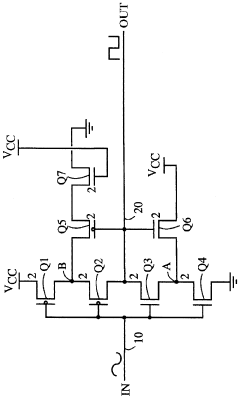
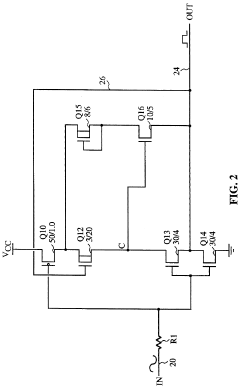
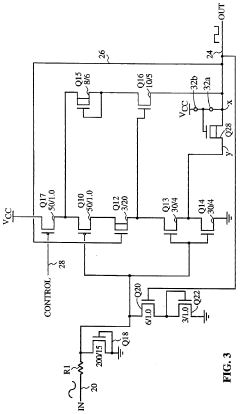
High speed and low noise margin schmitt trigger with controllable trip point
PatentInactiveUS5489866A
Innovation
- A Schmitt trigger design incorporating a buffer with pull-up and pull-down devices, an N-channel depletion mode transistor for feedback, and control transistors for timing, along with electrostatic discharge protection and optional voltage control, to achieve a noise margin of 0.5 volts and improved response speed.
Schmitt trigger with current assistance circuit
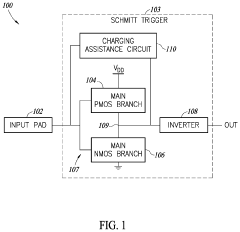
PatentActiveUS11901900B2
Innovation
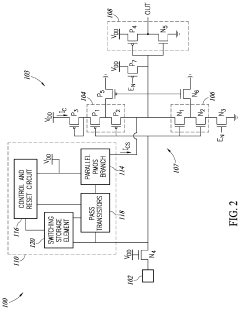
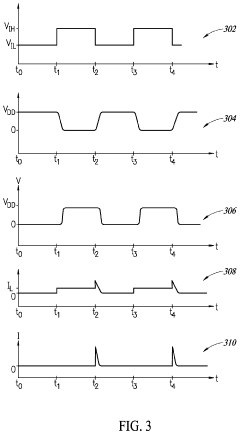
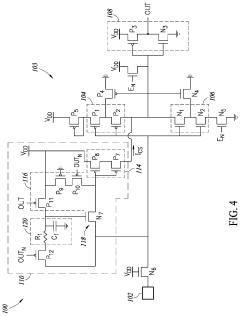
- Incorporating a charging assistance circuit that provides supplemental charging currents during transitions, contributing no static current consumption between transitions, thus enabling fast operation with minimal additional area consumption.
Power Efficiency in Schmitt Trigger Applications
Power efficiency has become a critical consideration in Schmitt trigger applications, particularly in data communication systems where noise reduction capabilities must be balanced with energy consumption. Traditional Schmitt trigger circuits, while effective at noise suppression, often consume significant power due to their hysteresis characteristics and constant current requirements during state transitions.
Recent advancements have focused on optimizing the power-performance trade-off in Schmitt trigger designs. Low-voltage CMOS implementations have emerged as promising solutions, with modified architectures that maintain noise immunity while reducing static power consumption by up to 40% compared to conventional designs. These implementations typically employ techniques such as dynamic threshold adjustment and adaptive biasing to minimize current draw during idle states.
Energy harvesting integration represents another frontier in power-efficient Schmitt trigger applications. By coupling Schmitt triggers with micro-scale energy harvesting technologies, systems can now operate in ultra-low-power modes, extending battery life in portable communication devices or enabling entirely self-powered operation in certain applications. This approach has shown particular promise in IoT sensor networks where data transmission must remain reliable despite intermittent power availability.
Circuit-level optimizations have yielded significant efficiency gains through techniques such as current starving and supply voltage scaling. Advanced designs incorporate sleep modes that dynamically adjust hysteresis windows based on noise conditions, activating full triggering capabilities only when necessary. This context-aware operation can reduce average power consumption by 60-75% in typical data communication scenarios without compromising noise rejection performance.
The semiconductor material selection also plays a crucial role in power efficiency. While silicon remains dominant, compound semiconductors like gallium nitride (GaN) and silicon carbide (SiC) are enabling Schmitt triggers with superior switching characteristics and lower conduction losses. These materials allow for higher operating frequencies with reduced power dissipation, particularly beneficial in high-speed data communication applications where noise rejection must occur at gigabit transmission rates.
Thermal management considerations have evolved alongside power efficiency improvements. Modern Schmitt trigger designs incorporate distributed architectures that prevent hotspot formation, reducing the need for active cooling in dense communication circuits. This passive thermal optimization approach contributes to overall system efficiency by eliminating auxiliary power requirements for temperature regulation while maintaining consistent noise threshold characteristics across operating conditions.
Recent advancements have focused on optimizing the power-performance trade-off in Schmitt trigger designs. Low-voltage CMOS implementations have emerged as promising solutions, with modified architectures that maintain noise immunity while reducing static power consumption by up to 40% compared to conventional designs. These implementations typically employ techniques such as dynamic threshold adjustment and adaptive biasing to minimize current draw during idle states.
Energy harvesting integration represents another frontier in power-efficient Schmitt trigger applications. By coupling Schmitt triggers with micro-scale energy harvesting technologies, systems can now operate in ultra-low-power modes, extending battery life in portable communication devices or enabling entirely self-powered operation in certain applications. This approach has shown particular promise in IoT sensor networks where data transmission must remain reliable despite intermittent power availability.
Circuit-level optimizations have yielded significant efficiency gains through techniques such as current starving and supply voltage scaling. Advanced designs incorporate sleep modes that dynamically adjust hysteresis windows based on noise conditions, activating full triggering capabilities only when necessary. This context-aware operation can reduce average power consumption by 60-75% in typical data communication scenarios without compromising noise rejection performance.
The semiconductor material selection also plays a crucial role in power efficiency. While silicon remains dominant, compound semiconductors like gallium nitride (GaN) and silicon carbide (SiC) are enabling Schmitt triggers with superior switching characteristics and lower conduction losses. These materials allow for higher operating frequencies with reduced power dissipation, particularly beneficial in high-speed data communication applications where noise rejection must occur at gigabit transmission rates.
Thermal management considerations have evolved alongside power efficiency improvements. Modern Schmitt trigger designs incorporate distributed architectures that prevent hotspot formation, reducing the need for active cooling in dense communication circuits. This passive thermal optimization approach contributes to overall system efficiency by eliminating auxiliary power requirements for temperature regulation while maintaining consistent noise threshold characteristics across operating conditions.
Integration with Modern Communication Protocols
The integration of Schmitt Trigger technology with modern communication protocols represents a critical advancement in ensuring reliable data transmission across increasingly complex networks. Contemporary protocols such as Ethernet, USB, CAN bus, and wireless standards (5G, Wi-Fi 6, Bluetooth 5.0) all benefit significantly from the noise immunity characteristics that Schmitt Triggers provide. These protocols operate in environments with varying levels of electrical noise and signal degradation, making robust signal conditioning essential.
In Ethernet applications, particularly in industrial settings where electromagnetic interference is prevalent, Schmitt Trigger-based transceivers help maintain signal integrity across long cable runs. The implementation of hysteresis in physical layer components ensures that minor voltage fluctuations do not trigger false state changes, thereby reducing bit error rates and improving overall network reliability.
USB interfaces, especially in high-speed variants (USB 3.0 and beyond), incorporate Schmitt Trigger circuits at input stages to handle the challenges of maintaining signal integrity across multiple connection types and varying cable qualities. This integration is particularly valuable in consumer electronics where operating environments are unpredictable and signal quality cannot be guaranteed.
In automotive applications, CAN bus systems rely heavily on Schmitt Trigger technology to maintain communication integrity in electrically noisy vehicle environments. The dual-threshold approach effectively filters out transient spikes from ignition systems, alternators, and other vehicle electrical components that would otherwise corrupt data transmission between critical control units.
Wireless protocols present unique challenges where Schmitt Triggers play a crucial role in baseband signal processing. In 5G infrastructure, the technology helps discriminate between valid signals and noise in high-frequency analog front-end circuits before digital processing occurs. Similarly, Wi-Fi 6 implementations utilize Schmitt Trigger principles in receiver designs to improve packet detection in congested wireless environments.
Protocol standardization bodies have increasingly recognized the importance of noise immunity, with many modern specifications explicitly recommending hysteresis-based input circuits. The IEEE 802.3 standards for Ethernet, for instance, specify minimum hysteresis requirements for physical layer implementations to ensure interoperability across different manufacturer equipment.
Emerging communication protocols for IoT applications, which often operate in power-constrained environments, benefit from the energy efficiency characteristics of properly designed Schmitt Trigger circuits. These implementations optimize the hysteresis window to balance power consumption with noise immunity, enabling reliable communication for battery-powered devices while extending operational lifetimes.
In Ethernet applications, particularly in industrial settings where electromagnetic interference is prevalent, Schmitt Trigger-based transceivers help maintain signal integrity across long cable runs. The implementation of hysteresis in physical layer components ensures that minor voltage fluctuations do not trigger false state changes, thereby reducing bit error rates and improving overall network reliability.
USB interfaces, especially in high-speed variants (USB 3.0 and beyond), incorporate Schmitt Trigger circuits at input stages to handle the challenges of maintaining signal integrity across multiple connection types and varying cable qualities. This integration is particularly valuable in consumer electronics where operating environments are unpredictable and signal quality cannot be guaranteed.
In automotive applications, CAN bus systems rely heavily on Schmitt Trigger technology to maintain communication integrity in electrically noisy vehicle environments. The dual-threshold approach effectively filters out transient spikes from ignition systems, alternators, and other vehicle electrical components that would otherwise corrupt data transmission between critical control units.
Wireless protocols present unique challenges where Schmitt Triggers play a crucial role in baseband signal processing. In 5G infrastructure, the technology helps discriminate between valid signals and noise in high-frequency analog front-end circuits before digital processing occurs. Similarly, Wi-Fi 6 implementations utilize Schmitt Trigger principles in receiver designs to improve packet detection in congested wireless environments.
Protocol standardization bodies have increasingly recognized the importance of noise immunity, with many modern specifications explicitly recommending hysteresis-based input circuits. The IEEE 802.3 standards for Ethernet, for instance, specify minimum hysteresis requirements for physical layer implementations to ensure interoperability across different manufacturer equipment.
Emerging communication protocols for IoT applications, which often operate in power-constrained environments, benefit from the energy efficiency characteristics of properly designed Schmitt Trigger circuits. These implementations optimize the hysteresis window to balance power consumption with noise immunity, enabling reliable communication for battery-powered devices while extending operational lifetimes.
Unlock deeper insights with PatSnap Eureka Quick Research — get a full tech report to explore trends and direct your research. Try now!
Generate Your Research Report Instantly with AI Agent
Supercharge your innovation with PatSnap Eureka AI Agent Platform!