Case Report: New Materials for Direct Lithium Extraction Systems
SEP 12, 20259 MIN READ
Generate Your Research Report Instantly with AI Agent
PatSnap Eureka helps you evaluate technical feasibility & market potential.
DLE Materials Background and Objectives
Direct Lithium Extraction (DLE) technology has emerged as a revolutionary approach to lithium production, representing a significant departure from traditional extraction methods such as evaporation ponds and hard-rock mining. The development of DLE can be traced back to the early 1990s, with initial research focusing on ion exchange and adsorption materials. However, it wasn't until the 2010s that significant advancements in material science catalyzed the commercial viability of these technologies.
The evolution of DLE materials has followed a trajectory from conventional ion exchange resins to highly specialized lithium-selective adsorbents. Early materials suffered from poor selectivity in the presence of competing ions such as sodium, magnesium, and calcium, which are abundant in lithium-rich brines. The technical progression has been driven by the increasing global demand for lithium, projected to grow by 500% by 2050 due to the rapid expansion of electric vehicle markets and energy storage systems.
Current DLE material development is focused on addressing several key technical objectives. Primary among these is enhancing lithium selectivity, particularly in complex brine environments with high Mg/Li ratios. Materials must demonstrate selectivity coefficients exceeding 50 for Li+ over Na+ and 100 for Li+ over Mg2+ to be commercially viable in most brine resources. Additionally, materials must exhibit rapid kinetics, allowing for adsorption-desorption cycles measured in hours rather than days.
Durability represents another critical objective, with materials needing to withstand thousands of cycles without significant degradation in performance. This translates to operational lifespans of 3-5 years in industrial settings. Simultaneously, materials must be cost-effective, with production costs allowing for lithium recovery at less than $5,000 per ton to remain competitive with conventional methods.
Environmental sustainability has emerged as an increasingly important objective in DLE material development. Next-generation materials aim to reduce water consumption by 90% compared to evaporation ponds and minimize chemical usage in regeneration processes. This aligns with the broader industry goal of reducing the environmental footprint of lithium production.
The technical trajectory points toward multi-functional composite materials that combine the advantages of inorganic frameworks with organic functional groups. These hybrid materials seek to optimize selectivity, kinetics, and durability simultaneously, rather than trading off these properties against each other as observed in many current-generation materials.
The evolution of DLE materials has followed a trajectory from conventional ion exchange resins to highly specialized lithium-selective adsorbents. Early materials suffered from poor selectivity in the presence of competing ions such as sodium, magnesium, and calcium, which are abundant in lithium-rich brines. The technical progression has been driven by the increasing global demand for lithium, projected to grow by 500% by 2050 due to the rapid expansion of electric vehicle markets and energy storage systems.
Current DLE material development is focused on addressing several key technical objectives. Primary among these is enhancing lithium selectivity, particularly in complex brine environments with high Mg/Li ratios. Materials must demonstrate selectivity coefficients exceeding 50 for Li+ over Na+ and 100 for Li+ over Mg2+ to be commercially viable in most brine resources. Additionally, materials must exhibit rapid kinetics, allowing for adsorption-desorption cycles measured in hours rather than days.
Durability represents another critical objective, with materials needing to withstand thousands of cycles without significant degradation in performance. This translates to operational lifespans of 3-5 years in industrial settings. Simultaneously, materials must be cost-effective, with production costs allowing for lithium recovery at less than $5,000 per ton to remain competitive with conventional methods.
Environmental sustainability has emerged as an increasingly important objective in DLE material development. Next-generation materials aim to reduce water consumption by 90% compared to evaporation ponds and minimize chemical usage in regeneration processes. This aligns with the broader industry goal of reducing the environmental footprint of lithium production.
The technical trajectory points toward multi-functional composite materials that combine the advantages of inorganic frameworks with organic functional groups. These hybrid materials seek to optimize selectivity, kinetics, and durability simultaneously, rather than trading off these properties against each other as observed in many current-generation materials.
Market Analysis for DLE Technologies
The Direct Lithium Extraction (DLE) market is experiencing unprecedented growth driven by the global transition to electric vehicles and renewable energy storage systems. Current market valuations place the DLE technology sector at approximately $1.5 billion in 2023, with projections indicating a compound annual growth rate of 27% through 2030, potentially reaching $8.6 billion by the end of the decade. This remarkable expansion is primarily fueled by the automotive industry's shift toward electrification, with major manufacturers committing billions to EV development.
Market demand for lithium is expected to triple by 2025 compared to 2021 levels, creating significant supply challenges that traditional extraction methods cannot adequately address. DLE technologies offer a compelling solution by potentially reducing extraction time from 18 months to mere days while dramatically improving recovery rates from 30-40% to over 90% in optimal conditions.
Regional analysis reveals North America as the current leader in DLE technology adoption, with substantial investments in the "Lithium Triangle" of South America (Argentina, Bolivia, and Chile) where approximately 58% of global lithium resources are concentrated. China maintains dominance in lithium processing, controlling roughly 60% of global capacity, but faces increasing competition as nations pursue supply chain security.
The market segmentation shows three primary DLE technology categories gaining traction: ion-exchange materials (42% market share), membrane-based systems (31%), and solvent extraction methods (18%), with emerging technologies comprising the remainder. Each addresses specific extraction challenges across different brine compositions and operational environments.
Customer analysis indicates mining corporations as the primary adopters, followed by energy companies diversifying into battery materials. Government entities are increasingly entering the market through strategic investments and public-private partnerships, particularly in regions with significant lithium deposits.
Price sensitivity remains moderate as lithium prices have increased over 400% since 2020, creating strong economic incentives for more efficient extraction technologies. The return on investment for DLE systems typically ranges from 2-4 years depending on implementation scale and resource quality, making them increasingly attractive compared to traditional evaporation pond methods.
Market barriers include high initial capital requirements, technical challenges in adapting systems to varied brine chemistries, and environmental permitting processes. However, these are increasingly offset by the significant operational advantages and sustainability benefits that new DLE materials and systems provide.
Market demand for lithium is expected to triple by 2025 compared to 2021 levels, creating significant supply challenges that traditional extraction methods cannot adequately address. DLE technologies offer a compelling solution by potentially reducing extraction time from 18 months to mere days while dramatically improving recovery rates from 30-40% to over 90% in optimal conditions.
Regional analysis reveals North America as the current leader in DLE technology adoption, with substantial investments in the "Lithium Triangle" of South America (Argentina, Bolivia, and Chile) where approximately 58% of global lithium resources are concentrated. China maintains dominance in lithium processing, controlling roughly 60% of global capacity, but faces increasing competition as nations pursue supply chain security.
The market segmentation shows three primary DLE technology categories gaining traction: ion-exchange materials (42% market share), membrane-based systems (31%), and solvent extraction methods (18%), with emerging technologies comprising the remainder. Each addresses specific extraction challenges across different brine compositions and operational environments.
Customer analysis indicates mining corporations as the primary adopters, followed by energy companies diversifying into battery materials. Government entities are increasingly entering the market through strategic investments and public-private partnerships, particularly in regions with significant lithium deposits.
Price sensitivity remains moderate as lithium prices have increased over 400% since 2020, creating strong economic incentives for more efficient extraction technologies. The return on investment for DLE systems typically ranges from 2-4 years depending on implementation scale and resource quality, making them increasingly attractive compared to traditional evaporation pond methods.
Market barriers include high initial capital requirements, technical challenges in adapting systems to varied brine chemistries, and environmental permitting processes. However, these are increasingly offset by the significant operational advantages and sustainability benefits that new DLE materials and systems provide.
Current State and Challenges in DLE Materials
Direct Lithium Extraction (DLE) technologies have emerged as promising alternatives to traditional lithium production methods, with materials science playing a pivotal role in their development. Currently, the global landscape of DLE materials encompasses several categories including ion-exchange materials, adsorbents, membranes, and electrochemical systems, each with distinct advantages and limitations.
Ion-exchange materials, particularly lithium aluminum layered double hydroxide chloride (LDH) and lithium manganese oxide (LMO), have demonstrated high selectivity for lithium ions in the presence of competing ions. However, these materials face challenges related to regeneration efficiency, with performance degradation observed after multiple extraction cycles. Recent advancements have improved cycle stability, but long-term durability remains a significant concern for commercial deployment.
Adsorbent-based materials, including metal oxides and organic frameworks, offer promising lithium selectivity but struggle with slow kinetics and limited capacity in real-world brine conditions. Metal-organic frameworks (MOFs) have shown exceptional theoretical capacity but face stability issues in highly saline environments typical of lithium-rich brines. The trade-off between selectivity and adsorption rate continues to challenge material scientists.
Membrane technologies for DLE have progressed significantly, with ceramic and polymer-based membranes showing potential for selective lithium transport. However, current membrane materials suffer from fouling in complex brine compositions, reducing operational lifetimes and increasing maintenance requirements. Additionally, the energy consumption associated with membrane-based separation remains higher than desired for economical extraction.
Electrochemical systems utilizing intercalation materials have demonstrated promising results in laboratory settings but face scalability challenges. Materials such as lithium iron phosphate and lithium titanate offer good selectivity but require precise voltage control and suffer from capacity fade during extended operation. The balance between energy input and lithium recovery efficiency remains suboptimal for commercial viability.
A critical challenge across all DLE material categories is performance in real-world conditions. Laboratory results often fail to translate to field applications due to the complex and variable nature of lithium brines. Factors such as temperature fluctuations, presence of contaminants, and varying brine compositions significantly impact material performance and longevity.
From a geographical perspective, DLE material research is concentrated in North America, Europe, and East Asia, with limited development in regions where lithium resources are abundant, such as South America's "Lithium Triangle." This geographical disconnect between research capabilities and resource locations presents additional challenges for technology implementation and optimization for specific brine chemistries.
The economic viability of DLE materials remains a significant hurdle, with current materials requiring either expensive synthesis processes or complex regeneration procedures. The cost-performance balance has not yet reached the threshold needed for widespread commercial adoption, particularly when competing with established extraction methods in regions with favorable conditions for traditional approaches.
Ion-exchange materials, particularly lithium aluminum layered double hydroxide chloride (LDH) and lithium manganese oxide (LMO), have demonstrated high selectivity for lithium ions in the presence of competing ions. However, these materials face challenges related to regeneration efficiency, with performance degradation observed after multiple extraction cycles. Recent advancements have improved cycle stability, but long-term durability remains a significant concern for commercial deployment.
Adsorbent-based materials, including metal oxides and organic frameworks, offer promising lithium selectivity but struggle with slow kinetics and limited capacity in real-world brine conditions. Metal-organic frameworks (MOFs) have shown exceptional theoretical capacity but face stability issues in highly saline environments typical of lithium-rich brines. The trade-off between selectivity and adsorption rate continues to challenge material scientists.
Membrane technologies for DLE have progressed significantly, with ceramic and polymer-based membranes showing potential for selective lithium transport. However, current membrane materials suffer from fouling in complex brine compositions, reducing operational lifetimes and increasing maintenance requirements. Additionally, the energy consumption associated with membrane-based separation remains higher than desired for economical extraction.
Electrochemical systems utilizing intercalation materials have demonstrated promising results in laboratory settings but face scalability challenges. Materials such as lithium iron phosphate and lithium titanate offer good selectivity but require precise voltage control and suffer from capacity fade during extended operation. The balance between energy input and lithium recovery efficiency remains suboptimal for commercial viability.
A critical challenge across all DLE material categories is performance in real-world conditions. Laboratory results often fail to translate to field applications due to the complex and variable nature of lithium brines. Factors such as temperature fluctuations, presence of contaminants, and varying brine compositions significantly impact material performance and longevity.
From a geographical perspective, DLE material research is concentrated in North America, Europe, and East Asia, with limited development in regions where lithium resources are abundant, such as South America's "Lithium Triangle." This geographical disconnect between research capabilities and resource locations presents additional challenges for technology implementation and optimization for specific brine chemistries.
The economic viability of DLE materials remains a significant hurdle, with current materials requiring either expensive synthesis processes or complex regeneration procedures. The cost-performance balance has not yet reached the threshold needed for widespread commercial adoption, particularly when competing with established extraction methods in regions with favorable conditions for traditional approaches.
Current DLE Material Solutions Assessment
01 Novel ion exchange materials for lithium extraction
Advanced ion exchange materials have been developed specifically for direct lithium extraction systems. These materials feature enhanced selectivity for lithium ions over competing ions such as sodium, potassium, and magnesium, which are commonly found in brine sources. The materials are designed with optimized pore structures and functional groups that can effectively capture lithium ions while minimizing the uptake of other elements. These novel ion exchangers demonstrate improved capacity, faster kinetics, and better regeneration properties compared to conventional materials.- Novel ion exchange materials for lithium extraction: Advanced ion exchange materials have been developed specifically for direct lithium extraction systems. These materials feature enhanced selectivity for lithium ions over competing ions such as sodium, potassium, and magnesium, which are commonly found in brine sources. The novel materials include modified inorganic sorbents, functionalized polymers, and composite materials with tailored pore structures that facilitate rapid lithium uptake while minimizing fouling and degradation during repeated extraction cycles.
- Metal-organic frameworks (MOFs) for lithium capture: Metal-organic frameworks represent a promising class of materials for direct lithium extraction due to their highly tunable structure and chemistry. These crystalline porous materials consist of metal ions or clusters coordinated to organic ligands, creating structures with exceptionally high surface areas and controlled pore sizes. MOFs designed specifically for lithium extraction incorporate binding sites that selectively interact with lithium ions, allowing for efficient separation from brine solutions with minimal energy requirements and improved recovery rates compared to conventional methods.
- Lithium-selective membrane technologies: Advanced membrane technologies have been developed to selectively extract lithium from various sources. These membranes incorporate specialized functional groups or nanostructures that allow lithium ions to pass through while blocking larger competing ions. Some designs utilize electrical potential differences to drive lithium transport across the membrane, while others employ novel composite structures combining organic and inorganic components to enhance selectivity and durability. These membrane systems offer advantages in continuous operation scenarios and can be integrated with existing brine processing infrastructure.
- Nanostructured lithium adsorbents: Nanostructured materials engineered specifically for lithium adsorption represent a significant advancement in direct lithium extraction technology. These materials include nanoparticles, nanofibers, and hierarchical porous structures with high surface area-to-volume ratios that maximize lithium capture capacity. Surface modifications with lithium-selective functional groups enhance binding affinity and selectivity. The nanoscale architecture of these materials facilitates rapid adsorption kinetics and efficient desorption during regeneration cycles, leading to improved extraction efficiency and reduced processing time.
- Electrochemical materials for lithium recovery: Electrochemical systems utilizing specialized electrode materials offer a promising approach for direct lithium extraction. These materials include intercalation compounds, redox-active polymers, and composite electrodes that can selectively capture and release lithium ions in response to applied electrical potential. The electrochemical approach allows for precise control over the extraction process and can operate with lower energy requirements compared to traditional evaporation methods. Recent advances include materials with improved cycling stability, faster kinetics, and enhanced selectivity for lithium over competing ions.
02 Metal-organic frameworks (MOFs) for lithium separation
Metal-organic frameworks represent a promising class of materials for direct lithium extraction due to their highly tunable structures and chemical properties. These crystalline porous materials consist of metal ions or clusters coordinated to organic ligands, creating three-dimensional structures with precisely engineered pore sizes ideal for lithium ion selectivity. The frameworks can be designed with specific binding sites that preferentially interact with lithium ions, allowing for efficient separation from other alkali metals. MOFs demonstrate exceptional lithium uptake capacity and can be synthesized using environmentally friendly methods.Expand Specific Solutions03 Lithium-selective membrane technologies
Advanced membrane technologies have been developed specifically for lithium extraction applications. These membranes incorporate specialized polymers or inorganic materials with lithium-selective transport channels that allow for the preferential passage of lithium ions while blocking competing ions. Some designs utilize electrical potential differences to drive lithium transport across the membrane, while others rely on concentration gradients. These membrane systems offer advantages including continuous operation capability, reduced chemical consumption, and lower energy requirements compared to traditional extraction methods.Expand Specific Solutions04 Nanostructured lithium adsorbents
Nanostructured materials engineered for lithium adsorption represent a significant advancement in direct lithium extraction technology. These materials leverage high surface area-to-volume ratios and precisely engineered surface chemistry to achieve superior lithium selectivity and capacity. Various nanostructures including nanoparticles, nanofibers, and nanoporous materials have been developed with functional groups specifically designed to interact with lithium ions. The nanoscale architecture allows for rapid adsorption kinetics and efficient mass transfer, resulting in faster extraction cycles and improved lithium recovery rates.Expand Specific Solutions05 Composite and hybrid materials for enhanced lithium extraction
Composite and hybrid materials combine the advantages of different material classes to create superior lithium extraction systems. These materials typically integrate inorganic components (providing structural stability and selectivity) with organic polymers (offering flexibility and processability). Examples include polymer-inorganic composites, carbon-based hybrid materials, and ceramic-polymer composites. The synergistic effects between the different components result in materials with enhanced mechanical stability, improved lithium selectivity, better resistance to fouling, and longer operational lifetimes compared to single-component materials.Expand Specific Solutions
Key Industry Players in DLE Materials Development
The direct lithium extraction (DLE) materials market is in a growth phase, characterized by rapid technological innovation and increasing commercial deployment. The market is expanding significantly due to rising demand for lithium in battery technologies, with key players developing proprietary materials and processes. Companies like Lilac Solutions and Summit Nanotech are pioneering ion-exchange technologies, while established entities such as Eramet and IFP Energies Nouvelles are investing in advanced extraction materials. Academic institutions including Central South University and North Carolina State University are contributing fundamental research. The technology landscape shows varying maturity levels, with some companies (American Battery Technology, Lyten) focusing on novel nanomaterials while others (Koch Technology Solutions, Toyota) are scaling up proven technologies for industrial implementation, creating a competitive ecosystem driving innovation in sustainable lithium production.
Lilac Solutions, Inc.
Technical Solution: Lilac Solutions has developed an ion-exchange technology platform specifically designed for lithium extraction from brines. Their proprietary ceramic ion-exchange beads selectively absorb lithium while rejecting other ions commonly found in brines. The technology employs a continuous countercurrent system where lithium-loaded beads are regenerated using a dilute acid solution, producing a concentrated lithium solution suitable for further processing. This approach enables direct lithium extraction with minimal pre-treatment requirements and significantly reduced environmental footprint compared to traditional evaporation ponds. The company's materials feature enhanced durability with specialized coatings that resist degradation in harsh brine environments, allowing for thousands of absorption-desorption cycles without significant performance loss. Lilac's system can be deployed in modular units, enabling scalable implementation across various brine resources with different chemical compositions.
Strengths: High selectivity for lithium over competing ions; rapid extraction kinetics reducing processing time from months to hours; water-efficient process with up to 90% reduction in water usage compared to evaporation ponds; adaptable to various brine chemistries. Weaknesses: Higher capital costs compared to traditional methods; requires electricity and reagents for operation; performance may vary with extreme brine compositions; technology still being scaled to commercial production levels.
Koch Technology Solutions LLC
Technical Solution: Koch Technology Solutions has developed an advanced membrane-based direct lithium extraction system that combines selective separation materials with electrochemical driving forces. Their technology utilizes composite membranes with lithium-selective transport channels that facilitate the selective passage of lithium ions while blocking competing species. The system employs a continuous electrochemical process where an applied potential gradient drives lithium transport across the membrane, concentrating it in a sweep solution. Koch's materials incorporate nanoscale engineering to create precise pore architectures and surface functionalities that optimize lithium selectivity and flux rates. Their approach minimizes chemical consumption by utilizing electrical energy as the primary driving force for separation. The company has integrated their membrane technology with sophisticated process control systems that can adapt to variations in feed composition, maximizing recovery efficiency across diverse brine resources. Koch's modular system design allows for flexible deployment and scalability to match resource characteristics and production requirements.
Strengths: Energy-efficient process with reduced chemical requirements; continuous operation capability with high throughput potential; adaptable to various brine compositions through tunable membrane properties; leverages Koch's extensive experience in industrial separation technologies. Weaknesses: Membrane fouling may occur with certain brine compositions requiring additional pre-treatment; higher electricity consumption compared to some competing technologies; potential challenges with long-term membrane durability in harsh environments; complex system integration requirements.
Critical Patents and Technical Literature Review
Direct extraction of lithium using micro-engineered adsorbent
PatentWO2025080725A1
Innovation
- Development of micro-engineered lithium-ion sieve adsorbents (LISs) using specific chemical structures and properties to selectively extract lithium from brines, incorporating dopants and stabilizers to enhance stability and performance.


Systems and methods for direct lithium extraction
PatentPendingUS20250011957A1
Innovation
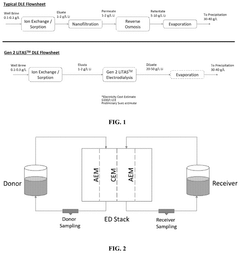
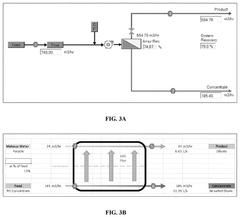
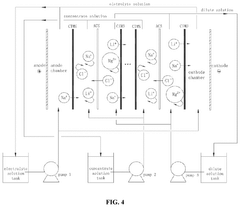
- The integration of selective membrane electrodialysis as a single step to simultaneously concentrate and purify lithium brines, reducing the number of required processing steps, capital and operating costs, and carbon footprint, while eliminating the need for large equipment at remote mining locations.
Environmental Impact and Sustainability Considerations
The environmental impact of Direct Lithium Extraction (DLE) systems represents a critical consideration in their development and deployment. Traditional lithium extraction methods, particularly evaporative ponds, consume vast quantities of water—approximately 500,000 gallons per ton of lithium—and occupy extensive land areas, disrupting local ecosystems and biodiversity. In contrast, emerging DLE technologies utilizing advanced materials offer significant environmental advantages.
New adsorption materials for DLE systems demonstrate remarkable water efficiency, reducing consumption by up to 90% compared to conventional methods. This conservation aspect is particularly crucial in lithium-rich regions that often face water scarcity issues, such as the "Lithium Triangle" spanning Chile, Argentina, and Bolivia. Furthermore, these materials enable a closed-loop extraction process that minimizes chemical usage and prevents harmful discharge into surrounding environments.
Land use efficiency represents another substantial environmental benefit of material-based DLE systems. While traditional evaporation ponds require approximately 2,000 hectares for operation, advanced DLE facilities utilizing selective adsorption materials can achieve equivalent production on less than 1% of that footprint. This dramatic reduction preserves natural habitats and reduces ecosystem fragmentation in sensitive areas.
Carbon footprint analysis reveals that material-based DLE systems can reduce greenhouse gas emissions by 30-50% compared to conventional extraction methods. This improvement stems from reduced energy requirements for pumping and processing, as well as the elimination of extensive evaporation periods. Several leading materials developers have committed to powering their DLE operations with renewable energy sources, further enhancing sustainability credentials.
Lifecycle assessment of new DLE materials indicates promising circularity potential. Research shows that ion-exchange polymers and inorganic adsorbents can maintain 80-90% efficiency after multiple regeneration cycles, extending operational lifespans and reducing waste. End-of-life recovery protocols are being developed to reclaim valuable components from exhausted materials, creating additional sustainability benefits.
Regulatory frameworks worldwide are increasingly recognizing the environmental advantages of advanced DLE systems. The European Union's Battery Directive revision specifically encourages "environmentally responsible lithium sourcing," while several lithium-consuming nations have introduced preferential import policies for materials extracted using sustainable methods. This regulatory landscape is accelerating the adoption of environmentally superior extraction technologies across the industry.
New adsorption materials for DLE systems demonstrate remarkable water efficiency, reducing consumption by up to 90% compared to conventional methods. This conservation aspect is particularly crucial in lithium-rich regions that often face water scarcity issues, such as the "Lithium Triangle" spanning Chile, Argentina, and Bolivia. Furthermore, these materials enable a closed-loop extraction process that minimizes chemical usage and prevents harmful discharge into surrounding environments.
Land use efficiency represents another substantial environmental benefit of material-based DLE systems. While traditional evaporation ponds require approximately 2,000 hectares for operation, advanced DLE facilities utilizing selective adsorption materials can achieve equivalent production on less than 1% of that footprint. This dramatic reduction preserves natural habitats and reduces ecosystem fragmentation in sensitive areas.
Carbon footprint analysis reveals that material-based DLE systems can reduce greenhouse gas emissions by 30-50% compared to conventional extraction methods. This improvement stems from reduced energy requirements for pumping and processing, as well as the elimination of extensive evaporation periods. Several leading materials developers have committed to powering their DLE operations with renewable energy sources, further enhancing sustainability credentials.
Lifecycle assessment of new DLE materials indicates promising circularity potential. Research shows that ion-exchange polymers and inorganic adsorbents can maintain 80-90% efficiency after multiple regeneration cycles, extending operational lifespans and reducing waste. End-of-life recovery protocols are being developed to reclaim valuable components from exhausted materials, creating additional sustainability benefits.
Regulatory frameworks worldwide are increasingly recognizing the environmental advantages of advanced DLE systems. The European Union's Battery Directive revision specifically encourages "environmentally responsible lithium sourcing," while several lithium-consuming nations have introduced preferential import policies for materials extracted using sustainable methods. This regulatory landscape is accelerating the adoption of environmentally superior extraction technologies across the industry.
Supply Chain Analysis for DLE Material Production
The Direct Lithium Extraction (DLE) material supply chain represents a critical component in the lithium production ecosystem, with significant implications for the global energy transition. Current DLE material production relies on a complex network of suppliers spanning multiple continents, creating potential vulnerabilities in the supply chain. Primary raw materials for ion-exchange sorbents and membranes originate predominantly from China, Australia, and Chile, with processing facilities concentrated in East Asia and North America.
Manufacturing capacity for specialized DLE materials remains limited, with only a handful of companies possessing the technical expertise and production capabilities required for high-performance extraction materials. This concentration creates bottlenecks in the supply chain, particularly as demand for lithium continues to accelerate with the expansion of electric vehicle markets and grid-scale energy storage systems.
The production of advanced ion-selective materials involves multiple processing stages, each requiring specialized equipment and expertise. Key components such as titanium dioxide, manganese dioxide, and specialized polymers for membranes face their own supply constraints. Notably, rare earth elements used in certain high-performance sorbents are subject to geopolitical tensions and export restrictions, adding another layer of complexity to the supply chain.
Transportation logistics present additional challenges, as many DLE projects are located in remote regions with limited infrastructure. The movement of specialized materials to these sites often involves multiple modes of transportation and border crossings, increasing costs and delivery timeframes. This logistical complexity can significantly impact project timelines and operational efficiency.
Quality control represents another critical aspect of the DLE material supply chain. The performance of extraction systems depends heavily on material consistency and purity, requiring rigorous testing and certification processes. Currently, standardization across the industry remains limited, with different manufacturers employing varying quality metrics and production standards.
Recycling and circular economy considerations are increasingly important for DLE material production. End-of-life management for spent sorbents and membranes presents both environmental challenges and opportunities for material recovery. Several companies are developing processes to regenerate and reuse DLE materials, potentially reducing reliance on primary raw material sources and minimizing waste streams.
Manufacturing capacity for specialized DLE materials remains limited, with only a handful of companies possessing the technical expertise and production capabilities required for high-performance extraction materials. This concentration creates bottlenecks in the supply chain, particularly as demand for lithium continues to accelerate with the expansion of electric vehicle markets and grid-scale energy storage systems.
The production of advanced ion-selective materials involves multiple processing stages, each requiring specialized equipment and expertise. Key components such as titanium dioxide, manganese dioxide, and specialized polymers for membranes face their own supply constraints. Notably, rare earth elements used in certain high-performance sorbents are subject to geopolitical tensions and export restrictions, adding another layer of complexity to the supply chain.
Transportation logistics present additional challenges, as many DLE projects are located in remote regions with limited infrastructure. The movement of specialized materials to these sites often involves multiple modes of transportation and border crossings, increasing costs and delivery timeframes. This logistical complexity can significantly impact project timelines and operational efficiency.
Quality control represents another critical aspect of the DLE material supply chain. The performance of extraction systems depends heavily on material consistency and purity, requiring rigorous testing and certification processes. Currently, standardization across the industry remains limited, with different manufacturers employing varying quality metrics and production standards.
Recycling and circular economy considerations are increasingly important for DLE material production. End-of-life management for spent sorbents and membranes presents both environmental challenges and opportunities for material recovery. Several companies are developing processes to regenerate and reuse DLE materials, potentially reducing reliance on primary raw material sources and minimizing waste streams.
Unlock deeper insights with PatSnap Eureka Quick Research — get a full tech report to explore trends and direct your research. Try now!
Generate Your Research Report Instantly with AI Agent
Supercharge your innovation with PatSnap Eureka AI Agent Platform!