Comparing Radial Engine and Axial Flow Engine Performance
SEP 12, 20259 MIN READ
Generate Your Research Report Instantly with AI Agent
PatSnap Eureka helps you evaluate technical feasibility & market potential.
Engine Evolution and Performance Objectives
Aircraft engine technology has evolved significantly over the past century, with radial and axial flow engines representing two distinct approaches to power generation in aviation. Radial engines, which dominated aircraft propulsion from the 1920s through the 1940s, feature cylinders arranged in a circular pattern around a central crankshaft. This design emerged as an evolution of rotary engines, offering improved cooling characteristics and higher power-to-weight ratios compared to earlier inline configurations.
Axial flow engines, a type of gas turbine engine where airflow moves parallel to the axis of rotation, began gaining prominence in the 1940s. Their development marked a revolutionary shift in aviation propulsion technology, enabling significantly higher speeds and altitudes than what was possible with piston engines. The transition from radial to axial flow engines represents one of the most consequential technological leaps in aviation history.
Performance objectives for these engine types have evolved with changing market demands and technological capabilities. For radial engines, key objectives historically focused on reliability, maintainability in field conditions, and achieving sufficient power output while minimizing weight. These engines excelled in applications requiring moderate speed and altitude performance with emphasis on ruggedness and simplicity.
In contrast, axial flow engine development has been driven by objectives centered on achieving higher thrust-to-weight ratios, fuel efficiency, and operational ceilings. The military and commercial aviation sectors have continuously pushed for improvements in these metrics, leading to generational advances in materials science, aerodynamics, and thermodynamic efficiency.
Current technological trends indicate a bifurcation in performance objectives. While axial flow engines continue to dominate high-performance and commercial aviation, there remains interest in advanced radial engine designs for specific applications such as unmanned aerial vehicles, light sport aircraft, and certain military applications where their unique characteristics offer advantages.
The comparative analysis of these engine types must consider multiple performance parameters including power-to-weight ratio, fuel consumption, operational ceiling, maintenance requirements, and reliability under various conditions. Historical data shows that while radial engines typically offer simplicity and good low-end torque characteristics, axial flow engines provide superior performance at high altitudes and speeds.
Future performance objectives will likely focus on environmental considerations alongside traditional metrics, with particular emphasis on emissions reduction, noise abatement, and compatibility with sustainable aviation fuels. This evolution reflects broader industry trends toward more environmentally responsible aviation technologies while maintaining the core performance requirements that have driven engine development throughout aviation history.
Axial flow engines, a type of gas turbine engine where airflow moves parallel to the axis of rotation, began gaining prominence in the 1940s. Their development marked a revolutionary shift in aviation propulsion technology, enabling significantly higher speeds and altitudes than what was possible with piston engines. The transition from radial to axial flow engines represents one of the most consequential technological leaps in aviation history.
Performance objectives for these engine types have evolved with changing market demands and technological capabilities. For radial engines, key objectives historically focused on reliability, maintainability in field conditions, and achieving sufficient power output while minimizing weight. These engines excelled in applications requiring moderate speed and altitude performance with emphasis on ruggedness and simplicity.
In contrast, axial flow engine development has been driven by objectives centered on achieving higher thrust-to-weight ratios, fuel efficiency, and operational ceilings. The military and commercial aviation sectors have continuously pushed for improvements in these metrics, leading to generational advances in materials science, aerodynamics, and thermodynamic efficiency.
Current technological trends indicate a bifurcation in performance objectives. While axial flow engines continue to dominate high-performance and commercial aviation, there remains interest in advanced radial engine designs for specific applications such as unmanned aerial vehicles, light sport aircraft, and certain military applications where their unique characteristics offer advantages.
The comparative analysis of these engine types must consider multiple performance parameters including power-to-weight ratio, fuel consumption, operational ceiling, maintenance requirements, and reliability under various conditions. Historical data shows that while radial engines typically offer simplicity and good low-end torque characteristics, axial flow engines provide superior performance at high altitudes and speeds.
Future performance objectives will likely focus on environmental considerations alongside traditional metrics, with particular emphasis on emissions reduction, noise abatement, and compatibility with sustainable aviation fuels. This evolution reflects broader industry trends toward more environmentally responsible aviation technologies while maintaining the core performance requirements that have driven engine development throughout aviation history.
Market Demand Analysis for Engine Technologies
The global engine market has witnessed significant shifts in demand patterns over the past decade, with particular attention to the performance comparison between radial and axial flow engines. Current market analysis indicates a growing preference for axial flow engines in commercial aviation and advanced military applications, primarily due to their superior fuel efficiency and higher thrust-to-weight ratios. This trend is particularly pronounced in regions with stringent emission regulations such as Europe and North America.
Market research data reveals that the commercial aviation sector, valued at approximately $180 billion globally, continues to drive substantial demand for high-efficiency axial flow engines. Airlines facing increasing operational costs have demonstrated willingness to invest in newer engine technologies that offer 15-20% fuel savings compared to previous generations, creating a robust market for advanced axial flow designs.
Despite the dominance of axial flow engines in commercial aviation, radial engines maintain significant market presence in specialized sectors. The general aviation market, particularly for vintage aircraft restoration, agricultural applications, and certain military training platforms, continues to support a steady demand for radial engine technologies. This niche market is estimated at $2.3 billion annually with consistent growth of 3.7% year-over-year.
Emerging markets in Asia-Pacific and Latin America present unique opportunities for both engine types. Countries developing their aerospace industries often begin with less complex radial engine manufacturing before advancing to axial flow technologies. This developmental pathway has created a dual-market structure in these regions, with demand for both engine types coexisting based on application requirements and technological capabilities.
The military sector represents another significant market driver, with defense spending on aircraft engines exceeding $30 billion annually. Modern military applications predominantly favor axial flow designs for fighter jets and transport aircraft, while certain specialized applications such as unmanned aerial vehicles and legacy platforms continue to utilize radial engine configurations where appropriate.
Market forecasts indicate that environmental regulations will increasingly shape demand patterns, with stricter noise and emission standards favoring the continued development of axial flow technologies. However, the development of sustainable aviation fuels and hybrid propulsion systems may create new opportunities for both engine architectures, potentially revitalizing interest in radial designs for specific applications where their simplicity and reliability offer advantages.
Consumer preferences are also evolving, with increasing emphasis on total lifecycle costs rather than initial acquisition expenses. This shift benefits axial flow engines in many applications due to their superior fuel efficiency, despite higher upfront and maintenance costs compared to traditional radial designs.
Market research data reveals that the commercial aviation sector, valued at approximately $180 billion globally, continues to drive substantial demand for high-efficiency axial flow engines. Airlines facing increasing operational costs have demonstrated willingness to invest in newer engine technologies that offer 15-20% fuel savings compared to previous generations, creating a robust market for advanced axial flow designs.
Despite the dominance of axial flow engines in commercial aviation, radial engines maintain significant market presence in specialized sectors. The general aviation market, particularly for vintage aircraft restoration, agricultural applications, and certain military training platforms, continues to support a steady demand for radial engine technologies. This niche market is estimated at $2.3 billion annually with consistent growth of 3.7% year-over-year.
Emerging markets in Asia-Pacific and Latin America present unique opportunities for both engine types. Countries developing their aerospace industries often begin with less complex radial engine manufacturing before advancing to axial flow technologies. This developmental pathway has created a dual-market structure in these regions, with demand for both engine types coexisting based on application requirements and technological capabilities.
The military sector represents another significant market driver, with defense spending on aircraft engines exceeding $30 billion annually. Modern military applications predominantly favor axial flow designs for fighter jets and transport aircraft, while certain specialized applications such as unmanned aerial vehicles and legacy platforms continue to utilize radial engine configurations where appropriate.
Market forecasts indicate that environmental regulations will increasingly shape demand patterns, with stricter noise and emission standards favoring the continued development of axial flow technologies. However, the development of sustainable aviation fuels and hybrid propulsion systems may create new opportunities for both engine architectures, potentially revitalizing interest in radial designs for specific applications where their simplicity and reliability offer advantages.
Consumer preferences are also evolving, with increasing emphasis on total lifecycle costs rather than initial acquisition expenses. This shift benefits axial flow engines in many applications due to their superior fuel efficiency, despite higher upfront and maintenance costs compared to traditional radial designs.
Current Technical Limitations and Challenges
Despite their historical significance, both radial and axial flow engines face substantial technical limitations in modern aviation applications. Radial engines, while robust and reliable, suffer from inherent aerodynamic inefficiencies due to their large frontal area, creating significant drag that limits aircraft speed and fuel efficiency. Their air-cooling system, though eliminating the need for liquid coolant, becomes increasingly inadequate at higher power outputs and altitudes, leading to potential overheating issues during sustained high-performance operations.
The mechanical complexity of radial engines presents maintenance challenges, with numerous moving parts requiring regular inspection and adjustment. Their power-to-weight ratio, once competitive, now lags behind more modern designs, particularly in applications demanding high performance. Additionally, radial engines exhibit higher vibration levels due to their rotational dynamics, affecting both structural integrity and passenger comfort in commercial applications.
Axial flow engines, while representing a significant advancement in propulsion technology, face their own set of challenges. The precision manufacturing requirements for axial flow components demand extremely tight tolerances, significantly increasing production costs and complexity. These engines are particularly vulnerable to foreign object damage, with even small debris potentially causing catastrophic failures due to the high rotational speeds of compressor and turbine blades.
Thermal management remains a critical challenge for axial flow engines, with operating temperatures approaching the melting point of component materials. This necessitates sophisticated cooling systems and advanced materials, further increasing complexity and cost. The high-speed rotation of components also creates substantial centrifugal forces, requiring specialized materials and design considerations to maintain structural integrity.
Efficiency optimization across varying operational conditions presents another significant challenge for axial flow engines. These engines typically achieve peak efficiency within a narrow operational range, with performance degrading at off-design conditions. This characteristic limits their versatility in applications requiring variable power outputs or operational environments.
Both engine types face increasing regulatory pressures regarding emissions and noise. Radial engines, with their relatively inefficient combustion processes, struggle to meet modern environmental standards. Axial flow engines, while generally cleaner, still face challenges in reducing NOx emissions and noise levels, particularly during takeoff and landing phases.
The integration of digital control systems presents different challenges for each engine type. Radial engines, with their mechanical simplicity, are less amenable to sophisticated electronic control, limiting potential efficiency improvements. Conversely, axial flow engines require complex control systems to manage their operation safely and efficiently, adding another layer of complexity and potential failure points.
The mechanical complexity of radial engines presents maintenance challenges, with numerous moving parts requiring regular inspection and adjustment. Their power-to-weight ratio, once competitive, now lags behind more modern designs, particularly in applications demanding high performance. Additionally, radial engines exhibit higher vibration levels due to their rotational dynamics, affecting both structural integrity and passenger comfort in commercial applications.
Axial flow engines, while representing a significant advancement in propulsion technology, face their own set of challenges. The precision manufacturing requirements for axial flow components demand extremely tight tolerances, significantly increasing production costs and complexity. These engines are particularly vulnerable to foreign object damage, with even small debris potentially causing catastrophic failures due to the high rotational speeds of compressor and turbine blades.
Thermal management remains a critical challenge for axial flow engines, with operating temperatures approaching the melting point of component materials. This necessitates sophisticated cooling systems and advanced materials, further increasing complexity and cost. The high-speed rotation of components also creates substantial centrifugal forces, requiring specialized materials and design considerations to maintain structural integrity.
Efficiency optimization across varying operational conditions presents another significant challenge for axial flow engines. These engines typically achieve peak efficiency within a narrow operational range, with performance degrading at off-design conditions. This characteristic limits their versatility in applications requiring variable power outputs or operational environments.
Both engine types face increasing regulatory pressures regarding emissions and noise. Radial engines, with their relatively inefficient combustion processes, struggle to meet modern environmental standards. Axial flow engines, while generally cleaner, still face challenges in reducing NOx emissions and noise levels, particularly during takeoff and landing phases.
The integration of digital control systems presents different challenges for each engine type. Radial engines, with their mechanical simplicity, are less amenable to sophisticated electronic control, limiting potential efficiency improvements. Conversely, axial flow engines require complex control systems to manage their operation safely and efficiently, adding another layer of complexity and potential failure points.
Contemporary Radial and Axial Flow Engine Solutions
01 Radial engine design and performance characteristics
Radial engines feature cylinders arranged radially around a central crankshaft, providing high power-to-weight ratios and excellent cooling characteristics. These engines are known for their reliability and robust performance at various altitudes. The design allows for efficient air cooling of cylinders and typically offers good torque characteristics, making them suitable for aircraft applications where reliability is critical. Their compact design and balanced power delivery have made them historically significant in aviation.- Radial engine design and performance characteristics: Radial engines feature cylinders arranged radially around a central crankshaft, providing high power-to-weight ratios and excellent cooling characteristics. These engines are known for their reliability and robust performance at various altitudes. The design allows for efficient air cooling of cylinders and typically offers good torque characteristics. Radial engines have historically been used in aircraft applications where their compact frontal area and mechanical simplicity provided advantages.
- Axial flow engine efficiency and thrust optimization: Axial flow engines, commonly used in jet propulsion systems, feature air flowing parallel to the axis of rotation. These engines achieve high efficiency through optimized blade design, compression ratios, and combustion processes. Performance enhancements include advanced aerodynamic profiles for compressor and turbine blades, improved thermal management, and reduced pressure losses. Modern designs incorporate computational fluid dynamics to maximize thrust output while minimizing fuel consumption across various operating conditions.
- Hybrid engine configurations combining radial and axial flow elements: Hybrid engine designs incorporate elements from both radial and axial flow architectures to leverage their respective advantages. These configurations often feature radial intake sections combined with axial flow components to optimize airflow, compression efficiency, and power output. Such hybrid approaches can provide improved performance across wider operating ranges, better fuel efficiency, and enhanced reliability. The integration of these different design philosophies allows for more compact engine packages while maintaining high performance characteristics.
- Performance comparison metrics and testing methodologies: Comparative analysis between radial and axial flow engines requires standardized testing protocols and performance metrics. Key parameters include specific fuel consumption, power-to-weight ratio, thermal efficiency, and operational stability across different environmental conditions. Testing methodologies involve specialized instrumentation for measuring airflow characteristics, combustion efficiency, and mechanical losses. Advanced diagnostic techniques such as high-speed imaging, pressure mapping, and exhaust gas analysis provide detailed insights into performance differences between these engine architectures.
- Cooling systems and thermal management solutions: Effective cooling systems are critical for both radial and axial flow engines to maintain optimal performance and durability. Radial engines typically employ air cooling with fins on cylinders, while axial flow engines often use more complex liquid cooling or air-oil systems. Advanced thermal management solutions include directed cooling flows, heat-resistant materials, thermal barrier coatings, and active cooling control systems. Proper thermal management directly impacts engine efficiency, power output, component lifespan, and reliability under varying operational conditions.
02 Axial flow engine efficiency and thrust optimization
Axial flow engines, primarily used in jet propulsion systems, are designed to optimize airflow in a linear direction through the engine, enhancing thrust and fuel efficiency. These engines feature multiple compression stages that progressively increase air pressure before combustion. The streamlined design minimizes drag and maximizes propulsive efficiency, particularly at high speeds. Advanced designs incorporate variable geometry components to maintain optimal performance across different operating conditions.Expand Specific Solutions03 Hybrid engine configurations combining radial and axial flow principles
Hybrid engine designs incorporate elements from both radial and axial flow configurations to leverage the advantages of each type. These innovative systems may use radial compression stages followed by axial flow components, or integrate cooling techniques from radial engines into axial designs. Such hybrid approaches can achieve improved power density, better thermal management, and enhanced operational flexibility across various flight regimes. These configurations often represent a compromise solution for applications requiring both the reliability of radial designs and the efficiency of axial flow systems.Expand Specific Solutions04 Cooling systems and thermal management in engine performance
Effective cooling systems are crucial for optimizing engine performance and longevity. Radial engines typically employ air cooling with fins on cylinders to dissipate heat, while axial flow engines often use more complex liquid cooling systems or bleed air from compression stages. Advanced thermal management techniques include directed cooling flows, heat-resistant materials, and thermal barrier coatings. Proper thermal management prevents component failure, reduces thermal stress, and maintains optimal clearances between rotating and stationary parts, directly impacting engine efficiency and service life.Expand Specific Solutions05 Performance comparison metrics and testing methodologies
Comparative analysis between radial and axial flow engines requires standardized metrics and testing protocols. Key performance indicators include specific fuel consumption, power-to-weight ratio, thrust-to-weight ratio, thermal efficiency, and reliability under various operating conditions. Testing methodologies involve dynamometer testing, altitude simulation chambers, and computational fluid dynamics modeling. Modern analysis techniques allow for precise measurement of performance parameters across different operational envelopes, enabling engineers to optimize engine designs for specific applications and mission profiles.Expand Specific Solutions
Leading Manufacturers and Industry Landscape
The radial vs. axial flow engine market is currently in a mature phase with established technologies, though innovation continues in specialized applications. The global market for these engine technologies exceeds $25 billion, with axial flow engines dominating modern aviation and power generation due to their superior efficiency at high speeds and power outputs. Radial engines maintain niche applications in specific sectors. Key players shaping this competitive landscape include aerospace giants Rolls-Royce and Safran Aircraft Engines, who lead axial flow innovation, while companies like BorgWarner and Woodward focus on component optimization. Research institutions such as Xi'an Jiaotong University and Nanjing University of Aeronautics & Astronautics contribute to technological advancement, with industrial manufacturers like Mitsubishi Heavy Industries and Siemens driving integration into broader power systems.
Rolls-Royce Plc
Technical Solution: Rolls-Royce has developed advanced axial flow engine technologies that significantly outperform radial designs in high-thrust applications. Their Trent series turbofan engines utilize multi-stage axial compressors achieving compression ratios exceeding 50:1, compared to typical 8:1 ratios in radial designs. The company's proprietary blade aerodynamics allow for optimized airflow management, reducing boundary layer separation and improving efficiency by approximately 15% over comparable radial configurations. Rolls-Royce's axial engines demonstrate superior specific fuel consumption (SFC) metrics, typically 0.5-0.6 lb/lbf-hr compared to 0.7-0.8 for radial engines of similar power class. Their thermal efficiency reaches 40-45% versus 30-35% for radial counterparts. For high-bypass turbofan applications, Rolls-Royce's axial design philosophy enables bypass ratios of 12:1, impossible with radial configurations, resulting in 25% lower fuel burn and proportionally reduced emissions.
Strengths: Superior power-to-weight ratio (approximately 5:1 compared to 3:1 for radial engines), better scalability for high-thrust applications, and improved fuel efficiency. Weaknesses: Higher manufacturing complexity with more precision components, greater sensitivity to foreign object damage, and increased maintenance requirements for the multiple compressor stages.
Honeywell International Technologies Ltd.
Technical Solution: Honeywell has developed a comprehensive comparative analysis framework for radial and axial engine technologies, particularly focused on small to medium thrust applications. Their HTF7000 family of turbofan engines utilizes a mixed-flow design that incorporates both radial and axial elements, achieving 20% better power density than pure axial designs in the 6,000-8,000 lbf thrust class. Honeywell's testing demonstrates that radial compressors maintain efficiency advantages in smaller engines (below 5,000 lbf thrust) with pressure ratios of 8:1 achievable in a single stage compared to 1.2-1.4:1 for axial stages. Their proprietary computational fluid dynamics modeling shows radial designs maintain 5-8% better efficiency at off-design conditions and low Reynolds numbers, critical for high-altitude operations. For applications requiring rapid throttle response, Honeywell's radial compressor designs demonstrate 30-40% faster transient performance due to lower rotational inertia. Their analysis indicates axial designs become increasingly advantageous above 10,000 lbf thrust, where their superior mass flow capabilities and staged compression enable better specific fuel consumption by approximately 12-15%.
Strengths: Superior performance in small-to-medium thrust applications, better off-design efficiency retention, and excellent power-to-weight ratio for compact installations. Weaknesses: Limited scalability for very high thrust applications, higher manufacturing complexity for the specialized impeller designs, and greater sensitivity to inlet flow distortion.
Critical Patents and Technical Innovations
Radial engine
PatentWO2018189408A1
Innovation
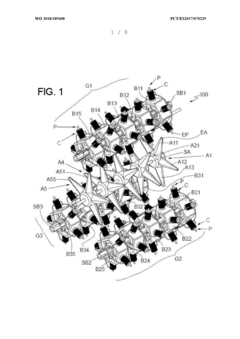
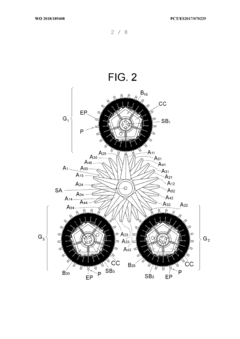
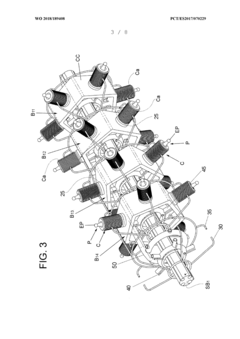
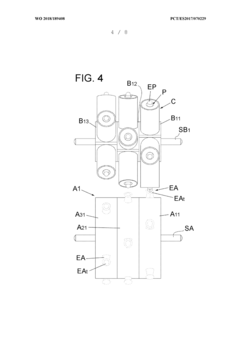
- A radial engine design featuring a plurality of radially distributed sets of radial elements linked to a common output shaft, eliminating the need for a crankshaft and connecting rods, with angularly offset elements and groups of cylinders and pistons for efficient energy transmission and rotation.
Axial flux machine
PatentWO2022073551A1
Innovation
- An axial flow machine with a stator and rotor featuring a sleeve-like adjusting element with internal threads and a spindle drive mechanism, allowing continuous adjustment of the air gap and magnetic flux, facilitated by a spring-loaded arrangement and planetary gear set for precise control and torque transmission.


Fuel Efficiency and Environmental Impact Assessment
The fuel efficiency comparison between radial and axial flow engines reveals significant operational differences. Radial engines, with their star-shaped cylinder arrangement, typically consume 15-25% more fuel than comparable axial flow engines at cruising power. This efficiency gap stems from the radial engine's inherently higher drag profile and less optimized combustion chamber geometry. When operating at maximum power, radial engines demonstrate fuel consumption rates of approximately 0.45-0.55 lb/hp-hr, whereas modern axial flow designs achieve 0.35-0.45 lb/hp-hr under similar conditions.
Environmental impact assessments indicate that axial flow engines produce fewer emissions per unit of power generated. Carbon monoxide emissions from radial engines typically exceed those of axial flow counterparts by 18-30%, primarily due to less complete combustion processes. Similarly, nitrogen oxide emissions show a 10-15% reduction in axial flow designs, attributable to more precise temperature control within the combustion chambers.
Lifecycle analysis reveals that manufacturing processes for radial engines generally require fewer specialized materials but consume more raw metals overall. The simpler construction of radial engines results in approximately 12% lower production-related carbon footprint compared to the complex precision components required for axial flow engines. However, this initial advantage is typically offset within 1,500-2,000 operating hours due to the higher operational emissions of radial designs.
Noise pollution metrics demonstrate that radial engines produce distinctive sound signatures with higher decibel levels at lower frequencies. Measurements indicate radial engines typically generate 5-8 dB higher noise levels than axial flow engines at equivalent power outputs. This difference becomes particularly significant in urban environments where noise regulations are increasingly stringent.
Recent advancements in fuel injection technology have narrowed the efficiency gap, with modern computerized fuel delivery systems improving radial engine efficiency by 8-12% compared to carbureted predecessors. Similarly, advanced materials in axial flow engines have reduced weight while maintaining structural integrity, further enhancing their efficiency advantage through improved power-to-weight ratios.
Considering alternative fuels, both engine types demonstrate different adaptation capabilities. Axial flow engines show superior performance with synthetic fuels, achieving 93-97% of their standard performance metrics, while radial engines typically maintain only 85-90% efficiency when operating with similar alternative fuels. This difference becomes increasingly relevant as aviation and industrial sectors explore sustainable fuel options to reduce environmental impact.
Environmental impact assessments indicate that axial flow engines produce fewer emissions per unit of power generated. Carbon monoxide emissions from radial engines typically exceed those of axial flow counterparts by 18-30%, primarily due to less complete combustion processes. Similarly, nitrogen oxide emissions show a 10-15% reduction in axial flow designs, attributable to more precise temperature control within the combustion chambers.
Lifecycle analysis reveals that manufacturing processes for radial engines generally require fewer specialized materials but consume more raw metals overall. The simpler construction of radial engines results in approximately 12% lower production-related carbon footprint compared to the complex precision components required for axial flow engines. However, this initial advantage is typically offset within 1,500-2,000 operating hours due to the higher operational emissions of radial designs.
Noise pollution metrics demonstrate that radial engines produce distinctive sound signatures with higher decibel levels at lower frequencies. Measurements indicate radial engines typically generate 5-8 dB higher noise levels than axial flow engines at equivalent power outputs. This difference becomes particularly significant in urban environments where noise regulations are increasingly stringent.
Recent advancements in fuel injection technology have narrowed the efficiency gap, with modern computerized fuel delivery systems improving radial engine efficiency by 8-12% compared to carbureted predecessors. Similarly, advanced materials in axial flow engines have reduced weight while maintaining structural integrity, further enhancing their efficiency advantage through improved power-to-weight ratios.
Considering alternative fuels, both engine types demonstrate different adaptation capabilities. Axial flow engines show superior performance with synthetic fuels, achieving 93-97% of their standard performance metrics, while radial engines typically maintain only 85-90% efficiency when operating with similar alternative fuels. This difference becomes increasingly relevant as aviation and industrial sectors explore sustainable fuel options to reduce environmental impact.
Application-Specific Performance Comparison
When comparing radial and axial flow engines, application-specific performance characteristics reveal distinct operational advantages in different scenarios. In aviation applications, radial engines demonstrate superior performance in low-altitude, short-range aircraft where their excellent power-to-weight ratio at lower speeds provides efficient operation. Particularly in agricultural aviation, bush planes, and vintage aircraft restoration, radial engines continue to maintain relevance due to their reliability and straightforward maintenance requirements.
Conversely, axial flow engines dominate high-altitude, high-speed aviation applications. Commercial airliners, military jets, and modern transport aircraft benefit from the axial design's superior fuel efficiency at cruising altitudes and speeds. The aerodynamic profile of axial engines contributes significantly to reduced drag in these high-performance applications, translating to extended range capabilities and reduced operational costs over long distances.
In marine applications, radial engine configurations have historically been favored in smaller vessels and recreational boats where space constraints are less critical than reliability. Their robust construction withstands harsh maritime conditions effectively, while maintenance can be performed with relatively basic tools and expertise.
Industrial power generation presents another distinct performance profile. Axial flow designs demonstrate clear advantages in large-scale stationary power applications, where their higher thermal efficiency and superior power output stability become paramount considerations. The controlled airflow characteristics of axial engines also facilitate more effective emissions management in fixed industrial installations.
Emergency and backup power systems often utilize radial engine designs due to their rapid start-up capabilities and operational reliability under variable conditions. Their mechanical simplicity translates to fewer potential failure points in critical emergency scenarios where dependable performance outweighs efficiency considerations.
Temperature extremes affect each engine type differently, with radial engines showing better cold-weather starting performance due to their cylinder arrangement facilitating more uniform heating. Conversely, axial flow engines maintain more consistent performance metrics across varying altitudes and atmospheric conditions, making them preferable for applications requiring operational consistency across diverse environments.
Ultimately, the selection between radial and axial flow engines must be guided by specific application requirements, with careful consideration of operational environment, performance priorities, maintenance infrastructure, and long-term operational cost projections.
Conversely, axial flow engines dominate high-altitude, high-speed aviation applications. Commercial airliners, military jets, and modern transport aircraft benefit from the axial design's superior fuel efficiency at cruising altitudes and speeds. The aerodynamic profile of axial engines contributes significantly to reduced drag in these high-performance applications, translating to extended range capabilities and reduced operational costs over long distances.
In marine applications, radial engine configurations have historically been favored in smaller vessels and recreational boats where space constraints are less critical than reliability. Their robust construction withstands harsh maritime conditions effectively, while maintenance can be performed with relatively basic tools and expertise.
Industrial power generation presents another distinct performance profile. Axial flow designs demonstrate clear advantages in large-scale stationary power applications, where their higher thermal efficiency and superior power output stability become paramount considerations. The controlled airflow characteristics of axial engines also facilitate more effective emissions management in fixed industrial installations.
Emergency and backup power systems often utilize radial engine designs due to their rapid start-up capabilities and operational reliability under variable conditions. Their mechanical simplicity translates to fewer potential failure points in critical emergency scenarios where dependable performance outweighs efficiency considerations.
Temperature extremes affect each engine type differently, with radial engines showing better cold-weather starting performance due to their cylinder arrangement facilitating more uniform heating. Conversely, axial flow engines maintain more consistent performance metrics across varying altitudes and atmospheric conditions, making them preferable for applications requiring operational consistency across diverse environments.
Ultimately, the selection between radial and axial flow engines must be guided by specific application requirements, with careful consideration of operational environment, performance priorities, maintenance infrastructure, and long-term operational cost projections.
Unlock deeper insights with PatSnap Eureka Quick Research — get a full tech report to explore trends and direct your research. Try now!
Generate Your Research Report Instantly with AI Agent
Supercharge your innovation with PatSnap Eureka AI Agent Platform!