

Direct Lithium Extraction: Novel Materials for Process Improvement
SEP 12, 20259 MIN READ
Generate Your Research Report Instantly with AI Agent
PatSnap Eureka helps you evaluate technical feasibility & market potential.
DLE Technology Background and Objectives
Direct Lithium Extraction (DLE) has emerged as a revolutionary approach to lithium production, representing a significant departure from traditional extraction methods that have dominated the industry for decades. Conventional lithium extraction primarily relies on solar evaporation of brine in large ponds or hard-rock mining, both of which present considerable environmental challenges and operational inefficiencies. The evolution of DLE technology began in the early 2000s, with significant acceleration in development occurring over the past decade as global demand for lithium has surged due to the rapid growth of electric vehicle and energy storage markets.
The technological trajectory of DLE has been characterized by continuous innovation in selective adsorption materials, ion exchange processes, and membrane technologies. These advancements have been driven by the pressing need to address the limitations of conventional extraction methods, including lengthy production timelines, substantial water consumption, and significant land use requirements. The industry has witnessed a progressive shift toward more sustainable and efficient extraction processes, with DLE representing the cutting edge of this transformation.
Current DLE technologies employ various mechanisms to selectively capture lithium ions from brine solutions, including ion-exchange sorbents, solvent extraction systems, and electrochemical processes. Each approach offers distinct advantages and challenges, with material science innovations playing a crucial role in enhancing selectivity, capacity, and durability of extraction media. The development of novel materials with improved lithium selectivity over competing ions such as sodium, magnesium, and calcium represents a key focus area for technological advancement.
The primary objectives of DLE technology development center on achieving higher lithium recovery rates, reducing water consumption, minimizing environmental footprint, and decreasing production costs. Specifically, researchers and industry stakeholders aim to develop materials and processes capable of extracting lithium from diverse brine sources, including geothermal fluids, oilfield brines, and unconventional resources with lower lithium concentrations that were previously considered uneconomical.
Looking forward, the technological evolution of DLE is expected to continue along several trajectories, including the development of more selective and durable adsorption materials, integration with renewable energy sources, process intensification through advanced engineering designs, and the implementation of closed-loop systems that minimize waste generation. These advancements are anticipated to significantly expand the global lithium resource base by enabling economical extraction from previously untapped sources, thereby supporting the growing demand for lithium in the clean energy transition.
The technological trajectory of DLE has been characterized by continuous innovation in selective adsorption materials, ion exchange processes, and membrane technologies. These advancements have been driven by the pressing need to address the limitations of conventional extraction methods, including lengthy production timelines, substantial water consumption, and significant land use requirements. The industry has witnessed a progressive shift toward more sustainable and efficient extraction processes, with DLE representing the cutting edge of this transformation.
Current DLE technologies employ various mechanisms to selectively capture lithium ions from brine solutions, including ion-exchange sorbents, solvent extraction systems, and electrochemical processes. Each approach offers distinct advantages and challenges, with material science innovations playing a crucial role in enhancing selectivity, capacity, and durability of extraction media. The development of novel materials with improved lithium selectivity over competing ions such as sodium, magnesium, and calcium represents a key focus area for technological advancement.
The primary objectives of DLE technology development center on achieving higher lithium recovery rates, reducing water consumption, minimizing environmental footprint, and decreasing production costs. Specifically, researchers and industry stakeholders aim to develop materials and processes capable of extracting lithium from diverse brine sources, including geothermal fluids, oilfield brines, and unconventional resources with lower lithium concentrations that were previously considered uneconomical.
Looking forward, the technological evolution of DLE is expected to continue along several trajectories, including the development of more selective and durable adsorption materials, integration with renewable energy sources, process intensification through advanced engineering designs, and the implementation of closed-loop systems that minimize waste generation. These advancements are anticipated to significantly expand the global lithium resource base by enabling economical extraction from previously untapped sources, thereby supporting the growing demand for lithium in the clean energy transition.
Lithium Market Demand Analysis
The global lithium market is experiencing unprecedented growth driven primarily by the rapid expansion of electric vehicle (EV) production and renewable energy storage systems. Current market valuations place the global lithium market at approximately $7.5 billion in 2022, with projections indicating a compound annual growth rate (CAGR) of 12-14% through 2030, potentially reaching $20-25 billion by the end of the decade.
Demand for lithium carbonate equivalent (LCE) has surged from roughly 300,000 metric tons in 2020 to over 600,000 metric tons in 2023, with forecasts suggesting demand could exceed 2 million metric tons by 2030. This exponential growth trajectory is creating significant supply constraints in the global market, with current extraction and processing capabilities struggling to meet rapidly increasing demand.
The automotive sector represents the dominant demand driver, accounting for approximately 80% of lithium consumption. Major automakers have announced ambitious electrification targets, with companies like Volkswagen, GM, and Ford committing to electric vehicle portfolios comprising 50-100% of their production by 2030-2035. This automotive transition alone is expected to increase lithium demand by 25-30% annually for the next five years.
Energy storage systems represent the second largest growth segment, with utility-scale battery installations increasing at rates of 35-40% annually. This application is particularly significant as renewable energy integration accelerates globally, requiring advanced storage solutions to manage intermittency challenges.
Consumer electronics, while a mature market segment for lithium batteries, continues to show steady growth of 5-7% annually, driven by increasing device sophistication and power requirements. Industrial applications and emerging technologies account for the remaining market share, with growth rates varying by specific application.
Geographically, demand is concentrated in manufacturing hubs, with China currently consuming approximately 40% of global lithium production, followed by Europe (25%), North America (20%), and other Asian markets (10%). However, regional consumption patterns are shifting as battery manufacturing capacity expands globally to reduce supply chain vulnerabilities.
Price volatility has been a defining characteristic of the lithium market, with spot prices for battery-grade lithium carbonate fluctuating between $10,000 and $80,000 per metric ton over the past five years. This volatility underscores the critical need for more efficient and scalable extraction technologies like Direct Lithium Extraction (DLE) that can increase supply reliability while potentially reducing production costs.
Demand for lithium carbonate equivalent (LCE) has surged from roughly 300,000 metric tons in 2020 to over 600,000 metric tons in 2023, with forecasts suggesting demand could exceed 2 million metric tons by 2030. This exponential growth trajectory is creating significant supply constraints in the global market, with current extraction and processing capabilities struggling to meet rapidly increasing demand.
The automotive sector represents the dominant demand driver, accounting for approximately 80% of lithium consumption. Major automakers have announced ambitious electrification targets, with companies like Volkswagen, GM, and Ford committing to electric vehicle portfolios comprising 50-100% of their production by 2030-2035. This automotive transition alone is expected to increase lithium demand by 25-30% annually for the next five years.
Energy storage systems represent the second largest growth segment, with utility-scale battery installations increasing at rates of 35-40% annually. This application is particularly significant as renewable energy integration accelerates globally, requiring advanced storage solutions to manage intermittency challenges.
Consumer electronics, while a mature market segment for lithium batteries, continues to show steady growth of 5-7% annually, driven by increasing device sophistication and power requirements. Industrial applications and emerging technologies account for the remaining market share, with growth rates varying by specific application.
Geographically, demand is concentrated in manufacturing hubs, with China currently consuming approximately 40% of global lithium production, followed by Europe (25%), North America (20%), and other Asian markets (10%). However, regional consumption patterns are shifting as battery manufacturing capacity expands globally to reduce supply chain vulnerabilities.
Price volatility has been a defining characteristic of the lithium market, with spot prices for battery-grade lithium carbonate fluctuating between $10,000 and $80,000 per metric ton over the past five years. This volatility underscores the critical need for more efficient and scalable extraction technologies like Direct Lithium Extraction (DLE) that can increase supply reliability while potentially reducing production costs.
Current DLE Technologies and Challenges
Direct Lithium Extraction (DLE) technologies have emerged as promising alternatives to traditional lithium extraction methods, particularly addressing the limitations of evaporative ponds and hard rock mining. Current DLE technologies can be broadly categorized into three main approaches: adsorption-based, ion exchange, and membrane-based systems, each with distinct operational principles and material requirements.
Adsorption-based DLE technologies utilize specialized materials with high selectivity for lithium ions. These materials, including lithium manganese oxides, lithium titanium oxides, and aluminum-based adsorbents, can selectively capture lithium from brines while rejecting competing ions such as sodium, potassium, and magnesium. However, these systems face challenges related to material stability during repeated adsorption-desorption cycles, particularly in high-salinity environments.
Ion exchange technologies employ engineered resins or inorganic materials that can selectively exchange lithium ions with hydrogen or other ions. Commercial systems like Tenova's LiSX process and Eramet's ELi process utilize these principles. While these technologies demonstrate high selectivity, they often require significant pre-treatment of brines to remove impurities and face challenges with resin degradation over time.
Membrane-based DLE systems, including electrodialysis and nanofiltration approaches, leverage size-selective or charge-selective membranes to separate lithium from other constituents. These technologies show promise for continuous operation but struggle with membrane fouling and high energy consumption, particularly when processing complex brine compositions.
Despite technological advances, current DLE methods face several persistent challenges. Energy intensity remains a significant concern, with many processes requiring substantial electrical input for pumping, heating, or electrochemical operations. Water consumption, while lower than evaporative methods, still presents sustainability challenges in water-scarce regions where many lithium resources are located.
Material performance limitations constitute another major hurdle. Current adsorbents and ion exchange materials often demonstrate diminished capacity and selectivity over multiple cycles, particularly in the presence of competing ions like magnesium. Additionally, the chemical stability of these materials in harsh brine environments (high salinity, variable pH) remains problematic for long-term deployment.
Scale-up challenges persist as laboratory-proven technologies encounter difficulties in maintaining performance at commercial scales. Process complexity and high capital costs further impede widespread adoption, with many systems requiring multiple pre-treatment and post-processing steps that increase operational complexity and reduce economic viability.
Adsorption-based DLE technologies utilize specialized materials with high selectivity for lithium ions. These materials, including lithium manganese oxides, lithium titanium oxides, and aluminum-based adsorbents, can selectively capture lithium from brines while rejecting competing ions such as sodium, potassium, and magnesium. However, these systems face challenges related to material stability during repeated adsorption-desorption cycles, particularly in high-salinity environments.
Ion exchange technologies employ engineered resins or inorganic materials that can selectively exchange lithium ions with hydrogen or other ions. Commercial systems like Tenova's LiSX process and Eramet's ELi process utilize these principles. While these technologies demonstrate high selectivity, they often require significant pre-treatment of brines to remove impurities and face challenges with resin degradation over time.
Membrane-based DLE systems, including electrodialysis and nanofiltration approaches, leverage size-selective or charge-selective membranes to separate lithium from other constituents. These technologies show promise for continuous operation but struggle with membrane fouling and high energy consumption, particularly when processing complex brine compositions.
Despite technological advances, current DLE methods face several persistent challenges. Energy intensity remains a significant concern, with many processes requiring substantial electrical input for pumping, heating, or electrochemical operations. Water consumption, while lower than evaporative methods, still presents sustainability challenges in water-scarce regions where many lithium resources are located.
Material performance limitations constitute another major hurdle. Current adsorbents and ion exchange materials often demonstrate diminished capacity and selectivity over multiple cycles, particularly in the presence of competing ions like magnesium. Additionally, the chemical stability of these materials in harsh brine environments (high salinity, variable pH) remains problematic for long-term deployment.
Scale-up challenges persist as laboratory-proven technologies encounter difficulties in maintaining performance at commercial scales. Process complexity and high capital costs further impede widespread adoption, with many systems requiring multiple pre-treatment and post-processing steps that increase operational complexity and reduce economic viability.
Novel Materials for DLE Solutions
01 Ion-selective sorbent materials for lithium extraction
Novel ion-selective sorbent materials have been developed to enhance the efficiency of direct lithium extraction processes. These materials are designed with specific functional groups that preferentially bind to lithium ions over other ions present in brine solutions. The selectivity of these sorbents significantly improves the purity of extracted lithium and reduces the need for extensive post-processing. These materials can be engineered with various structures including porous frameworks, membranes, and composite materials to optimize lithium adsorption capacity and kinetics.- Advanced ion exchange materials for lithium extraction: Novel ion exchange materials have been developed to enhance the selectivity and efficiency of lithium extraction from brines and other sources. These materials feature specialized functional groups that preferentially bind to lithium ions over competing ions such as sodium, potassium, and magnesium. The improved selectivity reduces the need for pre-treatment steps and increases the purity of extracted lithium. These materials can be regenerated multiple times, making the extraction process more economical and sustainable.
- Lithium-selective membrane technologies: Advanced membrane technologies have been developed specifically for direct lithium extraction processes. These membranes feature nanoporous structures with precisely controlled pore sizes that allow lithium ions to pass through while blocking larger ions. Some membranes incorporate lithium-selective functional groups that facilitate the transport of lithium ions across the membrane. These technologies significantly improve the efficiency of lithium separation from brines and reduce energy consumption compared to traditional extraction methods.
- Nanostructured adsorbent materials: Nanostructured materials with high surface area and tailored porosity have been developed for lithium adsorption. These materials include metal-organic frameworks, nanocomposites, and hierarchically porous structures that maximize lithium uptake capacity. The nanostructured design allows for rapid adsorption kinetics and efficient mass transfer, reducing processing time and energy requirements. Some of these materials incorporate specific functional groups that enhance lithium selectivity and can be easily regenerated using mild conditions.
- Electrochemical materials for lithium recovery: Novel electrochemical materials have been developed for direct lithium extraction that utilize electrical potential to selectively capture and release lithium ions. These materials include modified electrodes, intercalation compounds, and redox-active polymers that can reversibly bind lithium ions. The electrochemical approach allows for precise control over the extraction process and can be powered by renewable energy sources. These materials enable continuous operation with minimal chemical consumption and reduced environmental impact.
- Composite materials with enhanced stability and durability: Composite materials combining multiple functional components have been developed to enhance the stability and durability of lithium extraction materials. These composites typically incorporate a robust support material with active lithium-binding components, resulting in materials that can withstand harsh operating conditions such as high salinity, extreme pH, and elevated temperatures. The improved mechanical and chemical stability extends the operational lifetime of these materials, reducing replacement costs and improving the economic viability of direct lithium extraction processes.
02 Membrane-based technologies for lithium separation
Advanced membrane technologies have been developed specifically for lithium extraction processes. These membranes utilize selective permeability properties to separate lithium ions from other components in brine solutions. The membranes can be fabricated with various materials including polymers, ceramics, or composite structures with tailored pore sizes and surface chemistries. This approach enables continuous extraction processes with reduced energy consumption compared to traditional methods. The membrane-based technologies also offer advantages in terms of process scalability and environmental impact.Expand Specific Solutions03 Electrochemical materials for lithium recovery
Electrochemical systems utilizing novel electrode materials have been developed to improve direct lithium extraction efficiency. These materials include specially designed cathodes and anodes that facilitate selective lithium ion transport during electrochemical processes. The electrodes can be modified with functional coatings or doped with specific elements to enhance their selectivity and durability. Electrochemical approaches offer advantages such as reduced chemical consumption, lower environmental impact, and the ability to operate with variable brine compositions. These systems can be integrated with renewable energy sources to further improve sustainability.Expand Specific Solutions04 Nanostructured materials for enhanced lithium adsorption
Nanostructured materials with high surface area and tailored surface chemistry have been developed to improve lithium extraction efficiency. These materials include nanoparticles, nanofibers, and hierarchical porous structures that provide numerous active sites for lithium adsorption. The nanoscale architecture allows for rapid mass transfer and improved kinetics during the extraction process. Additionally, these materials can be functionalized with specific ligands or functional groups to enhance selectivity toward lithium ions. The high surface-to-volume ratio of nanostructured materials significantly increases the lithium recovery capacity compared to conventional adsorbents.Expand Specific Solutions05 Composite and hybrid materials for process integration
Composite and hybrid materials that combine multiple functionalities have been developed to address various challenges in direct lithium extraction. These materials integrate adsorption, separation, and regeneration capabilities into unified systems, improving process efficiency and reducing operational complexity. Examples include magnetic composite adsorbents that facilitate easy separation after lithium capture, and hybrid membranes that combine selective permeability with ion exchange properties. These integrated materials enable more compact process designs and can significantly reduce energy consumption and waste generation during lithium extraction operations.Expand Specific Solutions
Key Industry Players in DLE Technology
Direct Lithium Extraction (DLE) technology is currently in an early growth phase, with the global market expected to expand significantly due to increasing lithium demand for batteries. The technology is transitioning from pilot to commercial scale, with market projections reaching $1.5-2 billion by 2030. Technologically, companies are at varying maturity levels: Lilac Solutions leads with ion-exchange technology deployments, while BASF, Eramet, and Schlumberger are advancing their proprietary extraction methods. Academic institutions like the Chinese Academy of Sciences and North Carolina State University are developing novel materials, while industrial players such as BYD and Samsung SDI are investing in process optimization. Koch Technology Solutions and Adionics represent emerging players with selective extraction technologies that promise higher efficiency and reduced environmental impact compared to traditional evaporation methods.
Lilac Solutions, Inc.
Technical Solution: Lilac Solutions has developed an ion-exchange technology platform specifically designed for lithium extraction from brines. Their proprietary ion-exchange beads selectively absorb lithium ions from brine resources while rejecting other elements. The technology employs a continuous flow system where lithium-selective ceramic beads are mixed with brine in stirred tanks. After lithium absorption, the beads are separated and lithium is eluted using a water-based solution, producing a concentrated lithium solution suitable for further processing. This approach significantly reduces the physical footprint compared to traditional evaporation ponds, with extraction facilities potentially 1,000 times smaller while achieving higher recovery rates (up to 90% versus 40% for evaporation ponds). Lilac's system can process brines regardless of their chemical composition, enabling lithium extraction from previously uneconomical resources.
Strengths: High selectivity for lithium ions with minimal contamination; rapid processing time (hours vs. months for evaporation); significantly higher recovery rates; modular design allowing scalability; reduced water consumption and environmental footprint. Weaknesses: Requires electricity for operation; higher upfront capital costs compared to traditional methods; potential for ion-exchange material degradation over time requiring periodic replacement.
Institute of Process Engineering, Chinese Academy of Sciences
Technical Solution: The Institute of Process Engineering (IPE) at the Chinese Academy of Sciences has pioneered several advanced materials for Direct Lithium Extraction (DLE), focusing on membrane and adsorption technologies. Their research includes the development of lithium ion-sieves based on manganese oxide structures with tailored pore sizes that can selectively capture lithium ions from complex brine solutions. IPE has also created novel composite membranes incorporating lithium-selective functional groups that enable efficient separation of lithium from other ions. Their electrochemical approach combines membrane technology with applied electrical potential to enhance lithium migration and separation efficiency. Recent innovations include the development of metal-organic frameworks (MOFs) with precisely engineered binding sites that demonstrate exceptional lithium selectivity even in brines with high magnesium/lithium ratios, addressing one of the major challenges in lithium extraction from geothermal and oilfield brines.
Strengths: Exceptional selectivity for lithium over competing ions (particularly magnesium); materials designed for multiple adsorption-desorption cycles with minimal degradation; integration of theoretical modeling with experimental approaches for rational material design. Weaknesses: Some materials require complex synthesis procedures that may be challenging to scale up; potential sensitivity to impurities in real-world brine compositions; regeneration processes for some adsorbents may require significant energy or chemical inputs.
Critical Patents in Advanced Sorbent Materials
Process and product
PatentPendingUS20250161879A1
Innovation
- The process involves contacting an aqueous lithium solution with a lithium sorbent to absorb lithium, followed by separation of the loaded sorbent and depleted solution, and subsequent treatment to regenerate the sorbent. This process utilizes pH control to maintain the lithium depleted solution at a pH of about 3 to 7 and employs ultrafiltration or nanofiltration membranes for separation.


Mitigation of contamination of lithium selective media in a direct lithium extraction process
PatentPendingUS20250250653A1
Innovation
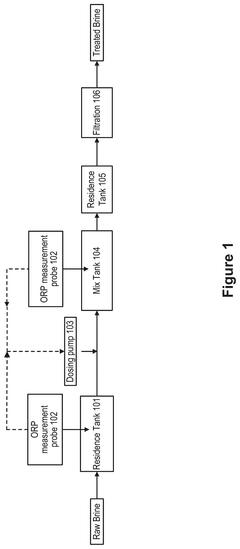
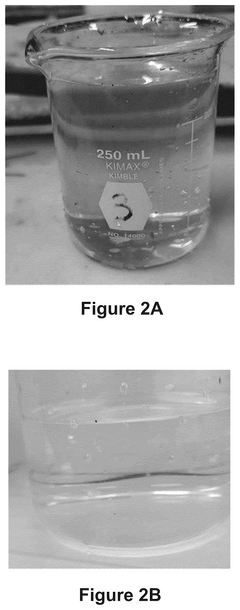
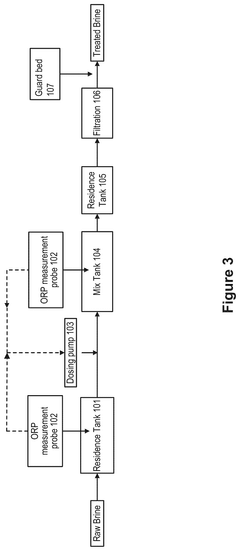
- Adjusting the oxidative-reductive potential and/or pH of the aqueous lithium salt-containing solution to render foulants inert, followed by removing these inert foulants using filtration or chelating agents to protect the lithium-selective media.
Environmental Impact Assessment
The environmental impact of Direct Lithium Extraction (DLE) technologies represents a critical consideration in their development and implementation. Traditional lithium extraction methods, particularly evaporative ponds, have significant environmental footprints including high water consumption, land use disruption, and chemical contamination. DLE technologies offer promising alternatives with potentially reduced environmental impacts.
Water usage represents one of the most significant environmental advantages of novel DLE materials and processes. While conventional evaporative methods consume approximately 500,000 gallons of water per ton of lithium produced, advanced DLE technologies utilizing selective adsorption materials can reduce water requirements by up to 90%. This dramatic reduction is particularly valuable in water-stressed regions where lithium resources are often concentrated.
Land disturbance metrics also favor DLE approaches. Evaporative ponds typically require 3,000-4,000 acres of land per operation, while DLE facilities can operate on less than 10 acres. This minimized footprint reduces habitat disruption and preserves natural landscapes in ecologically sensitive areas.
Carbon emissions associated with lithium production vary significantly between extraction methods. Life cycle assessments indicate that DLE technologies powered by renewable energy sources can achieve carbon footprints 30-60% lower than conventional methods. Novel materials that operate efficiently at ambient temperatures further reduce energy requirements and associated emissions.
Chemical usage and waste generation present both challenges and opportunities for DLE technologies. While some DLE processes require chemical reagents for lithium desorption and regeneration, advanced materials such as metal-organic frameworks (MOFs) and inorganic ion exchangers are being developed with improved selectivity and regeneration properties, reducing chemical consumption and waste generation.
Groundwater impacts remain a concern with any lithium extraction method. However, closed-loop DLE systems utilizing high-selectivity materials minimize the risk of contamination compared to open evaporation ponds. Monitoring systems and protective measures are essential components of environmentally responsible DLE operations.
Biodiversity protection represents another environmental advantage of DLE technologies. By reducing land requirements and minimizing habitat disruption, these approaches help preserve local ecosystems. This is particularly important in sensitive areas such as the lithium triangle in South America, where flamingo populations and other wildlife depend on the same water resources used in traditional lithium extraction.
Water usage represents one of the most significant environmental advantages of novel DLE materials and processes. While conventional evaporative methods consume approximately 500,000 gallons of water per ton of lithium produced, advanced DLE technologies utilizing selective adsorption materials can reduce water requirements by up to 90%. This dramatic reduction is particularly valuable in water-stressed regions where lithium resources are often concentrated.
Land disturbance metrics also favor DLE approaches. Evaporative ponds typically require 3,000-4,000 acres of land per operation, while DLE facilities can operate on less than 10 acres. This minimized footprint reduces habitat disruption and preserves natural landscapes in ecologically sensitive areas.
Carbon emissions associated with lithium production vary significantly between extraction methods. Life cycle assessments indicate that DLE technologies powered by renewable energy sources can achieve carbon footprints 30-60% lower than conventional methods. Novel materials that operate efficiently at ambient temperatures further reduce energy requirements and associated emissions.
Chemical usage and waste generation present both challenges and opportunities for DLE technologies. While some DLE processes require chemical reagents for lithium desorption and regeneration, advanced materials such as metal-organic frameworks (MOFs) and inorganic ion exchangers are being developed with improved selectivity and regeneration properties, reducing chemical consumption and waste generation.
Groundwater impacts remain a concern with any lithium extraction method. However, closed-loop DLE systems utilizing high-selectivity materials minimize the risk of contamination compared to open evaporation ponds. Monitoring systems and protective measures are essential components of environmentally responsible DLE operations.
Biodiversity protection represents another environmental advantage of DLE technologies. By reducing land requirements and minimizing habitat disruption, these approaches help preserve local ecosystems. This is particularly important in sensitive areas such as the lithium triangle in South America, where flamingo populations and other wildlife depend on the same water resources used in traditional lithium extraction.
Scalability and Economic Viability
The scalability and economic viability of Direct Lithium Extraction (DLE) technologies represent critical factors determining their widespread adoption in commercial lithium production. Current DLE implementations face significant challenges when transitioning from laboratory-scale demonstrations to industrial-scale operations. The capital expenditure (CAPEX) for establishing DLE facilities remains substantially higher than traditional evaporation pond methods, with estimates suggesting 25-30% greater initial investment requirements.
Operational expenditure (OPEX) considerations further complicate the economic equation. Novel adsorption materials, while demonstrating impressive selectivity and capacity metrics in controlled environments, often exhibit diminished performance under real-world conditions. The regeneration cycles of these materials typically decrease from theoretical 500+ cycles to practical 200-300 cycles when scaled up, significantly impacting long-term operational costs.
Energy consumption presents another substantial economic hurdle. Most advanced DLE processes require between 15-25 kWh per kilogram of lithium carbonate equivalent (LCE) produced, compared to 5-10 kWh for traditional methods. This energy intensity directly affects production costs and environmental footprint, potentially undermining the sustainability advantages that DLE promises to deliver.
Water usage efficiency, while generally superior to evaporation methods, varies considerably among different DLE technologies. Systems employing ion exchange materials typically require 30-50 cubic meters of water per ton of LCE, while those utilizing novel MOF (Metal-Organic Framework) materials may reduce this to 15-25 cubic meters. However, water treatment and recycling infrastructure adds complexity and cost to scaled operations.
Recent economic analyses indicate that DLE technologies become cost-competitive with traditional methods when production scales exceed 20,000 tons of LCE annually and when lithium concentrations in brine exceed 200 mg/L. Below these thresholds, the economic case weakens substantially unless premium pricing for faster production or environmental benefits can be secured.
Supply chain considerations for novel materials present additional scaling challenges. Many advanced adsorbents incorporate rare earth elements or specialized polymers with limited production capacity. Manufacturing scale-up for these materials lags behind the potential demand, creating bottlenecks in technology deployment and increasing material costs by 40-60% compared to laboratory-scale production.
Modular design approaches are emerging as a potential solution to scalability challenges, allowing incremental capacity expansion and reducing initial capital requirements. Companies implementing modular DLE systems report achieving positive ROI within 3-4 years, compared to 5-7 years for conventional large-scale implementations, suggesting a pathway toward improved economic viability through flexible scaling strategies.
Operational expenditure (OPEX) considerations further complicate the economic equation. Novel adsorption materials, while demonstrating impressive selectivity and capacity metrics in controlled environments, often exhibit diminished performance under real-world conditions. The regeneration cycles of these materials typically decrease from theoretical 500+ cycles to practical 200-300 cycles when scaled up, significantly impacting long-term operational costs.
Energy consumption presents another substantial economic hurdle. Most advanced DLE processes require between 15-25 kWh per kilogram of lithium carbonate equivalent (LCE) produced, compared to 5-10 kWh for traditional methods. This energy intensity directly affects production costs and environmental footprint, potentially undermining the sustainability advantages that DLE promises to deliver.
Water usage efficiency, while generally superior to evaporation methods, varies considerably among different DLE technologies. Systems employing ion exchange materials typically require 30-50 cubic meters of water per ton of LCE, while those utilizing novel MOF (Metal-Organic Framework) materials may reduce this to 15-25 cubic meters. However, water treatment and recycling infrastructure adds complexity and cost to scaled operations.
Recent economic analyses indicate that DLE technologies become cost-competitive with traditional methods when production scales exceed 20,000 tons of LCE annually and when lithium concentrations in brine exceed 200 mg/L. Below these thresholds, the economic case weakens substantially unless premium pricing for faster production or environmental benefits can be secured.
Supply chain considerations for novel materials present additional scaling challenges. Many advanced adsorbents incorporate rare earth elements or specialized polymers with limited production capacity. Manufacturing scale-up for these materials lags behind the potential demand, creating bottlenecks in technology deployment and increasing material costs by 40-60% compared to laboratory-scale production.
Modular design approaches are emerging as a potential solution to scalability challenges, allowing incremental capacity expansion and reducing initial capital requirements. Companies implementing modular DLE systems report achieving positive ROI within 3-4 years, compared to 5-7 years for conventional large-scale implementations, suggesting a pathway toward improved economic viability through flexible scaling strategies.
Unlock deeper insights with PatSnap Eureka Quick Research — get a full tech report to explore trends and direct your research. Try now!
Generate Your Research Report Instantly with AI Agent
Supercharge your innovation with PatSnap Eureka AI Agent Platform!