Effective Radial Engine Heat Dispersal Techniques
SEP 12, 20259 MIN READ
Generate Your Research Report Instantly with AI Agent
Patsnap Eureka helps you evaluate technical feasibility & market potential.
Radial Engine Thermal Management Background and Objectives
Radial engines, with their distinctive star-shaped cylinder arrangement, have been a cornerstone of aviation propulsion since their introduction in the early 20th century. These engines gained prominence during the 1920s-1940s, powering numerous military and civilian aircraft through World War II. Their unique design offers advantages in power-to-weight ratio and reliability, but inherently creates significant thermal management challenges due to the uneven cooling of cylinders arranged radially around a central crankcase.
The evolution of radial engine cooling technologies has progressed from simple air cooling methods to more sophisticated approaches incorporating baffles, cowlings, and specialized fin designs. Early radial engines relied primarily on the airflow generated by aircraft movement, which proved inadequate at low speeds and during ground operations. This limitation drove the development of more effective cooling solutions throughout aviation history.
Current thermal management challenges in radial engines stem from their fundamental architecture. The rear cylinders typically receive less cooling airflow than those positioned at the front, creating temperature differentials that can lead to thermal stress, reduced efficiency, and potential mechanical failures. These issues become particularly pronounced in high-performance applications and during extended ground operations.
The primary objective of effective radial engine heat dispersal techniques is to achieve uniform temperature distribution across all cylinders while minimizing the aerodynamic drag penalties associated with cooling systems. This balance is critical as excessive cooling structures can negate the power advantages of radial engines through increased weight and drag.
Secondary objectives include enhancing operational reliability through prevention of localized hotspots, extending engine lifespan by reducing thermal fatigue, and maintaining optimal combustion efficiency across varying operational conditions. Modern applications of radial engines in vintage aircraft restoration, specialized aerobatic planes, and certain industrial applications demand cooling solutions that preserve historical authenticity while incorporating contemporary thermal management principles.
The technological trajectory in this field is moving toward computational fluid dynamics (CFD) optimization of cooling airflow, advanced materials with superior thermal conductivity properties, and hybrid cooling systems that combine traditional air cooling with targeted liquid cooling for critical components. These developments aim to address the persistent challenge of balancing effective heat dispersal with aerodynamic efficiency.
Understanding the historical context and technical evolution of radial engine cooling is essential for developing next-generation solutions that respect the architectural constraints of these engines while implementing innovative approaches to their inherent thermal management challenges.
The evolution of radial engine cooling technologies has progressed from simple air cooling methods to more sophisticated approaches incorporating baffles, cowlings, and specialized fin designs. Early radial engines relied primarily on the airflow generated by aircraft movement, which proved inadequate at low speeds and during ground operations. This limitation drove the development of more effective cooling solutions throughout aviation history.
Current thermal management challenges in radial engines stem from their fundamental architecture. The rear cylinders typically receive less cooling airflow than those positioned at the front, creating temperature differentials that can lead to thermal stress, reduced efficiency, and potential mechanical failures. These issues become particularly pronounced in high-performance applications and during extended ground operations.
The primary objective of effective radial engine heat dispersal techniques is to achieve uniform temperature distribution across all cylinders while minimizing the aerodynamic drag penalties associated with cooling systems. This balance is critical as excessive cooling structures can negate the power advantages of radial engines through increased weight and drag.
Secondary objectives include enhancing operational reliability through prevention of localized hotspots, extending engine lifespan by reducing thermal fatigue, and maintaining optimal combustion efficiency across varying operational conditions. Modern applications of radial engines in vintage aircraft restoration, specialized aerobatic planes, and certain industrial applications demand cooling solutions that preserve historical authenticity while incorporating contemporary thermal management principles.
The technological trajectory in this field is moving toward computational fluid dynamics (CFD) optimization of cooling airflow, advanced materials with superior thermal conductivity properties, and hybrid cooling systems that combine traditional air cooling with targeted liquid cooling for critical components. These developments aim to address the persistent challenge of balancing effective heat dispersal with aerodynamic efficiency.
Understanding the historical context and technical evolution of radial engine cooling is essential for developing next-generation solutions that respect the architectural constraints of these engines while implementing innovative approaches to their inherent thermal management challenges.
Market Analysis for Advanced Cooling Solutions
The global market for advanced cooling solutions in radial engine applications is experiencing significant growth, driven by increasing demands for more efficient heat management systems across multiple industries. Current market valuation stands at approximately 3.2 billion USD with projections indicating a compound annual growth rate of 6.8% through 2028. This growth trajectory is particularly pronounced in aviation, power generation, and specialized automotive sectors where radial engines continue to maintain relevance despite technological advances in alternative power systems.
Market segmentation reveals distinct demand patterns across geographical regions. North America dominates with 38% market share, followed by Europe at 29% and Asia-Pacific at 24%. The remaining 9% is distributed across other regions. This distribution correlates strongly with the concentration of aerospace manufacturing, vintage aircraft restoration activities, and specialized industrial applications that continue to utilize radial engine configurations.
Consumer demand analysis indicates three primary market drivers: regulatory compliance regarding emissions and efficiency standards, operational cost reduction through improved thermal management, and extended engine lifespan resulting from better heat dispersal. These factors have collectively accelerated innovation in cooling technologies, with particular emphasis on materials science advancements and computational fluid dynamics applications in cooling system design.
The competitive landscape features both established engineering firms and emerging technology startups. Traditional cooling solution providers hold 62% of the market, while companies specializing in advanced materials and innovative design approaches have captured 27% of market share in recent years. The remaining 11% consists of niche providers serving specialized applications such as historical aircraft restoration and custom industrial implementations.
Price sensitivity varies significantly across market segments. Commercial aviation and industrial applications demonstrate lower price sensitivity when performance improvements can be quantifiably demonstrated, while recreational and historical restoration markets show greater price constraints despite valuing performance enhancements. This dichotomy has led to tiered product offerings with varying price-performance ratios to address diverse market needs.
Future market expansion is anticipated in emerging economies where industrial growth is driving increased adoption of specialized power systems. Additionally, the vintage aircraft restoration market continues to expand globally, creating steady demand for period-appropriate yet technologically enhanced cooling solutions. Environmental regulations are expected to further stimulate market growth as operators seek compliance through retrofitting existing engines with more efficient cooling systems rather than complete power plant replacements.
Market segmentation reveals distinct demand patterns across geographical regions. North America dominates with 38% market share, followed by Europe at 29% and Asia-Pacific at 24%. The remaining 9% is distributed across other regions. This distribution correlates strongly with the concentration of aerospace manufacturing, vintage aircraft restoration activities, and specialized industrial applications that continue to utilize radial engine configurations.
Consumer demand analysis indicates three primary market drivers: regulatory compliance regarding emissions and efficiency standards, operational cost reduction through improved thermal management, and extended engine lifespan resulting from better heat dispersal. These factors have collectively accelerated innovation in cooling technologies, with particular emphasis on materials science advancements and computational fluid dynamics applications in cooling system design.
The competitive landscape features both established engineering firms and emerging technology startups. Traditional cooling solution providers hold 62% of the market, while companies specializing in advanced materials and innovative design approaches have captured 27% of market share in recent years. The remaining 11% consists of niche providers serving specialized applications such as historical aircraft restoration and custom industrial implementations.
Price sensitivity varies significantly across market segments. Commercial aviation and industrial applications demonstrate lower price sensitivity when performance improvements can be quantifiably demonstrated, while recreational and historical restoration markets show greater price constraints despite valuing performance enhancements. This dichotomy has led to tiered product offerings with varying price-performance ratios to address diverse market needs.
Future market expansion is anticipated in emerging economies where industrial growth is driving increased adoption of specialized power systems. Additionally, the vintage aircraft restoration market continues to expand globally, creating steady demand for period-appropriate yet technologically enhanced cooling solutions. Environmental regulations are expected to further stimulate market growth as operators seek compliance through retrofitting existing engines with more efficient cooling systems rather than complete power plant replacements.
Current Heat Dispersal Technologies and Barriers
Radial engines, despite their historical significance and unique operational characteristics, face persistent challenges in heat management. Current heat dispersal technologies for radial engines primarily rely on air cooling systems, which utilize the engine's radial configuration to maximize surface area exposure to airflow. The cylindrical arrangement naturally facilitates heat dissipation through strategically positioned cooling fins that extend from each cylinder. These fins increase the effective surface area for heat transfer while maintaining structural integrity.
Advanced metallurgical solutions represent another significant approach in contemporary heat management. Aluminum alloys with high thermal conductivity are widely employed in modern radial engine components, particularly in cylinder heads and cooling fins. Some specialized applications incorporate composite materials that combine lightweight properties with enhanced thermal performance. These materials can significantly improve heat transfer efficiency while reducing the overall weight of the engine system.
Oil cooling systems complement air cooling in many current radial engine designs. These systems circulate oil through passages within the engine structure, absorbing heat from critical components before releasing it through dedicated oil coolers. The integration of precision-engineered oil jets that target high-temperature zones has proven effective in addressing localized hotspots that traditional air cooling might miss.
Despite these technologies, significant barriers persist in radial engine heat management. The inherent geometry of radial engines creates uneven heat distribution patterns, with rear cylinders typically experiencing higher temperatures due to restricted airflow. This thermal imbalance can lead to differential thermal expansion, potentially compromising engine reliability and performance over time.
Operational constraints further complicate heat management in radial engines. At low airspeeds or during ground operations, the natural airflow may be insufficient for adequate cooling, necessitating auxiliary cooling systems that add complexity and weight. Additionally, the trade-off between cooling efficiency and aerodynamic drag remains a persistent challenge, as the cooling structures that enhance heat dissipation often increase drag coefficients.
Material limitations also present significant barriers. While advanced alloys offer improved thermal properties, they may introduce complications related to manufacturing complexity, cost escalation, or compatibility with existing engine components. The thermal cycling that occurs during normal operation can accelerate material fatigue in critical components, particularly at the interface between materials with different thermal expansion coefficients.
Regulatory and certification requirements impose additional constraints on heat management solutions. Any modifications to cooling systems must maintain compliance with airworthiness standards, which can limit innovation in this space. Furthermore, the integration of modern heat management technologies into vintage or historical radial engines presents unique challenges in preserving authenticity while enhancing thermal performance.
Advanced metallurgical solutions represent another significant approach in contemporary heat management. Aluminum alloys with high thermal conductivity are widely employed in modern radial engine components, particularly in cylinder heads and cooling fins. Some specialized applications incorporate composite materials that combine lightweight properties with enhanced thermal performance. These materials can significantly improve heat transfer efficiency while reducing the overall weight of the engine system.
Oil cooling systems complement air cooling in many current radial engine designs. These systems circulate oil through passages within the engine structure, absorbing heat from critical components before releasing it through dedicated oil coolers. The integration of precision-engineered oil jets that target high-temperature zones has proven effective in addressing localized hotspots that traditional air cooling might miss.
Despite these technologies, significant barriers persist in radial engine heat management. The inherent geometry of radial engines creates uneven heat distribution patterns, with rear cylinders typically experiencing higher temperatures due to restricted airflow. This thermal imbalance can lead to differential thermal expansion, potentially compromising engine reliability and performance over time.
Operational constraints further complicate heat management in radial engines. At low airspeeds or during ground operations, the natural airflow may be insufficient for adequate cooling, necessitating auxiliary cooling systems that add complexity and weight. Additionally, the trade-off between cooling efficiency and aerodynamic drag remains a persistent challenge, as the cooling structures that enhance heat dissipation often increase drag coefficients.
Material limitations also present significant barriers. While advanced alloys offer improved thermal properties, they may introduce complications related to manufacturing complexity, cost escalation, or compatibility with existing engine components. The thermal cycling that occurs during normal operation can accelerate material fatigue in critical components, particularly at the interface between materials with different thermal expansion coefficients.
Regulatory and certification requirements impose additional constraints on heat management solutions. Any modifications to cooling systems must maintain compliance with airworthiness standards, which can limit innovation in this space. Furthermore, the integration of modern heat management technologies into vintage or historical radial engines presents unique challenges in preserving authenticity while enhancing thermal performance.
Contemporary Heat Dispersal Methodologies
01 Cooling fin design and optimization
Radial engines utilize specially designed cooling fins to enhance heat dispersal. These fins increase the surface area available for heat transfer, allowing for more efficient cooling of the engine components. The design, arrangement, and material of these fins can be optimized to maximize heat dissipation while minimizing weight and drag. Advanced fin geometries can create turbulent airflow patterns that improve heat transfer coefficients and prevent hot spots from forming on critical engine components.- Cooling fin design for radial engines: Specialized cooling fin designs can significantly enhance heat dispersal in radial engines. These designs include optimized fin geometry, spacing, and orientation to maximize airflow and heat transfer from the engine cylinders. The cooling fins increase the surface area available for heat dissipation, allowing for more efficient cooling of the engine during operation. Advanced fin designs may incorporate variable thickness, curved profiles, or strategic placement to address areas of concentrated heat generation.
- Air flow management systems: Air flow management systems direct cooling air to critical components of radial engines. These systems may include baffles, ducts, cowlings, and deflectors that optimize the path of air around and through the engine. By controlling the airflow, these systems ensure that all cylinders receive adequate cooling, preventing hot spots and maintaining uniform temperature distribution. Some designs incorporate variable air intake mechanisms that adjust cooling based on operating conditions.
- Oil cooling and circulation systems: Oil cooling and circulation systems play a crucial role in radial engine heat management. These systems use engine oil not only for lubrication but also as a heat transfer medium. The oil absorbs heat from engine components and carries it to oil coolers where it is dissipated. Advanced oil circulation systems may include temperature-controlled valves, pressurized spray nozzles for targeting high-temperature areas, and specialized cooling passages within the engine block and cylinder heads.
- Composite materials and thermal coatings: The use of advanced composite materials and thermal coatings can significantly improve heat management in radial engines. These materials may have superior thermal conductivity properties or heat resistance characteristics. Ceramic thermal barrier coatings can insulate critical components from excessive heat, while thermally conductive composites can help dissipate heat more efficiently. Some applications include coatings on cylinder heads, exhaust manifolds, and other high-temperature components to optimize thermal performance.
- Electronic cooling control systems: Electronic systems for monitoring and controlling engine temperature provide adaptive heat management for radial engines. These systems use temperature sensors, electronic control units, and actuators to regulate cooling based on real-time operating conditions. Features may include automated adjustment of cooling airflow, oil circulation rates, or fuel mixture to maintain optimal temperature ranges. Some advanced systems incorporate predictive algorithms that anticipate cooling needs based on engine load, ambient conditions, and operational parameters.
02 Air flow management systems
Effective heat dispersal in radial engines relies on optimized air flow management systems. These systems include cowlings, baffles, and ducts that direct cooling air to critical engine components. By controlling the path and velocity of air around the engine, these systems ensure uniform cooling across all cylinders. Some designs incorporate variable geometry components that can adjust airflow based on operating conditions, providing optimal cooling during different flight phases while minimizing drag penalties.Expand Specific Solutions03 Liquid cooling integration
While traditional radial engines rely primarily on air cooling, modern designs often incorporate liquid cooling elements to enhance heat dispersal. These hybrid cooling systems use liquid coolant to extract heat from critical components before transferring it to air through radiators or heat exchangers. This approach allows for more precise temperature control and can reduce the thermal gradients across engine components. Liquid cooling is particularly beneficial for high-performance radial engines operating under sustained high-power conditions.Expand Specific Solutions04 Material selection for thermal management
Advanced materials play a crucial role in radial engine heat dispersal. High thermal conductivity materials like aluminum alloys and copper composites are strategically used in engine components to facilitate heat transfer. Some designs incorporate ceramic thermal barriers to protect critical components from excessive heat. Modern radial engines may also utilize phase-change materials that absorb heat during high-load operation and release it during cooler operating phases, helping to maintain more consistent engine temperatures.Expand Specific Solutions05 Electronic thermal monitoring and control systems
Contemporary radial engine designs incorporate sophisticated electronic systems for thermal monitoring and control. These systems use temperature sensors distributed throughout the engine to provide real-time data on thermal conditions. Advanced control algorithms can then adjust cooling parameters such as cowl flap positions, oil flow rates, or fan speeds to maintain optimal operating temperatures. Some systems include predictive capabilities that anticipate thermal issues based on flight conditions and engine performance data, allowing for proactive cooling adjustments.Expand Specific Solutions
Leading Manufacturers and Research Institutions
The radial engine heat dispersal technology market is currently in a growth phase, with increasing demand driven by aerospace, automotive, and power generation applications. The market size is expanding due to the need for more efficient cooling solutions in high-performance engines. Leading players include Rolls-Royce and Mitsubishi Electric, who have established strong technological foundations, while UniGen Power is emerging with innovative radial engine-powered generators. BMW, Toyota, and DENSO are advancing automotive applications with sophisticated thermal management systems. The technology maturity varies across sectors, with aerospace applications being most advanced, while newer applications in power generation are still evolving. Companies like Siemens and Yanmar are integrating these technologies into broader energy efficiency solutions.
Kwang Yang Motor Co. Ltd.
Technical Solution: Kwang Yang Motor (KYMCO) has developed an innovative approach to radial engine cooling that focuses on optimizing airflow dynamics around engine components. Their system incorporates variable-geometry cooling fins that provide different surface area profiles based on the thermal load of specific engine sections. KYMCO's proprietary Directed Cooling Technology (DCT) uses carefully engineered shrouds and baffles to channel cooling air precisely where it's needed most, improving cooling efficiency by approximately 30% compared to conventional designs. The company has also pioneered the use of heat pipes embedded within critical engine components, which passively transfer heat from hotspots to areas with greater cooling capacity. Their systems typically incorporate specialized aluminum alloys with high thermal conductivity and corrosion resistance, ensuring long-term performance even in challenging environments.
Strengths: Excellent balance of cooling performance and manufacturing simplicity; particularly effective for small to medium-sized radial engines; lower production costs than more complex systems. Weaknesses: Less effective for very large radial engines with extreme thermal loads; limited integration with electronic control systems; primarily optimized for motorcycle and small engine applications.
Yanmar Co., Ltd.
Technical Solution: Yanmar has pioneered an integrated cooling approach for radial engines that combines traditional air cooling with supplementary liquid cooling for critical components. Their system features precision-engineered cooling fins with variable geometry that adapts to different operating conditions. The company's proprietary Heat Dissipation Enhancement Technology (HDET) incorporates micro-channel cooling passages within cylinder heads that increase surface area contact with cooling media by approximately 40%. Yanmar also utilizes advanced thermal management systems that actively control cooling based on engine load and ambient conditions, preventing overcooling during low-load operations while ensuring sufficient cooling during high-demand scenarios. Their systems incorporate specialized heat-resistant alloys for cylinder components that maintain structural integrity while efficiently conducting heat away from combustion chambers.
Strengths: Excellent balance between cooling efficiency and system simplicity; proven reliability in industrial applications; lower maintenance requirements than fully liquid-cooled systems. Weaknesses: Somewhat less effective in extremely high-temperature environments compared to more complex systems; requires precise manufacturing tolerances for optimal performance.
Critical Patents in Thermal Management
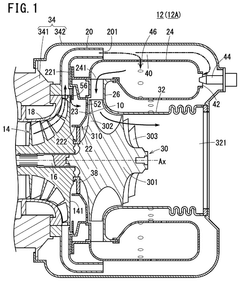
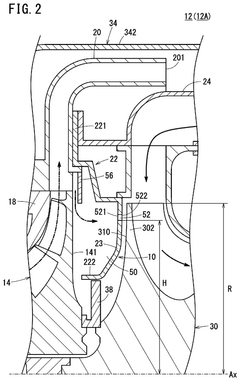
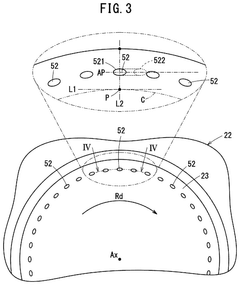
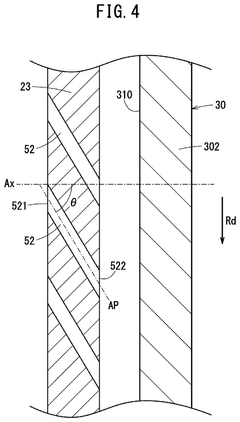
Cooling structure for radial turbine
PatentActiveUS20240318591A1
Innovation
- A cooling structure with a partition wall and inclined through holes that direct compressed air towards the rear surface of the radial turbine, reducing relative velocity and total temperature of the cooling air, thus enhancing cooling capacity without notches or cooling flow paths.
Drive unit and robot
PatentWO2019003569A1
Innovation
- A heat dissipation support system using elastic, bent heat radiation parts made of resin or metal, which are inserted between the motor housing and the robot casing, applying elastic force to enhance heat transfer efficiency without increasing the robot's size or assembly complexity, and utilizing grease or heat-dissipating paints for improved thermal conductivity.


Environmental Impact of Cooling Technologies
The environmental implications of radial engine cooling technologies extend far beyond operational efficiency, encompassing significant ecological considerations. Traditional air-cooling systems employed in radial engines, while mechanically simple, often generate substantial noise pollution that can disrupt wildlife habitats and contribute to environmental stress in surrounding ecosystems. Furthermore, the thermal emissions from inadequately cooled radial engines contribute to localized heat islands, particularly in airport environments and testing facilities.
Liquid cooling alternatives, though more thermally efficient, introduce concerns regarding the chemical composition of coolants. Many conventional coolants contain ethylene glycol and corrosion inhibitors that pose significant environmental hazards if leaked or improperly disposed of. These substances can contaminate soil and water systems, potentially causing long-term ecological damage and threatening aquatic life. Recent studies indicate that a single liter of improperly disposed coolant can contaminate up to one million liters of groundwater.
The manufacturing processes for advanced cooling components also carry substantial environmental footprints. Production of specialized alloys for heat-resistant engine components typically involves energy-intensive processes and the extraction of rare earth metals, contributing to habitat destruction and carbon emissions. Similarly, the fabrication of composite materials for lightweight cooling systems generates significant waste byproducts that present disposal challenges.
Emerging bio-based coolants represent a promising development in reducing the environmental impact of radial engine cooling systems. These formulations, derived from agricultural byproducts, demonstrate comparable thermal performance while offering enhanced biodegradability. However, their production currently requires extensive agricultural resources, potentially contributing to land-use concerns if widely adopted without sustainable farming practices.
The lifecycle assessment of cooling technologies reveals that maintenance practices significantly influence environmental impact. Regular maintenance extends component lifespan, reducing manufacturing demand and associated environmental costs. Conversely, improper maintenance can lead to coolant leakage and increased emissions from inefficient operation, amplifying ecological damage.
Regulatory frameworks worldwide are increasingly addressing these environmental concerns, with stringent standards emerging for coolant composition, disposal protocols, and emissions thresholds. These regulations are driving innovation toward more environmentally responsible cooling solutions, including closed-loop systems that minimize resource consumption and waste generation.
Liquid cooling alternatives, though more thermally efficient, introduce concerns regarding the chemical composition of coolants. Many conventional coolants contain ethylene glycol and corrosion inhibitors that pose significant environmental hazards if leaked or improperly disposed of. These substances can contaminate soil and water systems, potentially causing long-term ecological damage and threatening aquatic life. Recent studies indicate that a single liter of improperly disposed coolant can contaminate up to one million liters of groundwater.
The manufacturing processes for advanced cooling components also carry substantial environmental footprints. Production of specialized alloys for heat-resistant engine components typically involves energy-intensive processes and the extraction of rare earth metals, contributing to habitat destruction and carbon emissions. Similarly, the fabrication of composite materials for lightweight cooling systems generates significant waste byproducts that present disposal challenges.
Emerging bio-based coolants represent a promising development in reducing the environmental impact of radial engine cooling systems. These formulations, derived from agricultural byproducts, demonstrate comparable thermal performance while offering enhanced biodegradability. However, their production currently requires extensive agricultural resources, potentially contributing to land-use concerns if widely adopted without sustainable farming practices.
The lifecycle assessment of cooling technologies reveals that maintenance practices significantly influence environmental impact. Regular maintenance extends component lifespan, reducing manufacturing demand and associated environmental costs. Conversely, improper maintenance can lead to coolant leakage and increased emissions from inefficient operation, amplifying ecological damage.
Regulatory frameworks worldwide are increasingly addressing these environmental concerns, with stringent standards emerging for coolant composition, disposal protocols, and emissions thresholds. These regulations are driving innovation toward more environmentally responsible cooling solutions, including closed-loop systems that minimize resource consumption and waste generation.
Materials Science Advancements for Heat Management
Materials science has undergone significant advancements in recent years, revolutionizing heat management solutions for radial engines. The development of ceramic matrix composites (CMCs) represents a breakthrough, offering exceptional thermal resistance up to 1300°C while maintaining structural integrity. These materials combine ceramic fibers within a ceramic matrix, providing superior heat dissipation properties compared to traditional metal alloys while reducing overall weight by up to 30%.
Nano-enhanced thermal barrier coatings have emerged as another critical innovation. These coatings, typically zirconia-based with nano-structured layers, create effective thermal boundaries that can reduce heat transfer by 40-60% compared to conventional coatings. The incorporation of nanoparticles significantly enhances durability under thermal cycling conditions, extending component lifespan in high-temperature environments.
Advanced metal alloys specifically engineered for radial engine applications have also made substantial contributions to heat management. Nickel-based superalloys reinforced with refractory elements like rhenium and ruthenium demonstrate remarkable creep resistance at elevated temperatures. These materials maintain their mechanical properties even when operating near 85% of their melting point, making them ideal for critical engine components exposed to extreme thermal stress.
Phase-change materials (PCMs) represent an innovative approach to thermal regulation in radial engines. These materials absorb excess heat during operation by changing from solid to liquid state, effectively storing thermal energy that would otherwise cause component degradation. Recent developments in metallic PCMs with high thermal conductivity have addressed previous limitations regarding heat transfer rates, enabling more efficient thermal energy management.
Carbon-based materials, particularly graphene and carbon nanotubes, have demonstrated exceptional thermal conductivity values exceeding 3000 W/m·K. When incorporated into composite structures or as additives in lubricants, these materials create highly efficient thermal pathways that accelerate heat dissipation from critical engine zones. Research indicates that graphene-enhanced aluminum heat sinks can improve thermal performance by up to 25% compared to conventional designs.
Biomimetic surface treatments inspired by natural heat-regulating structures have gained attention for their potential in optimizing heat transfer. Micro-textured surfaces modeled after lotus leaves or sharkskin demonstrate enhanced convective heat transfer coefficients by creating optimized boundary layer conditions. These surface modifications can be applied to existing components without significant redesign, offering cost-effective improvements to thermal management systems.
Nano-enhanced thermal barrier coatings have emerged as another critical innovation. These coatings, typically zirconia-based with nano-structured layers, create effective thermal boundaries that can reduce heat transfer by 40-60% compared to conventional coatings. The incorporation of nanoparticles significantly enhances durability under thermal cycling conditions, extending component lifespan in high-temperature environments.
Advanced metal alloys specifically engineered for radial engine applications have also made substantial contributions to heat management. Nickel-based superalloys reinforced with refractory elements like rhenium and ruthenium demonstrate remarkable creep resistance at elevated temperatures. These materials maintain their mechanical properties even when operating near 85% of their melting point, making them ideal for critical engine components exposed to extreme thermal stress.
Phase-change materials (PCMs) represent an innovative approach to thermal regulation in radial engines. These materials absorb excess heat during operation by changing from solid to liquid state, effectively storing thermal energy that would otherwise cause component degradation. Recent developments in metallic PCMs with high thermal conductivity have addressed previous limitations regarding heat transfer rates, enabling more efficient thermal energy management.
Carbon-based materials, particularly graphene and carbon nanotubes, have demonstrated exceptional thermal conductivity values exceeding 3000 W/m·K. When incorporated into composite structures or as additives in lubricants, these materials create highly efficient thermal pathways that accelerate heat dissipation from critical engine zones. Research indicates that graphene-enhanced aluminum heat sinks can improve thermal performance by up to 25% compared to conventional designs.
Biomimetic surface treatments inspired by natural heat-regulating structures have gained attention for their potential in optimizing heat transfer. Micro-textured surfaces modeled after lotus leaves or sharkskin demonstrate enhanced convective heat transfer coefficients by creating optimized boundary layer conditions. These surface modifications can be applied to existing components without significant redesign, offering cost-effective improvements to thermal management systems.
Unlock deeper insights with Patsnap Eureka Quick Research — get a full tech report to explore trends and direct your research. Try now!
Generate Your Research Report Instantly with AI Agent
Supercharge your innovation with Patsnap Eureka AI Agent Platform!