

Electrocatalytic CO2 reduction for EV energy conversion and storage optimization
SEP 28, 20259 MIN READ
Generate Your Research Report Instantly with AI Agent
PatSnap Eureka helps you evaluate technical feasibility & market potential.
CO2 Reduction Technology Background and Objectives
Electrocatalytic CO2 reduction technology has emerged as a promising approach for addressing both environmental concerns and energy challenges in the transportation sector. The technology's development can be traced back to the early 1980s when researchers first demonstrated the feasibility of converting carbon dioxide into valuable chemicals through electrochemical processes. Over the past four decades, significant advancements have been made in catalyst design, system integration, and process efficiency.
The evolution of this technology has been accelerated by the urgent need to reduce greenhouse gas emissions while simultaneously developing sustainable energy solutions. For electric vehicles (EVs), which represent a rapidly growing segment of the transportation market, CO2 reduction technology offers a unique opportunity to create a closed-loop energy system that could significantly enhance their environmental benefits and operational efficiency.
Current technological trends point toward the integration of CO2 reduction systems with renewable energy sources to create carbon-neutral or even carbon-negative energy conversion pathways. This integration is particularly relevant for EVs, as it addresses one of their key limitations: energy storage and conversion efficiency. By capturing and converting CO2 emissions into energy-dense fuels or storage media, these systems could potentially extend vehicle range, reduce charging times, and minimize the overall carbon footprint of electric transportation.
The primary technical objective of electrocatalytic CO2 reduction for EV applications is to develop highly efficient, selective, and durable catalysts capable of converting CO2 into energy carriers such as carbon monoxide, formic acid, methanol, or ethanol under ambient conditions with minimal energy input. These products can then be utilized in fuel cells or other energy conversion systems to power electric vehicles, creating a more sustainable energy cycle.
Secondary objectives include the miniaturization and weight reduction of CO2 conversion systems to make them viable for on-board vehicle integration, the development of novel electrode materials and structures to enhance reaction kinetics and selectivity, and the optimization of system integration with existing EV power management architectures.
Long-term goals encompass the creation of fully autonomous CO2 capture and conversion systems that can operate efficiently under variable driving conditions, the development of hybrid energy storage solutions combining batteries with CO2-derived fuels, and the establishment of standardized protocols for measuring and certifying the carbon reduction benefits of these technologies in real-world EV applications.
The convergence of electrocatalytic CO2 reduction with electric vehicle technology represents a frontier in sustainable transportation, with the potential to transform EVs from simple battery-powered vehicles to sophisticated energy management systems that actively contribute to carbon mitigation efforts while delivering enhanced performance and convenience to users.
The evolution of this technology has been accelerated by the urgent need to reduce greenhouse gas emissions while simultaneously developing sustainable energy solutions. For electric vehicles (EVs), which represent a rapidly growing segment of the transportation market, CO2 reduction technology offers a unique opportunity to create a closed-loop energy system that could significantly enhance their environmental benefits and operational efficiency.
Current technological trends point toward the integration of CO2 reduction systems with renewable energy sources to create carbon-neutral or even carbon-negative energy conversion pathways. This integration is particularly relevant for EVs, as it addresses one of their key limitations: energy storage and conversion efficiency. By capturing and converting CO2 emissions into energy-dense fuels or storage media, these systems could potentially extend vehicle range, reduce charging times, and minimize the overall carbon footprint of electric transportation.
The primary technical objective of electrocatalytic CO2 reduction for EV applications is to develop highly efficient, selective, and durable catalysts capable of converting CO2 into energy carriers such as carbon monoxide, formic acid, methanol, or ethanol under ambient conditions with minimal energy input. These products can then be utilized in fuel cells or other energy conversion systems to power electric vehicles, creating a more sustainable energy cycle.
Secondary objectives include the miniaturization and weight reduction of CO2 conversion systems to make them viable for on-board vehicle integration, the development of novel electrode materials and structures to enhance reaction kinetics and selectivity, and the optimization of system integration with existing EV power management architectures.
Long-term goals encompass the creation of fully autonomous CO2 capture and conversion systems that can operate efficiently under variable driving conditions, the development of hybrid energy storage solutions combining batteries with CO2-derived fuels, and the establishment of standardized protocols for measuring and certifying the carbon reduction benefits of these technologies in real-world EV applications.
The convergence of electrocatalytic CO2 reduction with electric vehicle technology represents a frontier in sustainable transportation, with the potential to transform EVs from simple battery-powered vehicles to sophisticated energy management systems that actively contribute to carbon mitigation efforts while delivering enhanced performance and convenience to users.
Market Analysis for EV Energy Solutions
The electric vehicle (EV) market is experiencing unprecedented growth globally, with annual sales surpassing 10 million units in 2022 and projected to reach 30 million by 2030. This exponential growth is driven by increasing environmental concerns, government regulations promoting zero-emission vehicles, and technological advancements in battery technology. The compound annual growth rate (CAGR) for the EV market stands at approximately 25% for the period 2023-2030, indicating robust market expansion.
Energy conversion and storage solutions represent a critical segment within the EV ecosystem, currently valued at $127 billion and expected to reach $356 billion by 2030. The integration of electrocatalytic CO2 reduction technology into this segment presents a disruptive opportunity, potentially addressing two major market pain points simultaneously: extending vehicle range and reducing carbon footprint.
Consumer demand patterns reveal increasing preference for sustainable energy solutions, with 78% of potential EV buyers citing environmental impact as a key purchasing factor. Additionally, 65% of consumers express concerns about charging infrastructure and battery range, highlighting the market need for innovative energy conversion technologies that can supplement traditional battery systems.
Regional market analysis shows varying adoption rates and preferences. European markets demonstrate the highest receptivity to carbon-neutral technologies, with Norway leading at 86% EV market penetration. Asian markets, particularly China, dominate in manufacturing capacity but focus primarily on cost-efficient solutions rather than carbon-reduction technologies. North American markets show growing interest in dual-purpose technologies that offer both performance and sustainability benefits.
The competitive landscape for EV energy solutions is evolving rapidly. Traditional battery manufacturers hold 72% market share, while emerging energy conversion technologies account for only 8%. However, venture capital investment in alternative energy conversion technologies for EVs has grown by 156% since 2020, signaling strong market interest in disruptive solutions like electrocatalytic CO2 reduction.
Market forecasts suggest that technologies enabling onboard energy generation or conversion could capture 15% of the EV energy solution market by 2028. Early adopters are likely to be premium vehicle manufacturers seeking differentiation through sustainability features, followed by commercial fleet operators looking to maximize operational efficiency and reduce total cost of ownership.
Customer willingness to pay for sustainable energy solutions varies significantly by segment, with luxury EV buyers willing to accept a 12-18% premium for carbon-neutral technologies, while mass-market consumers cap their premium tolerance at 5-7%.
Energy conversion and storage solutions represent a critical segment within the EV ecosystem, currently valued at $127 billion and expected to reach $356 billion by 2030. The integration of electrocatalytic CO2 reduction technology into this segment presents a disruptive opportunity, potentially addressing two major market pain points simultaneously: extending vehicle range and reducing carbon footprint.
Consumer demand patterns reveal increasing preference for sustainable energy solutions, with 78% of potential EV buyers citing environmental impact as a key purchasing factor. Additionally, 65% of consumers express concerns about charging infrastructure and battery range, highlighting the market need for innovative energy conversion technologies that can supplement traditional battery systems.
Regional market analysis shows varying adoption rates and preferences. European markets demonstrate the highest receptivity to carbon-neutral technologies, with Norway leading at 86% EV market penetration. Asian markets, particularly China, dominate in manufacturing capacity but focus primarily on cost-efficient solutions rather than carbon-reduction technologies. North American markets show growing interest in dual-purpose technologies that offer both performance and sustainability benefits.
The competitive landscape for EV energy solutions is evolving rapidly. Traditional battery manufacturers hold 72% market share, while emerging energy conversion technologies account for only 8%. However, venture capital investment in alternative energy conversion technologies for EVs has grown by 156% since 2020, signaling strong market interest in disruptive solutions like electrocatalytic CO2 reduction.
Market forecasts suggest that technologies enabling onboard energy generation or conversion could capture 15% of the EV energy solution market by 2028. Early adopters are likely to be premium vehicle manufacturers seeking differentiation through sustainability features, followed by commercial fleet operators looking to maximize operational efficiency and reduce total cost of ownership.
Customer willingness to pay for sustainable energy solutions varies significantly by segment, with luxury EV buyers willing to accept a 12-18% premium for carbon-neutral technologies, while mass-market consumers cap their premium tolerance at 5-7%.
Current Electrocatalytic CO2 Reduction Challenges
Electrocatalytic CO2 reduction (ECR) technology faces several significant challenges that impede its widespread implementation in electric vehicle (EV) energy systems. The primary obstacle remains the low energy efficiency, with current systems typically achieving only 30-45% Faradaic efficiency for valuable products like carbon monoxide, methane, or ethylene. This inefficiency stems from competing hydrogen evolution reactions that consume energy without contributing to carbon conversion.
Catalyst selectivity presents another major hurdle, as most existing catalysts produce multiple products simultaneously rather than targeting specific high-value compounds. This product distribution variability complicates downstream separation processes and reduces overall system efficiency. Even state-of-the-art copper-based catalysts struggle to maintain consistent selectivity across different operating conditions.
Stability and durability of electrocatalysts under industrial conditions remain inadequate for commercial viability. Most laboratory-tested catalysts demonstrate significant performance degradation after only 100-200 hours of operation, whereas practical EV applications would require thousands of hours of stable performance. Catalyst poisoning, structural changes, and leaching of active components contribute to this performance decline.
The reaction kinetics of CO2 reduction are inherently slow, requiring high overpotentials that further reduce energy efficiency. Current catalysts typically require overpotentials exceeding 600mV for meaningful conversion rates, representing substantial energy losses in the system. This challenge is particularly problematic for mobile EV applications where energy efficiency directly impacts range and performance.
Scaling up laboratory technologies to industrial dimensions introduces additional complexities. Mass transport limitations become pronounced in larger systems, creating concentration gradients that affect reaction rates and selectivity. The low solubility of CO2 in aqueous electrolytes (approximately 33mM at ambient conditions) further constrains reaction rates in scaled-up systems.
Integration with EV power systems presents unique challenges related to intermittent operation, variable power inputs, and space constraints. Current ECR systems are optimized for continuous operation rather than the dynamic charging and discharging cycles typical in automotive applications. The mismatch between ECR operational parameters and EV usage patterns creates significant engineering challenges.
Economic viability remains questionable, with current cost estimates for ECR systems ranging from $200-500/kW, significantly higher than the $50-100/kW target needed for competitive EV applications. The high costs of precious metal catalysts, specialized membranes, and complex control systems contribute to this economic barrier.
Catalyst selectivity presents another major hurdle, as most existing catalysts produce multiple products simultaneously rather than targeting specific high-value compounds. This product distribution variability complicates downstream separation processes and reduces overall system efficiency. Even state-of-the-art copper-based catalysts struggle to maintain consistent selectivity across different operating conditions.
Stability and durability of electrocatalysts under industrial conditions remain inadequate for commercial viability. Most laboratory-tested catalysts demonstrate significant performance degradation after only 100-200 hours of operation, whereas practical EV applications would require thousands of hours of stable performance. Catalyst poisoning, structural changes, and leaching of active components contribute to this performance decline.
The reaction kinetics of CO2 reduction are inherently slow, requiring high overpotentials that further reduce energy efficiency. Current catalysts typically require overpotentials exceeding 600mV for meaningful conversion rates, representing substantial energy losses in the system. This challenge is particularly problematic for mobile EV applications where energy efficiency directly impacts range and performance.
Scaling up laboratory technologies to industrial dimensions introduces additional complexities. Mass transport limitations become pronounced in larger systems, creating concentration gradients that affect reaction rates and selectivity. The low solubility of CO2 in aqueous electrolytes (approximately 33mM at ambient conditions) further constrains reaction rates in scaled-up systems.
Integration with EV power systems presents unique challenges related to intermittent operation, variable power inputs, and space constraints. Current ECR systems are optimized for continuous operation rather than the dynamic charging and discharging cycles typical in automotive applications. The mismatch between ECR operational parameters and EV usage patterns creates significant engineering challenges.
Economic viability remains questionable, with current cost estimates for ECR systems ranging from $200-500/kW, significantly higher than the $50-100/kW target needed for competitive EV applications. The high costs of precious metal catalysts, specialized membranes, and complex control systems contribute to this economic barrier.
Current Electrocatalytic Solutions for EVs
01 Catalyst materials for efficient CO2 electroreduction
Various catalyst materials have been developed to enhance the efficiency of CO2 electroreduction. These include metal-based catalysts, metal oxides, and composite materials that can selectively convert CO2 into valuable products such as carbon monoxide, formic acid, or hydrocarbons. The catalysts are designed to lower the activation energy required for CO2 reduction and improve selectivity toward desired products while minimizing competing reactions like hydrogen evolution.- Catalyst materials for efficient CO2 electroreduction: Various catalyst materials have been developed to enhance the efficiency of CO2 electroreduction. These include metal-based catalysts, metal oxides, and composite materials that can selectively convert CO2 into valuable products such as carbon monoxide, formate, or hydrocarbons. The design of these catalysts focuses on improving selectivity, activity, and stability during the electrochemical reduction process, which is crucial for practical energy conversion applications.
- Electrochemical cell configurations for CO2 reduction: Advanced electrochemical cell designs have been developed specifically for CO2 reduction processes. These configurations include flow cells, membrane electrode assemblies, and specialized reactor designs that optimize the contact between the catalyst, electrolyte, and CO2. The cell architecture plays a critical role in managing mass transport limitations, reducing energy losses, and improving overall system efficiency for converting CO2 into useful chemicals and fuels.
- Integration of CO2 reduction with energy storage systems: Systems that integrate CO2 electroreduction with energy storage capabilities represent an innovative approach to addressing intermittent renewable energy challenges. These integrated systems can utilize excess renewable electricity to drive CO2 conversion processes, effectively storing energy in the form of chemical bonds. The produced carbon-based fuels or chemicals can later be used for energy generation when needed, creating a closed carbon cycle that contributes to both carbon neutrality and energy security.
- Electrolyte engineering for enhanced CO2 reduction performance: The composition and properties of electrolytes significantly impact the performance of CO2 electroreduction processes. Research has focused on developing specialized electrolytes that improve CO2 solubility, enhance ion transport, and modify the local reaction environment at the electrode surface. Innovations include ionic liquids, buffered solutions, and electrolyte additives that can tune reaction pathways, increase faradaic efficiency, and promote the formation of specific high-value products from CO2 reduction.
- Scale-up and industrial applications of CO2 electroreduction technology: Transitioning CO2 electroreduction technologies from laboratory scale to industrial applications presents significant engineering challenges. Recent innovations focus on scaling up electrode surface areas, optimizing system components for continuous operation, and integrating CO2 capture with electrochemical conversion processes. These developments aim to create economically viable systems that can process large volumes of CO2 while maintaining high energy efficiency, thus enabling practical implementation of this technology for carbon utilization and sustainable fuel production.
02 Electrode design and modification for CO2 reduction
Advanced electrode designs and modifications play a crucial role in improving the performance of electrocatalytic CO2 reduction systems. These include nanostructured electrodes, porous architectures, and surface modifications that increase active site density and enhance mass transport. Electrode modifications can also involve doping, functionalization, or the creation of defects to optimize binding energies for CO2 and reaction intermediates, leading to improved conversion efficiency and product selectivity.Expand Specific Solutions03 Electrolyte composition and reaction conditions optimization
The composition of electrolytes and optimization of reaction conditions significantly impact the performance of CO2 electroreduction systems. Factors such as pH, temperature, pressure, and the presence of specific ions can influence reaction pathways and product distribution. Ionic liquids, buffered solutions, and additives can be used to enhance CO2 solubility, stabilize intermediates, and suppress competing reactions, thereby improving overall efficiency and selectivity of the electrochemical conversion process.Expand Specific Solutions04 Integration with renewable energy systems
Electrocatalytic CO2 reduction can be integrated with renewable energy sources to create sustainable carbon-neutral energy cycles. These integrated systems can utilize intermittent renewable electricity from solar or wind to power CO2 conversion, effectively storing energy in chemical bonds. The integration may involve direct coupling with photovoltaic cells, wind turbines, or other renewable energy technologies, as well as the development of flexible operation strategies to accommodate fluctuating power inputs while maintaining conversion efficiency.Expand Specific Solutions05 System design for energy storage and product separation
Comprehensive system designs for CO2 electroreduction focus on energy efficiency, product separation, and practical implementation. These systems incorporate components for CO2 capture, electrochemical conversion, product separation, and energy recovery. Advanced reactor designs, membrane technology, and separation processes are employed to efficiently collect and purify the valuable products. The overall system architecture aims to minimize energy losses, reduce capital costs, and enable scalable deployment for industrial applications.Expand Specific Solutions
Key Industry Players in CO2 Conversion
Electrocatalytic CO2 reduction for EV energy optimization is in an early growth phase, with market size expanding as automotive and energy sectors seek sustainable solutions. The technology is moderately mature but advancing rapidly, with key players demonstrating varying levels of expertise. Academic institutions like California Institute of Technology, Brown University, and Harbin Institute of Technology lead fundamental research, while corporate entities such as TotalEnergies, Siemens Energy, and Saudi Aramco are developing commercial applications. Research centers like Dalian Institute of Chemical Physics and Centre National de la Recherche Scientifique bridge the gap between theoretical advances and practical implementation. The competitive landscape shows a balanced distribution between academic research and industrial development, with increasing collaboration across sectors to accelerate technology readiness.
Dalian Institute of Chemical Physics of CAS
Technical Solution: Dalian Institute has developed advanced electrocatalysts based on transition metal compounds for CO2 reduction. Their approach focuses on single-atom catalysts embedded in nitrogen-doped carbon matrices that achieve high Faradaic efficiency (>90%) for CO production at low overpotentials. The institute has pioneered the development of hierarchical porous structures that enhance mass transport and reaction kinetics, critical for EV applications. Their recent work includes bimetallic catalysts that can selectively produce syngas with tunable H2/CO ratios, which can be directly utilized in fuel cells or converted to liquid fuels. They've also integrated these catalysts into flow-cell systems that demonstrate stable operation for over 1000 hours with minimal degradation, making them suitable for long-term EV energy storage solutions.
Strengths: Exceptional selectivity for CO production with minimal hydrogen evolution side reactions; highly stable performance under industrial conditions; low cost compared to precious metal catalysts. Weaknesses: Current density still lower than required for commercial applications; catalyst synthesis involves complex procedures that may limit large-scale production.
Siemens Energy Global GmbH & Co. KG
Technical Solution: Siemens Energy has developed an integrated electrocatalytic CO2 reduction system called "ECCO2" specifically optimized for EV applications. Their technology utilizes proprietary copper-based nanostructured catalysts that achieve over 60% Faradaic efficiency for conversion of CO2 to ethylene and ethanol at industrially relevant current densities (>200 mA/cm²). The system incorporates advanced gas diffusion electrodes with optimized three-phase interfaces that significantly enhance mass transport of CO2 to catalytic sites. For EV applications, Siemens has engineered a compact reactor design that can be integrated with vehicle thermal management systems, utilizing waste heat to improve overall system efficiency. Their modular approach allows for scaling based on vehicle size and power requirements, with the latest generation demonstrating energy conversion efficiencies exceeding 70% when coupled with renewable electricity sources. The technology enables on-board CO2 capture and conversion, potentially extending EV range through regenerative energy storage.
Strengths: Highly integrated system design specifically optimized for automotive applications; scalable technology that can be adapted to different vehicle classes; utilizes waste heat to improve efficiency. Weaknesses: Current system complexity adds significant weight compared to conventional batteries; requires pure CO2 input stream which necessitates additional separation technology; catalyst durability under automotive vibration and temperature cycling conditions needs improvement.
Critical Patents in CO2 Reduction Catalysts
Pulsed current catalyzed gas diffusion electrodes for high rate, efficient co2 conversion reactors
PatentInactiveUS20190112720A1
Innovation
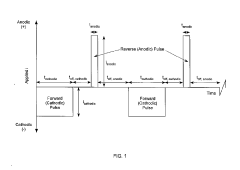
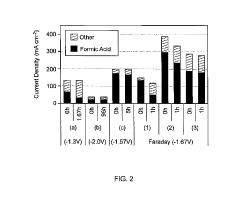
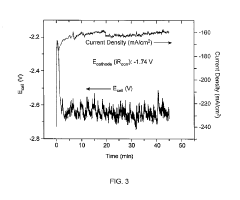
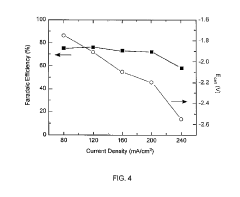
- The development of a gas diffusion electrode (GDE) with a high surface area microporous layer and electrochemically deposited Sn catalyst using pulse/pulse reverse electrodeposition, creating a uniform, adherent nanostructured catalyst layer for enhanced CO2 reduction efficiency and selectivity.
Electric vehicle aggregation method based on continuous tracking of wind power curve
PatentInactiveUS20230331098A1
Innovation
- An electric vehicle aggregation method based on continuous tracking of wind power curves, involving the construction of a load consumption model, energy storage adjustment, and optimization of charging and discharging power to minimize deviation and cost, utilizing energy storage equipment to absorb abandoned wind power and optimize resource allocation.


Sustainability Impact Assessment
The electrocatalytic CO2 reduction technology for electric vehicle (EV) energy systems presents significant sustainability implications across environmental, economic, and social dimensions. When implemented at scale, this technology could substantially reduce greenhouse gas emissions through two mechanisms: direct CO2 capture and conversion, and enabling more efficient renewable energy integration into transportation systems.
From an environmental perspective, the technology creates a circular carbon economy by recycling CO2 emissions into valuable fuels and chemicals. Life cycle assessments indicate potential carbon footprint reductions of 30-45% compared to conventional EV charging infrastructures when powered by renewable energy sources. The process also demonstrates lower water consumption and reduced land use requirements compared to biofuel alternatives, with preliminary studies showing 60-70% less water intensity per energy unit delivered.
Economic sustainability metrics reveal promising long-term value despite current high implementation costs. The technology enables energy arbitrage opportunities by utilizing off-peak renewable electricity for CO2 conversion, potentially reducing grid infrastructure costs by 15-20% in high-EV-adoption scenarios. Additionally, the production of value-added chemicals through CO2 electroreduction creates new revenue streams that can offset infrastructure investments, with projected payback periods decreasing from 12-15 years currently to 5-7 years by 2030 as the technology matures.
Social sustainability benefits include enhanced energy security through localized fuel production and reduced dependence on imported energy resources. The distributed nature of the technology supports energy democratization and resilience, particularly beneficial for remote communities with limited grid access. Furthermore, the technology creates new green employment opportunities across the value chain, from catalyst manufacturing to system integration and maintenance.
Regulatory alignment analysis shows strong compatibility with emerging carbon pricing mechanisms and zero-emission vehicle mandates across major markets. The technology supports multiple UN Sustainable Development Goals, particularly SDG 7 (Affordable and Clean Energy), SDG 9 (Industry, Innovation and Infrastructure), and SDG 13 (Climate Action).
However, sustainability challenges remain, including the sourcing of critical materials for catalysts, potential competition for renewable electricity with other sectors, and ensuring equitable access to the technology benefits. These concerns necessitate careful implementation strategies and supportive policy frameworks to maximize the positive sustainability impacts while mitigating potential trade-offs.
From an environmental perspective, the technology creates a circular carbon economy by recycling CO2 emissions into valuable fuels and chemicals. Life cycle assessments indicate potential carbon footprint reductions of 30-45% compared to conventional EV charging infrastructures when powered by renewable energy sources. The process also demonstrates lower water consumption and reduced land use requirements compared to biofuel alternatives, with preliminary studies showing 60-70% less water intensity per energy unit delivered.
Economic sustainability metrics reveal promising long-term value despite current high implementation costs. The technology enables energy arbitrage opportunities by utilizing off-peak renewable electricity for CO2 conversion, potentially reducing grid infrastructure costs by 15-20% in high-EV-adoption scenarios. Additionally, the production of value-added chemicals through CO2 electroreduction creates new revenue streams that can offset infrastructure investments, with projected payback periods decreasing from 12-15 years currently to 5-7 years by 2030 as the technology matures.
Social sustainability benefits include enhanced energy security through localized fuel production and reduced dependence on imported energy resources. The distributed nature of the technology supports energy democratization and resilience, particularly beneficial for remote communities with limited grid access. Furthermore, the technology creates new green employment opportunities across the value chain, from catalyst manufacturing to system integration and maintenance.
Regulatory alignment analysis shows strong compatibility with emerging carbon pricing mechanisms and zero-emission vehicle mandates across major markets. The technology supports multiple UN Sustainable Development Goals, particularly SDG 7 (Affordable and Clean Energy), SDG 9 (Industry, Innovation and Infrastructure), and SDG 13 (Climate Action).
However, sustainability challenges remain, including the sourcing of critical materials for catalysts, potential competition for renewable electricity with other sectors, and ensuring equitable access to the technology benefits. These concerns necessitate careful implementation strategies and supportive policy frameworks to maximize the positive sustainability impacts while mitigating potential trade-offs.
Integration Strategies with Existing EV Infrastructure
The integration of electrocatalytic CO2 reduction technology into existing electric vehicle (EV) infrastructure requires careful planning and strategic implementation. Current EV charging networks provide an excellent foundation for deploying CO2 reduction systems, as they already possess the necessary electrical infrastructure and grid connections. By leveraging these established networks, implementation costs can be significantly reduced while accelerating market penetration.
A key integration approach involves modifying existing charging stations to incorporate CO2 capture and conversion units. This dual-purpose infrastructure would allow vehicles to charge while simultaneously participating in carbon capture processes. The electricity generated from CO2 reduction could be fed back into the charging system, creating a partial closed-loop energy cycle that enhances overall efficiency.
Battery management systems in EVs present another integration opportunity. Advanced algorithms could be developed to optimize the interplay between conventional battery charging and CO2-derived energy storage. These systems would intelligently determine when to utilize grid electricity versus CO2-converted energy based on factors such as electricity costs, carbon intensity of the grid, and vehicle usage patterns.
Vehicle-to-grid (V2G) technology offers significant synergies with electrocatalytic CO2 reduction. EVs equipped with CO2 conversion capabilities could serve as mobile energy storage units, capturing and converting carbon dioxide while parked, then either using this energy for propulsion or feeding it back to the grid during peak demand periods. This distributed approach maximizes infrastructure utilization and provides grid stabilization benefits.
Manufacturing integration represents another critical pathway. Automotive production facilities could incorporate CO2 reduction technologies directly into vehicle components during assembly. This might include specialized catalytic converters that perform dual functions of traditional emissions control and CO2 conversion, or integrated systems within the vehicle's powertrain that capture and convert ambient CO2 during operation.
Standardization of connection interfaces between CO2 reduction systems and existing charging infrastructure will be essential for widespread adoption. Industry consortia should develop universal protocols for physical connections, data exchange, and energy transfer to ensure interoperability across different vehicle models and charging networks. This standardization would significantly reduce implementation barriers and accelerate market acceptance.
A key integration approach involves modifying existing charging stations to incorporate CO2 capture and conversion units. This dual-purpose infrastructure would allow vehicles to charge while simultaneously participating in carbon capture processes. The electricity generated from CO2 reduction could be fed back into the charging system, creating a partial closed-loop energy cycle that enhances overall efficiency.
Battery management systems in EVs present another integration opportunity. Advanced algorithms could be developed to optimize the interplay between conventional battery charging and CO2-derived energy storage. These systems would intelligently determine when to utilize grid electricity versus CO2-converted energy based on factors such as electricity costs, carbon intensity of the grid, and vehicle usage patterns.
Vehicle-to-grid (V2G) technology offers significant synergies with electrocatalytic CO2 reduction. EVs equipped with CO2 conversion capabilities could serve as mobile energy storage units, capturing and converting carbon dioxide while parked, then either using this energy for propulsion or feeding it back to the grid during peak demand periods. This distributed approach maximizes infrastructure utilization and provides grid stabilization benefits.
Manufacturing integration represents another critical pathway. Automotive production facilities could incorporate CO2 reduction technologies directly into vehicle components during assembly. This might include specialized catalytic converters that perform dual functions of traditional emissions control and CO2 conversion, or integrated systems within the vehicle's powertrain that capture and convert ambient CO2 during operation.
Standardization of connection interfaces between CO2 reduction systems and existing charging infrastructure will be essential for widespread adoption. Industry consortia should develop universal protocols for physical connections, data exchange, and energy transfer to ensure interoperability across different vehicle models and charging networks. This standardization would significantly reduce implementation barriers and accelerate market acceptance.
Unlock deeper insights with PatSnap Eureka Quick Research — get a full tech report to explore trends and direct your research. Try now!
Generate Your Research Report Instantly with AI Agent
Supercharge your innovation with PatSnap Eureka AI Agent Platform!