

Enhancing mmWave Potential in Connected Vehicle Ecosystem
SEP 22, 20259 MIN READ
Generate Your Research Report Instantly with AI Agent
PatSnap Eureka helps you evaluate technical feasibility & market potential.
mmWave Technology Background and Objectives
Millimeter wave (mmWave) technology represents a significant advancement in wireless communication, operating in the frequency range of 30-300 GHz with wavelengths between 1-10 millimeters. This technology has evolved considerably since its initial development in the mid-20th century for military and radar applications. The past decade has witnessed accelerated development of mmWave for commercial applications, particularly in 5G networks, due to its capacity to deliver multi-gigabit data rates and ultra-low latency communication.
In the context of connected vehicles, mmWave technology offers transformative potential by enabling high-bandwidth, low-latency communications essential for advanced vehicular applications. The evolution trajectory shows a clear progression from basic radar systems to sophisticated vehicle-to-everything (V2X) communication platforms capable of supporting autonomous driving functions and enhanced traffic management systems.
The primary technical objective for mmWave in connected vehicle ecosystems is to overcome the inherent physical limitations of high-frequency transmission while maximizing its advantages. These objectives include extending reliable communication range beyond current limitations of 100-200 meters, mitigating signal degradation caused by environmental factors, and developing robust beamforming techniques to maintain connectivity during high-mobility scenarios.
Current research aims to enhance mmWave's resilience against atmospheric absorption, rain fade, and physical obstructions that typically impede high-frequency signals. Additionally, there are focused efforts to reduce power consumption and hardware complexity, making mmWave technology more viable for mass deployment in vehicular systems.
The technology trend indicates a convergence of mmWave communications with other emerging technologies such as edge computing, artificial intelligence, and advanced sensor fusion. This integration aims to create a comprehensive connected vehicle ecosystem that can support not only basic safety applications but also advanced features like cooperative perception, coordinated maneuvers, and predictive collision avoidance.
Looking forward, the technical roadmap for mmWave in connected vehicles includes developing adaptive beamforming algorithms specifically optimized for high-mobility environments, creating standardized protocols for seamless V2X communication, and establishing robust security frameworks to protect the integrity of high-bandwidth vehicular data exchanges.
The ultimate goal is to establish mmWave as a cornerstone technology in the connected vehicle infrastructure, enabling a new generation of transportation systems characterized by enhanced safety, efficiency, and user experience through ultra-reliable, high-capacity wireless connectivity.
In the context of connected vehicles, mmWave technology offers transformative potential by enabling high-bandwidth, low-latency communications essential for advanced vehicular applications. The evolution trajectory shows a clear progression from basic radar systems to sophisticated vehicle-to-everything (V2X) communication platforms capable of supporting autonomous driving functions and enhanced traffic management systems.
The primary technical objective for mmWave in connected vehicle ecosystems is to overcome the inherent physical limitations of high-frequency transmission while maximizing its advantages. These objectives include extending reliable communication range beyond current limitations of 100-200 meters, mitigating signal degradation caused by environmental factors, and developing robust beamforming techniques to maintain connectivity during high-mobility scenarios.
Current research aims to enhance mmWave's resilience against atmospheric absorption, rain fade, and physical obstructions that typically impede high-frequency signals. Additionally, there are focused efforts to reduce power consumption and hardware complexity, making mmWave technology more viable for mass deployment in vehicular systems.
The technology trend indicates a convergence of mmWave communications with other emerging technologies such as edge computing, artificial intelligence, and advanced sensor fusion. This integration aims to create a comprehensive connected vehicle ecosystem that can support not only basic safety applications but also advanced features like cooperative perception, coordinated maneuvers, and predictive collision avoidance.
Looking forward, the technical roadmap for mmWave in connected vehicles includes developing adaptive beamforming algorithms specifically optimized for high-mobility environments, creating standardized protocols for seamless V2X communication, and establishing robust security frameworks to protect the integrity of high-bandwidth vehicular data exchanges.
The ultimate goal is to establish mmWave as a cornerstone technology in the connected vehicle infrastructure, enabling a new generation of transportation systems characterized by enhanced safety, efficiency, and user experience through ultra-reliable, high-capacity wireless connectivity.
Connected Vehicle Market Demand Analysis
The connected vehicle market is experiencing unprecedented growth, driven by advancements in communication technologies, particularly millimeter wave (mmWave) technology. Current market analysis indicates that the global connected vehicle market is projected to reach $225 billion by 2027, with a compound annual growth rate of 17.1% from 2022 to 2027. This substantial growth reflects the increasing consumer demand for enhanced safety features, improved traffic management, and seamless connectivity experiences while traveling.
The demand for connected vehicle technologies is primarily fueled by three key factors: safety requirements, efficiency improvements, and enhanced user experiences. Safety-related applications, including collision avoidance systems and emergency vehicle notifications, represent the largest segment of the market, accounting for approximately 38% of the total market share. This segment is expected to maintain its dominance as regulatory bodies worldwide continue to implement stricter safety standards for vehicles.
Efficiency-focused applications, such as traffic optimization and fuel management systems, constitute about 29% of the market. These applications are particularly attractive to fleet operators and logistics companies seeking to reduce operational costs and environmental impact. The remaining market share is divided among entertainment systems, vehicle diagnostics, and other convenience features that enhance the overall driving experience.
Regional analysis reveals varying adoption rates and market maturity across different geographical areas. North America currently leads the market with a 35% share, followed closely by Europe at 32% and Asia-Pacific at 25%. However, the Asia-Pacific region is expected to demonstrate the highest growth rate over the next five years, primarily driven by rapid technological adoption in China, Japan, and South Korea.
Consumer surveys indicate a growing willingness to pay premium prices for vehicles equipped with advanced connectivity features. Approximately 67% of potential car buyers consider connectivity features as important factors in their purchasing decisions, with this percentage rising to 78% among consumers under 40 years old. This trend suggests a robust consumer-driven demand that will continue to propel market growth.
The integration of mmWave technology in connected vehicles addresses specific market needs that lower-frequency technologies cannot fulfill. The demand for high-bandwidth applications such as high-definition mapping, real-time video analytics, and augmented reality displays requires the data transmission capabilities that only mmWave can provide. Industry forecasts suggest that mmWave-enabled vehicle applications will grow at a rate of 24.3% annually, outpacing the overall connected vehicle market growth.
The demand for connected vehicle technologies is primarily fueled by three key factors: safety requirements, efficiency improvements, and enhanced user experiences. Safety-related applications, including collision avoidance systems and emergency vehicle notifications, represent the largest segment of the market, accounting for approximately 38% of the total market share. This segment is expected to maintain its dominance as regulatory bodies worldwide continue to implement stricter safety standards for vehicles.
Efficiency-focused applications, such as traffic optimization and fuel management systems, constitute about 29% of the market. These applications are particularly attractive to fleet operators and logistics companies seeking to reduce operational costs and environmental impact. The remaining market share is divided among entertainment systems, vehicle diagnostics, and other convenience features that enhance the overall driving experience.
Regional analysis reveals varying adoption rates and market maturity across different geographical areas. North America currently leads the market with a 35% share, followed closely by Europe at 32% and Asia-Pacific at 25%. However, the Asia-Pacific region is expected to demonstrate the highest growth rate over the next five years, primarily driven by rapid technological adoption in China, Japan, and South Korea.
Consumer surveys indicate a growing willingness to pay premium prices for vehicles equipped with advanced connectivity features. Approximately 67% of potential car buyers consider connectivity features as important factors in their purchasing decisions, with this percentage rising to 78% among consumers under 40 years old. This trend suggests a robust consumer-driven demand that will continue to propel market growth.
The integration of mmWave technology in connected vehicles addresses specific market needs that lower-frequency technologies cannot fulfill. The demand for high-bandwidth applications such as high-definition mapping, real-time video analytics, and augmented reality displays requires the data transmission capabilities that only mmWave can provide. Industry forecasts suggest that mmWave-enabled vehicle applications will grow at a rate of 24.3% annually, outpacing the overall connected vehicle market growth.
mmWave Implementation Challenges in Automotive
Despite the promising potential of mmWave technology in connected vehicle ecosystems, several significant implementation challenges persist in automotive applications. The high-frequency nature of mmWave signals (typically 24-100 GHz) creates unique obstacles that must be addressed before widespread adoption becomes feasible.
Signal propagation represents a primary concern, as mmWave signals exhibit poor penetration through solid objects and are highly susceptible to atmospheric attenuation. In automotive environments, this translates to reliability issues during adverse weather conditions such as rain, fog, or snow, which can significantly degrade signal quality and effective range. This characteristic poses serious concerns for safety-critical applications where consistent connectivity is paramount.
Hardware miniaturization and integration present another substantial challenge. Automotive-grade mmWave systems require sophisticated antenna arrays and signal processing components that must be compact enough to integrate seamlessly into vehicle designs while maintaining aesthetic appeal. Additionally, these components must withstand extreme temperature variations, vibration, and other harsh automotive environmental conditions without performance degradation over the vehicle's lifetime.
Power consumption optimization remains problematic for mmWave implementations. The high-frequency operation and complex signal processing requirements demand considerable energy, potentially straining vehicle electrical systems. This is particularly challenging for electric vehicles where energy efficiency directly impacts range and performance metrics that consumers prioritize.
Interference management constitutes a growing concern as mmWave deployment increases. In dense traffic scenarios, hundreds of vehicles equipped with mmWave systems may operate in close proximity, creating potential for signal interference that could compromise system reliability. Sophisticated channel allocation and interference mitigation techniques must be developed to address this challenge.
Cost factors significantly impact adoption timelines. Current mmWave components remain expensive compared to conventional automotive communication technologies, making them prohibitive for mass-market implementation. Until economies of scale reduce production costs, mmWave technology may remain limited to premium vehicle segments.
Regulatory and standardization issues further complicate implementation. Different regions maintain varying regulations regarding frequency allocation and transmission power limits for mmWave bands. The automotive industry requires globally harmonized standards to enable cost-effective manufacturing and seamless cross-border operation of connected vehicles.
Calibration and testing methodologies present unique challenges due to the directional nature and high frequency of mmWave signals. Developing efficient production-line testing procedures that can verify proper operation of these systems remains technically challenging and time-consuming.
Signal propagation represents a primary concern, as mmWave signals exhibit poor penetration through solid objects and are highly susceptible to atmospheric attenuation. In automotive environments, this translates to reliability issues during adverse weather conditions such as rain, fog, or snow, which can significantly degrade signal quality and effective range. This characteristic poses serious concerns for safety-critical applications where consistent connectivity is paramount.
Hardware miniaturization and integration present another substantial challenge. Automotive-grade mmWave systems require sophisticated antenna arrays and signal processing components that must be compact enough to integrate seamlessly into vehicle designs while maintaining aesthetic appeal. Additionally, these components must withstand extreme temperature variations, vibration, and other harsh automotive environmental conditions without performance degradation over the vehicle's lifetime.
Power consumption optimization remains problematic for mmWave implementations. The high-frequency operation and complex signal processing requirements demand considerable energy, potentially straining vehicle electrical systems. This is particularly challenging for electric vehicles where energy efficiency directly impacts range and performance metrics that consumers prioritize.
Interference management constitutes a growing concern as mmWave deployment increases. In dense traffic scenarios, hundreds of vehicles equipped with mmWave systems may operate in close proximity, creating potential for signal interference that could compromise system reliability. Sophisticated channel allocation and interference mitigation techniques must be developed to address this challenge.
Cost factors significantly impact adoption timelines. Current mmWave components remain expensive compared to conventional automotive communication technologies, making them prohibitive for mass-market implementation. Until economies of scale reduce production costs, mmWave technology may remain limited to premium vehicle segments.
Regulatory and standardization issues further complicate implementation. Different regions maintain varying regulations regarding frequency allocation and transmission power limits for mmWave bands. The automotive industry requires globally harmonized standards to enable cost-effective manufacturing and seamless cross-border operation of connected vehicles.
Calibration and testing methodologies present unique challenges due to the directional nature and high frequency of mmWave signals. Developing efficient production-line testing procedures that can verify proper operation of these systems remains technically challenging and time-consuming.
Current mmWave Solutions for V2X Communications
01 Enhanced communication systems using mmWave technology
Millimeter wave (mmWave) technology enables high-speed data transmission and improved communication capabilities. These systems utilize the high-frequency spectrum to achieve greater bandwidth and data rates for next-generation wireless networks. The technology can be implemented in various communication infrastructures including 5G networks, satellite communications, and device-to-device connectivity, offering significant enhancements over traditional communication systems.- Enhanced Communication Systems with mmWave Technology: Millimeter wave (mmWave) technology enables significant improvements in communication systems by utilizing high-frequency spectrum bands. These enhancements include increased data transmission rates, reduced latency, and improved network capacity. The technology supports advanced wireless communications for 5G and beyond, enabling high-bandwidth applications and more efficient spectrum utilization in dense urban environments.
- mmWave Applications in Sensing and Radar Systems: mmWave technology offers substantial enhancements for sensing and radar applications due to its short wavelength characteristics. These systems provide high-resolution imaging, precise object detection, and accurate distance measurement capabilities. The technology enables advanced automotive radar systems, security scanning, and industrial sensing applications with improved accuracy and detection capabilities compared to traditional radar technologies.
- Integration of mmWave in IoT and Smart Devices: The integration of mmWave technology in Internet of Things (IoT) and smart devices creates opportunities for enhanced connectivity and functionality. This technology enables high-speed, short-range communications between devices, supporting applications such as smart homes, industrial automation, and wearable technology. The implementation of mmWave in these systems allows for more efficient data exchange and improved device performance in connected environments.
- mmWave Technology for Financial and Commercial Applications: mmWave technology offers potential enhancements for financial and commercial applications through improved security, transaction processing, and customer experience. The technology enables contactless payment systems, secure authentication methods, and enhanced data analytics for retail environments. These applications leverage the high bandwidth and secure nature of mmWave communications to improve business operations and customer interactions.
- Infrastructure and Hardware Advancements for mmWave Deployment: The deployment of mmWave technology requires significant advancements in infrastructure and hardware components. These include specialized antenna designs, signal processing techniques, and power management solutions to overcome the propagation challenges associated with high-frequency waves. The development of beamforming technology, integrated circuits, and efficient power amplifiers enables practical implementation of mmWave systems in various applications and environments.
02 mmWave applications in sensing and detection
Millimeter wave technology provides advanced sensing and detection capabilities due to its high-frequency characteristics. These applications include radar systems for autonomous vehicles, security scanning, object detection, and environmental monitoring. The short wavelength of mmWave signals allows for high-resolution imaging and precise detection of objects even in challenging conditions, making it valuable for various sensing applications.Expand Specific Solutions03 Integration of mmWave with AI and machine learning
The combination of millimeter wave technology with artificial intelligence and machine learning algorithms creates powerful systems for data processing and decision-making. This integration enables smart networks that can adapt to changing conditions, optimize signal processing, and enhance overall system performance. AI-driven mmWave systems can predict network demands, automatically adjust parameters, and provide more efficient resource allocation.Expand Specific Solutions04 Energy efficiency improvements in mmWave systems
Advancements in millimeter wave technology focus on reducing power consumption while maintaining high performance. These improvements include optimized circuit designs, efficient signal processing algorithms, and adaptive power management techniques. Energy-efficient mmWave systems are crucial for battery-powered devices and sustainable network infrastructure, enabling longer operational times and reduced environmental impact.Expand Specific Solutions05 mmWave technology for industrial and IoT applications
Millimeter wave technology offers significant benefits for industrial automation and Internet of Things (IoT) deployments. The high bandwidth and low latency characteristics enable real-time monitoring, precise control systems, and massive device connectivity. These applications include smart manufacturing, industrial sensors, automated quality control, and connected infrastructure, providing enhanced operational efficiency and new capabilities for industrial environments.Expand Specific Solutions
Key Industry Players in Automotive mmWave
The mmWave connected vehicle ecosystem is in an early growth phase, with market size expanding rapidly as automotive and telecommunications sectors converge. Technology maturity varies significantly across key players, with telecommunications giants like Qualcomm, Ericsson, and Nokia leading in core mmWave technology development. Automotive manufacturers Toyota and Continental are advancing vehicle-specific implementations, while academic institutions (Beijing University of Posts & Telecommunications, Southeast University) contribute foundational research. Technology companies including Samsung, Intel, and Apple are developing complementary hardware and software solutions. The competitive landscape shows a three-tiered structure: established telecommunications leaders, automotive innovators, and emerging specialized players like Blu Wireless Technology and InterDigital focusing on niche applications within the connected vehicle ecosystem.
Toyota Motor Corp.
Technical Solution: Toyota has developed an innovative mmWave communication system for connected vehicles called Toyota Connected Vehicle mmWave Platform. This technology operates primarily in the 28 GHz band and delivers data rates of up to 5 Gbps with latency under 2ms for vehicle-to-everything (V2X) applications. Toyota's approach uniquely integrates mmWave capabilities directly into vehicle architecture rather than treating it as an add-on component, with strategically positioned antenna arrays embedded in vehicle exteriors to maximize coverage while maintaining aerodynamics. Their system employs a hybrid networking approach that combines dedicated short-range communications (DSRC) for safety-critical applications with mmWave for high-bandwidth use cases like sensor data sharing and high-definition map updates. Toyota has developed specialized beam management algorithms that account for vehicle dynamics and road geometry to maintain reliable connectivity even during complex maneuvers. Their platform incorporates vehicle-to-vehicle (V2V) mmWave relay capabilities, allowing vehicles to extend network coverage in areas with limited infrastructure. Toyota has conducted extensive real-world testing across various driving environments, demonstrating reliable mmWave performance in challenging weather conditions through adaptive modulation and coding schemes[5]. Their system also features integrated edge computing capabilities that process sensor fusion data locally to enable cooperative perception between vehicles with minimal latency.
Strengths: Deep integration with vehicle systems and architecture; extensive automotive environmental testing expertise; holistic approach combining multiple communication technologies for reliability. Weaknesses: Less experience with cellular network infrastructure compared to telecommunications companies; solution requires significant vehicle hardware integration; challenges with standardization across different vehicle manufacturers.
Samsung Electronics Co., Ltd.
Technical Solution: Samsung has pioneered mmWave technology for connected vehicles through its Samsung Automotive mmWave Communication System. This solution utilizes the 28 GHz band to deliver data rates exceeding 7 Gbps with ultra-low latency of under 5ms in vehicular environments. Samsung's approach incorporates multiple-input multiple-output (MIMO) antenna arrays with 256 elements that enable precise 3D beamforming and beam tracking capabilities essential for maintaining connectivity with fast-moving vehicles. Their system employs a distributed architecture with multiple radio units strategically positioned along roadways to ensure seamless handovers between coverage zones. Samsung has developed specialized signal processing algorithms that mitigate the Doppler effect at high vehicle speeds, a significant challenge for mmWave implementations. Their solution integrates with existing cellular infrastructure through a hybrid networking approach that combines mmWave with sub-6 GHz 5G for reliability. Samsung has demonstrated this technology in real-world trials achieving 99.6% connection reliability at speeds up to 190 km/h[2], proving the viability of mmWave for mission-critical automotive applications including real-time HD map updates and cooperative perception between vehicles.
Strengths: Extensive experience in 5G infrastructure development; vertical integration capabilities from chipsets to complete systems; proven high-speed mobility performance in field trials. Weaknesses: Limited automotive industry partnerships compared to competitors; solution requires dense infrastructure deployment along roadways; higher power consumption requirements for vehicle-mounted equipment.
Core mmWave Patents and Technical Literature
Vehicular millimeter wave communication for non-line of sight scenarios
PatentActiveUS20200068044A1
Innovation
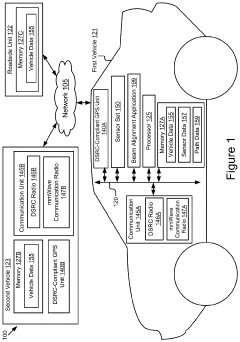
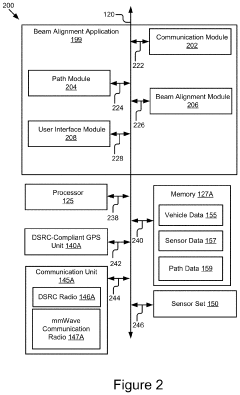
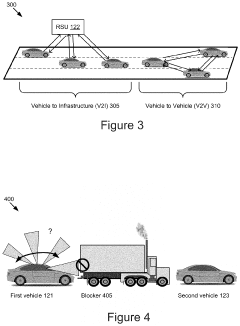
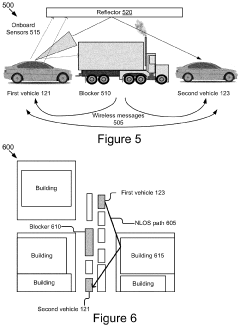
- A method that involves determining a non-line of sight (NLOS) path based on vehicle and sensor data to avoid potential blockages by reflecting beams off suitable objects, with beam alignment performed before the blockage occurs, and adapting transmission schemes like modulation and beam width adjustments to ensure successful communication, switching to line-of-sight paths if NLOS paths fail.
Patent
Innovation
- Adaptive beamforming techniques that dynamically adjust mmWave signal patterns based on vehicle movement and environmental conditions, significantly improving connectivity reliability in high-mobility scenarios.
- Multi-vehicle cooperative sensing framework that enables distributed mmWave nodes across multiple vehicles to form a mesh network, enhancing coverage and reducing blind spots in complex traffic environments.
- Novel hybrid beamforming architecture that combines analog and digital beamforming to optimize power consumption while maintaining high directivity, extending the effective range of mmWave communications in vehicular networks.
Regulatory Framework for V2X Communications
The regulatory landscape for Vehicle-to-Everything (V2X) communications represents a critical framework that shapes the deployment and operation of mmWave technology in connected vehicle ecosystems. Currently, regulatory bodies worldwide are developing and refining policies to accommodate the unique characteristics of mmWave spectrum while ensuring safety, security, and interoperability across transportation systems.
In the United States, the Federal Communications Commission (FCC) has allocated spectrum in the 76-81 GHz range for vehicular radar applications and is considering additional allocations in the 57-71 GHz and 71-76 GHz bands for broader V2X communications. The FCC's ongoing debate between DSRC (Dedicated Short-Range Communications) and C-V2X (Cellular Vehicle-to-Everything) technologies has significant implications for mmWave implementation, as future regulatory decisions will determine spectrum availability and technical standards.
The European Union, through the European Telecommunications Standards Institute (ETSI), has established harmonized standards for Intelligent Transport Systems (ITS) operating in the 5.9 GHz band, with ongoing work to incorporate mmWave frequencies above 24 GHz. The EU's regulatory approach emphasizes technology neutrality while maintaining strict requirements for electromagnetic compatibility and road safety applications.
In Asia, countries like Japan, South Korea, and China have developed distinct regulatory frameworks. Japan's Ministry of Internal Affairs and Communications has allocated the 79 GHz band for automotive radar and is exploring higher frequency bands for enhanced V2X capabilities. China's approach integrates V2X regulations within its broader intelligent transportation strategy, with the Ministry of Industry and Information Technology (MIIT) leading standardization efforts for mmWave applications in connected vehicles.
Cross-border interoperability presents a significant regulatory challenge, as vehicles frequently traverse different jurisdictions with varying technical standards and spectrum allocations. International bodies such as the International Telecommunication Union (ITU) and the World Radiocommunication Conference (WRC) are working to harmonize global spectrum allocations for automotive applications, though regional differences persist.
Data privacy and cybersecurity regulations also significantly impact mmWave V2X deployments. The high bandwidth of mmWave communications enables the transmission of substantial amounts of potentially sensitive data, necessitating robust regulatory frameworks for data protection. The EU's General Data Protection Regulation (GDPR) and similar legislation worldwide establish requirements for secure data handling in connected vehicle ecosystems, adding another layer of complexity to mmWave V2X implementation.
In the United States, the Federal Communications Commission (FCC) has allocated spectrum in the 76-81 GHz range for vehicular radar applications and is considering additional allocations in the 57-71 GHz and 71-76 GHz bands for broader V2X communications. The FCC's ongoing debate between DSRC (Dedicated Short-Range Communications) and C-V2X (Cellular Vehicle-to-Everything) technologies has significant implications for mmWave implementation, as future regulatory decisions will determine spectrum availability and technical standards.
The European Union, through the European Telecommunications Standards Institute (ETSI), has established harmonized standards for Intelligent Transport Systems (ITS) operating in the 5.9 GHz band, with ongoing work to incorporate mmWave frequencies above 24 GHz. The EU's regulatory approach emphasizes technology neutrality while maintaining strict requirements for electromagnetic compatibility and road safety applications.
In Asia, countries like Japan, South Korea, and China have developed distinct regulatory frameworks. Japan's Ministry of Internal Affairs and Communications has allocated the 79 GHz band for automotive radar and is exploring higher frequency bands for enhanced V2X capabilities. China's approach integrates V2X regulations within its broader intelligent transportation strategy, with the Ministry of Industry and Information Technology (MIIT) leading standardization efforts for mmWave applications in connected vehicles.
Cross-border interoperability presents a significant regulatory challenge, as vehicles frequently traverse different jurisdictions with varying technical standards and spectrum allocations. International bodies such as the International Telecommunication Union (ITU) and the World Radiocommunication Conference (WRC) are working to harmonize global spectrum allocations for automotive applications, though regional differences persist.
Data privacy and cybersecurity regulations also significantly impact mmWave V2X deployments. The high bandwidth of mmWave communications enables the transmission of substantial amounts of potentially sensitive data, necessitating robust regulatory frameworks for data protection. The EU's General Data Protection Regulation (GDPR) and similar legislation worldwide establish requirements for secure data handling in connected vehicle ecosystems, adding another layer of complexity to mmWave V2X implementation.
Safety and Security Considerations in mmWave V2X
The integration of mmWave technology in Vehicle-to-Everything (V2X) communications presents significant safety and security challenges that must be addressed to ensure widespread adoption. As mmWave operates at frequencies between 30-300 GHz, its unique propagation characteristics create both advantages and vulnerabilities in the connected vehicle ecosystem.
Physical safety considerations are paramount when implementing mmWave V2X systems. The high-frequency signals have limited penetration capabilities and are susceptible to blockage by obstacles, potentially creating communication dead zones in urban environments. This limitation could compromise critical safety applications such as collision avoidance and emergency vehicle notifications. Additionally, the directional nature of mmWave beams requires sophisticated beam management protocols to maintain reliable connections between rapidly moving vehicles.
Cybersecurity vulnerabilities represent another critical concern in mmWave V2X deployments. The increased bandwidth and data transmission capabilities of mmWave systems expand the attack surface for malicious actors. Potential threats include signal jamming, spoofing attacks, and man-in-the-middle interceptions that could compromise vehicle safety systems or expose sensitive user data. The directional beam nature of mmWave communications offers some inherent security advantages by making eavesdropping more difficult, but this benefit is partially offset by the complexity of securing dynamic beam-forming systems.
Privacy considerations also emerge as mmWave V2X systems can potentially collect and transmit significantly more detailed data about vehicles, drivers, and their surroundings. The high-resolution sensing capabilities enabled by mmWave radar could inadvertently capture personally identifiable information, raising concerns about location tracking and behavioral profiling. Regulatory frameworks must evolve to address these privacy implications while preserving the safety benefits of the technology.
Electromagnetic exposure safety represents another dimension requiring careful assessment. While current research indicates that mmWave radiation poses minimal health risks due to its non-ionizing nature and limited penetration depth into human tissue, continued monitoring and compliance with evolving international exposure standards remain essential as deployment scales.
Reliability under adverse weather conditions presents additional safety challenges. Rain, snow, and fog can significantly attenuate mmWave signals, potentially degrading system performance during precisely the conditions when advanced safety features are most needed. Redundancy approaches combining mmWave with complementary communication technologies operating at lower frequencies may be necessary to ensure consistent safety performance across all environmental conditions.
Physical safety considerations are paramount when implementing mmWave V2X systems. The high-frequency signals have limited penetration capabilities and are susceptible to blockage by obstacles, potentially creating communication dead zones in urban environments. This limitation could compromise critical safety applications such as collision avoidance and emergency vehicle notifications. Additionally, the directional nature of mmWave beams requires sophisticated beam management protocols to maintain reliable connections between rapidly moving vehicles.
Cybersecurity vulnerabilities represent another critical concern in mmWave V2X deployments. The increased bandwidth and data transmission capabilities of mmWave systems expand the attack surface for malicious actors. Potential threats include signal jamming, spoofing attacks, and man-in-the-middle interceptions that could compromise vehicle safety systems or expose sensitive user data. The directional beam nature of mmWave communications offers some inherent security advantages by making eavesdropping more difficult, but this benefit is partially offset by the complexity of securing dynamic beam-forming systems.
Privacy considerations also emerge as mmWave V2X systems can potentially collect and transmit significantly more detailed data about vehicles, drivers, and their surroundings. The high-resolution sensing capabilities enabled by mmWave radar could inadvertently capture personally identifiable information, raising concerns about location tracking and behavioral profiling. Regulatory frameworks must evolve to address these privacy implications while preserving the safety benefits of the technology.
Electromagnetic exposure safety represents another dimension requiring careful assessment. While current research indicates that mmWave radiation poses minimal health risks due to its non-ionizing nature and limited penetration depth into human tissue, continued monitoring and compliance with evolving international exposure standards remain essential as deployment scales.
Reliability under adverse weather conditions presents additional safety challenges. Rain, snow, and fog can significantly attenuate mmWave signals, potentially degrading system performance during precisely the conditions when advanced safety features are most needed. Redundancy approaches combining mmWave with complementary communication technologies operating at lower frequencies may be necessary to ensure consistent safety performance across all environmental conditions.
Unlock deeper insights with PatSnap Eureka Quick Research — get a full tech report to explore trends and direct your research. Try now!
Generate Your Research Report Instantly with AI Agent
Supercharge your innovation with PatSnap Eureka AI Agent Platform!