How Binder Jetting Delivers Dimensional Conformance For Precision Assemblies?
SEP 12, 202510 MIN READ
Generate Your Research Report Instantly with AI Agent
PatSnap Eureka helps you evaluate technical feasibility & market potential.
Binder Jetting Technology Background and Objectives
Binder Jetting technology emerged in the early 1990s at the Massachusetts Institute of Technology, representing a significant advancement in additive manufacturing. This powder-based 3D printing process selectively deposits a liquid binding agent onto thin layers of powder material, creating complex geometries that would be challenging or impossible to produce using traditional manufacturing methods. The technology has evolved considerably over the past three decades, transitioning from primarily prototyping applications to end-use production parts with increasingly demanding specifications.
The fundamental principle of Binder Jetting involves the precise deposition of binding agents through industrial printheads onto powder beds, followed by curing and sintering processes. This approach offers distinct advantages over other additive manufacturing technologies, particularly in achieving dimensional accuracy for precision assemblies. Unlike laser-based processes that introduce thermal stresses, Binder Jetting operates at ambient temperatures during the printing phase, minimizing part distortion and enabling tighter dimensional tolerances.
Recent technological advancements have focused on enhancing the precision of Binder Jetting systems through improvements in printhead technology, binding agent formulations, and powder characteristics. The development of printheads with higher resolution and more precise droplet control has significantly improved the dimensional accuracy achievable with this technology. Simultaneously, research into specialized binders has expanded material compatibility while maintaining or improving dimensional stability during post-processing.
The primary objective of modern Binder Jetting development is to establish reliable manufacturing processes capable of producing components with predictable dimensional characteristics suitable for precision assemblies. This includes achieving consistent part-to-part repeatability, minimizing shrinkage during sintering, and maintaining geometric accuracy across complex features. These capabilities are particularly crucial for industries such as aerospace, automotive, and medical device manufacturing, where component fit and function depend on precise dimensional conformance.
Another key technological goal involves expanding the material portfolio while maintaining dimensional precision. While initially limited to ceramics and metals with relatively simple geometries, contemporary research aims to enable Binder Jetting of high-performance alloys and multi-material components without sacrificing dimensional accuracy. This expansion would significantly broaden the application scope of the technology across various industrial sectors.
The trajectory of Binder Jetting technology is increasingly focused on process automation and integration into existing manufacturing workflows. This includes the development of in-line quality control systems, predictive modeling tools for dimensional compensation, and standardized procedures for process validation. These advancements collectively aim to position Binder Jetting as a mature manufacturing technology capable of reliably producing precision components at scale.
The fundamental principle of Binder Jetting involves the precise deposition of binding agents through industrial printheads onto powder beds, followed by curing and sintering processes. This approach offers distinct advantages over other additive manufacturing technologies, particularly in achieving dimensional accuracy for precision assemblies. Unlike laser-based processes that introduce thermal stresses, Binder Jetting operates at ambient temperatures during the printing phase, minimizing part distortion and enabling tighter dimensional tolerances.
Recent technological advancements have focused on enhancing the precision of Binder Jetting systems through improvements in printhead technology, binding agent formulations, and powder characteristics. The development of printheads with higher resolution and more precise droplet control has significantly improved the dimensional accuracy achievable with this technology. Simultaneously, research into specialized binders has expanded material compatibility while maintaining or improving dimensional stability during post-processing.
The primary objective of modern Binder Jetting development is to establish reliable manufacturing processes capable of producing components with predictable dimensional characteristics suitable for precision assemblies. This includes achieving consistent part-to-part repeatability, minimizing shrinkage during sintering, and maintaining geometric accuracy across complex features. These capabilities are particularly crucial for industries such as aerospace, automotive, and medical device manufacturing, where component fit and function depend on precise dimensional conformance.
Another key technological goal involves expanding the material portfolio while maintaining dimensional precision. While initially limited to ceramics and metals with relatively simple geometries, contemporary research aims to enable Binder Jetting of high-performance alloys and multi-material components without sacrificing dimensional accuracy. This expansion would significantly broaden the application scope of the technology across various industrial sectors.
The trajectory of Binder Jetting technology is increasingly focused on process automation and integration into existing manufacturing workflows. This includes the development of in-line quality control systems, predictive modeling tools for dimensional compensation, and standardized procedures for process validation. These advancements collectively aim to position Binder Jetting as a mature manufacturing technology capable of reliably producing precision components at scale.
Market Demand for Precision Assembly Manufacturing
The precision assembly manufacturing market is experiencing robust growth driven by increasing demand across multiple industries for components with tight tolerances and dimensional accuracy. The global precision manufacturing market was valued at approximately $210 billion in 2022 and is projected to reach $320 billion by 2028, growing at a CAGR of 7.3% during the forecast period. This growth is primarily fueled by advancements in industries such as aerospace, automotive, medical devices, and consumer electronics, where precision assemblies are critical for product performance and reliability.
In the aerospace sector, the need for lightweight yet structurally sound components with complex geometries has intensified the demand for advanced manufacturing technologies. Aircraft manufacturers require parts with tolerances as tight as ±0.001 inches to ensure optimal performance and safety. Similarly, the automotive industry's shift toward electric vehicles has created new requirements for precision components in battery systems, motor assemblies, and thermal management solutions.
The medical device industry represents another significant market driver, with the global market expected to reach $800 billion by 2030. Surgical instruments, implantable devices, and diagnostic equipment all require exceptional dimensional accuracy. For instance, orthopedic implants typically demand tolerances within ±0.005 mm to ensure proper fit and function within the human body.
Consumer electronics manufacturers face increasing pressure to produce smaller, more feature-rich devices, necessitating components with micro-scale precision. The miniaturization trend has pushed manufacturing tolerances below ±0.01 mm in many applications, creating substantial challenges for traditional manufacturing methods.
Traditional manufacturing processes often struggle to consistently achieve these demanding specifications while maintaining cost-effectiveness and production efficiency. Conventional methods like CNC machining, while precise, can be prohibitively expensive for complex geometries and may require multiple setups that introduce cumulative errors.
Market research indicates that 78% of precision manufacturing companies are actively seeking new technologies to improve dimensional accuracy while reducing production costs. Additionally, 65% of end-users report willingness to pay premium prices for components with guaranteed dimensional conformance, highlighting the value proposition for advanced manufacturing solutions.
The industry is also experiencing growing demand for rapid prototyping capabilities that maintain production-grade precision, with 82% of surveyed companies expressing interest in technologies that can bridge the gap between prototyping and final production while maintaining dimensional accuracy throughout the process.
In the aerospace sector, the need for lightweight yet structurally sound components with complex geometries has intensified the demand for advanced manufacturing technologies. Aircraft manufacturers require parts with tolerances as tight as ±0.001 inches to ensure optimal performance and safety. Similarly, the automotive industry's shift toward electric vehicles has created new requirements for precision components in battery systems, motor assemblies, and thermal management solutions.
The medical device industry represents another significant market driver, with the global market expected to reach $800 billion by 2030. Surgical instruments, implantable devices, and diagnostic equipment all require exceptional dimensional accuracy. For instance, orthopedic implants typically demand tolerances within ±0.005 mm to ensure proper fit and function within the human body.
Consumer electronics manufacturers face increasing pressure to produce smaller, more feature-rich devices, necessitating components with micro-scale precision. The miniaturization trend has pushed manufacturing tolerances below ±0.01 mm in many applications, creating substantial challenges for traditional manufacturing methods.
Traditional manufacturing processes often struggle to consistently achieve these demanding specifications while maintaining cost-effectiveness and production efficiency. Conventional methods like CNC machining, while precise, can be prohibitively expensive for complex geometries and may require multiple setups that introduce cumulative errors.
Market research indicates that 78% of precision manufacturing companies are actively seeking new technologies to improve dimensional accuracy while reducing production costs. Additionally, 65% of end-users report willingness to pay premium prices for components with guaranteed dimensional conformance, highlighting the value proposition for advanced manufacturing solutions.
The industry is also experiencing growing demand for rapid prototyping capabilities that maintain production-grade precision, with 82% of surveyed companies expressing interest in technologies that can bridge the gap between prototyping and final production while maintaining dimensional accuracy throughout the process.
Current State and Challenges in Binder Jetting Technology
Binder jetting technology has evolved significantly since its inception in the early 1990s at MIT. Currently, this additive manufacturing process has established itself as a viable solution for producing complex metal and ceramic components with dimensional precision. The technology utilizes a liquid binding agent selectively deposited onto powder material layers to create three-dimensional structures, offering advantages in geometric freedom and material versatility compared to traditional manufacturing methods.
Global adoption of binder jetting has accelerated in recent years, with notable technological advancements in North America, Europe, and increasingly in Asia. Major industrial players have invested substantially in refining the process parameters and material compatibility, resulting in improved dimensional accuracy and surface finish quality. The current state of the technology enables production of components with tolerances approaching ±0.2% for smaller features and ±0.1 mm for larger geometries, making it increasingly suitable for precision assembly applications.
Despite these advancements, binder jetting faces several significant challenges that limit its broader implementation for high-precision assemblies. Material shrinkage during sintering remains a primary concern, with dimensional changes of 15-20% being common, requiring sophisticated compensation strategies in the design phase. This shrinkage is often non-uniform across different geometric features, complicating predictive modeling efforts.
Surface finish quality presents another obstacle, as the characteristic stair-stepping effect and powder particle adhesion can compromise dimensional conformance at critical interfaces. Current post-processing techniques to address these issues often introduce additional variables that can affect dimensional stability. The industry has yet to establish standardized methodologies for consistently achieving high-precision surface finishes across various material systems.
Material property variability constitutes a persistent challenge, with final part density typically ranging from 95-99.5% depending on process parameters and material characteristics. This density variation directly impacts mechanical properties and dimensional stability, particularly for precision assembly applications where consistent performance is essential.
Process repeatability remains problematic, with part-to-part and build-to-build variations still exceeding the requirements for certain high-precision applications. Environmental factors such as humidity and temperature fluctuations during printing and sintering contribute to these inconsistencies. Current monitoring systems provide limited real-time feedback for process adjustment, though recent developments in machine learning algorithms show promise for adaptive control systems.
Regulatory frameworks and certification standards for binder jetted components in precision applications are still evolving, creating uncertainty for manufacturers seeking to implement this technology in regulated industries such as aerospace and medical devices. The lack of comprehensive material property databases and standardized testing protocols further complicates qualification efforts.
Global adoption of binder jetting has accelerated in recent years, with notable technological advancements in North America, Europe, and increasingly in Asia. Major industrial players have invested substantially in refining the process parameters and material compatibility, resulting in improved dimensional accuracy and surface finish quality. The current state of the technology enables production of components with tolerances approaching ±0.2% for smaller features and ±0.1 mm for larger geometries, making it increasingly suitable for precision assembly applications.
Despite these advancements, binder jetting faces several significant challenges that limit its broader implementation for high-precision assemblies. Material shrinkage during sintering remains a primary concern, with dimensional changes of 15-20% being common, requiring sophisticated compensation strategies in the design phase. This shrinkage is often non-uniform across different geometric features, complicating predictive modeling efforts.
Surface finish quality presents another obstacle, as the characteristic stair-stepping effect and powder particle adhesion can compromise dimensional conformance at critical interfaces. Current post-processing techniques to address these issues often introduce additional variables that can affect dimensional stability. The industry has yet to establish standardized methodologies for consistently achieving high-precision surface finishes across various material systems.
Material property variability constitutes a persistent challenge, with final part density typically ranging from 95-99.5% depending on process parameters and material characteristics. This density variation directly impacts mechanical properties and dimensional stability, particularly for precision assembly applications where consistent performance is essential.
Process repeatability remains problematic, with part-to-part and build-to-build variations still exceeding the requirements for certain high-precision applications. Environmental factors such as humidity and temperature fluctuations during printing and sintering contribute to these inconsistencies. Current monitoring systems provide limited real-time feedback for process adjustment, though recent developments in machine learning algorithms show promise for adaptive control systems.
Regulatory frameworks and certification standards for binder jetted components in precision applications are still evolving, creating uncertainty for manufacturers seeking to implement this technology in regulated industries such as aerospace and medical devices. The lack of comprehensive material property databases and standardized testing protocols further complicates qualification efforts.
Current Dimensional Control Methods in Binder Jetting
01 Process parameters for dimensional accuracy in binder jetting
Various process parameters can be optimized to improve dimensional conformance in binder jetting. These include binder saturation levels, printing speed, layer thickness, and curing conditions. By carefully controlling these parameters, manufacturers can minimize shrinkage, warping, and other dimensional deviations during the printing and post-processing stages, resulting in parts that more closely match the intended specifications.- Process parameters optimization for dimensional accuracy: Optimizing process parameters in binder jetting is crucial for achieving dimensional conformance. This includes controlling printing speed, layer thickness, binder saturation levels, and curing conditions. By fine-tuning these parameters, manufacturers can minimize shrinkage, warping, and dimensional variations in the final printed parts. Advanced process monitoring and feedback systems can be implemented to maintain consistent dimensional accuracy throughout the printing process.
- Material formulation for improved dimensional stability: Specialized powder and binder formulations can significantly enhance dimensional conformance in binder jetting. These formulations include modified particle size distributions, custom binder chemistries, and additives that control shrinkage during sintering. Materials engineered with controlled thermal expansion properties help maintain dimensional accuracy throughout the thermal processing stages. Composite materials with reinforcing elements can also be used to minimize warping and distortion.
- Post-processing techniques for dimensional correction: Various post-processing methods can be employed to improve the dimensional conformance of binder jetted parts. These include controlled sintering profiles, isostatic pressing, infiltration techniques, and precision machining operations. Advanced thermal processing with carefully controlled heating and cooling rates helps minimize distortion. Some approaches involve creating slightly oversized green parts that achieve target dimensions after accounting for predictable shrinkage during sintering.
- Computational modeling and simulation for dimensional prediction: Computational tools and simulation software enable prediction and compensation for dimensional changes during the binder jetting process. These include finite element analysis, machine learning algorithms, and digital twins that model material behavior during printing and sintering. Predictive models allow for pre-distortion of part geometries to compensate for expected shrinkage. Real-time simulation coupled with in-process monitoring helps maintain dimensional conformance throughout the manufacturing process.
- In-process monitoring and feedback control systems: Advanced monitoring systems integrated into binder jetting equipment provide real-time data on dimensional accuracy during printing. These systems use optical sensors, machine vision, and other measurement technologies to detect deviations from target dimensions. Closed-loop control algorithms automatically adjust process parameters to maintain dimensional conformance. Some systems incorporate artificial intelligence to continuously improve dimensional accuracy based on historical production data.
02 Material formulations for improved dimensional stability
Specialized powder and binder formulations can significantly enhance dimensional conformance in binder jetting processes. These formulations may include modified particle size distributions, additives to control shrinkage, and binders with optimized rheological properties. By engineering materials specifically for binder jetting applications, manufacturers can achieve more predictable shrinkage rates and better dimensional accuracy in the final parts.Expand Specific Solutions03 Post-processing techniques for dimensional control
Various post-processing methods can be employed to improve the dimensional accuracy of binder jetted parts. These include controlled sintering profiles, infiltration techniques, and surface treatments. By optimizing these post-processing steps, manufacturers can minimize distortion and achieve tighter tolerances in the final components, even compensating for some dimensional changes that occur during the printing process.Expand Specific Solutions04 Design compensation strategies for dimensional conformance
Predictive modeling and design compensation strategies can be implemented to account for expected dimensional changes during the binder jetting process. These approaches involve adjusting the initial design dimensions based on anticipated shrinkage or expansion during printing and sintering. By incorporating these compensations into the design phase, manufacturers can produce parts that more closely match the intended final dimensions despite the inherent dimensional changes in the process.Expand Specific Solutions05 Monitoring and feedback systems for dimensional quality control
Advanced monitoring systems and feedback control mechanisms can be integrated into binder jetting processes to ensure dimensional conformance. These systems may include in-situ measurement technologies, machine vision systems, and closed-loop control algorithms that make real-time adjustments to process parameters. By continuously monitoring the printing process and making appropriate adjustments, manufacturers can maintain consistent dimensional accuracy across production runs.Expand Specific Solutions
Leading Companies in Binder Jetting and Precision Manufacturing
Binder Jetting technology for precision assemblies is currently in a growth phase, with the market expanding due to increasing demand for high-precision manufacturing solutions. The competitive landscape is characterized by established players like Desktop Metal and Digital Metal leading innovation in dimensional conformance capabilities, while traditional manufacturing giants such as Volkswagen AG and Ricoh are integrating this technology into their production processes. Academic institutions including Harbin Institute of Technology and Virginia Tech are advancing fundamental research, creating a dynamic ecosystem. The technology has reached moderate maturity with proven applications in automotive (Kirchhoff, Volkswagen) and aerospace (Airbus) sectors, though continued refinement in material compatibility and process optimization remains a focus area for industry leaders.
Desktop Metal, Inc.
Technical Solution: Desktop Metal has pioneered advanced binder jetting technology through their Production System™ platform, which utilizes Single Pass Jetting™ technology to deliver dimensional accuracy within ±0.3% of the designed specifications for precision assemblies. Their process employs a proprietary binding agent that is precisely deposited onto a powder bed using industrial inkjet printheads, followed by a thermal debinding and sintering process that achieves up to 96-99.8% density in final parts. The company's patented bi-directional printing approach significantly reduces production time while maintaining tight tolerances necessary for precision assemblies. Desktop Metal's technology incorporates real-time optical inspection systems that monitor dimensional accuracy during the build process, allowing for immediate adjustments to ensure conformance. Their specialized software algorithms compensate for material shrinkage during sintering, predicting and adjusting for dimensional changes to achieve final parts that meet stringent assembly requirements.
Strengths: High throughput capability (up to 100x faster than laser-based systems), excellent dimensional accuracy for complex geometries, and cost-effective production of high-volume precision parts. Weaknesses: Requires post-processing steps including debinding and sintering which can introduce additional variables affecting dimensional stability, and material options are more limited compared to some competing technologies.
Digital Metal AB
Technical Solution: Digital Metal has developed a high-precision binder jetting technology specifically optimized for small, complex metal components requiring tight tolerances. Their DM P2500 system achieves dimensional accuracy of ±0.5% with minimum feature sizes down to 0.2mm, making it particularly suitable for precision assemblies in industries like aerospace, medical, and luxury goods. Digital Metal's proprietary binder formulation creates strong green parts that maintain their structural integrity throughout the production process, reducing deformation risks. Their technology employs a layer thickness as fine as 42 microns, enabling exceptional surface finish quality with Ra values as low as 6 μm after sintering. The company has implemented advanced process monitoring systems that track over 500 parameters during printing to ensure dimensional conformance. Digital Metal's proprietary sintering protocols include controlled atmosphere environments and precise temperature ramping profiles that minimize distortion during densification, resulting in final parts with dimensional tolerances suitable for direct assembly without additional machining.
Strengths: Exceptional surface finish quality, ability to produce extremely small and intricate features with high precision, and excellent repeatability across production batches. Weaknesses: Lower build volume compared to some competitors limits production capacity, and the technology is primarily optimized for smaller components rather than larger structural parts.
Key Technical Innovations for Dimensional Conformance
System and method for reducing effects of spreading forces during 3D printing
PatentWO2019136222A1
Innovation
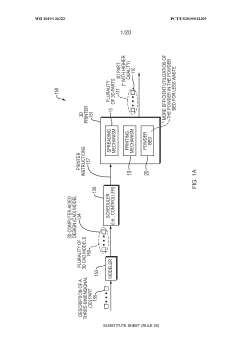
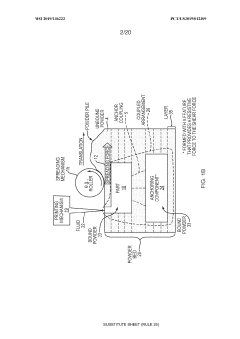
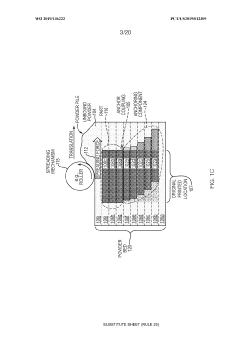
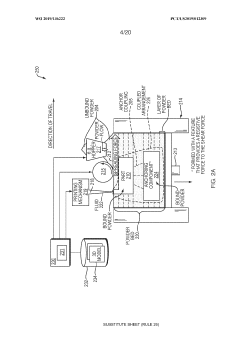
- The implementation of an anchoring component with a resistive force that is printed in a coupled arrangement with the part, using either direct or indirect anchor couplings, to immobilize printed layers and resist spreading forces, thereby preventing layer shifting and smearing. This anchoring component can be designed with specific geometric features or layers that complement the part's shape, and is formed using unbound powder or anti-sintering agents to facilitate decoupling post-printing.
Metering build material in three-dimensional (3D) printing using a tool
PatentActiveUS11931767B2
Innovation
- A method and system that utilize a moveable surface with a controlled gap and motion to meter metallic powders from a hopper, where the gap and motion enable predictable flow onto a powder bed, combined with a leveler and printhead to form uniform layers and apply binder fluid for bonding.


Material Science Advancements for Binder Jetting
Material science advancements have been pivotal in enhancing the capabilities of binder jetting technology for precision manufacturing. Recent developments in binder formulations have significantly improved the binding strength between powder particles, resulting in green parts with superior structural integrity before sintering. These advanced binders incorporate polymeric compounds with optimized molecular weight distributions that provide both adequate flowability during printing and robust mechanical properties after curing.
Powder metallurgy has evolved concurrently, with innovations in particle engineering yielding powders specifically designed for binder jetting applications. The latest generation of metal powders features carefully controlled particle size distributions, typically ranging from 5-50 μm, with spherical morphologies that enhance flowability and packing density. Surface treatments that improve wettability have been developed to ensure consistent binder-powder interactions across the build platform.
Composite materials represent another frontier in binder jetting material science. Researchers have successfully developed ceramic-metal and polymer-metal composite systems that combine the advantageous properties of multiple material classes. These composites offer enhanced dimensional stability during the sintering process by counteracting differential shrinkage rates that traditionally challenge precision manufacturing.
Nanomaterial integration has emerged as a promising approach to improve the microstructural properties of binder jetted parts. The incorporation of nanoparticles into either the powder feedstock or binder solution can serve as sintering aids, reducing required sintering temperatures and times while promoting uniform densification. This advancement is particularly valuable for maintaining dimensional conformance in complex geometries where traditional sintering processes might introduce distortion.
Sintering science has also progressed significantly, with the development of controlled atmosphere sintering protocols specifically optimized for binder jetted parts. These protocols implement precise temperature ramps and hold times that account for the unique characteristics of parts produced through binder jetting, including their initial porosity and binder content. Advanced sintering techniques such as microwave-assisted sintering and spark plasma sintering have been adapted for binder jetted components, offering more uniform heating and reduced processing times.
Material characterization techniques have evolved to provide real-time feedback during the binder jetting process. In-situ monitoring systems can now detect variations in powder bed density and binder saturation, allowing for dynamic adjustments that maintain dimensional consistency throughout the build. Post-processing characterization methods have also advanced, with high-resolution CT scanning and optical metrology enabling comprehensive dimensional analysis of finished parts.
Powder metallurgy has evolved concurrently, with innovations in particle engineering yielding powders specifically designed for binder jetting applications. The latest generation of metal powders features carefully controlled particle size distributions, typically ranging from 5-50 μm, with spherical morphologies that enhance flowability and packing density. Surface treatments that improve wettability have been developed to ensure consistent binder-powder interactions across the build platform.
Composite materials represent another frontier in binder jetting material science. Researchers have successfully developed ceramic-metal and polymer-metal composite systems that combine the advantageous properties of multiple material classes. These composites offer enhanced dimensional stability during the sintering process by counteracting differential shrinkage rates that traditionally challenge precision manufacturing.
Nanomaterial integration has emerged as a promising approach to improve the microstructural properties of binder jetted parts. The incorporation of nanoparticles into either the powder feedstock or binder solution can serve as sintering aids, reducing required sintering temperatures and times while promoting uniform densification. This advancement is particularly valuable for maintaining dimensional conformance in complex geometries where traditional sintering processes might introduce distortion.
Sintering science has also progressed significantly, with the development of controlled atmosphere sintering protocols specifically optimized for binder jetted parts. These protocols implement precise temperature ramps and hold times that account for the unique characteristics of parts produced through binder jetting, including their initial porosity and binder content. Advanced sintering techniques such as microwave-assisted sintering and spark plasma sintering have been adapted for binder jetted components, offering more uniform heating and reduced processing times.
Material characterization techniques have evolved to provide real-time feedback during the binder jetting process. In-situ monitoring systems can now detect variations in powder bed density and binder saturation, allowing for dynamic adjustments that maintain dimensional consistency throughout the build. Post-processing characterization methods have also advanced, with high-resolution CT scanning and optical metrology enabling comprehensive dimensional analysis of finished parts.
Quality Assurance Systems for Additive Manufacturing
Quality assurance systems for additive manufacturing, particularly in binder jetting technology, have evolved significantly to ensure dimensional conformance in precision assemblies. These systems incorporate multi-layered verification protocols that operate throughout the manufacturing process, from pre-production to final inspection.
In-situ monitoring technologies represent a critical advancement in quality assurance for binder jetting processes. These systems utilize high-resolution cameras, laser profilometry, and thermal imaging to detect anomalies during the printing process. Real-time data collection enables immediate adjustments to printing parameters, significantly reducing the likelihood of dimensional deviations in precision components.
Statistical process control (SPC) methodologies have been adapted specifically for binder jetting operations. These systems establish control limits for critical dimensional parameters and continuously monitor production data to identify trends before they result in non-conforming parts. Advanced algorithms can predict potential failures based on subtle variations in process parameters, enabling preemptive corrective actions.
Post-processing verification systems employ coordinate measuring machines (CMMs), optical scanning, and computed tomography to validate dimensional accuracy of binder jetted components. These technologies can detect deviations as small as 10 microns, ensuring that precision assemblies meet stringent tolerance requirements. Integration of these verification systems with digital twins allows for comparison between as-designed and as-built components.
Closed-loop feedback systems represent the latest advancement in quality assurance for binder jetting. These systems automatically adjust printing parameters based on measured deviations, creating a self-correcting manufacturing process. Machine learning algorithms continuously improve these adjustments by analyzing historical data and outcomes, resulting in progressively better dimensional conformance over time.
Certification protocols specific to binder jetting have been developed by standards organizations including ASTM International and ISO. These protocols establish testing methodologies, acceptance criteria, and documentation requirements for quality assurance systems. Compliance with these standards provides confidence in the dimensional stability and reliability of binder jetted components used in precision assemblies.
Material-specific quality assurance measures address the unique challenges presented by different powder compositions used in binder jetting. These measures include powder characterization, binder-powder interaction analysis, and sintering behavior prediction to ensure consistent dimensional results across production batches.
In-situ monitoring technologies represent a critical advancement in quality assurance for binder jetting processes. These systems utilize high-resolution cameras, laser profilometry, and thermal imaging to detect anomalies during the printing process. Real-time data collection enables immediate adjustments to printing parameters, significantly reducing the likelihood of dimensional deviations in precision components.
Statistical process control (SPC) methodologies have been adapted specifically for binder jetting operations. These systems establish control limits for critical dimensional parameters and continuously monitor production data to identify trends before they result in non-conforming parts. Advanced algorithms can predict potential failures based on subtle variations in process parameters, enabling preemptive corrective actions.
Post-processing verification systems employ coordinate measuring machines (CMMs), optical scanning, and computed tomography to validate dimensional accuracy of binder jetted components. These technologies can detect deviations as small as 10 microns, ensuring that precision assemblies meet stringent tolerance requirements. Integration of these verification systems with digital twins allows for comparison between as-designed and as-built components.
Closed-loop feedback systems represent the latest advancement in quality assurance for binder jetting. These systems automatically adjust printing parameters based on measured deviations, creating a self-correcting manufacturing process. Machine learning algorithms continuously improve these adjustments by analyzing historical data and outcomes, resulting in progressively better dimensional conformance over time.
Certification protocols specific to binder jetting have been developed by standards organizations including ASTM International and ISO. These protocols establish testing methodologies, acceptance criteria, and documentation requirements for quality assurance systems. Compliance with these standards provides confidence in the dimensional stability and reliability of binder jetted components used in precision assemblies.
Material-specific quality assurance measures address the unique challenges presented by different powder compositions used in binder jetting. These measures include powder characterization, binder-powder interaction analysis, and sintering behavior prediction to ensure consistent dimensional results across production batches.
Unlock deeper insights with PatSnap Eureka Quick Research — get a full tech report to explore trends and direct your research. Try now!
Generate Your Research Report Instantly with AI Agent
Supercharge your innovation with PatSnap Eureka AI Agent Platform!