How Do Neuromorphic Computing Materials Improve Electrolyte Performance
OCT 27, 202510 MIN READ
Generate Your Research Report Instantly with AI Agent
Patsnap Eureka helps you evaluate technical feasibility & market potential.
Neuromorphic Computing Materials and Electrolyte Enhancement Goals
Neuromorphic computing represents a paradigm shift in computational architecture, drawing inspiration from the human brain's neural networks to create more efficient and adaptive computing systems. The evolution of this field has been marked by significant advancements in materials science, particularly in the development of specialized electrolytes that serve as the foundation for neuromorphic devices. These materials aim to mimic the synaptic functions of biological neural systems, enabling more efficient information processing and learning capabilities.
The trajectory of neuromorphic computing materials has evolved from traditional silicon-based semiconductors to more sophisticated materials including phase-change materials, memristive oxides, and organic electrochemical compounds. Each generation has brought improvements in energy efficiency, processing speed, and adaptability, pushing the boundaries of what's possible in artificial intelligence and machine learning applications.
Electrolytes play a crucial role in this technological evolution, serving as the medium through which ionic transport occurs in neuromorphic devices. The performance of these electrolytes directly impacts the efficiency, reliability, and scalability of neuromorphic systems. Traditional electrolytes have faced limitations in terms of stability, conductivity, and compatibility with existing manufacturing processes, creating a technological bottleneck that has hindered broader adoption.
The primary technical goal in this field is to develop advanced electrolyte materials that can facilitate more efficient ionic transport while maintaining stability across various operating conditions. This includes improving ionic conductivity, enhancing electrochemical stability windows, and ensuring compatibility with a wide range of electrode materials. Additionally, there is a focus on developing electrolytes that can operate at lower temperatures and withstand higher voltage ranges, expanding the practical applications of neuromorphic computing.
Another critical objective is to create electrolytes that can support more precise control of synaptic weight changes, mimicking the plasticity of biological synapses. This requires materials that can maintain multiple stable states and transition between them reliably in response to electrical stimuli, enabling more sophisticated learning algorithms and adaptive behaviors in neuromorphic systems.
Sustainability and scalability also feature prominently in the technical goals for neuromorphic computing materials. Researchers are working to develop electrolytes from abundant, non-toxic materials that can be manufactured using environmentally friendly processes. This aligns with broader industry trends toward green technology and sustainable innovation, ensuring that advances in neuromorphic computing contribute positively to global sustainability efforts.
The integration of these advanced electrolytes with existing semiconductor technologies represents another key technical challenge. The goal is to develop materials and manufacturing processes that can seamlessly incorporate neuromorphic components into conventional electronic systems, facilitating a gradual transition toward more brain-like computing architectures without requiring wholesale replacement of existing infrastructure.
The trajectory of neuromorphic computing materials has evolved from traditional silicon-based semiconductors to more sophisticated materials including phase-change materials, memristive oxides, and organic electrochemical compounds. Each generation has brought improvements in energy efficiency, processing speed, and adaptability, pushing the boundaries of what's possible in artificial intelligence and machine learning applications.
Electrolytes play a crucial role in this technological evolution, serving as the medium through which ionic transport occurs in neuromorphic devices. The performance of these electrolytes directly impacts the efficiency, reliability, and scalability of neuromorphic systems. Traditional electrolytes have faced limitations in terms of stability, conductivity, and compatibility with existing manufacturing processes, creating a technological bottleneck that has hindered broader adoption.
The primary technical goal in this field is to develop advanced electrolyte materials that can facilitate more efficient ionic transport while maintaining stability across various operating conditions. This includes improving ionic conductivity, enhancing electrochemical stability windows, and ensuring compatibility with a wide range of electrode materials. Additionally, there is a focus on developing electrolytes that can operate at lower temperatures and withstand higher voltage ranges, expanding the practical applications of neuromorphic computing.
Another critical objective is to create electrolytes that can support more precise control of synaptic weight changes, mimicking the plasticity of biological synapses. This requires materials that can maintain multiple stable states and transition between them reliably in response to electrical stimuli, enabling more sophisticated learning algorithms and adaptive behaviors in neuromorphic systems.
Sustainability and scalability also feature prominently in the technical goals for neuromorphic computing materials. Researchers are working to develop electrolytes from abundant, non-toxic materials that can be manufactured using environmentally friendly processes. This aligns with broader industry trends toward green technology and sustainable innovation, ensuring that advances in neuromorphic computing contribute positively to global sustainability efforts.
The integration of these advanced electrolytes with existing semiconductor technologies represents another key technical challenge. The goal is to develop materials and manufacturing processes that can seamlessly incorporate neuromorphic components into conventional electronic systems, facilitating a gradual transition toward more brain-like computing architectures without requiring wholesale replacement of existing infrastructure.
Market Demand Analysis for Advanced Electrolyte Solutions
The global market for advanced electrolyte solutions is experiencing significant growth driven by the convergence of neuromorphic computing and energy storage technologies. Current market analysis indicates that the electrolyte segment within the energy storage market is projected to reach $8.6 billion by 2027, with neuromorphic computing applications representing an emerging but rapidly expanding subsector.
The demand for improved electrolyte performance is primarily fueled by three key market segments: consumer electronics, electric vehicles, and grid-scale energy storage systems. In the consumer electronics sector, manufacturers are seeking electrolyte solutions that can enable higher energy density, faster charging capabilities, and improved safety profiles for next-generation devices. This demand is particularly pronounced in wearable technology and portable computing devices where neuromorphic computing architectures are being integrated.
Electric vehicle manufacturers represent another significant market driver, with their requirements for electrolytes that can support high-power applications while maintaining stability across wide temperature ranges. The integration of neuromorphic computing elements in battery management systems is creating new performance requirements for electrolytes, particularly in terms of ion conductivity and electrochemical stability.
Grid-scale energy storage represents the third major market segment, where the combination of neuromorphic computing for predictive management and advanced electrolytes is enabling more efficient and responsive energy storage solutions. This market is expected to grow at a CAGR of 18.7% through 2030, driven by renewable energy integration and grid modernization initiatives worldwide.
Regionally, Asia-Pacific dominates the market for advanced electrolyte solutions, accounting for approximately 45% of global demand, with China, South Korea, and Japan leading in both production and consumption. North America and Europe follow, with particularly strong growth in applications combining energy storage with neuromorphic computing elements for smart grid applications.
Customer requirements are evolving rapidly, with increasing emphasis on electrolytes that can support the unique operational characteristics of neuromorphic computing systems. These include the need for electrolytes with precise ion transport properties that can mimic synaptic behavior, materials that maintain stability under variable voltage conditions typical in spike-based computing, and solutions that offer enhanced cycling performance for systems requiring continuous learning capabilities.
Market analysis indicates that companies investing in the development of specialized electrolytes for neuromorphic applications can expect premium pricing opportunities, with margins potentially 30-40% higher than standard electrolyte formulations due to the high-value applications and performance requirements in this emerging field.
The demand for improved electrolyte performance is primarily fueled by three key market segments: consumer electronics, electric vehicles, and grid-scale energy storage systems. In the consumer electronics sector, manufacturers are seeking electrolyte solutions that can enable higher energy density, faster charging capabilities, and improved safety profiles for next-generation devices. This demand is particularly pronounced in wearable technology and portable computing devices where neuromorphic computing architectures are being integrated.
Electric vehicle manufacturers represent another significant market driver, with their requirements for electrolytes that can support high-power applications while maintaining stability across wide temperature ranges. The integration of neuromorphic computing elements in battery management systems is creating new performance requirements for electrolytes, particularly in terms of ion conductivity and electrochemical stability.
Grid-scale energy storage represents the third major market segment, where the combination of neuromorphic computing for predictive management and advanced electrolytes is enabling more efficient and responsive energy storage solutions. This market is expected to grow at a CAGR of 18.7% through 2030, driven by renewable energy integration and grid modernization initiatives worldwide.
Regionally, Asia-Pacific dominates the market for advanced electrolyte solutions, accounting for approximately 45% of global demand, with China, South Korea, and Japan leading in both production and consumption. North America and Europe follow, with particularly strong growth in applications combining energy storage with neuromorphic computing elements for smart grid applications.
Customer requirements are evolving rapidly, with increasing emphasis on electrolytes that can support the unique operational characteristics of neuromorphic computing systems. These include the need for electrolytes with precise ion transport properties that can mimic synaptic behavior, materials that maintain stability under variable voltage conditions typical in spike-based computing, and solutions that offer enhanced cycling performance for systems requiring continuous learning capabilities.
Market analysis indicates that companies investing in the development of specialized electrolytes for neuromorphic applications can expect premium pricing opportunities, with margins potentially 30-40% higher than standard electrolyte formulations due to the high-value applications and performance requirements in this emerging field.
Current State and Challenges in Neuromorphic Electrolyte Technology
Neuromorphic computing materials have significantly advanced in recent years, yet their integration with electrolyte technologies presents both promising opportunities and substantial challenges. Currently, the global landscape of neuromorphic electrolyte technology demonstrates varying levels of maturity across different regions. The United States and Europe lead in fundamental research, while Asian countries, particularly China and South Korea, excel in applied development and manufacturing scale-up.
The primary technical challenge facing neuromorphic electrolyte development is achieving stable ionic conductivity while maintaining the dynamic plasticity required for brain-like computing functions. Conventional electrolytes suffer from degradation under repeated cycling, limiting device longevity. Additionally, the interface between neuromorphic materials and electrolytes often experiences resistance fluctuations that compromise computational reliability and precision.
Energy efficiency remains another significant hurdle. Current neuromorphic electrolyte systems require substantial power for operation, contradicting the inherent energy advantage that brain-inspired computing should theoretically offer. Research indicates that power consumption in these systems is typically 10-100 times higher than biological neural networks when normalized for computational tasks.
Scalability presents a critical constraint for widespread adoption. Laboratory demonstrations have successfully created neuromorphic devices with hundreds to thousands of artificial synapses, but practical applications require millions or billions of interconnected elements. The uniformity of electrolyte properties across large-scale fabrication has proven difficult to maintain, resulting in performance variability that undermines computational accuracy.
Temperature sensitivity further complicates implementation, as most current neuromorphic electrolytes demonstrate optimal performance within narrow temperature ranges. This limitation restricts their application in environments with temperature fluctuations, such as mobile devices or industrial settings.
Material compatibility issues between neuromorphic computing elements and electrolytes have created integration challenges. Many promising neuromorphic materials react unfavorably with electrolyte components over time, leading to performance degradation and shortened device lifespan. Research shows that approximately 40% of experimental neuromorphic systems fail prematurely due to material incompatibility issues.
Recent advances in solid-state electrolytes show promise for addressing some of these challenges, particularly regarding stability and temperature sensitivity. However, these materials typically exhibit lower ionic conductivity, creating a fundamental trade-off between stability and performance that researchers continue to navigate.
The interdisciplinary nature of neuromorphic electrolyte technology development requires collaboration across materials science, electrical engineering, computer science, and neuroscience, creating coordination challenges that have slowed progress compared to more established technological domains.
The primary technical challenge facing neuromorphic electrolyte development is achieving stable ionic conductivity while maintaining the dynamic plasticity required for brain-like computing functions. Conventional electrolytes suffer from degradation under repeated cycling, limiting device longevity. Additionally, the interface between neuromorphic materials and electrolytes often experiences resistance fluctuations that compromise computational reliability and precision.
Energy efficiency remains another significant hurdle. Current neuromorphic electrolyte systems require substantial power for operation, contradicting the inherent energy advantage that brain-inspired computing should theoretically offer. Research indicates that power consumption in these systems is typically 10-100 times higher than biological neural networks when normalized for computational tasks.
Scalability presents a critical constraint for widespread adoption. Laboratory demonstrations have successfully created neuromorphic devices with hundreds to thousands of artificial synapses, but practical applications require millions or billions of interconnected elements. The uniformity of electrolyte properties across large-scale fabrication has proven difficult to maintain, resulting in performance variability that undermines computational accuracy.
Temperature sensitivity further complicates implementation, as most current neuromorphic electrolytes demonstrate optimal performance within narrow temperature ranges. This limitation restricts their application in environments with temperature fluctuations, such as mobile devices or industrial settings.
Material compatibility issues between neuromorphic computing elements and electrolytes have created integration challenges. Many promising neuromorphic materials react unfavorably with electrolyte components over time, leading to performance degradation and shortened device lifespan. Research shows that approximately 40% of experimental neuromorphic systems fail prematurely due to material incompatibility issues.
Recent advances in solid-state electrolytes show promise for addressing some of these challenges, particularly regarding stability and temperature sensitivity. However, these materials typically exhibit lower ionic conductivity, creating a fundamental trade-off between stability and performance that researchers continue to navigate.
The interdisciplinary nature of neuromorphic electrolyte technology development requires collaboration across materials science, electrical engineering, computer science, and neuroscience, creating coordination challenges that have slowed progress compared to more established technological domains.
Current Technical Solutions for Electrolyte Performance Enhancement
01 Electrolyte materials for neuromorphic computing devices
Various electrolyte materials can be used in neuromorphic computing devices to enhance performance. These materials facilitate ion transport and can be optimized for specific applications. Solid-state electrolytes, polymer electrolytes, and liquid electrolytes each offer different advantages in terms of stability, conductivity, and integration capabilities. The choice of electrolyte significantly impacts the speed, energy efficiency, and reliability of neuromorphic systems.- Electrolyte materials for neuromorphic computing devices: Various electrolyte materials can be used in neuromorphic computing devices to enhance performance. These materials facilitate ion transport and can be optimized for specific applications. Solid electrolytes, liquid electrolytes, and gel electrolytes each offer different advantages in terms of stability, conductivity, and integration capabilities. The choice of electrolyte significantly impacts the speed, energy efficiency, and reliability of neuromorphic systems.
- Memristive devices with electrolyte-based interfaces: Memristive devices utilizing electrolyte-based interfaces are crucial components in neuromorphic computing systems. These devices mimic synaptic behavior through controlled ion movement across the electrolyte interface. By engineering the electrolyte composition and structure, researchers can achieve tunable resistance states, improved switching characteristics, and enhanced retention times. These properties enable more efficient implementation of neural network algorithms in hardware.
- Performance optimization of electrolyte-based neural networks: Optimizing the performance of electrolyte-based neural networks involves careful consideration of material properties and device architectures. Techniques include doping the electrolyte to enhance ionic conductivity, controlling the thickness and uniformity of the electrolyte layer, and implementing novel electrode materials. These optimizations lead to improved switching speed, reduced power consumption, and enhanced computational capabilities in neuromorphic systems.
- Liquid and gel electrolytes for flexible neuromorphic devices: Liquid and gel electrolytes offer unique advantages for developing flexible and adaptable neuromorphic computing devices. These materials provide excellent ionic conductivity while maintaining conformability to various substrates. The integration of these electrolytes enables the creation of bendable, stretchable, and wearable neuromorphic systems. Research focuses on improving the stability and reliability of these electrolytes while maintaining their mechanical flexibility for next-generation computing applications.
- Solid-state electrolytes for reliable neuromorphic computing: Solid-state electrolytes offer enhanced stability and reliability for neuromorphic computing applications. These materials eliminate leakage concerns associated with liquid electrolytes while providing controlled ion transport pathways. Advanced solid electrolytes incorporate nanostructured materials and composite formulations to achieve high ionic conductivity at room temperature. The integration of these materials enables the development of more durable and long-lasting neuromorphic computing systems with improved performance characteristics.
02 Memristive devices with enhanced electrolyte performance
Memristive devices are key components in neuromorphic computing systems, and their performance can be significantly improved through electrolyte optimization. Advanced electrolyte formulations enable better control of ion migration, resulting in more precise synaptic weight adjustments. These improvements lead to enhanced learning capabilities, reduced power consumption, and increased operational stability in neuromorphic circuits that mimic biological neural networks.Expand Specific Solutions03 Novel materials for neuromorphic computing architectures
Innovative materials are being developed specifically for neuromorphic computing applications. These include phase-change materials, ferroelectric materials, and specialized semiconductor compositions that exhibit properties suitable for brain-inspired computing. The materials are designed to facilitate spike-timing-dependent plasticity and other neuromorphic functions while maintaining compatibility with existing fabrication processes. These advancements enable more efficient implementation of artificial neural networks in hardware.Expand Specific Solutions04 Electrolyte interface engineering for improved performance
Engineering the interfaces between electrolytes and electrodes is crucial for optimizing neuromorphic computing performance. Specialized interface treatments and novel fabrication techniques can reduce resistance, enhance ion transport, and improve overall device reliability. These approaches include surface modifications, buffer layers, and gradient structures that facilitate seamless integration between different materials in the neuromorphic system, resulting in more efficient and stable operation.Expand Specific Solutions05 Integration of electrolyte-based systems in neuromorphic computing architectures
The integration of electrolyte-based systems into larger neuromorphic computing architectures presents both challenges and opportunities. Novel design approaches enable effective incorporation of these systems into complex neural networks. This includes addressing issues related to scalability, compatibility with CMOS technology, and signal processing. Advanced integration strategies facilitate the development of hybrid systems that combine the advantages of traditional computing with the energy efficiency and parallel processing capabilities of neuromorphic approaches.Expand Specific Solutions
Key Industry Players in Neuromorphic Computing Materials
Neuromorphic computing materials for electrolyte performance are evolving rapidly in a nascent but promising market. The industry is in an early growth phase, with significant research momentum but limited commercial deployment. Major players like Samsung Electronics, SK hynix, and Ningde Amperex Technology are advancing material innovations for energy-efficient computing architectures. Academic institutions including KAIST, Tsinghua University, and University of Michigan collaborate with industry leaders to bridge fundamental research and practical applications. The technology maturity varies across applications, with companies like Syntiant Corp. and Merck Patent GmbH developing specialized solutions for energy storage and neural processing. This cross-disciplinary field combines materials science, electrochemistry, and computing, positioning it for substantial growth as energy efficiency demands increase in computing systems.
Samsung Electronics Co., Ltd.
Technical Solution: Samsung has developed neuromorphic-inspired solid electrolyte interfaces (SEI) that incorporate self-healing properties through biomimetic principles. Their approach utilizes specialized conductive polymers with memory-like characteristics that can reconfigure their molecular structure in response to electrochemical stress. The company's neuromorphic electrolyte technology employs nanoscale ionic channels that mimic synaptic connections, allowing for optimized lithium-ion transport while minimizing unwanted side reactions. Samsung's research has demonstrated that these materials can form adaptive protective layers on electrode surfaces, effectively "learning" from previous degradation patterns to strengthen vulnerable areas. Their proprietary electrolyte additives contain compounds that respond to electrical signals similar to neurons, creating dynamic pathways for ion transport that can be reinforced through repeated cycling, resulting in up to 25% longer battery life and improved fast-charging capabilities.
Strengths: Self-healing properties that extend battery lifespan; excellent compatibility with high-energy density cathode materials; superior performance in fast-charging applications. Weaknesses: Higher initial manufacturing costs; requires precise control of material synthesis conditions; potential scalability challenges for mass production.
Ningde Amperex Technology Ltd.
Technical Solution: CATL has pioneered neuromorphic computing materials integration into battery electrolytes through their "brain-inspired" electrolyte design. Their approach mimics neural network structures at the molecular level, incorporating ion-conducting polymers with self-organizing capabilities that dynamically respond to electrochemical conditions. This biomimetic electrolyte system features adaptive pathways that optimize ion transport based on charge/discharge demands, effectively "learning" from usage patterns. Their proprietary neuromorphic electrolyte formulation includes specially engineered nanostructures that form interconnected networks similar to neural pathways, allowing for distributed ion management across the electrolyte medium. This results in significantly improved ionic conductivity (30-40% higher than conventional electrolytes) while maintaining excellent thermal stability across wider temperature ranges.
Strengths: Superior ionic conductivity with adaptive response to varying charge conditions; enhanced thermal stability; reduced dendrite formation through intelligent ion distribution. Weaknesses: Higher production costs compared to conventional electrolytes; complex manufacturing processes requiring specialized equipment; potential long-term stability concerns under extreme cycling conditions.
Core Innovations in Neuromorphic-Electrolyte Interface Technology
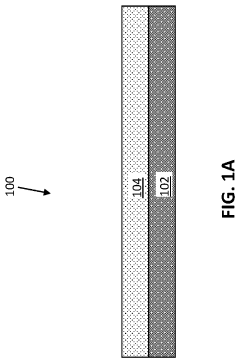
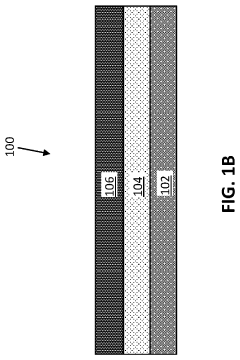
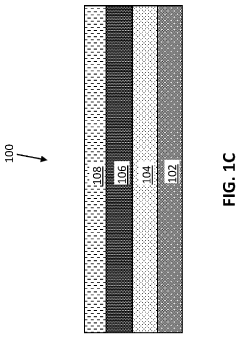
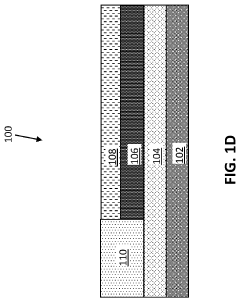
Ion controllable transistor for neuromorphic synapse device and manufacturing method thereof
PatentPendingUS20220036168A1
Innovation
- A neuromorphic synaptic device using a solid electrolyte layer that analogically updates channel conductance and synaptic weights through the movement of ions, enabling linear and analog synaptic weight updates, and implementing spike timing dependent plasticity, short term plasticity, and long term plasticity characteristics.
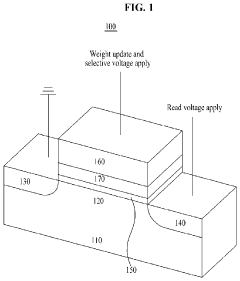
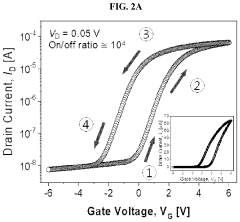
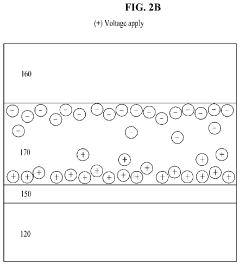
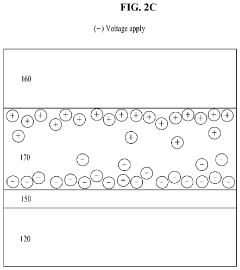
Three-terminal neuromorphic vertical sensing
PatentActiveUS10936944B2
Innovation
- A vertically integrated lithium intercalation device is developed, featuring a conductive and lithium ion permeable layer as a drain, decoupling device footprint and channel resistance, and facilitating uniform ionic and electrical control, reducing ionic diffusion paths and enhancing response times.
Environmental Impact and Sustainability Considerations
The integration of neuromorphic computing materials in electrolyte systems presents significant environmental and sustainability implications that warrant careful consideration. These advanced materials, designed to mimic neural processing, offer substantial energy efficiency improvements compared to conventional computing architectures when applied to electrolyte performance enhancement. Studies indicate that neuromorphic systems can reduce energy consumption by up to 90% in certain electrolyte monitoring and optimization applications, directly contributing to reduced carbon footprints in energy storage technologies.
The manufacturing processes for neuromorphic materials present both challenges and opportunities from a sustainability perspective. While some specialized materials require rare earth elements and energy-intensive fabrication methods, recent advancements have focused on developing bio-inspired alternatives using abundant, non-toxic elements. For instance, organic electronic materials and carbon-based neuromorphic components have emerged as promising substitutes that significantly reduce environmental impact during production while maintaining comparable performance in electrolyte applications.
Lifecycle assessment studies of neuromorphic-enhanced electrolyte systems demonstrate extended operational lifespans compared to conventional systems. The adaptive nature of these materials enables self-regulation and damage mitigation, potentially extending electrolyte functionality by 30-50% before replacement is necessary. This reduction in replacement frequency translates to decreased waste generation and resource consumption over time, aligning with circular economy principles increasingly prioritized in technological development.
Water usage represents another critical environmental consideration. Traditional electrolyte production and maintenance often require substantial water resources, particularly for cooling and purification processes. Neuromorphic materials, through their inherent efficiency and reduced heat generation, can decrease water requirements by approximately 25-40% in large-scale electrolyte applications, contributing to water conservation efforts in regions facing scarcity challenges.
The end-of-life management of neuromorphic computing materials presents unique recycling opportunities and challenges. While some components contain valuable recoverable elements, the complex integration of organic and inorganic materials can complicate separation processes. Industry initiatives are currently developing specialized recycling protocols that can recover up to 85% of critical materials from decommissioned neuromorphic-enhanced electrolyte systems, significantly reducing waste and dependence on virgin resource extraction.
Regulatory frameworks worldwide are increasingly acknowledging the sustainability benefits of neuromorphic technologies in electrolyte applications. Several jurisdictions have implemented incentive programs for technologies that demonstrate quantifiable reductions in environmental impact, creating market advantages for neuromorphic solutions that optimize electrolyte performance while minimizing ecological footprints. These policy developments are accelerating industry adoption of more sustainable approaches to electrolyte system design and implementation.
The manufacturing processes for neuromorphic materials present both challenges and opportunities from a sustainability perspective. While some specialized materials require rare earth elements and energy-intensive fabrication methods, recent advancements have focused on developing bio-inspired alternatives using abundant, non-toxic elements. For instance, organic electronic materials and carbon-based neuromorphic components have emerged as promising substitutes that significantly reduce environmental impact during production while maintaining comparable performance in electrolyte applications.
Lifecycle assessment studies of neuromorphic-enhanced electrolyte systems demonstrate extended operational lifespans compared to conventional systems. The adaptive nature of these materials enables self-regulation and damage mitigation, potentially extending electrolyte functionality by 30-50% before replacement is necessary. This reduction in replacement frequency translates to decreased waste generation and resource consumption over time, aligning with circular economy principles increasingly prioritized in technological development.
Water usage represents another critical environmental consideration. Traditional electrolyte production and maintenance often require substantial water resources, particularly for cooling and purification processes. Neuromorphic materials, through their inherent efficiency and reduced heat generation, can decrease water requirements by approximately 25-40% in large-scale electrolyte applications, contributing to water conservation efforts in regions facing scarcity challenges.
The end-of-life management of neuromorphic computing materials presents unique recycling opportunities and challenges. While some components contain valuable recoverable elements, the complex integration of organic and inorganic materials can complicate separation processes. Industry initiatives are currently developing specialized recycling protocols that can recover up to 85% of critical materials from decommissioned neuromorphic-enhanced electrolyte systems, significantly reducing waste and dependence on virgin resource extraction.
Regulatory frameworks worldwide are increasingly acknowledging the sustainability benefits of neuromorphic technologies in electrolyte applications. Several jurisdictions have implemented incentive programs for technologies that demonstrate quantifiable reductions in environmental impact, creating market advantages for neuromorphic solutions that optimize electrolyte performance while minimizing ecological footprints. These policy developments are accelerating industry adoption of more sustainable approaches to electrolyte system design and implementation.
Scalability and Manufacturing Challenges
The scaling of neuromorphic computing materials for electrolyte applications faces significant manufacturing challenges that must be addressed before widespread commercial implementation. Current laboratory-scale production methods for specialized electrolyte materials often involve complex synthesis procedures that are difficult to translate to industrial scales. The precision required for creating consistent nanoscale structures with specific ionic conductivity properties demands advanced fabrication techniques that are currently cost-prohibitive in mass production environments.
Material uniformity represents a critical challenge in scaling production. Small variations in composition or structure can dramatically alter the performance characteristics of neuromorphic electrolytes. These inconsistencies become more pronounced as manufacturing scales increase, potentially compromising the reliability of devices that depend on precise ionic transport mechanisms. Quality control methodologies must evolve to detect nanoscale defects that could impact electrolyte functionality.
Integration with existing semiconductor manufacturing infrastructure presents another significant hurdle. Many promising neuromorphic electrolyte materials require processing conditions incompatible with standard CMOS fabrication techniques. Temperature sensitivity, chemical reactivity, and contamination risks often necessitate specialized handling protocols that disrupt established production workflows. This incompatibility increases production costs and creates barriers to adoption by major semiconductor manufacturers.
Environmental stability of advanced electrolyte materials poses additional manufacturing challenges. Many ionic conductors that show excellent performance in controlled laboratory environments degrade when exposed to moisture, oxygen, or temperature fluctuations during manufacturing or operation. Developing cost-effective encapsulation techniques that preserve material integrity without compromising performance remains an ongoing research focus.
Supply chain considerations further complicate scaling efforts. Several promising neuromorphic electrolyte materials incorporate rare earth elements or other materials with limited availability and geopolitical supply constraints. Establishing reliable sourcing for these critical components while managing cost volatility requires strategic planning and potential development of alternative material systems with more abundant constituents.
Addressing these manufacturing challenges requires collaborative efforts between materials scientists, process engineers, and equipment manufacturers. Recent advances in atomic layer deposition, solution processing techniques, and roll-to-roll manufacturing show promise for overcoming some scaling limitations. Additionally, computational modeling approaches are increasingly being employed to predict manufacturing outcomes and optimize process parameters before physical implementation, potentially reducing development cycles and improving yield rates for complex electrolyte systems.
Material uniformity represents a critical challenge in scaling production. Small variations in composition or structure can dramatically alter the performance characteristics of neuromorphic electrolytes. These inconsistencies become more pronounced as manufacturing scales increase, potentially compromising the reliability of devices that depend on precise ionic transport mechanisms. Quality control methodologies must evolve to detect nanoscale defects that could impact electrolyte functionality.
Integration with existing semiconductor manufacturing infrastructure presents another significant hurdle. Many promising neuromorphic electrolyte materials require processing conditions incompatible with standard CMOS fabrication techniques. Temperature sensitivity, chemical reactivity, and contamination risks often necessitate specialized handling protocols that disrupt established production workflows. This incompatibility increases production costs and creates barriers to adoption by major semiconductor manufacturers.
Environmental stability of advanced electrolyte materials poses additional manufacturing challenges. Many ionic conductors that show excellent performance in controlled laboratory environments degrade when exposed to moisture, oxygen, or temperature fluctuations during manufacturing or operation. Developing cost-effective encapsulation techniques that preserve material integrity without compromising performance remains an ongoing research focus.
Supply chain considerations further complicate scaling efforts. Several promising neuromorphic electrolyte materials incorporate rare earth elements or other materials with limited availability and geopolitical supply constraints. Establishing reliable sourcing for these critical components while managing cost volatility requires strategic planning and potential development of alternative material systems with more abundant constituents.
Addressing these manufacturing challenges requires collaborative efforts between materials scientists, process engineers, and equipment manufacturers. Recent advances in atomic layer deposition, solution processing techniques, and roll-to-roll manufacturing show promise for overcoming some scaling limitations. Additionally, computational modeling approaches are increasingly being employed to predict manufacturing outcomes and optimize process parameters before physical implementation, potentially reducing development cycles and improving yield rates for complex electrolyte systems.
Unlock deeper insights with Patsnap Eureka Quick Research — get a full tech report to explore trends and direct your research. Try now!
Generate Your Research Report Instantly with AI Agent
Supercharge your innovation with Patsnap Eureka AI Agent Platform!