How to Optimize Direct Lithium Extraction for Efficiency
SEP 11, 20259 MIN READ
Generate Your Research Report Instantly with AI Agent
Patsnap Eureka helps you evaluate technical feasibility & market potential.
DLE Technology Background and Objectives
Direct Lithium Extraction (DLE) has emerged as a revolutionary approach to lithium production, representing a significant departure from traditional extraction methods that have dominated the industry for decades. The evolution of lithium extraction technology began with conventional methods such as solar evaporation from salt flats (salars) and hard-rock mining, both characterized by extensive land use, high water consumption, and lengthy production timelines.
The development of DLE technologies gained momentum in the early 2000s as global demand for lithium began to surge with the proliferation of portable electronics and the nascent electric vehicle industry. This technological trajectory accelerated significantly after 2010, driven by the exponential growth in lithium-ion battery applications and increasing environmental concerns surrounding traditional extraction methods.
DLE encompasses a diverse range of innovative approaches including adsorption, ion exchange, solvent extraction, and membrane processes, all designed to selectively extract lithium from brine resources with greater efficiency and reduced environmental impact. These technologies aim to address the fundamental limitations of conventional methods by significantly reducing water usage, minimizing land disturbance, and shortening production timelines from years to days or hours.
The primary technical objectives for optimizing DLE efficiency center around several key parameters: increasing lithium recovery rates beyond the current 50-90% range; improving selectivity to minimize co-extraction of contaminants; reducing energy consumption; extending adsorbent or membrane lifespan; and developing processes compatible with diverse brine chemistries across global lithium resources.
Recent technological advancements have focused on novel materials development, including engineered sorbents with enhanced lithium selectivity, advanced membrane technologies with improved permeability and rejection characteristics, and innovative process configurations that optimize energy and resource utilization. These developments represent critical steps toward realizing the full potential of DLE technologies.
The ultimate goal of DLE optimization is to establish economically viable processes that can achieve lithium recovery costs below $5,000 per ton while maintaining high purity levels suitable for battery-grade applications. This would position DLE as a competitive alternative to conventional methods, capable of meeting the projected tripling of global lithium demand by 2030 while adhering to increasingly stringent environmental standards and sustainability requirements.
As the technology continues to mature, interdisciplinary collaboration between materials scientists, chemical engineers, hydrogeologists, and environmental specialists will be essential to overcome remaining technical challenges and accelerate commercial implementation across diverse lithium resources worldwide.
The development of DLE technologies gained momentum in the early 2000s as global demand for lithium began to surge with the proliferation of portable electronics and the nascent electric vehicle industry. This technological trajectory accelerated significantly after 2010, driven by the exponential growth in lithium-ion battery applications and increasing environmental concerns surrounding traditional extraction methods.
DLE encompasses a diverse range of innovative approaches including adsorption, ion exchange, solvent extraction, and membrane processes, all designed to selectively extract lithium from brine resources with greater efficiency and reduced environmental impact. These technologies aim to address the fundamental limitations of conventional methods by significantly reducing water usage, minimizing land disturbance, and shortening production timelines from years to days or hours.
The primary technical objectives for optimizing DLE efficiency center around several key parameters: increasing lithium recovery rates beyond the current 50-90% range; improving selectivity to minimize co-extraction of contaminants; reducing energy consumption; extending adsorbent or membrane lifespan; and developing processes compatible with diverse brine chemistries across global lithium resources.
Recent technological advancements have focused on novel materials development, including engineered sorbents with enhanced lithium selectivity, advanced membrane technologies with improved permeability and rejection characteristics, and innovative process configurations that optimize energy and resource utilization. These developments represent critical steps toward realizing the full potential of DLE technologies.
The ultimate goal of DLE optimization is to establish economically viable processes that can achieve lithium recovery costs below $5,000 per ton while maintaining high purity levels suitable for battery-grade applications. This would position DLE as a competitive alternative to conventional methods, capable of meeting the projected tripling of global lithium demand by 2030 while adhering to increasingly stringent environmental standards and sustainability requirements.
As the technology continues to mature, interdisciplinary collaboration between materials scientists, chemical engineers, hydrogeologists, and environmental specialists will be essential to overcome remaining technical challenges and accelerate commercial implementation across diverse lithium resources worldwide.
Market Demand Analysis for Lithium Resources
The global lithium market has experienced unprecedented growth in recent years, primarily driven by the rapid expansion of electric vehicle (EV) production and renewable energy storage systems. Annual demand for lithium is projected to increase from approximately 500,000 metric tons of lithium carbonate equivalent (LCE) in 2021 to over 3 million metric tons by 2030, representing a compound annual growth rate exceeding 25%. This exponential growth trajectory underscores the critical importance of developing more efficient lithium extraction technologies.
The EV sector remains the dominant force behind lithium demand, accounting for roughly 80% of total consumption. Major automotive manufacturers have committed billions to electrification strategies, with companies like Volkswagen, GM, and Ford announcing plans to phase out internal combustion engines entirely within the next 10-15 years. This transition is creating sustained pressure on lithium supply chains.
Energy storage systems represent the second-largest market segment for lithium resources, growing at approximately 30% annually. Grid-scale battery installations are becoming increasingly common as utilities seek to balance intermittent renewable energy sources and enhance grid stability. Countries with ambitious renewable energy targets, particularly in Europe and Asia-Pacific regions, are driving significant demand in this sector.
Consumer electronics continues to provide a stable baseline demand for lithium, though its share of total consumption is declining proportionally as EV and energy storage applications expand. Nevertheless, the absolute volume of lithium required for portable devices continues to increase steadily at 5-7% annually.
Geographically, China dominates global lithium processing capacity, controlling over 60% of refined lithium production. However, concerns about supply chain security have prompted significant investments in alternative processing facilities in North America, Europe, and Australia. This regionalization trend is reshaping market dynamics and creating new opportunities for technological innovation in lithium extraction.
Price volatility has been a defining characteristic of lithium markets, with spot prices fluctuating by as much as 400% over the past five years. This volatility underscores the urgent need for more cost-effective and scalable extraction technologies. Direct Lithium Extraction (DLE) methods offer particular promise in this regard, potentially reducing production costs by 30-50% compared to traditional evaporation techniques while simultaneously decreasing environmental impact.
The sustainability profile of lithium production has become increasingly important to end-users, with major battery and automotive manufacturers establishing strict environmental, social, and governance (ESG) criteria for their supply chains. This market pressure is accelerating the transition toward more environmentally responsible extraction methods, creating additional incentives for DLE technology optimization.
The EV sector remains the dominant force behind lithium demand, accounting for roughly 80% of total consumption. Major automotive manufacturers have committed billions to electrification strategies, with companies like Volkswagen, GM, and Ford announcing plans to phase out internal combustion engines entirely within the next 10-15 years. This transition is creating sustained pressure on lithium supply chains.
Energy storage systems represent the second-largest market segment for lithium resources, growing at approximately 30% annually. Grid-scale battery installations are becoming increasingly common as utilities seek to balance intermittent renewable energy sources and enhance grid stability. Countries with ambitious renewable energy targets, particularly in Europe and Asia-Pacific regions, are driving significant demand in this sector.
Consumer electronics continues to provide a stable baseline demand for lithium, though its share of total consumption is declining proportionally as EV and energy storage applications expand. Nevertheless, the absolute volume of lithium required for portable devices continues to increase steadily at 5-7% annually.
Geographically, China dominates global lithium processing capacity, controlling over 60% of refined lithium production. However, concerns about supply chain security have prompted significant investments in alternative processing facilities in North America, Europe, and Australia. This regionalization trend is reshaping market dynamics and creating new opportunities for technological innovation in lithium extraction.
Price volatility has been a defining characteristic of lithium markets, with spot prices fluctuating by as much as 400% over the past five years. This volatility underscores the urgent need for more cost-effective and scalable extraction technologies. Direct Lithium Extraction (DLE) methods offer particular promise in this regard, potentially reducing production costs by 30-50% compared to traditional evaporation techniques while simultaneously decreasing environmental impact.
The sustainability profile of lithium production has become increasingly important to end-users, with major battery and automotive manufacturers establishing strict environmental, social, and governance (ESG) criteria for their supply chains. This market pressure is accelerating the transition toward more environmentally responsible extraction methods, creating additional incentives for DLE technology optimization.
Current DLE Challenges and Technical Limitations
Despite significant advancements in Direct Lithium Extraction (DLE) technologies, several critical challenges and technical limitations continue to impede widespread commercial adoption and optimal efficiency. The most pressing issue remains the selectivity of sorbents and extraction media, which often struggle to effectively separate lithium from competing ions such as sodium, magnesium, and calcium in complex brine compositions. This selectivity challenge directly impacts extraction efficiency and the economic viability of DLE operations.
Energy consumption represents another substantial hurdle for DLE implementation. Current technologies require significant energy inputs for pumping, heating, and regeneration processes, with some systems consuming between 40-70 kWh per kilogram of lithium carbonate equivalent (LCE) produced. This high energy demand not only increases operational costs but also diminishes the environmental advantages that DLE promises over traditional extraction methods.
Water management presents a multifaceted challenge, particularly in water-stressed regions where many lithium resources are located. Most DLE processes require substantial water volumes for extraction and subsequent processing, creating potential conflicts with local communities and ecosystems. Additionally, the management of wastewater containing concentrated rejected salts and potential chemical additives requires sophisticated treatment systems that add complexity and cost.
Sorbent durability and regeneration efficiency constitute significant technical limitations. Many ion-exchange materials and adsorbents experience performance degradation after multiple extraction-regeneration cycles, necessitating frequent replacement and increasing operational costs. Some materials show up to 30% capacity reduction after just 50-100 cycles, far below the thousands of cycles needed for commercial viability.
Scaling challenges persist as laboratory successes often fail to translate to field operations. The heterogeneous nature of brine resources, with varying temperatures, chemical compositions, and physical properties, means that technologies optimized for specific conditions may perform poorly in others. This variability necessitates customized approaches that complicate standardization efforts.
Process integration represents another significant limitation, as many DLE technologies function effectively as isolated unit operations but struggle when integrated into complete lithium production systems. The interfaces between extraction, concentration, purification, and conversion to final products often create inefficiencies that reduce overall system performance.
Economic barriers further constrain DLE adoption, with high capital expenditures for specialized equipment and materials, coupled with uncertain operational expenses due to limited commercial-scale operational data. These financial uncertainties deter investment and slow technological advancement in the field.
Energy consumption represents another substantial hurdle for DLE implementation. Current technologies require significant energy inputs for pumping, heating, and regeneration processes, with some systems consuming between 40-70 kWh per kilogram of lithium carbonate equivalent (LCE) produced. This high energy demand not only increases operational costs but also diminishes the environmental advantages that DLE promises over traditional extraction methods.
Water management presents a multifaceted challenge, particularly in water-stressed regions where many lithium resources are located. Most DLE processes require substantial water volumes for extraction and subsequent processing, creating potential conflicts with local communities and ecosystems. Additionally, the management of wastewater containing concentrated rejected salts and potential chemical additives requires sophisticated treatment systems that add complexity and cost.
Sorbent durability and regeneration efficiency constitute significant technical limitations. Many ion-exchange materials and adsorbents experience performance degradation after multiple extraction-regeneration cycles, necessitating frequent replacement and increasing operational costs. Some materials show up to 30% capacity reduction after just 50-100 cycles, far below the thousands of cycles needed for commercial viability.
Scaling challenges persist as laboratory successes often fail to translate to field operations. The heterogeneous nature of brine resources, with varying temperatures, chemical compositions, and physical properties, means that technologies optimized for specific conditions may perform poorly in others. This variability necessitates customized approaches that complicate standardization efforts.
Process integration represents another significant limitation, as many DLE technologies function effectively as isolated unit operations but struggle when integrated into complete lithium production systems. The interfaces between extraction, concentration, purification, and conversion to final products often create inefficiencies that reduce overall system performance.
Economic barriers further constrain DLE adoption, with high capital expenditures for specialized equipment and materials, coupled with uncertain operational expenses due to limited commercial-scale operational data. These financial uncertainties deter investment and slow technological advancement in the field.
Current DLE Optimization Solutions
01 Adsorption-based extraction methods
Adsorption-based methods utilize specialized materials to selectively capture lithium ions from brine solutions. These methods employ ion-exchange resins, inorganic adsorbents, or functionalized membranes that have high selectivity for lithium over competing ions like sodium, magnesium, and calcium. The efficiency of these processes depends on the adsorbent's capacity, selectivity, regeneration capability, and cycle stability. Advanced adsorbents can achieve higher lithium recovery rates while requiring less chemical consumption and processing time.- Adsorption-based extraction methods: Adsorption-based methods utilize specialized materials to selectively capture lithium ions from brine solutions. These methods employ ion-exchange resins, inorganic adsorbents, or functionalized membranes that have high selectivity for lithium over competing ions like sodium, magnesium, and calcium. The efficiency of these methods depends on the adsorption capacity, selectivity, regeneration capability, and kinetics of the adsorbent materials. Advanced adsorbents can significantly increase lithium recovery rates while reducing processing time and chemical consumption.
- Membrane and electrochemical separation technologies: Membrane and electrochemical technologies employ selective barriers or electrical potential differences to separate lithium from other elements in brine solutions. These methods include electrodialysis, capacitive deionization, and selective membrane filtration. The efficiency of these approaches is determined by membrane selectivity, energy consumption, and resistance to fouling. Recent innovations in membrane materials and electrochemical cell designs have improved lithium extraction efficiency while reducing energy requirements and operational costs.
- Solvent extraction and chemical precipitation methods: Solvent extraction and chemical precipitation methods involve the use of specific chemicals to selectively extract or precipitate lithium from brine solutions. These techniques utilize pH adjustment, addition of precipitating agents, or organic solvents that preferentially bind to lithium. The efficiency of these methods is influenced by reagent selectivity, reaction kinetics, and separation efficiency. Optimized chemical formulations can enhance lithium recovery rates while minimizing reagent consumption and waste generation.
- Process optimization and integration systems: Process optimization and integration systems focus on improving the overall efficiency of direct lithium extraction through enhanced process design, control strategies, and integration of multiple extraction stages. These approaches include continuous flow systems, cascade extraction arrangements, and real-time monitoring and control systems. The efficiency gains come from optimized operating parameters, reduced downtime, minimized reagent consumption, and energy recovery. Advanced process integration can significantly increase lithium recovery rates while reducing operational costs and environmental impact.
- Pre-treatment and brine conditioning methods: Pre-treatment and brine conditioning methods improve direct lithium extraction efficiency by modifying the composition of the brine solution before the main extraction process. These techniques include impurity removal, concentration adjustment, and modification of physical properties like temperature and pH. Effective pre-treatment can significantly enhance the performance of subsequent extraction steps by reducing interference from competing ions, preventing scaling and fouling, and optimizing the chemical environment for lithium separation. Advanced pre-treatment approaches can substantially increase overall process efficiency while extending equipment lifespan.
02 Membrane and electrochemical separation technologies
Electrochemical separation technologies employ ion-selective membranes and electrical potential to extract lithium from brines. These systems can include electrodialysis, capacitive deionization, or electrochemical cells specifically designed for lithium separation. The efficiency is determined by membrane selectivity, energy consumption, and system design. These methods often achieve higher purity lithium products with reduced processing steps compared to traditional evaporation methods, while also enabling continuous operation and reduced water consumption.Expand Specific Solutions03 Solvent extraction and chemical precipitation
Chemical precipitation and solvent extraction methods involve the use of specific reagents to selectively separate lithium from brine solutions. These techniques rely on pH adjustment, addition of precipitating agents, or organic solvents that preferentially bind to lithium. The efficiency depends on reagent selectivity, reaction kinetics, and separation conditions. These methods can achieve high lithium recovery rates with relatively simple equipment, though they may require careful management of chemical consumption and waste streams.Expand Specific Solutions04 Process optimization and integration systems
Integrated systems combine multiple extraction technologies to maximize efficiency and overcome limitations of individual methods. These systems often incorporate pre-treatment steps, multi-stage extraction processes, and recovery circuits designed to handle specific brine compositions. Process optimization involves careful control of operating parameters, recycling of reagents, and energy recovery systems. Advanced monitoring and control systems enable real-time adjustments to maintain optimal performance under varying feed conditions, resulting in higher overall lithium recovery and reduced operational costs.Expand Specific Solutions05 Novel materials and sustainable extraction approaches
Innovative materials and sustainable approaches focus on developing environmentally friendly extraction methods with reduced water and energy consumption. These include novel adsorbents derived from renewable resources, green solvents, and processes designed to minimize waste generation. Some approaches incorporate renewable energy sources to power extraction operations or utilize waste heat from other industrial processes. These methods aim to improve the sustainability profile of lithium extraction while maintaining or enhancing efficiency, addressing growing concerns about the environmental impact of lithium production.Expand Specific Solutions
Key Industry Players in DLE Development
Direct Lithium Extraction (DLE) technology is currently in an early growth phase, with the global market expected to reach $1.2 billion by 2030. The competitive landscape features established energy companies like Schlumberger and Koch Technology Solutions alongside innovative startups such as Lilac Solutions, Watercycle Technologies, and Forager Station. Technical maturity varies significantly across players, with companies like POSCO Holdings and International Battery Metals demonstrating commercial-scale implementations, while academic institutions including Central South University and The University of Manchester contribute fundamental research advancements. The integration of DLE with battery manufacturing ecosystems is emerging as a strategic advantage, as evidenced by BYD and CATL's subsidiary Guangdong Bangpu's investments in this technology to secure lithium supply chains.
Schlumberger Technologies, Inc.
Technical Solution: Schlumberger has developed advanced Direct Lithium Extraction (DLE) technologies through their NeoLith Energy platform, which utilizes selective adsorption processes to extract lithium from brine resources. Their approach employs proprietary ion-exchange materials that selectively capture lithium ions while rejecting competing ions like sodium, magnesium, and calcium. The process operates in a continuous flow system where brine passes through adsorption columns containing these materials, allowing for lithium capture at higher recovery rates (typically 70-90%) compared to traditional evaporation methods (30-50%). Schlumberger's technology significantly reduces water consumption by returning most of the brine to its source after lithium extraction, and operates with a substantially smaller physical footprint than evaporation ponds. Their system incorporates advanced process control and automation to optimize operational parameters in real-time, adjusting to variations in brine chemistry and environmental conditions to maintain extraction efficiency.
Strengths: Higher recovery rates than conventional methods; significantly reduced water footprint; smaller land requirements; faster production timeline (days vs. months); adaptability to various brine chemistries. Weaknesses: Higher energy consumption requirements; more complex operational management; potentially higher capital costs; technology still being scaled to commercial levels.
Koch Technology Solutions LLC
Technical Solution: Koch Technology Solutions has developed an innovative DLE technology platform called Li-Pro™, which combines selective adsorption with advanced membrane processes for lithium extraction. Their system utilizes specialized sorbent materials with high selectivity for lithium ions even in the presence of competing ions. The Li-Pro™ process incorporates a multi-stage approach where brine first undergoes pre-treatment to remove impurities, followed by the selective adsorption of lithium using proprietary materials. The captured lithium is then eluted using optimized chemical solutions and concentrated through membrane processes. Koch's technology achieves lithium recovery rates of up to 90% while minimizing reagent consumption through sophisticated recycling systems. The company has implemented advanced process control systems that continuously monitor and adjust operational parameters to maintain optimal performance across varying brine compositions and flow rates, resulting in consistent lithium output quality and reduced operational costs.
Strengths: High lithium selectivity across diverse brine compositions; reduced chemical consumption through reagent recycling; modular design allowing for scalable implementation; integration with existing operations. Weaknesses: Potentially higher initial capital investment; requires specialized technical expertise for operation; membrane components may require periodic replacement; energy requirements for the multi-stage process.
Core DLE Innovations and Patents
Ion extraction column for brine
PatentPendingUS20250092490A1
Innovation
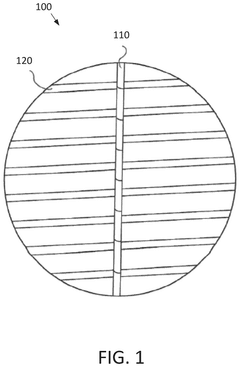
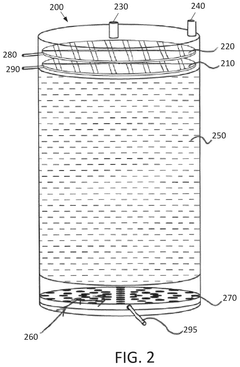
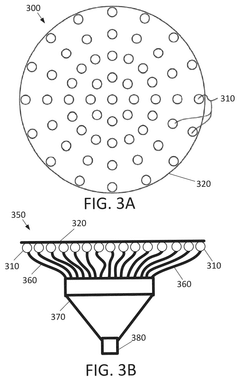
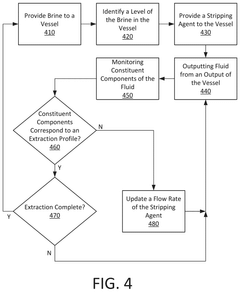
- A method and apparatus for direct lithium extraction (DLE) using a porous media bed with a uniform extractant material that absorbs target ions like lithium, followed by a stripping solution to separate and regenerate the extractant, maintaining a sharp interface between brine and stripping solution to maximize extraction efficiency.
Flexible brine pre-treatment for direct lithium extraction
PatentPendingUS20250145497A1
Innovation
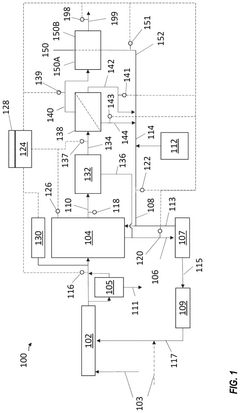
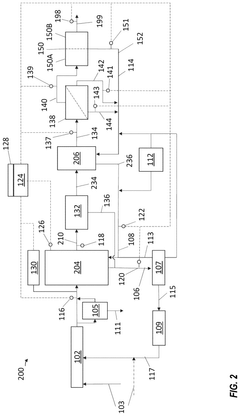
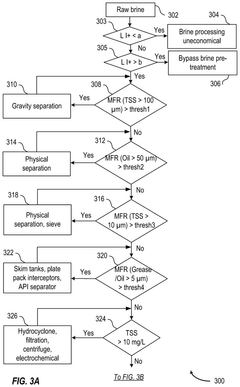
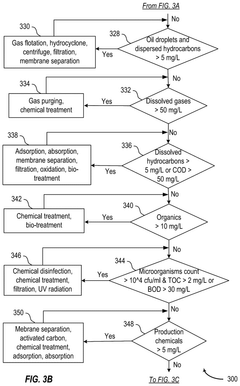
- A flexible brine pre-treatment process that involves measuring properties of a sample brine, comparing them to specified thresholds, and selecting appropriate pre-treatment stages to modify the brine properties, thereby optimizing the DLE process.
Environmental Impact Assessment of DLE Methods
Direct Lithium Extraction (DLE) technologies, while promising for efficient lithium production, carry significant environmental implications that must be thoroughly assessed. The environmental footprint of DLE methods varies considerably depending on the specific technology employed, with impacts ranging from water usage to chemical contamination and energy consumption.
Water resource management represents a critical environmental concern for DLE operations. Although DLE generally requires less water than traditional evaporation ponds, certain methods still consume substantial water volumes, particularly in water-stressed regions where lithium brine resources are often located. Advanced DLE technologies utilizing ion exchange or adsorption processes demonstrate improved water efficiency, with some systems achieving up to 90% water recovery rates compared to conventional methods.
Chemical usage in DLE processes presents another environmental challenge. Many extraction methods employ acids, bases, or specialized solvents that, if improperly managed, can contaminate surrounding ecosystems. Recent innovations in green chemistry have led to the development of biodegradable sorbents and environmentally benign reagents that significantly reduce potential ecological harm while maintaining extraction efficiency.
Energy consumption patterns across different DLE technologies reveal substantial variations in carbon footprint. Membrane-based systems typically require 2-5 kWh per kilogram of lithium carbonate equivalent (LCE), while adsorption-based methods may consume 3-7 kWh/kg LCE. Implementing renewable energy sources at extraction facilities can substantially mitigate these impacts, with several pilot projects demonstrating successful integration of solar and geothermal energy.
Land disturbance from DLE operations is markedly lower than traditional evaporation methods, requiring approximately 50-90% less surface area for equivalent production capacity. This reduced footprint minimizes habitat disruption and preserves biodiversity in sensitive desert ecosystems where many lithium resources are located.
Brine reinjection practices significantly influence the long-term sustainability of lithium extraction. Proper reinjection maintains aquifer pressure and prevents subsidence, while improper management can lead to hydrological imbalances affecting both groundwater systems and surface water bodies. Advanced monitoring systems utilizing real-time sensors and predictive modeling have improved reinjection management, reducing potential negative impacts on local hydrology.
Waste management challenges vary by DLE technology, with solid waste streams requiring particular attention. Some methods generate metal-laden residues that necessitate specialized disposal protocols, while others produce potentially valuable by-products that could support circular economy principles if properly recovered and utilized.
Life cycle assessments comparing various DLE methods indicate that adsorption and ion exchange technologies generally demonstrate superior environmental performance when optimized, with greenhouse gas emissions 30-60% lower than traditional evaporation methods for equivalent lithium production.
Water resource management represents a critical environmental concern for DLE operations. Although DLE generally requires less water than traditional evaporation ponds, certain methods still consume substantial water volumes, particularly in water-stressed regions where lithium brine resources are often located. Advanced DLE technologies utilizing ion exchange or adsorption processes demonstrate improved water efficiency, with some systems achieving up to 90% water recovery rates compared to conventional methods.
Chemical usage in DLE processes presents another environmental challenge. Many extraction methods employ acids, bases, or specialized solvents that, if improperly managed, can contaminate surrounding ecosystems. Recent innovations in green chemistry have led to the development of biodegradable sorbents and environmentally benign reagents that significantly reduce potential ecological harm while maintaining extraction efficiency.
Energy consumption patterns across different DLE technologies reveal substantial variations in carbon footprint. Membrane-based systems typically require 2-5 kWh per kilogram of lithium carbonate equivalent (LCE), while adsorption-based methods may consume 3-7 kWh/kg LCE. Implementing renewable energy sources at extraction facilities can substantially mitigate these impacts, with several pilot projects demonstrating successful integration of solar and geothermal energy.
Land disturbance from DLE operations is markedly lower than traditional evaporation methods, requiring approximately 50-90% less surface area for equivalent production capacity. This reduced footprint minimizes habitat disruption and preserves biodiversity in sensitive desert ecosystems where many lithium resources are located.
Brine reinjection practices significantly influence the long-term sustainability of lithium extraction. Proper reinjection maintains aquifer pressure and prevents subsidence, while improper management can lead to hydrological imbalances affecting both groundwater systems and surface water bodies. Advanced monitoring systems utilizing real-time sensors and predictive modeling have improved reinjection management, reducing potential negative impacts on local hydrology.
Waste management challenges vary by DLE technology, with solid waste streams requiring particular attention. Some methods generate metal-laden residues that necessitate specialized disposal protocols, while others produce potentially valuable by-products that could support circular economy principles if properly recovered and utilized.
Life cycle assessments comparing various DLE methods indicate that adsorption and ion exchange technologies generally demonstrate superior environmental performance when optimized, with greenhouse gas emissions 30-60% lower than traditional evaporation methods for equivalent lithium production.
Economic Feasibility of DLE Implementation
The economic viability of Direct Lithium Extraction (DLE) implementation represents a critical factor in determining its adoption across the lithium industry. Initial capital expenditure for DLE facilities ranges from $15,000 to $30,000 per ton of annual lithium carbonate equivalent (LCE) production capacity, significantly lower than traditional evaporation pond methods which require $18,000 to $40,000 per ton. This cost advantage becomes particularly pronounced when considering the reduced land requirements, with DLE facilities occupying up to 90% less space than conventional operations.
Operational expenditure analysis reveals that DLE technologies currently demonstrate production costs between $3,500 and $7,500 per ton of LCE, compared to $2,500 to $6,000 for traditional methods. While slightly higher in some implementations, these costs are projected to decrease by 15-25% over the next five years as technologies mature and economies of scale are realized. The economic equation is further balanced by DLE's substantially reduced time-to-market, with projects reaching production in 2-3 years versus 5-7 years for evaporation methods.
Return on investment calculations indicate that DLE projects can achieve payback periods of 4-6 years, contingent upon lithium market prices remaining above $15,000 per ton. Sensitivity analysis demonstrates that DLE economics become increasingly favorable as environmental regulations tighten and water conservation becomes more economically valuable, particularly in water-stressed regions where traditional extraction faces mounting operational constraints.
The economic assessment must also account for technology-specific variables. Adsorption-based DLE systems typically show lower energy requirements but higher adsorbent replacement costs, while membrane and solvent extraction approaches may present higher energy demands but reduced consumable expenses. These trade-offs significantly impact long-term economic performance and must be evaluated based on site-specific conditions including brine chemistry, energy availability, and local resource pricing.
Financing models for DLE implementation have evolved to accommodate the technology's risk profile. Venture capital has shown increasing interest, with investment in DLE startups exceeding $1.2 billion between 2020 and 2023. Strategic partnerships between technology providers and established mining companies have emerged as a predominant model, allowing risk-sharing and combining technological innovation with operational expertise. Government incentives, particularly in regions prioritizing domestic lithium production, further enhance economic feasibility through tax benefits, grants, and expedited permitting processes.
Operational expenditure analysis reveals that DLE technologies currently demonstrate production costs between $3,500 and $7,500 per ton of LCE, compared to $2,500 to $6,000 for traditional methods. While slightly higher in some implementations, these costs are projected to decrease by 15-25% over the next five years as technologies mature and economies of scale are realized. The economic equation is further balanced by DLE's substantially reduced time-to-market, with projects reaching production in 2-3 years versus 5-7 years for evaporation methods.
Return on investment calculations indicate that DLE projects can achieve payback periods of 4-6 years, contingent upon lithium market prices remaining above $15,000 per ton. Sensitivity analysis demonstrates that DLE economics become increasingly favorable as environmental regulations tighten and water conservation becomes more economically valuable, particularly in water-stressed regions where traditional extraction faces mounting operational constraints.
The economic assessment must also account for technology-specific variables. Adsorption-based DLE systems typically show lower energy requirements but higher adsorbent replacement costs, while membrane and solvent extraction approaches may present higher energy demands but reduced consumable expenses. These trade-offs significantly impact long-term economic performance and must be evaluated based on site-specific conditions including brine chemistry, energy availability, and local resource pricing.
Financing models for DLE implementation have evolved to accommodate the technology's risk profile. Venture capital has shown increasing interest, with investment in DLE startups exceeding $1.2 billion between 2020 and 2023. Strategic partnerships between technology providers and established mining companies have emerged as a predominant model, allowing risk-sharing and combining technological innovation with operational expertise. Government incentives, particularly in regions prioritizing domestic lithium production, further enhance economic feasibility through tax benefits, grants, and expedited permitting processes.
Unlock deeper insights with Patsnap Eureka Quick Research — get a full tech report to explore trends and direct your research. Try now!
Generate Your Research Report Instantly with AI Agent
Supercharge your innovation with Patsnap Eureka AI Agent Platform!