
How to Optimize Pharmaceutical Formulation Using Sodium Alginate?
JUL 14, 20259 MIN READ
Generate Your Research Report Instantly with AI Agent
Patsnap Eureka helps you evaluate technical feasibility & market potential.
Sodium Alginate in Pharma: Background and Objectives
Sodium alginate, a versatile biopolymer derived from brown seaweed, has gained significant attention in the pharmaceutical industry due to its unique properties and wide-ranging applications. The evolution of this natural polysaccharide in pharmaceutical formulations can be traced back to the mid-20th century, with its use expanding rapidly in recent decades.
The primary objective of utilizing sodium alginate in pharmaceutical formulations is to enhance drug delivery systems, improve bioavailability, and achieve controlled release profiles. Its ability to form hydrogels and its biocompatibility make it an ideal candidate for various drug delivery applications, including oral, topical, and injectable formulations.
The technological progression of sodium alginate in pharmaceuticals has been marked by several key milestones. Initially, it was primarily used as a thickening agent and stabilizer. However, as research advanced, its potential for controlled release and targeted drug delivery became apparent. The development of alginate-based microparticles and nanoparticles in the 1990s opened up new possibilities for encapsulation and protection of sensitive drugs.
In recent years, the focus has shifted towards exploring sodium alginate's potential in advanced drug delivery systems. This includes its application in 3D bioprinting for tissue engineering, the development of smart hydrogels responsive to environmental stimuli, and its use in combination with other polymers to create hybrid systems with enhanced properties.
The current technological landscape surrounding sodium alginate in pharmaceuticals is characterized by a drive towards precision medicine and personalized drug delivery. Researchers are exploring ways to fine-tune alginate-based formulations to achieve specific release profiles, target particular tissues or organs, and respond to physiological conditions within the body.
Looking ahead, the technological goals for sodium alginate in pharmaceutical formulations are multifaceted. There is a growing emphasis on developing alginate-based systems that can overcome biological barriers, such as the blood-brain barrier or the gastrointestinal epithelium. Additionally, there is a push towards creating "smart" alginate formulations that can adapt to the patient's physiological conditions, providing truly personalized medicine.
Another important objective is to standardize and optimize the production and characterization of pharmaceutical-grade sodium alginate. This includes developing more consistent extraction and purification methods, as well as establishing robust quality control measures to ensure batch-to-batch reproducibility.
As we delve deeper into the optimization of pharmaceutical formulations using sodium alginate, it is crucial to consider these technological backgrounds and objectives. The ongoing research and development in this field promise to unlock new possibilities for drug delivery, potentially revolutionizing treatment strategies for a wide range of diseases and medical conditions.
The primary objective of utilizing sodium alginate in pharmaceutical formulations is to enhance drug delivery systems, improve bioavailability, and achieve controlled release profiles. Its ability to form hydrogels and its biocompatibility make it an ideal candidate for various drug delivery applications, including oral, topical, and injectable formulations.
The technological progression of sodium alginate in pharmaceuticals has been marked by several key milestones. Initially, it was primarily used as a thickening agent and stabilizer. However, as research advanced, its potential for controlled release and targeted drug delivery became apparent. The development of alginate-based microparticles and nanoparticles in the 1990s opened up new possibilities for encapsulation and protection of sensitive drugs.
In recent years, the focus has shifted towards exploring sodium alginate's potential in advanced drug delivery systems. This includes its application in 3D bioprinting for tissue engineering, the development of smart hydrogels responsive to environmental stimuli, and its use in combination with other polymers to create hybrid systems with enhanced properties.
The current technological landscape surrounding sodium alginate in pharmaceuticals is characterized by a drive towards precision medicine and personalized drug delivery. Researchers are exploring ways to fine-tune alginate-based formulations to achieve specific release profiles, target particular tissues or organs, and respond to physiological conditions within the body.
Looking ahead, the technological goals for sodium alginate in pharmaceutical formulations are multifaceted. There is a growing emphasis on developing alginate-based systems that can overcome biological barriers, such as the blood-brain barrier or the gastrointestinal epithelium. Additionally, there is a push towards creating "smart" alginate formulations that can adapt to the patient's physiological conditions, providing truly personalized medicine.
Another important objective is to standardize and optimize the production and characterization of pharmaceutical-grade sodium alginate. This includes developing more consistent extraction and purification methods, as well as establishing robust quality control measures to ensure batch-to-batch reproducibility.
As we delve deeper into the optimization of pharmaceutical formulations using sodium alginate, it is crucial to consider these technological backgrounds and objectives. The ongoing research and development in this field promise to unlock new possibilities for drug delivery, potentially revolutionizing treatment strategies for a wide range of diseases and medical conditions.
Market Analysis: Alginate-Based Drug Formulations
The market for alginate-based drug formulations has experienced significant growth in recent years, driven by the increasing demand for advanced drug delivery systems and the unique properties of sodium alginate. This natural polysaccharide, derived from brown seaweed, offers excellent biocompatibility, biodegradability, and versatility in pharmaceutical applications.
The global alginate market size was valued at approximately $600 million in 2020, with a substantial portion attributed to pharmaceutical and biomedical applications. The market is projected to grow at a compound annual growth rate (CAGR) of 4.5% from 2021 to 2028, reaching an estimated value of $850 million by the end of the forecast period.
Within the pharmaceutical sector, alginate-based formulations have gained traction in various drug delivery applications. These include controlled release systems, wound dressings, and tissue engineering scaffolds. The controlled release segment holds the largest market share, accounting for over 40% of the total alginate-based pharmaceutical market.
Geographically, North America dominates the market, followed by Europe and Asia-Pacific. The United States, in particular, leads in terms of research and development activities related to alginate-based drug formulations. However, emerging economies in Asia-Pacific, such as China and India, are expected to witness the highest growth rates due to increasing healthcare expenditure and growing pharmaceutical industries.
Key factors driving market growth include the rising prevalence of chronic diseases, the need for targeted drug delivery systems, and the growing adoption of natural and biocompatible materials in pharmaceutical formulations. Additionally, the increasing focus on personalized medicine and the development of novel drug delivery technologies are expected to create new opportunities for alginate-based formulations.
However, the market faces challenges such as the variability in alginate quality depending on its source and extraction methods, as well as regulatory hurdles associated with the approval of new drug delivery systems. These factors may impact the widespread adoption of alginate-based formulations in certain pharmaceutical applications.
Despite these challenges, the future outlook for alginate-based drug formulations remains positive. Ongoing research and development efforts are focused on enhancing the properties of alginate, such as improving its mechanical strength and stability, to expand its applications in drug delivery. Furthermore, the integration of alginate with other biomaterials and advanced technologies, such as 3D printing, is expected to open up new avenues for innovative pharmaceutical formulations.
The global alginate market size was valued at approximately $600 million in 2020, with a substantial portion attributed to pharmaceutical and biomedical applications. The market is projected to grow at a compound annual growth rate (CAGR) of 4.5% from 2021 to 2028, reaching an estimated value of $850 million by the end of the forecast period.
Within the pharmaceutical sector, alginate-based formulations have gained traction in various drug delivery applications. These include controlled release systems, wound dressings, and tissue engineering scaffolds. The controlled release segment holds the largest market share, accounting for over 40% of the total alginate-based pharmaceutical market.
Geographically, North America dominates the market, followed by Europe and Asia-Pacific. The United States, in particular, leads in terms of research and development activities related to alginate-based drug formulations. However, emerging economies in Asia-Pacific, such as China and India, are expected to witness the highest growth rates due to increasing healthcare expenditure and growing pharmaceutical industries.
Key factors driving market growth include the rising prevalence of chronic diseases, the need for targeted drug delivery systems, and the growing adoption of natural and biocompatible materials in pharmaceutical formulations. Additionally, the increasing focus on personalized medicine and the development of novel drug delivery technologies are expected to create new opportunities for alginate-based formulations.
However, the market faces challenges such as the variability in alginate quality depending on its source and extraction methods, as well as regulatory hurdles associated with the approval of new drug delivery systems. These factors may impact the widespread adoption of alginate-based formulations in certain pharmaceutical applications.
Despite these challenges, the future outlook for alginate-based drug formulations remains positive. Ongoing research and development efforts are focused on enhancing the properties of alginate, such as improving its mechanical strength and stability, to expand its applications in drug delivery. Furthermore, the integration of alginate with other biomaterials and advanced technologies, such as 3D printing, is expected to open up new avenues for innovative pharmaceutical formulations.
Current Challenges in Sodium Alginate Formulations
Despite the widespread use of sodium alginate in pharmaceutical formulations, several challenges persist in optimizing its application. One of the primary issues is the variability in alginate composition and quality. Sodium alginate, derived from brown seaweed, can exhibit significant batch-to-batch variations in molecular weight, viscosity, and guluronic to mannuronic acid ratio. These inconsistencies can lead to unpredictable drug release profiles and formulation instability, making it difficult to achieve reproducible results in pharmaceutical products.
Another challenge lies in controlling the cross-linking process of sodium alginate. While this property is advantageous for creating hydrogels and sustained-release formulations, achieving precise and uniform cross-linking can be problematic. Factors such as pH, temperature, and the presence of multivalent cations can significantly affect the cross-linking kinetics and gel strength, potentially impacting drug release rates and formulation stability.
The pH sensitivity of sodium alginate presents both opportunities and challenges in formulation development. While this characteristic allows for targeted drug delivery in specific gastrointestinal regions, it also makes the polymer susceptible to premature degradation or dissolution in acidic environments. This can lead to undesired drug release in the stomach for formulations intended for intestinal delivery, necessitating additional protective measures or complex formulation strategies.
Biocompatibility and immunogenicity concerns also pose challenges in certain applications of sodium alginate. Although generally regarded as safe, some studies have reported mild inflammatory responses or immune reactions to alginate-based materials. This is particularly relevant for parenteral or implantable formulations, where long-term exposure to the polymer may occur.
The moisture sensitivity of sodium alginate can lead to formulation instability during storage and handling. Hygroscopic properties may result in changes in viscosity, flow properties, and even premature cross-linking, affecting the overall quality and performance of the pharmaceutical product. This necessitates careful consideration of packaging and storage conditions to maintain formulation integrity.
Lastly, the interaction of sodium alginate with other excipients and active pharmaceutical ingredients (APIs) can be complex and sometimes unpredictable. Ionic interactions, hydrogen bonding, or physical entanglement with other formulation components may alter the release kinetics of drugs or affect the overall stability of the formulation. This complexity requires extensive compatibility studies and careful formulation design to achieve the desired pharmaceutical properties.
Addressing these challenges requires a multifaceted approach, combining advanced analytical techniques, innovative formulation strategies, and a deep understanding of alginate chemistry and polymer physics. As research in this field progresses, new solutions and optimization techniques are continually being developed to harness the full potential of sodium alginate in pharmaceutical applications.
Another challenge lies in controlling the cross-linking process of sodium alginate. While this property is advantageous for creating hydrogels and sustained-release formulations, achieving precise and uniform cross-linking can be problematic. Factors such as pH, temperature, and the presence of multivalent cations can significantly affect the cross-linking kinetics and gel strength, potentially impacting drug release rates and formulation stability.
The pH sensitivity of sodium alginate presents both opportunities and challenges in formulation development. While this characteristic allows for targeted drug delivery in specific gastrointestinal regions, it also makes the polymer susceptible to premature degradation or dissolution in acidic environments. This can lead to undesired drug release in the stomach for formulations intended for intestinal delivery, necessitating additional protective measures or complex formulation strategies.
Biocompatibility and immunogenicity concerns also pose challenges in certain applications of sodium alginate. Although generally regarded as safe, some studies have reported mild inflammatory responses or immune reactions to alginate-based materials. This is particularly relevant for parenteral or implantable formulations, where long-term exposure to the polymer may occur.
The moisture sensitivity of sodium alginate can lead to formulation instability during storage and handling. Hygroscopic properties may result in changes in viscosity, flow properties, and even premature cross-linking, affecting the overall quality and performance of the pharmaceutical product. This necessitates careful consideration of packaging and storage conditions to maintain formulation integrity.
Lastly, the interaction of sodium alginate with other excipients and active pharmaceutical ingredients (APIs) can be complex and sometimes unpredictable. Ionic interactions, hydrogen bonding, or physical entanglement with other formulation components may alter the release kinetics of drugs or affect the overall stability of the formulation. This complexity requires extensive compatibility studies and careful formulation design to achieve the desired pharmaceutical properties.
Addressing these challenges requires a multifaceted approach, combining advanced analytical techniques, innovative formulation strategies, and a deep understanding of alginate chemistry and polymer physics. As research in this field progresses, new solutions and optimization techniques are continually being developed to harness the full potential of sodium alginate in pharmaceutical applications.
Existing Sodium Alginate Formulation Techniques
01 Optimization of sodium alginate concentration
The concentration of sodium alginate in formulations is crucial for achieving desired properties. Optimizing the concentration can improve viscosity, stability, and drug release characteristics. Researchers have explored various concentrations to balance these factors and enhance overall formulation performance.- Optimization of sodium alginate concentration: The concentration of sodium alginate in formulations is crucial for achieving desired properties. Optimizing the concentration can improve viscosity, stability, and drug release profiles. Researchers have explored various concentrations to balance these factors and enhance overall formulation performance.
- Combination with other polymers: Combining sodium alginate with other polymers can enhance its properties and expand its applications. Blending with polymers like chitosan, pectin, or cellulose derivatives can improve mechanical strength, mucoadhesion, and controlled release characteristics of the formulation.
- Cross-linking methods for sodium alginate: Various cross-linking methods can be employed to modify the properties of sodium alginate. Techniques such as ionic cross-linking with calcium ions, covalent cross-linking, or photo-cross-linking can be optimized to achieve desired mechanical properties, swelling behavior, and drug release kinetics.
- Incorporation of active ingredients: Optimizing the incorporation of active ingredients into sodium alginate formulations is essential for drug delivery applications. Factors such as drug-polymer interactions, encapsulation efficiency, and release kinetics need to be considered and optimized to achieve the desired therapeutic effect.
- Processing techniques for sodium alginate formulations: Various processing techniques can be employed to optimize sodium alginate formulations. Methods such as spray drying, freeze-drying, electrospinning, or 3D printing can be used to create different forms of sodium alginate-based materials with tailored properties for specific applications.
02 Combination with other polymers
Combining sodium alginate with other polymers can enhance its properties and expand its applications. Blending with polymers like chitosan, pectin, or cellulose derivatives can improve mechanical strength, mucoadhesion, and controlled release profiles of the formulations.Expand Specific Solutions03 Cross-linking methods for sodium alginate
Various cross-linking methods have been developed to modify the properties of sodium alginate. These include ionic cross-linking with divalent cations, covalent cross-linking with chemical agents, and physical cross-linking techniques. Optimizing these methods can lead to improved gel strength, stability, and controlled release characteristics.Expand Specific Solutions04 Incorporation of active ingredients
Sodium alginate formulations can be optimized to effectively incorporate and deliver various active ingredients. This includes drugs, proteins, and bioactive compounds. Researchers have explored different techniques to enhance the loading efficiency, stability, and release kinetics of these active ingredients within the alginate matrix.Expand Specific Solutions05 Processing techniques for sodium alginate formulations
Various processing techniques have been developed to optimize sodium alginate formulations. These include spray drying, freeze-drying, electrospinning, and microencapsulation. Each technique offers unique advantages in terms of particle size control, morphology, and preservation of active ingredients, allowing for tailored formulations for specific applications.Expand Specific Solutions
Key Players in Pharmaceutical Alginate Research
The pharmaceutical formulation optimization using sodium alginate is in a mature stage of development, with a significant market size and established technological applications. The industry is characterized by a mix of academic institutions and commercial enterprises, indicating a well-developed ecosystem. Key players include Ocean University of China and Qingdao Bright Moon Seaweed Group Co., Ltd., leveraging their expertise in marine-derived products. Pharmaceutical companies like Teva Pharmaceutical Industries Ltd. and Bausch & Lomb, Inc. are likely integrating sodium alginate into their formulation processes. The presence of diverse players suggests a competitive landscape with ongoing research and development efforts to enhance formulation techniques and expand applications in drug delivery systems.
Knoll AG
Technical Solution: Knoll AG has pioneered the use of sodium alginate in oral solid dosage forms. Their approach focuses on creating multi-layered tablet formulations with sodium alginate as a key component. The company has developed a proprietary compression technique that allows for the creation of distinct layers with different release profiles[7]. Knoll's formulation incorporates a combination of high and low molecular weight sodium alginates to achieve optimal swelling and erosion characteristics. They have also introduced a novel co-processing method that combines sodium alginate with other excipients to enhance tablet compressibility and disintegration properties[8]. Additionally, Knoll has developed a specialized coating technology using alginate-based films to provide enteric protection and targeted release in the intestinal tract[9].
Strengths: Versatile application in various oral dosage forms, ability to create complex release profiles, and improved tablet properties. Weaknesses: Potential for batch-to-batch variability in alginate properties and the need for specialized manufacturing equipment.
Bausch & Lomb, Inc.
Technical Solution: Bausch & Lomb has focused on utilizing sodium alginate in ophthalmic formulations. Their approach involves developing a unique in situ gelling system that transforms from a liquid to a gel upon contact with the eye surface. This system incorporates sodium alginate as the primary gelling agent, combined with other polymers to optimize viscosity and mucoadhesive properties[4]. The company has also introduced a novel ion-activated gelation mechanism, where the presence of ions in tear fluid triggers the formation of a stable gel network[5]. To enhance the stability of incorporated APIs, Bausch & Lomb has developed a proprietary method of encapsulating drugs within alginate nanoparticles, which are then dispersed within the gel matrix[6].
Strengths: Improved ocular residence time, enhanced patient compliance, and potential for sustained drug release. Weaknesses: Limited to ophthalmic applications and potential for initial blurring of vision upon application.
Innovative Approaches in Alginate Drug Delivery
Solid dispersions
PatentPendingUS20230059619A1
Innovation
- A solid dispersion comprising a low solubility active ingredient combined with sodium or potassium alginate, with specific weight ratios and viscosity-dependent formulations to enhance drug release, using methods like solvent evaporation or supercritical fluid methods.
Sustained release formulation for sparingly soluble main drugs
PatentInactiveUS20050260263A1
Innovation
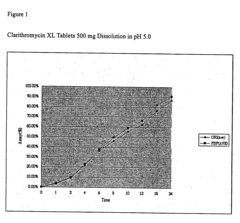
- A controlled release pharmaceutical composition using only sodium alginate, combined with an organic carboxylic acid, to create a micro-environment of low pH and form a film that controls drug release, improving stability and reducing gastrointestinal side effects, while simplifying the manufacturing process.
Regulatory Considerations for Alginate-Based Drugs
The regulatory landscape for alginate-based drugs is complex and multifaceted, requiring careful consideration throughout the pharmaceutical development process. Sodium alginate, as a naturally derived polymer, presents unique challenges and opportunities in the regulatory sphere.
In the United States, the Food and Drug Administration (FDA) classifies sodium alginate-containing products based on their intended use and mechanism of action. When used as an excipient in drug formulations, sodium alginate falls under the Generally Recognized as Safe (GRAS) category. However, when it plays a more active role in drug delivery or as a primary component of a medical device, additional regulatory scrutiny is applied.
The European Medicines Agency (EMA) has similar considerations for alginate-based drugs. Under the European regulatory framework, sodium alginate may be classified as an excipient, active substance, or medical device component, depending on its function within the formulation. This classification significantly impacts the regulatory pathway and requirements for market approval.
Safety and toxicity assessments are crucial aspects of regulatory compliance for alginate-based drugs. While sodium alginate has a long history of safe use in food and pharmaceutical applications, regulatory bodies require comprehensive safety data for novel formulations or delivery systems. This includes acute and chronic toxicity studies, as well as evaluations of potential immunogenicity and allergenicity.
Quality control and consistency in production are paramount for regulatory approval. Manufacturers must demonstrate robust quality management systems and adherence to Good Manufacturing Practices (GMP). This includes stringent control of raw material sourcing, as the natural origin of sodium alginate can lead to variability in composition and purity.
Stability testing is another critical regulatory consideration. Alginate-based formulations must demonstrate adequate shelf-life and maintain their physicochemical properties under various environmental conditions. This often involves long-term stability studies and accelerated aging tests to satisfy regulatory requirements.
For alginate-based drug delivery systems, regulators pay close attention to the release kinetics and bioavailability of the active pharmaceutical ingredient (API). Manufacturers must provide comprehensive data on drug release profiles and in vivo performance to support their claims and ensure patient safety.
Regulatory bodies also emphasize the importance of characterization studies for alginate-based formulations. This includes detailed analysis of molecular weight distribution, viscosity, and gelation properties, as these factors can significantly impact drug performance and safety.
In conclusion, navigating the regulatory landscape for alginate-based drugs requires a thorough understanding of both pharmaceutical regulations and the unique properties of sodium alginate. Manufacturers must engage early and often with regulatory agencies to ensure compliance and streamline the approval process for these innovative formulations.
In the United States, the Food and Drug Administration (FDA) classifies sodium alginate-containing products based on their intended use and mechanism of action. When used as an excipient in drug formulations, sodium alginate falls under the Generally Recognized as Safe (GRAS) category. However, when it plays a more active role in drug delivery or as a primary component of a medical device, additional regulatory scrutiny is applied.
The European Medicines Agency (EMA) has similar considerations for alginate-based drugs. Under the European regulatory framework, sodium alginate may be classified as an excipient, active substance, or medical device component, depending on its function within the formulation. This classification significantly impacts the regulatory pathway and requirements for market approval.
Safety and toxicity assessments are crucial aspects of regulatory compliance for alginate-based drugs. While sodium alginate has a long history of safe use in food and pharmaceutical applications, regulatory bodies require comprehensive safety data for novel formulations or delivery systems. This includes acute and chronic toxicity studies, as well as evaluations of potential immunogenicity and allergenicity.
Quality control and consistency in production are paramount for regulatory approval. Manufacturers must demonstrate robust quality management systems and adherence to Good Manufacturing Practices (GMP). This includes stringent control of raw material sourcing, as the natural origin of sodium alginate can lead to variability in composition and purity.
Stability testing is another critical regulatory consideration. Alginate-based formulations must demonstrate adequate shelf-life and maintain their physicochemical properties under various environmental conditions. This often involves long-term stability studies and accelerated aging tests to satisfy regulatory requirements.
For alginate-based drug delivery systems, regulators pay close attention to the release kinetics and bioavailability of the active pharmaceutical ingredient (API). Manufacturers must provide comprehensive data on drug release profiles and in vivo performance to support their claims and ensure patient safety.
Regulatory bodies also emphasize the importance of characterization studies for alginate-based formulations. This includes detailed analysis of molecular weight distribution, viscosity, and gelation properties, as these factors can significantly impact drug performance and safety.
In conclusion, navigating the regulatory landscape for alginate-based drugs requires a thorough understanding of both pharmaceutical regulations and the unique properties of sodium alginate. Manufacturers must engage early and often with regulatory agencies to ensure compliance and streamline the approval process for these innovative formulations.
Biocompatibility and Safety of Alginate Formulations
Sodium alginate, a naturally derived polysaccharide, has gained significant attention in pharmaceutical formulations due to its biocompatibility and safety profile. The biocompatibility of alginate-based formulations is primarily attributed to its structural similarity to extracellular matrices, which allows for seamless integration with biological systems. This characteristic makes alginate an ideal candidate for various drug delivery applications, including controlled release systems and tissue engineering scaffolds.
The safety of alginate formulations has been extensively studied, with numerous in vitro and in vivo studies demonstrating its low toxicity and minimal immunogenic response. Alginate's non-toxic nature is particularly advantageous in oral drug delivery systems, where it can protect sensitive drugs from harsh gastric environments while ensuring safe passage through the gastrointestinal tract. Furthermore, its biodegradability ensures that the material can be metabolized and eliminated from the body without causing long-term accumulation or adverse effects.
However, it is crucial to consider the source and purity of sodium alginate when evaluating its biocompatibility and safety. Alginates derived from different species of brown seaweed may exhibit variations in their chemical composition, which can influence their biological interactions. Rigorous purification processes are essential to remove potential contaminants, such as heavy metals or endotoxins, which could compromise the safety profile of the formulation.
The molecular weight and viscosity of sodium alginate also play a significant role in determining its biocompatibility and safety. Higher molecular weight alginates tend to form more stable gels, which can affect drug release kinetics and tissue interactions. Conversely, lower molecular weight alginates may be more readily absorbed and eliminated from the body. Optimizing these parameters is crucial for achieving the desired therapeutic outcomes while maintaining a favorable safety profile.
In recent years, advanced characterization techniques have enabled a more comprehensive understanding of alginate-cell interactions at the molecular level. These insights have led to the development of modified alginate formulations with enhanced biocompatibility and functionality. For instance, the incorporation of cell-adhesion peptides or growth factors into alginate matrices has shown promise in improving cell attachment and proliferation in tissue engineering applications.
While the overall safety profile of alginate formulations is favorable, it is essential to consider potential allergic reactions in a small subset of patients. Although rare, some individuals may exhibit hypersensitivity to alginate or its derivatives. Consequently, thorough pre-clinical and clinical evaluations are necessary to assess the risk-benefit ratio of alginate-based pharmaceutical formulations for specific therapeutic applications.
The safety of alginate formulations has been extensively studied, with numerous in vitro and in vivo studies demonstrating its low toxicity and minimal immunogenic response. Alginate's non-toxic nature is particularly advantageous in oral drug delivery systems, where it can protect sensitive drugs from harsh gastric environments while ensuring safe passage through the gastrointestinal tract. Furthermore, its biodegradability ensures that the material can be metabolized and eliminated from the body without causing long-term accumulation or adverse effects.
However, it is crucial to consider the source and purity of sodium alginate when evaluating its biocompatibility and safety. Alginates derived from different species of brown seaweed may exhibit variations in their chemical composition, which can influence their biological interactions. Rigorous purification processes are essential to remove potential contaminants, such as heavy metals or endotoxins, which could compromise the safety profile of the formulation.
The molecular weight and viscosity of sodium alginate also play a significant role in determining its biocompatibility and safety. Higher molecular weight alginates tend to form more stable gels, which can affect drug release kinetics and tissue interactions. Conversely, lower molecular weight alginates may be more readily absorbed and eliminated from the body. Optimizing these parameters is crucial for achieving the desired therapeutic outcomes while maintaining a favorable safety profile.
In recent years, advanced characterization techniques have enabled a more comprehensive understanding of alginate-cell interactions at the molecular level. These insights have led to the development of modified alginate formulations with enhanced biocompatibility and functionality. For instance, the incorporation of cell-adhesion peptides or growth factors into alginate matrices has shown promise in improving cell attachment and proliferation in tissue engineering applications.
While the overall safety profile of alginate formulations is favorable, it is essential to consider potential allergic reactions in a small subset of patients. Although rare, some individuals may exhibit hypersensitivity to alginate or its derivatives. Consequently, thorough pre-clinical and clinical evaluations are necessary to assess the risk-benefit ratio of alginate-based pharmaceutical formulations for specific therapeutic applications.
Unlock deeper insights with Patsnap Eureka Quick Research — get a full tech report to explore trends and direct your research. Try now!
Generate Your Research Report Instantly with AI Agent
Supercharge your innovation with Patsnap Eureka AI Agent Platform!