How to Test Direct Lithium Extraction Under Variable Temperatures
SEP 11, 202510 MIN READ
Generate Your Research Report Instantly with AI Agent
PatSnap Eureka helps you evaluate technical feasibility & market potential.
DLE Technology Background and Objectives
Direct Lithium Extraction (DLE) has emerged as a revolutionary technology in the lithium mining industry over the past decade. Traditional lithium extraction methods primarily relied on evaporation ponds and hard rock mining, which are time-consuming, land-intensive, and environmentally problematic. DLE technologies represent a paradigm shift, offering more sustainable and efficient alternatives for extracting lithium from brine resources.
The evolution of DLE technologies can be traced back to the early 2000s, with significant advancements occurring in the 2010s as global demand for lithium accelerated due to the electric vehicle revolution and renewable energy storage requirements. The technology has progressed from laboratory-scale experiments to pilot plants, with several commercial implementations now underway globally.
DLE encompasses various methodologies including adsorption, ion exchange, solvent extraction, and membrane processes. Each approach offers distinct advantages and limitations, particularly when operating under variable temperature conditions. Temperature fluctuations significantly impact extraction efficiency, selectivity, kinetics, and overall process economics - making temperature a critical parameter in DLE technology development and implementation.
The primary objective of testing DLE under variable temperatures is to establish robust performance metrics across realistic operational conditions. Lithium-rich brines exist in diverse geographical locations with temperature profiles ranging from near-freezing in high-altitude salars to geothermal brines exceeding 100°C. Understanding how DLE technologies perform across this temperature spectrum is essential for technology selection and process optimization.
Specific technical goals include quantifying temperature-dependent adsorption isotherms, determining optimal operational temperature windows for different sorbent materials, evaluating temperature effects on selectivity (Li+ vs. competing ions), assessing thermal cycling impacts on sorbent longevity, and developing temperature compensation strategies for process control systems.
From a commercial perspective, temperature testing aims to establish realistic energy requirements for heating or cooling brines during processing, which significantly impacts operational expenditures. Additionally, understanding temperature effects helps in designing more resilient DLE systems capable of maintaining consistent performance despite seasonal variations or day-night temperature fluctuations.
The ultimate goal is to develop temperature-resilient DLE technologies that can maintain high lithium recovery rates, selectivity, and cycle life across variable temperature conditions, thereby enabling more widespread deployment of these technologies in diverse geographical settings and accelerating the global transition to sustainable lithium production.
The evolution of DLE technologies can be traced back to the early 2000s, with significant advancements occurring in the 2010s as global demand for lithium accelerated due to the electric vehicle revolution and renewable energy storage requirements. The technology has progressed from laboratory-scale experiments to pilot plants, with several commercial implementations now underway globally.
DLE encompasses various methodologies including adsorption, ion exchange, solvent extraction, and membrane processes. Each approach offers distinct advantages and limitations, particularly when operating under variable temperature conditions. Temperature fluctuations significantly impact extraction efficiency, selectivity, kinetics, and overall process economics - making temperature a critical parameter in DLE technology development and implementation.
The primary objective of testing DLE under variable temperatures is to establish robust performance metrics across realistic operational conditions. Lithium-rich brines exist in diverse geographical locations with temperature profiles ranging from near-freezing in high-altitude salars to geothermal brines exceeding 100°C. Understanding how DLE technologies perform across this temperature spectrum is essential for technology selection and process optimization.
Specific technical goals include quantifying temperature-dependent adsorption isotherms, determining optimal operational temperature windows for different sorbent materials, evaluating temperature effects on selectivity (Li+ vs. competing ions), assessing thermal cycling impacts on sorbent longevity, and developing temperature compensation strategies for process control systems.
From a commercial perspective, temperature testing aims to establish realistic energy requirements for heating or cooling brines during processing, which significantly impacts operational expenditures. Additionally, understanding temperature effects helps in designing more resilient DLE systems capable of maintaining consistent performance despite seasonal variations or day-night temperature fluctuations.
The ultimate goal is to develop temperature-resilient DLE technologies that can maintain high lithium recovery rates, selectivity, and cycle life across variable temperature conditions, thereby enabling more widespread deployment of these technologies in diverse geographical settings and accelerating the global transition to sustainable lithium production.
Market Analysis for Temperature-Resilient DLE Solutions
The Direct Lithium Extraction (DLE) market is experiencing significant growth driven by the escalating demand for lithium in electric vehicle batteries and energy storage systems. Current market projections indicate that the global DLE market could reach $2 billion by 2025, with a compound annual growth rate exceeding 30% between 2021-2028. This growth trajectory is particularly pronounced for temperature-resilient DLE solutions, which address a critical gap in extraction efficiency across diverse geological conditions.
Temperature variability represents one of the most significant challenges in lithium extraction processes. Brine reservoirs worldwide exhibit temperature ranges from 20°C to over 90°C, with significant seasonal fluctuations in some regions. Traditional DLE technologies demonstrate optimal performance within narrow temperature bands, typically 25-35°C, with efficiency decreasing dramatically outside these parameters. This limitation has created substantial market demand for temperature-resilient extraction technologies.
Market segmentation reveals three primary customer categories seeking temperature-resilient DLE solutions: established lithium producers looking to optimize existing operations, junior mining companies developing new extraction sites in challenging environments, and technology providers seeking to license advanced extraction methods. Geographically, the highest demand concentration appears in the "Lithium Triangle" of South America (Argentina, Bolivia, Chile), where temperature fluctuations in brine pools can exceed 30°C between day and night operations.
Recent market surveys indicate that mining operators are willing to pay premium prices for DLE technologies demonstrating consistent extraction efficiency across temperature ranges of 15-85°C. The potential cost savings from eliminating temperature control infrastructure and maintaining year-round operational consistency justify investment in more advanced solutions. Industry analysts estimate that temperature-resilient DLE technologies could reduce operational costs by 15-20% compared to conventional methods requiring temperature stabilization.
Competitive analysis reveals an emerging market gap for comprehensive temperature testing protocols and standardized performance metrics for DLE technologies. Currently, most technology providers conduct testing under idealized laboratory conditions that fail to replicate real-world temperature variability. This has created market confusion and skepticism regarding performance claims, with mining operators increasingly demanding rigorous temperature-variable testing before adoption.
The market opportunity extends beyond the extraction technology itself to include specialized testing equipment, temperature simulation systems, and certification services that can validate DLE performance across variable temperature conditions. Early movers in this testing infrastructure space could capture significant market share as the industry moves toward standardized performance benchmarking for temperature resilience.
Temperature variability represents one of the most significant challenges in lithium extraction processes. Brine reservoirs worldwide exhibit temperature ranges from 20°C to over 90°C, with significant seasonal fluctuations in some regions. Traditional DLE technologies demonstrate optimal performance within narrow temperature bands, typically 25-35°C, with efficiency decreasing dramatically outside these parameters. This limitation has created substantial market demand for temperature-resilient extraction technologies.
Market segmentation reveals three primary customer categories seeking temperature-resilient DLE solutions: established lithium producers looking to optimize existing operations, junior mining companies developing new extraction sites in challenging environments, and technology providers seeking to license advanced extraction methods. Geographically, the highest demand concentration appears in the "Lithium Triangle" of South America (Argentina, Bolivia, Chile), where temperature fluctuations in brine pools can exceed 30°C between day and night operations.
Recent market surveys indicate that mining operators are willing to pay premium prices for DLE technologies demonstrating consistent extraction efficiency across temperature ranges of 15-85°C. The potential cost savings from eliminating temperature control infrastructure and maintaining year-round operational consistency justify investment in more advanced solutions. Industry analysts estimate that temperature-resilient DLE technologies could reduce operational costs by 15-20% compared to conventional methods requiring temperature stabilization.
Competitive analysis reveals an emerging market gap for comprehensive temperature testing protocols and standardized performance metrics for DLE technologies. Currently, most technology providers conduct testing under idealized laboratory conditions that fail to replicate real-world temperature variability. This has created market confusion and skepticism regarding performance claims, with mining operators increasingly demanding rigorous temperature-variable testing before adoption.
The market opportunity extends beyond the extraction technology itself to include specialized testing equipment, temperature simulation systems, and certification services that can validate DLE performance across variable temperature conditions. Early movers in this testing infrastructure space could capture significant market share as the industry moves toward standardized performance benchmarking for temperature resilience.
Current Challenges in Temperature-Variable DLE Testing
Direct Lithium Extraction (DLE) testing under variable temperature conditions presents significant technical challenges that impede the optimization and scalability of this critical technology. Temperature fluctuations substantially impact extraction efficiency, selectivity, and sorbent performance, creating a complex testing environment that current methodologies struggle to address adequately.
The primary challenge lies in maintaining precise temperature control throughout the testing process. Laboratory-scale DLE tests typically operate under controlled conditions, but real-world implementation faces temperature variations due to seasonal changes, diurnal cycles, and geothermal gradient differences across extraction sites. These variations can cause up to 30-40% efficiency fluctuations in some DLE technologies, particularly those utilizing ion-exchange materials with temperature-dependent selectivity coefficients.
Standardization of testing protocols represents another significant hurdle. The industry lacks universally accepted methodologies for evaluating DLE performance across temperature ranges, making cross-comparison between different technologies and research findings problematic. This absence of standardization has led to fragmented research approaches and inconsistent reporting of temperature effects on extraction metrics.
Equipment limitations further complicate temperature-variable testing. Most commercial testing apparatus is designed for operation within narrow temperature bands, typically 20-30°C, whereas lithium brine sources globally exhibit temperatures ranging from 4°C in high-altitude salars to over 90°C in geothermal reservoirs. Developing testing equipment capable of maintaining stable conditions while simulating these extreme variations requires sophisticated engineering solutions not readily available to many research institutions.
The kinetics of lithium adsorption and desorption processes change dramatically with temperature fluctuations, necessitating complex modeling approaches. Current mathematical models often fail to accurately predict performance across broad temperature ranges, particularly when dealing with novel sorbent materials. This modeling gap creates significant uncertainty in scaling laboratory results to field implementations.
Brine chemistry complexity compounds these challenges, as temperature changes alter solubility, precipitation dynamics, and competitive ion interactions. For instance, calcium and magnesium interference with lithium extraction sites shows marked temperature dependence, with some studies reporting up to 50% variation in interference effects between 20°C and 60°C.
Long-term stability testing under temperature cycling conditions remains particularly problematic. Accelerated aging tests that incorporate temperature variability are difficult to design and validate, yet critical for predicting sorbent longevity and economic viability of DLE implementations. Current testing regimes rarely exceed 100 cycles, whereas commercial viability requires thousands of cycles under fluctuating conditions.
The primary challenge lies in maintaining precise temperature control throughout the testing process. Laboratory-scale DLE tests typically operate under controlled conditions, but real-world implementation faces temperature variations due to seasonal changes, diurnal cycles, and geothermal gradient differences across extraction sites. These variations can cause up to 30-40% efficiency fluctuations in some DLE technologies, particularly those utilizing ion-exchange materials with temperature-dependent selectivity coefficients.
Standardization of testing protocols represents another significant hurdle. The industry lacks universally accepted methodologies for evaluating DLE performance across temperature ranges, making cross-comparison between different technologies and research findings problematic. This absence of standardization has led to fragmented research approaches and inconsistent reporting of temperature effects on extraction metrics.
Equipment limitations further complicate temperature-variable testing. Most commercial testing apparatus is designed for operation within narrow temperature bands, typically 20-30°C, whereas lithium brine sources globally exhibit temperatures ranging from 4°C in high-altitude salars to over 90°C in geothermal reservoirs. Developing testing equipment capable of maintaining stable conditions while simulating these extreme variations requires sophisticated engineering solutions not readily available to many research institutions.
The kinetics of lithium adsorption and desorption processes change dramatically with temperature fluctuations, necessitating complex modeling approaches. Current mathematical models often fail to accurately predict performance across broad temperature ranges, particularly when dealing with novel sorbent materials. This modeling gap creates significant uncertainty in scaling laboratory results to field implementations.
Brine chemistry complexity compounds these challenges, as temperature changes alter solubility, precipitation dynamics, and competitive ion interactions. For instance, calcium and magnesium interference with lithium extraction sites shows marked temperature dependence, with some studies reporting up to 50% variation in interference effects between 20°C and 60°C.
Long-term stability testing under temperature cycling conditions remains particularly problematic. Accelerated aging tests that incorporate temperature variability are difficult to design and validate, yet critical for predicting sorbent longevity and economic viability of DLE implementations. Current testing regimes rarely exceed 100 cycles, whereas commercial viability requires thousands of cycles under fluctuating conditions.
Existing Temperature Testing Protocols for DLE Systems
01 Temperature optimization in direct lithium extraction processes
Temperature plays a critical role in optimizing direct lithium extraction (DLE) processes. Controlling temperature parameters can significantly impact extraction efficiency, selectivity, and kinetics. Optimal temperature ranges must be established for specific sorbent materials and brine compositions to maximize lithium recovery while minimizing energy consumption. Temperature optimization can lead to improved adsorption capacity and faster extraction cycles in DLE operations.- Temperature optimization in direct lithium extraction processes: Temperature plays a critical role in direct lithium extraction (DLE) efficiency. Optimizing temperature parameters can significantly enhance lithium recovery rates from brines and other sources. Research indicates that specific temperature ranges can improve the selectivity of sorbents and ion exchange materials used in DLE processes, leading to higher purity lithium products and reduced energy consumption. Temperature control systems are essential components in modern DLE facilities to maintain optimal extraction conditions.
- Temperature-responsive extraction materials: Advanced materials with temperature-responsive properties have been developed for direct lithium extraction. These materials change their lithium adsorption and desorption characteristics at different temperatures, allowing for controlled extraction cycles. Some sorbents exhibit increased lithium selectivity at elevated temperatures while others perform better in lower temperature ranges. By leveraging these temperature-dependent properties, extraction processes can be designed with improved efficiency and reduced chemical consumption. The development of these materials represents a significant advancement in DLE technology.
- Temperature effects on lithium extraction kinetics: The kinetics of lithium extraction processes are significantly influenced by temperature variability. Higher temperatures generally accelerate the extraction kinetics, reducing the time required for lithium ions to be adsorbed onto extraction media. However, excessive temperatures can lead to degradation of extraction materials and increased energy costs. Studies have established optimal temperature ranges that balance extraction speed with operational efficiency. Understanding these kinetics is crucial for designing DLE systems that can adapt to varying feed compositions and environmental conditions.
- Temperature control systems for DLE operations: Sophisticated temperature control systems have been developed specifically for direct lithium extraction operations. These systems incorporate advanced sensors, heat exchangers, and control algorithms to maintain precise temperature conditions throughout the extraction process. Some designs include heat recovery mechanisms to improve energy efficiency by capturing and reusing thermal energy. Temperature monitoring at multiple process points ensures consistent extraction performance despite variations in ambient conditions or feed brine temperatures. These control systems are essential for commercial-scale DLE operations to maintain optimal extraction efficiency.
- Temperature-based regeneration of extraction media: Temperature variation is utilized as an effective method for regenerating lithium extraction media. By applying controlled temperature swings, adsorbed lithium can be released from extraction materials, allowing for continuous operation cycles. This temperature-swing approach can reduce or eliminate the need for chemical regenerants, lowering operational costs and environmental impact. Research has focused on optimizing the temperature differential required for efficient regeneration while minimizing energy consumption. Some systems combine temperature swings with other regeneration methods for enhanced performance and extended media lifespan.
02 Temperature effects on sorbent materials in lithium extraction
The performance of sorbent materials used in direct lithium extraction is significantly affected by temperature variability. Higher temperatures can increase ion mobility and diffusion rates, potentially enhancing lithium uptake by sorbents. However, excessive temperatures may degrade certain sorbent materials or reduce their selectivity for lithium over competing ions. Understanding the temperature-dependent behavior of various sorbent materials is essential for designing robust DLE systems that can operate effectively across different environmental conditions.Expand Specific Solutions03 Temperature-controlled regeneration in lithium extraction cycles
Regeneration of sorbent materials is a critical step in the direct lithium extraction process, and temperature control during this phase significantly impacts overall system efficiency. Temperature variations can be strategically applied to facilitate the release of captured lithium ions from sorbents during regeneration. Controlled heating protocols can optimize the desorption process, while maintaining appropriate temperatures during regeneration cycles helps preserve sorbent integrity and extend operational lifespan of extraction systems.Expand Specific Solutions04 Temperature management systems for lithium extraction facilities
Specialized temperature management systems are essential components of efficient direct lithium extraction facilities. These systems incorporate heat exchangers, thermal insulation, and precise temperature monitoring equipment to maintain optimal operating conditions throughout the extraction process. Advanced control algorithms can adjust heating and cooling parameters in response to changing environmental conditions or brine compositions. Effective temperature management reduces energy consumption while ensuring consistent lithium recovery rates across seasonal temperature variations.Expand Specific Solutions05 Temperature impact on lithium extraction economics and sustainability
Temperature variability significantly influences the economic viability and environmental sustainability of direct lithium extraction operations. Energy requirements for heating or cooling brines can represent a substantial portion of operational costs. Implementing temperature-efficient extraction technologies and heat recovery systems can improve the overall energy balance and reduce carbon footprint. Optimizing temperature parameters helps balance extraction efficiency against energy consumption, contributing to more sustainable lithium production practices that align with environmental regulations and climate goals.Expand Specific Solutions
Leading Companies and Research Institutions in DLE Technology
Direct Lithium Extraction (DLE) technology is currently in an early growth phase, with the market expected to expand significantly due to increasing demand for lithium in battery applications. The global DLE market is projected to reach several billion dollars by 2030, driven by the electric vehicle revolution. Technologically, variable temperature testing represents a critical challenge as DLE processes must maintain efficiency across diverse environmental conditions. Companies like Watercycle Technologies are pioneering advanced extraction methods with over 95% recovery rates, while established players such as Tianjin Lishen Battery and Blue Solutions are investing in temperature-resilient extraction technologies. Academic institutions including Tsinghua University and IIT Kanpur are collaborating with industry to develop temperature-stable sorbents and membranes, indicating a competitive landscape where technological innovation is rapidly accelerating toward commercial viability.
WATERCYCLE TECHNOLOGIES LIMITED
Technical Solution: WATERCYCLE TECHNOLOGIES has developed an innovative testing framework for Direct Lithium Extraction under variable temperature conditions, focusing on their proprietary electrochemical extraction technology. Their approach utilizes temperature-controlled flow cells with precise thermal management systems capable of maintaining stable temperatures between 5°C and 95°C during extraction processes. The company employs real-time electrochemical impedance spectroscopy to monitor how temperature fluctuations affect lithium ion transport and selectivity across their specialized membranes. Their testing protocol includes systematic evaluation of energy consumption at different temperatures, providing crucial data on process economics across seasonal temperature variations. WATERCYCLE has also developed miniaturized test units that can rapidly screen multiple extraction materials and conditions simultaneously under controlled temperature gradients, accelerating the optimization process for different brine compositions. Their methodology incorporates long-duration stability tests under cyclical temperature changes to evaluate material degradation and performance consistency in real-world applications.
Strengths: Their electrochemical approach offers excellent energy efficiency metrics across temperature ranges compared to traditional thermal methods. The company's testing platform provides exceptional data on membrane performance and selectivity under variable temperatures. Weaknesses: Their technology is relatively new to the market and lacks extensive field validation data compared to more established extraction methods.
Forschungszentrum Jülich GmbH
Technical Solution: Forschungszentrum Jülich has pioneered a sophisticated multi-parameter testing platform for Direct Lithium Extraction technologies under variable temperature conditions. Their system employs temperature-controlled reaction vessels equipped with in-situ monitoring capabilities that can operate across temperatures ranging from ambient to 150°C. The research center utilizes advanced spectroscopic and chromatographic techniques to analyze lithium selectivity and extraction efficiency in real-time as temperature fluctuates. Their methodology incorporates automated cycling tests to evaluate sorbent material degradation under repeated temperature variations, simulating real-world operational conditions. Forschungszentrum Jülich has developed specialized equipment that can simultaneously control temperature, pressure, and flow rate to create realistic testing environments for various DLE technologies, particularly focusing on how temperature affects ion exchange kinetics and adsorption isotherms in complex brine solutions containing competing ions.
Strengths: Exceptional precision in temperature control and measurement allows for detailed understanding of temperature-dependent extraction mechanisms. Their integrated analytical approach provides comprehensive data on multiple performance parameters simultaneously. Weaknesses: High equipment complexity requires significant technical expertise to operate and maintain, potentially limiting widespread adoption of their testing protocols.
Key Technical Innovations in Temperature-Controlled DLE Testing
Method for measuring the lithium content of cooling water in a nuclear power plant
PatentInactiveEP0802410A1
Innovation
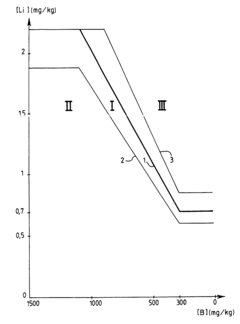
- A method that involves measuring the electrical conductivity of a sample of cooling water, determining the boron concentration, and using a specific relationship to calculate the instantaneous lithium concentration, with adjustments made based on reference curves to maintain optimal pH and minimize corrosion, using a thermostatically controlled conductivity cell and precise temperature measurements to account for temperature effects.



A method for selective leaching of lithium from lithium-ion battery waste
PatentWO2025078724A1
Innovation
- A method involving hydrothermal pretreatment of lithium-ion battery waste under controlled temperature (120-250°C) and pressure (50 bar or less) using CO2 as the sole reactant, allowing for selective leaching of lithium in a single step process.


Environmental Impact Assessment of DLE Technologies
Direct Lithium Extraction (DLE) technologies represent a significant advancement in lithium production methods, but their environmental impacts require thorough assessment, particularly when testing under variable temperature conditions. The environmental footprint of DLE varies considerably depending on the specific technology employed and the operating conditions, with temperature being a critical factor affecting both efficiency and environmental outcomes.
Temperature variations can significantly influence the water consumption patterns of DLE operations. At higher temperatures, some DLE technologies demonstrate increased water evaporation rates, potentially exacerbating water scarcity issues in arid regions where lithium resources are often located. Conversely, lower temperatures may necessitate additional energy inputs for heating, creating a different set of environmental challenges.
Energy consumption profiles of DLE technologies exhibit strong temperature dependence. Testing reveals that adsorption-based DLE methods typically require less energy at moderate temperatures (20-30°C) but become increasingly energy-intensive at lower temperatures due to reduced kinetics. This temperature-efficiency relationship directly impacts carbon emissions associated with the extraction process, particularly when fossil fuels power the operation.
Chemical usage in DLE processes also varies with temperature conditions. Higher temperatures generally accelerate chemical reactions, potentially reducing the quantity of reagents required but sometimes increasing the volatility of certain compounds. Environmental monitoring during variable temperature testing should therefore include comprehensive analysis of air emissions and potential chemical transformations.
Waste stream characteristics from DLE operations demonstrate notable temperature sensitivity. Testing protocols must incorporate analysis of precipitate formation, brine chemistry alterations, and potential contaminant mobilization across the full spectrum of anticipated operating temperatures. This is particularly important for understanding long-term environmental impacts on groundwater systems and surrounding ecosystems.
Biodiversity impacts represent another critical dimension requiring assessment. Temperature variations in DLE testing can provide valuable insights into potential seasonal effects on local ecosystems, particularly in temperature-sensitive aquatic environments where discharged brines may alter thermal regimes.
Land use requirements for DLE facilities may also be influenced by temperature considerations, as extreme temperature conditions might necessitate additional infrastructure for climate control or weatherproofing, expanding the physical footprint of operations. Testing under variable temperatures helps optimize facility design to minimize land disturbance while maintaining operational efficiency.
Comprehensive environmental impact assessment methodologies for DLE must therefore incorporate temperature as a key variable, utilizing standardized protocols that account for seasonal variations and climate change scenarios to ensure environmental sustainability across the operational lifespan of these emerging technologies.
Temperature variations can significantly influence the water consumption patterns of DLE operations. At higher temperatures, some DLE technologies demonstrate increased water evaporation rates, potentially exacerbating water scarcity issues in arid regions where lithium resources are often located. Conversely, lower temperatures may necessitate additional energy inputs for heating, creating a different set of environmental challenges.
Energy consumption profiles of DLE technologies exhibit strong temperature dependence. Testing reveals that adsorption-based DLE methods typically require less energy at moderate temperatures (20-30°C) but become increasingly energy-intensive at lower temperatures due to reduced kinetics. This temperature-efficiency relationship directly impacts carbon emissions associated with the extraction process, particularly when fossil fuels power the operation.
Chemical usage in DLE processes also varies with temperature conditions. Higher temperatures generally accelerate chemical reactions, potentially reducing the quantity of reagents required but sometimes increasing the volatility of certain compounds. Environmental monitoring during variable temperature testing should therefore include comprehensive analysis of air emissions and potential chemical transformations.
Waste stream characteristics from DLE operations demonstrate notable temperature sensitivity. Testing protocols must incorporate analysis of precipitate formation, brine chemistry alterations, and potential contaminant mobilization across the full spectrum of anticipated operating temperatures. This is particularly important for understanding long-term environmental impacts on groundwater systems and surrounding ecosystems.
Biodiversity impacts represent another critical dimension requiring assessment. Temperature variations in DLE testing can provide valuable insights into potential seasonal effects on local ecosystems, particularly in temperature-sensitive aquatic environments where discharged brines may alter thermal regimes.
Land use requirements for DLE facilities may also be influenced by temperature considerations, as extreme temperature conditions might necessitate additional infrastructure for climate control or weatherproofing, expanding the physical footprint of operations. Testing under variable temperatures helps optimize facility design to minimize land disturbance while maintaining operational efficiency.
Comprehensive environmental impact assessment methodologies for DLE must therefore incorporate temperature as a key variable, utilizing standardized protocols that account for seasonal variations and climate change scenarios to ensure environmental sustainability across the operational lifespan of these emerging technologies.
Standardization Requirements for DLE Testing Procedures
The standardization of Direct Lithium Extraction (DLE) testing procedures under variable temperature conditions represents a critical gap in the current lithium extraction industry. Without established protocols, comparing efficiency and performance across different DLE technologies becomes problematic, hindering technological advancement and investment decisions.
A comprehensive standardization framework must address temperature variability as a primary testing parameter. This framework should establish baseline temperature ranges (typically 5°C to 95°C) that reflect real-world operational conditions across diverse geothermal resources and brine compositions. Testing protocols should mandate minimum temperature increments (e.g., 10°C steps) to capture performance variations across the operational spectrum.
Standardized metrics for evaluation must include temperature-dependent extraction efficiency, selectivity ratios at varying temperatures, adsorption/desorption kinetics, and thermal energy consumption. These metrics should be reported using consistent units and measurement methodologies to enable direct comparison between different DLE technologies and implementations.
Equipment calibration requirements constitute another essential component of standardization. Testing apparatus should undergo temperature calibration procedures traceable to international standards, with documented temperature stability parameters (±0.5°C) and uniform heating/cooling rates. Thermal gradient monitoring within testing vessels should be mandatory to ensure homogeneous temperature distribution.
Sample preparation protocols represent a critical standardization need, requiring specifications for brine composition documentation, pre-treatment procedures, and storage conditions. The standardization should establish reference brine formulations representing various geographical sources to facilitate comparative analysis across different testing facilities.
Data reporting formats must be standardized to include temperature-time profiles, extraction efficiency curves as functions of temperature, and statistical analysis of temperature-dependent performance variations. Uncertainty quantification methodologies should be explicitly defined to ensure reported results include appropriate confidence intervals.
Interlaboratory validation procedures constitute the final standardization requirement, establishing protocols for round-robin testing to verify reproducibility across different facilities. This should include reference materials with known temperature-dependent extraction characteristics and statistical methods for evaluating inter-laboratory consistency.
A comprehensive standardization framework must address temperature variability as a primary testing parameter. This framework should establish baseline temperature ranges (typically 5°C to 95°C) that reflect real-world operational conditions across diverse geothermal resources and brine compositions. Testing protocols should mandate minimum temperature increments (e.g., 10°C steps) to capture performance variations across the operational spectrum.
Standardized metrics for evaluation must include temperature-dependent extraction efficiency, selectivity ratios at varying temperatures, adsorption/desorption kinetics, and thermal energy consumption. These metrics should be reported using consistent units and measurement methodologies to enable direct comparison between different DLE technologies and implementations.
Equipment calibration requirements constitute another essential component of standardization. Testing apparatus should undergo temperature calibration procedures traceable to international standards, with documented temperature stability parameters (±0.5°C) and uniform heating/cooling rates. Thermal gradient monitoring within testing vessels should be mandatory to ensure homogeneous temperature distribution.
Sample preparation protocols represent a critical standardization need, requiring specifications for brine composition documentation, pre-treatment procedures, and storage conditions. The standardization should establish reference brine formulations representing various geographical sources to facilitate comparative analysis across different testing facilities.
Data reporting formats must be standardized to include temperature-time profiles, extraction efficiency curves as functions of temperature, and statistical analysis of temperature-dependent performance variations. Uncertainty quantification methodologies should be explicitly defined to ensure reported results include appropriate confidence intervals.
Interlaboratory validation procedures constitute the final standardization requirement, establishing protocols for round-robin testing to verify reproducibility across different facilities. This should include reference materials with known temperature-dependent extraction characteristics and statistical methods for evaluating inter-laboratory consistency.
Unlock deeper insights with PatSnap Eureka Quick Research — get a full tech report to explore trends and direct your research. Try now!
Generate Your Research Report Instantly with AI Agent
Supercharge your innovation with PatSnap Eureka AI Agent Platform!