Impact of Carboxylic Acid on Modern Biosensor Technologies
JUL 31, 20259 MIN READ
Generate Your Research Report Instantly with AI Agent
Patsnap Eureka helps you evaluate technical feasibility & market potential.
Carboxylic Acid in Biosensors: Background and Objectives
Carboxylic acids have emerged as crucial components in the development and advancement of modern biosensor technologies. These organic compounds, characterized by their -COOH functional group, play a pivotal role in various biological processes and have become integral to the design and functionality of biosensors. The evolution of biosensor technology has been closely intertwined with the understanding and utilization of carboxylic acids, marking significant milestones in the field of analytical chemistry and biomedical diagnostics.
The primary objective of incorporating carboxylic acids in biosensors is to enhance sensitivity, selectivity, and overall performance. These compounds serve as excellent linkers for biomolecule immobilization, facilitating the attachment of enzymes, antibodies, or nucleic acids to sensor surfaces. This immobilization is crucial for creating stable and efficient biosensing platforms capable of detecting a wide range of analytes with high precision.
Historically, the use of carboxylic acids in biosensors can be traced back to the early developments in enzyme-based glucose sensors. The ability of carboxylic acids to form covalent bonds with enzymes while maintaining their catalytic activity paved the way for more robust and reliable glucose monitoring devices. This breakthrough has since expanded to numerous other applications in healthcare, environmental monitoring, and food safety.
The technological trajectory of carboxylic acid utilization in biosensors has seen a shift from simple surface modifications to more complex nanostructured materials. Recent advancements include the development of carboxylated nanoparticles, carbon nanotubes, and graphene-based materials, which offer increased surface area and improved electron transfer properties. These innovations have significantly enhanced the sensitivity and detection limits of modern biosensors.
Current research focuses on exploiting the versatility of carboxylic acids to create multi-functional biosensing platforms. Scientists are exploring ways to integrate carboxylic acid-based materials with other functional groups to develop sensors capable of simultaneous multi-analyte detection. This approach aims to address the growing demand for comprehensive, real-time monitoring in various fields, including personalized medicine and environmental surveillance.
The future objectives in this field revolve around overcoming existing limitations and pushing the boundaries of biosensor capabilities. Key areas of focus include improving the long-term stability of carboxylic acid-modified surfaces, enhancing the specificity of biomolecule attachment, and developing novel carboxylic acid derivatives with superior sensing properties. Additionally, there is a growing interest in creating eco-friendly, biodegradable biosensors utilizing naturally occurring carboxylic acids, aligning with the global push towards sustainable technologies.
The primary objective of incorporating carboxylic acids in biosensors is to enhance sensitivity, selectivity, and overall performance. These compounds serve as excellent linkers for biomolecule immobilization, facilitating the attachment of enzymes, antibodies, or nucleic acids to sensor surfaces. This immobilization is crucial for creating stable and efficient biosensing platforms capable of detecting a wide range of analytes with high precision.
Historically, the use of carboxylic acids in biosensors can be traced back to the early developments in enzyme-based glucose sensors. The ability of carboxylic acids to form covalent bonds with enzymes while maintaining their catalytic activity paved the way for more robust and reliable glucose monitoring devices. This breakthrough has since expanded to numerous other applications in healthcare, environmental monitoring, and food safety.
The technological trajectory of carboxylic acid utilization in biosensors has seen a shift from simple surface modifications to more complex nanostructured materials. Recent advancements include the development of carboxylated nanoparticles, carbon nanotubes, and graphene-based materials, which offer increased surface area and improved electron transfer properties. These innovations have significantly enhanced the sensitivity and detection limits of modern biosensors.
Current research focuses on exploiting the versatility of carboxylic acids to create multi-functional biosensing platforms. Scientists are exploring ways to integrate carboxylic acid-based materials with other functional groups to develop sensors capable of simultaneous multi-analyte detection. This approach aims to address the growing demand for comprehensive, real-time monitoring in various fields, including personalized medicine and environmental surveillance.
The future objectives in this field revolve around overcoming existing limitations and pushing the boundaries of biosensor capabilities. Key areas of focus include improving the long-term stability of carboxylic acid-modified surfaces, enhancing the specificity of biomolecule attachment, and developing novel carboxylic acid derivatives with superior sensing properties. Additionally, there is a growing interest in creating eco-friendly, biodegradable biosensors utilizing naturally occurring carboxylic acids, aligning with the global push towards sustainable technologies.
Market Analysis for Carboxylic Acid-Based Biosensors
The market for carboxylic acid-based biosensors is experiencing significant growth, driven by increasing demand for rapid, accurate, and cost-effective diagnostic tools across various industries. The healthcare sector remains the primary market, with applications in point-of-care testing, disease diagnosis, and drug discovery. The food and beverage industry also shows substantial potential, utilizing these biosensors for quality control and safety monitoring.
In the healthcare market, the rising prevalence of chronic diseases and the need for early diagnosis are key drivers. Carboxylic acid-based biosensors offer advantages in detecting biomarkers associated with conditions such as diabetes, cardiovascular diseases, and cancer. The global biosensors market in healthcare is projected to grow steadily, with carboxylic acid-based sensors playing a crucial role in this expansion.
The food and beverage industry is another significant market for these biosensors. With increasing concerns about food safety and quality, there is a growing demand for rapid and reliable testing methods. Carboxylic acid-based biosensors are being employed to detect contaminants, assess freshness, and monitor fermentation processes. This sector is expected to show robust growth in biosensor adoption over the coming years.
Environmental monitoring represents an emerging market for carboxylic acid-based biosensors. These devices are being developed for detecting pollutants in water and soil, offering potential for applications in agriculture, waste management, and ecological research. While currently a smaller market segment, it shows promise for future expansion.
The industrial sector, particularly in chemical and pharmaceutical manufacturing, is also adopting these biosensors for process control and quality assurance. The ability to provide real-time, in-situ measurements makes carboxylic acid-based biosensors valuable tools in industrial settings.
Geographically, North America and Europe lead in market share due to advanced healthcare infrastructure and stringent food safety regulations. However, the Asia-Pacific region is expected to show the highest growth rate, driven by increasing healthcare expenditure, rapid industrialization, and growing awareness of food safety issues.
Challenges in the market include the need for improved sensor stability, selectivity, and sensitivity. Additionally, regulatory hurdles and the high cost of some advanced biosensor systems may limit market penetration in certain sectors. Despite these challenges, the overall market outlook for carboxylic acid-based biosensors remains positive, with technological advancements and expanding applications driving continued growth.
In the healthcare market, the rising prevalence of chronic diseases and the need for early diagnosis are key drivers. Carboxylic acid-based biosensors offer advantages in detecting biomarkers associated with conditions such as diabetes, cardiovascular diseases, and cancer. The global biosensors market in healthcare is projected to grow steadily, with carboxylic acid-based sensors playing a crucial role in this expansion.
The food and beverage industry is another significant market for these biosensors. With increasing concerns about food safety and quality, there is a growing demand for rapid and reliable testing methods. Carboxylic acid-based biosensors are being employed to detect contaminants, assess freshness, and monitor fermentation processes. This sector is expected to show robust growth in biosensor adoption over the coming years.
Environmental monitoring represents an emerging market for carboxylic acid-based biosensors. These devices are being developed for detecting pollutants in water and soil, offering potential for applications in agriculture, waste management, and ecological research. While currently a smaller market segment, it shows promise for future expansion.
The industrial sector, particularly in chemical and pharmaceutical manufacturing, is also adopting these biosensors for process control and quality assurance. The ability to provide real-time, in-situ measurements makes carboxylic acid-based biosensors valuable tools in industrial settings.
Geographically, North America and Europe lead in market share due to advanced healthcare infrastructure and stringent food safety regulations. However, the Asia-Pacific region is expected to show the highest growth rate, driven by increasing healthcare expenditure, rapid industrialization, and growing awareness of food safety issues.
Challenges in the market include the need for improved sensor stability, selectivity, and sensitivity. Additionally, regulatory hurdles and the high cost of some advanced biosensor systems may limit market penetration in certain sectors. Despite these challenges, the overall market outlook for carboxylic acid-based biosensors remains positive, with technological advancements and expanding applications driving continued growth.
Current Challenges in Carboxylic Acid Biosensor Technology
Despite significant advancements in carboxylic acid biosensor technologies, several challenges persist that hinder their widespread adoption and optimal performance. One of the primary obstacles is the lack of selectivity in complex biological matrices. Carboxylic acids often coexist with structurally similar compounds, making it difficult for biosensors to distinguish between target analytes and interfering substances. This issue is particularly pronounced in clinical and environmental samples, where multiple organic acids are present.
Sensitivity remains another critical challenge, especially when detecting trace amounts of carboxylic acids in dilute solutions. While some biosensors have shown promising results in controlled laboratory conditions, their performance often deteriorates in real-world applications where analyte concentrations can be extremely low. This limitation hampers the use of biosensors in early disease detection and environmental monitoring, where the ability to detect minute quantities is crucial.
Stability and longevity of biosensors pose significant hurdles in their practical implementation. Many carboxylic acid biosensors suffer from rapid degradation of their biological recognition elements, such as enzymes or antibodies, when exposed to harsh environmental conditions or prolonged use. This instability leads to decreased sensor performance over time and necessitates frequent recalibration or replacement, increasing operational costs and reducing reliability.
The development of miniaturized and portable biosensor platforms for on-site carboxylic acid detection faces technical challenges related to integration and signal amplification. Miniaturization often results in reduced sensitivity due to smaller sensing areas and limited sample volumes. Additionally, incorporating multiple components, such as recognition elements, transducers, and signal processing units, into a compact device while maintaining performance integrity remains a complex task.
Reproducibility and standardization across different batches of biosensors are ongoing concerns in the field. Variations in manufacturing processes, biological component quality, and environmental factors can lead to inconsistent results between sensors, making it difficult to establish reliable benchmarks and compare data across different studies or applications.
Lastly, the cost-effectiveness of carboxylic acid biosensors, particularly for large-scale production and deployment, remains a significant challenge. Many current biosensor designs rely on expensive materials or complex fabrication processes, limiting their accessibility and widespread adoption in resource-limited settings or for routine monitoring applications.
Sensitivity remains another critical challenge, especially when detecting trace amounts of carboxylic acids in dilute solutions. While some biosensors have shown promising results in controlled laboratory conditions, their performance often deteriorates in real-world applications where analyte concentrations can be extremely low. This limitation hampers the use of biosensors in early disease detection and environmental monitoring, where the ability to detect minute quantities is crucial.
Stability and longevity of biosensors pose significant hurdles in their practical implementation. Many carboxylic acid biosensors suffer from rapid degradation of their biological recognition elements, such as enzymes or antibodies, when exposed to harsh environmental conditions or prolonged use. This instability leads to decreased sensor performance over time and necessitates frequent recalibration or replacement, increasing operational costs and reducing reliability.
The development of miniaturized and portable biosensor platforms for on-site carboxylic acid detection faces technical challenges related to integration and signal amplification. Miniaturization often results in reduced sensitivity due to smaller sensing areas and limited sample volumes. Additionally, incorporating multiple components, such as recognition elements, transducers, and signal processing units, into a compact device while maintaining performance integrity remains a complex task.
Reproducibility and standardization across different batches of biosensors are ongoing concerns in the field. Variations in manufacturing processes, biological component quality, and environmental factors can lead to inconsistent results between sensors, making it difficult to establish reliable benchmarks and compare data across different studies or applications.
Lastly, the cost-effectiveness of carboxylic acid biosensors, particularly for large-scale production and deployment, remains a significant challenge. Many current biosensor designs rely on expensive materials or complex fabrication processes, limiting their accessibility and widespread adoption in resource-limited settings or for routine monitoring applications.
Existing Carboxylic Acid Biosensor Solutions
01 Synthesis of carboxylic acids
Various methods for synthesizing carboxylic acids are described, including oxidation of primary alcohols or aldehydes, hydrolysis of nitriles, and carbonylation reactions. These processes often involve catalysts and specific reaction conditions to achieve high yields and selectivity.- Synthesis of carboxylic acids: Various methods for synthesizing carboxylic acids are described, including oxidation of primary alcohols or aldehydes, hydrolysis of nitriles, and carbonylation reactions. These processes often involve catalysts and specific reaction conditions to achieve high yields and selectivity.
- Derivatives and applications of carboxylic acids: Carboxylic acids serve as precursors for various derivatives such as esters, amides, and anhydrides. These compounds find applications in pharmaceuticals, polymers, and industrial processes. The synthesis and properties of these derivatives are explored in several patents.
- Purification and separation techniques: Methods for purifying and separating carboxylic acids from reaction mixtures or natural sources are described. These techniques include crystallization, distillation, extraction, and chromatography, aimed at obtaining high-purity carboxylic acids for various applications.
- Carboxylic acids in polymer chemistry: The use of carboxylic acids in polymer synthesis and modification is explored. This includes their role as monomers, chain terminators, and functional groups for improving polymer properties such as adhesion, solubility, and reactivity.
- Environmental and green chemistry aspects: Environmentally friendly approaches to carboxylic acid synthesis and utilization are discussed. This includes the use of renewable resources, bio-based feedstocks, and sustainable catalytic processes to produce carboxylic acids and their derivatives with reduced environmental impact.
02 Derivatives and applications of carboxylic acids
Carboxylic acids serve as precursors for various derivatives such as esters, amides, and anhydrides. These compounds find applications in pharmaceuticals, polymers, and industrial processes. The synthesis and properties of these derivatives are explored in several patents.Expand Specific Solutions03 Purification and separation techniques
Methods for purifying and separating carboxylic acids from reaction mixtures or natural sources are described. These techniques may include crystallization, distillation, extraction, and chromatography, aimed at obtaining high-purity carboxylic acids for various applications.Expand Specific Solutions04 Carboxylic acids in polymer chemistry
The use of carboxylic acids in polymer synthesis and modification is explored. This includes their role as monomers, chain terminators, and functional groups for post-polymerization modifications. Applications in adhesives, coatings, and biodegradable materials are also discussed.Expand Specific Solutions05 Environmental and green chemistry aspects
Environmentally friendly processes for producing and using carboxylic acids are described. This includes bio-based production methods, catalytic processes with reduced waste, and applications in sustainable materials and technologies.Expand Specific Solutions
Key Players in Carboxylic Acid Biosensor Industry
The impact of carboxylic acid on modern biosensor technologies is at a critical juncture in its development, with the market showing significant growth potential. The industry is transitioning from early-stage research to more advanced applications, driven by increasing demand for precise and rapid diagnostic tools. Key players like PHC Holdings Corp., Ajinomoto Co., Inc., and FUJIFILM Corp. are investing heavily in R&D, pushing the technology towards maturity. The market size is expanding, fueled by applications in healthcare, environmental monitoring, and food safety. While the technology is progressing, it's not yet fully mature, with companies like Applied BioCode, Inc. and Abbott Diabetes Care, Inc. continually innovating to improve sensitivity, selectivity, and miniaturization of carboxylic acid-based biosensors.
Applied BioCode, Inc.
Technical Solution: Applied BioCode has developed a multiplex biosensor platform that leverages carboxylic acid chemistry for biomolecule immobilization. Their Barcoded Magnetic Beads (BMB) technology uses carboxylic acid-functionalized magnetic particles as the basis for their assays[5]. The carboxylic acid groups on the bead surface allow for covalent attachment of capture probes, such as antibodies or nucleic acids, through carbodiimide chemistry[6]. This approach enables the simultaneous detection of multiple analytes in a single sample. The company has applied this technology to develop highly sensitive and specific assays for various biomarkers, including those related to infectious diseases and autoimmune disorders[7]. The carboxylic acid-based immobilization strategy contributes to the stability and reproducibility of their assays.
Strengths: High multiplexing capability, versatile platform for various biomarkers, improved assay stability. Weaknesses: Requires specialized equipment, may have higher cost compared to traditional single-analyte tests.
Abbott Diabetes Care, Inc.
Technical Solution: Abbott Diabetes Care has developed advanced biosensor technologies incorporating carboxylic acid functionalities for glucose monitoring. Their FreeStyle Libre system utilizes a novel enzyme-based electrochemical sensor with carboxylic acid groups to enhance glucose binding and improve sensor stability[1]. The sensor employs a wired-enzyme technology where the glucose oxidase enzyme is covalently bonded to a polymer backbone containing carboxylic acid moieties, facilitating efficient electron transfer[2]. This design allows for rapid and accurate glucose measurements without the need for routine finger prick calibrations[3]. The company has also explored the use of carboxylic acid-modified carbon nanotubes to further improve sensor sensitivity and longevity[4].
Strengths: Highly accurate and stable glucose sensing, reduced need for calibration, improved user comfort. Weaknesses: Limited to glucose monitoring, may face competition from non-invasive technologies.
Innovations in Carboxylic Acid Sensing Mechanisms
Biosensor
PatentInactiveUS7648617B2
Innovation
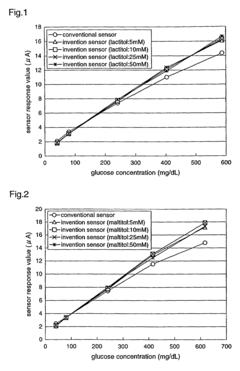
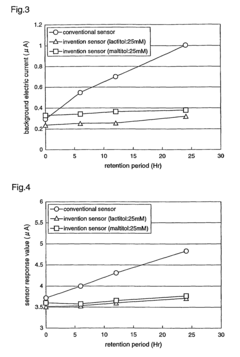
- Incorporating sugar alcohols, metallic salts, or organic acids with carboxyl groups into the reagent layer to suppress background electric current and prevent reactions with contaminants, while maintaining enzyme functionality, thereby enhancing linearity and sensitivity.


Sensor molecules incorporating a boronic acid sensor group
PatentInactiveEP1849008A1
Innovation
- Development of sensor molecules incorporating a boronic acid sensor group that selectively bind to alpha-hydroxy carboxylic acids, utilizing a specific binding mechanism that distinguishes them from glucose, allowing for their selective detection and quantitation through changes in chemical or physical properties.
Environmental Impact of Carboxylic Acid Biosensors
The environmental impact of carboxylic acid biosensors is a critical consideration in their development and deployment. These biosensors, which utilize carboxylic acids as key components in their sensing mechanisms, have both positive and negative effects on the environment.
One of the primary environmental benefits of carboxylic acid biosensors is their potential to improve environmental monitoring and pollution detection. These sensors can be used to detect and measure various pollutants, including organic compounds and heavy metals, in water and soil samples. By providing rapid and accurate measurements, they enable more effective environmental management and remediation efforts.
However, the production and disposal of carboxylic acid biosensors also raise environmental concerns. The manufacturing process may involve the use of hazardous chemicals and energy-intensive procedures, contributing to carbon emissions and potential chemical pollution. Additionally, the disposal of used biosensors, which may contain toxic materials or non-biodegradable components, requires careful consideration to prevent environmental contamination.
The use of carboxylic acids in biosensors also presents potential risks to aquatic ecosystems. If improperly handled or disposed of, these acids can alter the pH balance of water bodies, potentially harming aquatic life and disrupting ecosystem functions. This risk necessitates the development of proper handling and disposal protocols for biosensor devices and their components.
On the other hand, carboxylic acid biosensors offer opportunities for more sustainable practices in various industries. For instance, in agriculture, these sensors can optimize fertilizer use by accurately measuring soil acidity, potentially reducing excessive chemical application and minimizing runoff into water systems. Similarly, in wastewater treatment, biosensors can enhance process efficiency, leading to improved water quality and reduced energy consumption.
The miniaturization trend in biosensor technology also has environmental implications. Smaller sensors require fewer materials and potentially less energy to operate, aligning with sustainability goals. However, the increased use of nanomaterials in these miniaturized sensors raises questions about their long-term environmental impact and potential bioaccumulation in ecosystems.
As the technology advances, there is a growing focus on developing more environmentally friendly biosensor materials and manufacturing processes. Research into biodegradable components and green chemistry approaches aims to mitigate the environmental footprint of these devices. Additionally, efforts to improve the longevity and reusability of biosensors could significantly reduce waste generation and resource consumption associated with their production and use.
One of the primary environmental benefits of carboxylic acid biosensors is their potential to improve environmental monitoring and pollution detection. These sensors can be used to detect and measure various pollutants, including organic compounds and heavy metals, in water and soil samples. By providing rapid and accurate measurements, they enable more effective environmental management and remediation efforts.
However, the production and disposal of carboxylic acid biosensors also raise environmental concerns. The manufacturing process may involve the use of hazardous chemicals and energy-intensive procedures, contributing to carbon emissions and potential chemical pollution. Additionally, the disposal of used biosensors, which may contain toxic materials or non-biodegradable components, requires careful consideration to prevent environmental contamination.
The use of carboxylic acids in biosensors also presents potential risks to aquatic ecosystems. If improperly handled or disposed of, these acids can alter the pH balance of water bodies, potentially harming aquatic life and disrupting ecosystem functions. This risk necessitates the development of proper handling and disposal protocols for biosensor devices and their components.
On the other hand, carboxylic acid biosensors offer opportunities for more sustainable practices in various industries. For instance, in agriculture, these sensors can optimize fertilizer use by accurately measuring soil acidity, potentially reducing excessive chemical application and minimizing runoff into water systems. Similarly, in wastewater treatment, biosensors can enhance process efficiency, leading to improved water quality and reduced energy consumption.
The miniaturization trend in biosensor technology also has environmental implications. Smaller sensors require fewer materials and potentially less energy to operate, aligning with sustainability goals. However, the increased use of nanomaterials in these miniaturized sensors raises questions about their long-term environmental impact and potential bioaccumulation in ecosystems.
As the technology advances, there is a growing focus on developing more environmentally friendly biosensor materials and manufacturing processes. Research into biodegradable components and green chemistry approaches aims to mitigate the environmental footprint of these devices. Additionally, efforts to improve the longevity and reusability of biosensors could significantly reduce waste generation and resource consumption associated with their production and use.
Biosensor Miniaturization and Portability Trends
The trend towards biosensor miniaturization and portability has been a significant driving force in the development of modern biosensor technologies. This trend is particularly relevant when considering the impact of carboxylic acid on these systems. As biosensors become smaller and more portable, the integration of carboxylic acid detection and utilization becomes increasingly important for a wide range of applications.
One of the key aspects of this trend is the development of microfluidic devices that can efficiently handle small volumes of samples containing carboxylic acids. These miniaturized systems allow for rapid analysis and reduced reagent consumption, making them ideal for point-of-care diagnostics and environmental monitoring. The incorporation of carboxylic acid-sensitive elements into these microfluidic platforms has enabled the creation of highly sensitive and selective portable biosensors.
Advancements in nanomaterials and nanotechnology have also played a crucial role in the miniaturization of biosensors capable of detecting and utilizing carboxylic acids. Nanostructured materials, such as carbon nanotubes and graphene, have been employed to enhance the sensitivity and selectivity of carboxylic acid detection in compact biosensor designs. These materials provide increased surface area and improved electron transfer properties, allowing for more efficient interactions with carboxylic acid molecules.
The integration of wireless communication technologies and miniaturized electronics has further contributed to the portability of carboxylic acid-based biosensors. This integration allows for real-time data transmission and analysis, enabling remote monitoring and rapid decision-making in various applications, from healthcare to environmental protection.
Another important aspect of the miniaturization trend is the development of wearable biosensors that can detect and monitor carboxylic acids in bodily fluids. These devices offer continuous, non-invasive monitoring of various health parameters related to carboxylic acid levels, such as lactic acid in sweat during physical activity or acetoacetic acid in breath for diabetes management.
The ongoing miniaturization efforts have also led to the creation of lab-on-a-chip devices that can perform multiple analytical steps, including sample preparation, carboxylic acid detection, and data analysis, all within a single, compact platform. This integration of various functionalities into a small form factor has greatly expanded the potential applications of carboxylic acid-based biosensors in fields such as food safety, environmental monitoring, and personalized medicine.
As the trend towards miniaturization and portability continues, researchers are exploring novel materials and fabrication techniques to further reduce the size and enhance the performance of carboxylic acid-based biosensors. This includes the development of flexible and stretchable sensors that can conform to various surfaces, as well as the integration of artificial intelligence and machine learning algorithms to improve data analysis and interpretation in compact, portable devices.
One of the key aspects of this trend is the development of microfluidic devices that can efficiently handle small volumes of samples containing carboxylic acids. These miniaturized systems allow for rapid analysis and reduced reagent consumption, making them ideal for point-of-care diagnostics and environmental monitoring. The incorporation of carboxylic acid-sensitive elements into these microfluidic platforms has enabled the creation of highly sensitive and selective portable biosensors.
Advancements in nanomaterials and nanotechnology have also played a crucial role in the miniaturization of biosensors capable of detecting and utilizing carboxylic acids. Nanostructured materials, such as carbon nanotubes and graphene, have been employed to enhance the sensitivity and selectivity of carboxylic acid detection in compact biosensor designs. These materials provide increased surface area and improved electron transfer properties, allowing for more efficient interactions with carboxylic acid molecules.
The integration of wireless communication technologies and miniaturized electronics has further contributed to the portability of carboxylic acid-based biosensors. This integration allows for real-time data transmission and analysis, enabling remote monitoring and rapid decision-making in various applications, from healthcare to environmental protection.
Another important aspect of the miniaturization trend is the development of wearable biosensors that can detect and monitor carboxylic acids in bodily fluids. These devices offer continuous, non-invasive monitoring of various health parameters related to carboxylic acid levels, such as lactic acid in sweat during physical activity or acetoacetic acid in breath for diabetes management.
The ongoing miniaturization efforts have also led to the creation of lab-on-a-chip devices that can perform multiple analytical steps, including sample preparation, carboxylic acid detection, and data analysis, all within a single, compact platform. This integration of various functionalities into a small form factor has greatly expanded the potential applications of carboxylic acid-based biosensors in fields such as food safety, environmental monitoring, and personalized medicine.
As the trend towards miniaturization and portability continues, researchers are exploring novel materials and fabrication techniques to further reduce the size and enhance the performance of carboxylic acid-based biosensors. This includes the development of flexible and stretchable sensors that can conform to various surfaces, as well as the integration of artificial intelligence and machine learning algorithms to improve data analysis and interpretation in compact, portable devices.
Unlock deeper insights with Patsnap Eureka Quick Research — get a full tech report to explore trends and direct your research. Try now!
Generate Your Research Report Instantly with AI Agent
Supercharge your innovation with Patsnap Eureka AI Agent Platform!