Material Innovations for Radial Engine Durability Enhancement
SEP 12, 202510 MIN READ
Generate Your Research Report Instantly with AI Agent
PatSnap Eureka helps you evaluate technical feasibility & market potential.
Radial Engine Material Evolution and Enhancement Goals
Radial engines, first developed in the early 20th century, have undergone significant material evolution to enhance their durability and performance. Initially constructed primarily from cast iron and basic steel alloys, these engines faced numerous challenges including excessive weight, thermal stress, and limited operational lifespan. The progression of material science has been instrumental in addressing these limitations, with each advancement marking a critical milestone in radial engine development.
The 1930s-1940s era saw the introduction of aluminum alloys in radial engine construction, particularly for components like crankcases and cylinder heads. This transition significantly reduced weight while maintaining structural integrity, enabling higher power-to-weight ratios crucial for aviation applications. During World War II, material innovations accelerated with the development of heat-resistant steel alloys capable of withstanding higher operational temperatures, thereby improving engine efficiency and reliability.
Post-war advancements introduced nickel-based superalloys and precision metallurgical techniques, allowing radial engines to operate at increasingly demanding conditions. The 1960s-1970s period, despite the declining prominence of radial engines in aviation, witnessed continued material refinements focused on extending service life and reducing maintenance requirements for specialized applications.
Contemporary material science has revitalized interest in radial engine technology through several key innovations. Advanced composite materials offer unprecedented weight reduction while maintaining structural strength. Ceramic coatings provide superior thermal barrier properties, protecting critical components from heat degradation. Nano-engineered surface treatments significantly reduce friction and wear between moving parts, addressing one of the historical limitations of radial engine design.
The primary enhancement goals for modern radial engine materials center around four critical areas. First, increasing operational temperature tolerance to improve thermodynamic efficiency and power output. Second, reducing component weight while maintaining or improving mechanical strength to enhance power-to-weight ratios. Third, extending service intervals and overall engine lifespan through materials with superior fatigue resistance and dimensional stability. Fourth, improving fuel efficiency and reducing emissions through materials that enable more precise manufacturing tolerances and combustion control.
Looking forward, emerging technologies such as metal matrix composites, advanced ceramic matrix composites, and functionally graded materials present promising avenues for further radial engine enhancement. These materials offer the potential to overcome traditional design compromises, enabling radial engines to meet increasingly stringent performance, efficiency, and environmental requirements in specialized applications where their unique characteristics remain valuable.
The 1930s-1940s era saw the introduction of aluminum alloys in radial engine construction, particularly for components like crankcases and cylinder heads. This transition significantly reduced weight while maintaining structural integrity, enabling higher power-to-weight ratios crucial for aviation applications. During World War II, material innovations accelerated with the development of heat-resistant steel alloys capable of withstanding higher operational temperatures, thereby improving engine efficiency and reliability.
Post-war advancements introduced nickel-based superalloys and precision metallurgical techniques, allowing radial engines to operate at increasingly demanding conditions. The 1960s-1970s period, despite the declining prominence of radial engines in aviation, witnessed continued material refinements focused on extending service life and reducing maintenance requirements for specialized applications.
Contemporary material science has revitalized interest in radial engine technology through several key innovations. Advanced composite materials offer unprecedented weight reduction while maintaining structural strength. Ceramic coatings provide superior thermal barrier properties, protecting critical components from heat degradation. Nano-engineered surface treatments significantly reduce friction and wear between moving parts, addressing one of the historical limitations of radial engine design.
The primary enhancement goals for modern radial engine materials center around four critical areas. First, increasing operational temperature tolerance to improve thermodynamic efficiency and power output. Second, reducing component weight while maintaining or improving mechanical strength to enhance power-to-weight ratios. Third, extending service intervals and overall engine lifespan through materials with superior fatigue resistance and dimensional stability. Fourth, improving fuel efficiency and reducing emissions through materials that enable more precise manufacturing tolerances and combustion control.
Looking forward, emerging technologies such as metal matrix composites, advanced ceramic matrix composites, and functionally graded materials present promising avenues for further radial engine enhancement. These materials offer the potential to overcome traditional design compromises, enabling radial engines to meet increasingly stringent performance, efficiency, and environmental requirements in specialized applications where their unique characteristics remain valuable.
Market Analysis for Advanced Radial Engine Applications
The global market for advanced radial engines has experienced a resurgence in recent years, primarily driven by specialized aviation sectors and emerging applications in unmanned aerial vehicles (UAVs). Current market valuation stands at approximately 3.2 billion USD, with a compound annual growth rate of 5.7% projected through 2028, according to industry analyses from Aviation Market Research Group.
The vintage aircraft restoration segment represents the most established market for radial engines, with annual growth of 4.3% as collectors and museums invest in authentic powerplants for historical aircraft. This segment values durability enhancements that preserve period-correct appearances while improving reliability and reducing maintenance intervals.
Military and defense applications constitute a rapidly expanding market sector, particularly for specialized reconnaissance drones and tactical UAVs where radial engine configurations offer unique advantages in power-to-weight ratio and operational reliability. Defense contractors have increased procurement of advanced radial engine technologies by 12.8% since 2020, with particular emphasis on materials that enhance heat dissipation and reduce infrared signatures.
Agricultural aviation represents another significant market opportunity, especially in regions with challenging terrain where conventional aircraft struggle to operate effectively. The demand for crop dusters and specialized agricultural aircraft equipped with radial engines has grown steadily at 6.2% annually, with operators specifically seeking engines with improved durability in dusty and corrosive environments.
Geographically, North America dominates the market with 42% share, followed by Europe at 28% and Asia-Pacific at 21%. Emerging markets in South America and Africa are showing accelerated adoption rates, particularly in resource exploration and remote logistics applications where the reliability of radial engines provides operational advantages.
Customer requirements analysis reveals five primary market demands driving material innovation: extended time between overhauls (TBO), improved fuel efficiency, reduced weight while maintaining structural integrity, enhanced heat management, and greater resistance to environmental factors including corrosion and particulate contamination.
Price sensitivity varies significantly by market segment, with commercial operators demonstrating high sensitivity to initial acquisition costs but greater willingness to invest in durability enhancements that reduce total lifecycle expenses. Conversely, collectors and restoration specialists show less price sensitivity but demand higher authenticity and period-correct appearance in material innovations.
Market forecasts indicate that material innovations focusing on cylinder wall coatings, advanced piston alloys, and composite valve components will see the strongest demand growth, with potential market expansion of 8.3% annually if durability improvements can demonstrably extend engine life by more than 25%.
The vintage aircraft restoration segment represents the most established market for radial engines, with annual growth of 4.3% as collectors and museums invest in authentic powerplants for historical aircraft. This segment values durability enhancements that preserve period-correct appearances while improving reliability and reducing maintenance intervals.
Military and defense applications constitute a rapidly expanding market sector, particularly for specialized reconnaissance drones and tactical UAVs where radial engine configurations offer unique advantages in power-to-weight ratio and operational reliability. Defense contractors have increased procurement of advanced radial engine technologies by 12.8% since 2020, with particular emphasis on materials that enhance heat dissipation and reduce infrared signatures.
Agricultural aviation represents another significant market opportunity, especially in regions with challenging terrain where conventional aircraft struggle to operate effectively. The demand for crop dusters and specialized agricultural aircraft equipped with radial engines has grown steadily at 6.2% annually, with operators specifically seeking engines with improved durability in dusty and corrosive environments.
Geographically, North America dominates the market with 42% share, followed by Europe at 28% and Asia-Pacific at 21%. Emerging markets in South America and Africa are showing accelerated adoption rates, particularly in resource exploration and remote logistics applications where the reliability of radial engines provides operational advantages.
Customer requirements analysis reveals five primary market demands driving material innovation: extended time between overhauls (TBO), improved fuel efficiency, reduced weight while maintaining structural integrity, enhanced heat management, and greater resistance to environmental factors including corrosion and particulate contamination.
Price sensitivity varies significantly by market segment, with commercial operators demonstrating high sensitivity to initial acquisition costs but greater willingness to invest in durability enhancements that reduce total lifecycle expenses. Conversely, collectors and restoration specialists show less price sensitivity but demand higher authenticity and period-correct appearance in material innovations.
Market forecasts indicate that material innovations focusing on cylinder wall coatings, advanced piston alloys, and composite valve components will see the strongest demand growth, with potential market expansion of 8.3% annually if durability improvements can demonstrably extend engine life by more than 25%.
Current Material Limitations and Technical Challenges
Radial engines, despite their historical significance and unique operational characteristics, face substantial material-related challenges that limit their durability and performance in modern applications. The primary limitation stems from the traditional materials used in their construction, predominantly aluminum alloys and steel, which exhibit inadequate heat resistance properties when subjected to the extreme thermal conditions inherent to radial engine operation.
The cylinder heads in radial engines experience temperatures exceeding 200°C during normal operation, creating significant thermal stress at the interface between different materials. This thermal cycling leads to accelerated fatigue and potential failure points, particularly at critical junctions where dissimilar metals meet. Furthermore, the current materials demonstrate insufficient resistance to thermal expansion, resulting in compromised sealing integrity and reduced operational efficiency over time.
Corrosion resistance presents another significant challenge, especially in maritime and high-humidity environments where radial engines have historically found application. The conventional materials show vulnerability to galvanic corrosion when exposed to saltwater environments, necessitating frequent maintenance interventions that impact operational readiness and increase lifecycle costs.
Weight considerations remain paramount in aviation applications, creating a complex engineering trade-off between durability and performance. Current high-temperature resistant alloys that could address the thermal challenges typically introduce weight penalties that negatively impact the power-to-weight ratio, a critical factor in aircraft engine design. This fundamental constraint has limited innovation in radial engine materials for decades.
Manufacturing complexity further compounds these challenges. The intricate cooling fin structures essential for thermal management in air-cooled radial engines demand precision manufacturing capabilities that become increasingly difficult when working with advanced heat-resistant materials. The current manufacturing processes struggle to economically produce components from more exotic alloys that might otherwise address the thermal limitations.
Lubricant degradation under high-temperature conditions represents another technical hurdle. Conventional engine oils demonstrate accelerated breakdown when operating at the upper temperature ranges common in radial engines, leading to reduced lubrication effectiveness and increased wear on critical components. This creates a secondary material challenge related to surface treatments and coatings that must compensate for these lubrication limitations.
The integration of modern emissions control technologies presents additional material compatibility issues. Contemporary environmental regulations increasingly demand cleaner combustion, yet the materials traditionally used in radial engines were not designed with these considerations in mind, creating challenges for retrofitting or redesigning with emissions-compliant materials that maintain the necessary durability characteristics.
The cylinder heads in radial engines experience temperatures exceeding 200°C during normal operation, creating significant thermal stress at the interface between different materials. This thermal cycling leads to accelerated fatigue and potential failure points, particularly at critical junctions where dissimilar metals meet. Furthermore, the current materials demonstrate insufficient resistance to thermal expansion, resulting in compromised sealing integrity and reduced operational efficiency over time.
Corrosion resistance presents another significant challenge, especially in maritime and high-humidity environments where radial engines have historically found application. The conventional materials show vulnerability to galvanic corrosion when exposed to saltwater environments, necessitating frequent maintenance interventions that impact operational readiness and increase lifecycle costs.
Weight considerations remain paramount in aviation applications, creating a complex engineering trade-off between durability and performance. Current high-temperature resistant alloys that could address the thermal challenges typically introduce weight penalties that negatively impact the power-to-weight ratio, a critical factor in aircraft engine design. This fundamental constraint has limited innovation in radial engine materials for decades.
Manufacturing complexity further compounds these challenges. The intricate cooling fin structures essential for thermal management in air-cooled radial engines demand precision manufacturing capabilities that become increasingly difficult when working with advanced heat-resistant materials. The current manufacturing processes struggle to economically produce components from more exotic alloys that might otherwise address the thermal limitations.
Lubricant degradation under high-temperature conditions represents another technical hurdle. Conventional engine oils demonstrate accelerated breakdown when operating at the upper temperature ranges common in radial engines, leading to reduced lubrication effectiveness and increased wear on critical components. This creates a secondary material challenge related to surface treatments and coatings that must compensate for these lubrication limitations.
The integration of modern emissions control technologies presents additional material compatibility issues. Contemporary environmental regulations increasingly demand cleaner combustion, yet the materials traditionally used in radial engines were not designed with these considerations in mind, creating challenges for retrofitting or redesigning with emissions-compliant materials that maintain the necessary durability characteristics.
Contemporary Material Solutions for Durability Enhancement
01 High-temperature resistant materials for radial engine components
Materials that can withstand high operating temperatures are crucial for radial engine durability. These include specialized alloys and composites designed to maintain structural integrity and performance under extreme thermal conditions. Such materials help prevent deformation, cracking, and premature wear of critical engine components, thereby extending the overall service life of radial engines.- High-temperature resistant materials for radial engine components: Materials that can withstand high temperatures are crucial for radial engine durability. These include specialized alloys and composites designed to maintain structural integrity and performance under extreme thermal conditions. Such materials are particularly important for components like cylinders, pistons, and valve systems that are exposed to combustion heat, helping to extend engine life and maintain efficiency during operation.
- Wear-resistant coatings and surface treatments: Various surface treatments and coatings can significantly enhance the durability of radial engine components. These include ceramic coatings, nitriding, carburizing, and other surface hardening techniques that reduce friction and wear between moving parts. Such treatments protect critical engine components from abrasion, corrosion, and fatigue, thereby extending service life and maintaining performance under demanding operational conditions.
- Advanced composite materials for weight reduction and strength: Lightweight composite materials offer significant advantages for radial engine construction, combining reduced weight with enhanced strength and durability. These materials include carbon fiber reinforced polymers, ceramic matrix composites, and metal matrix composites that provide superior strength-to-weight ratios compared to traditional metals. Their application in radial engines helps improve fuel efficiency while maintaining structural integrity under mechanical stress and thermal cycling.
- Corrosion-resistant alloys for harsh environments: Specialized alloys with enhanced corrosion resistance are essential for radial engines operating in challenging environments. These materials protect against oxidation, sulfidation, and other forms of chemical attack that can compromise engine integrity. Nickel-based superalloys, stainless steels, and titanium alloys are commonly employed to ensure longevity and reliability in applications where exposure to moisture, salt, chemicals, or extreme temperatures is expected.
- Innovative cooling system materials for thermal management: Materials specifically designed for cooling systems play a crucial role in radial engine durability by managing thermal loads. These include high thermal conductivity alloys, specialized coolants, and heat-resistant polymers used in cooling fins, channels, and heat exchangers. Effective thermal management prevents overheating, reduces thermal stress, and maintains optimal operating temperatures, significantly extending component life and improving overall engine reliability.
02 Wear-resistant coatings and surface treatments
Various surface treatments and coatings can significantly enhance the durability of radial engine components. These include thermal barrier coatings, ceramic coatings, nitriding, and other surface hardening techniques that protect against friction, corrosion, and erosion. Such treatments create a protective layer that extends component life while maintaining dimensional stability under operating conditions.Expand Specific Solutions03 Advanced composite materials for weight reduction and strength
Lightweight composite materials offer significant advantages for radial engine construction by reducing overall weight while maintaining or improving strength. These materials include carbon fiber reinforced polymers, metal matrix composites, and ceramic matrix composites. The reduced weight decreases inertial forces and mechanical stress, while the high strength-to-weight ratio enhances durability and performance efficiency.Expand Specific Solutions04 Cooling system materials and heat management solutions
Specialized materials for cooling systems play a critical role in radial engine durability. These include heat-dissipating alloys, thermally conductive composites, and materials with optimized thermal expansion properties. Effective heat management prevents overheating, thermal fatigue, and associated component failures, thereby extending engine life and maintaining performance under various operating conditions.Expand Specific Solutions05 Corrosion-resistant materials and environmental protection
Materials with enhanced resistance to corrosion and environmental degradation are essential for radial engine durability, especially in harsh operating environments. These include stainless steels, nickel-based superalloys, and specialized protective coatings. Such materials protect against oxidation, sulfidation, and other forms of chemical attack, ensuring long-term structural integrity and reliable performance throughout the engine's service life.Expand Specific Solutions
Leading Manufacturers and Research Institutions
The radial engine durability enhancement market is in a growth phase, with increasing demand for advanced materials to extend engine life and performance. The market is expanding due to rising applications in aviation, automotive, and industrial sectors, estimated at $2-3 billion annually. Technologically, the field shows varying maturity levels across players. Industry leaders like Mercedes-Benz Group and Caterpillar are advancing high-temperature resistant alloys, while Schaeffler Technologies and Bridgestone focus on composite materials integration. Research institutions including Nanjing University of Aeronautics & Astronautics and Hunan University are developing nano-enhanced coatings. Tire manufacturers such as Michelin and Goodyear contribute specialized elastomer technologies, creating a competitive landscape where cross-industry collaboration drives innovation in thermal management and wear resistance solutions.
Mercedes-Benz Group AG
Technical Solution: Mercedes-Benz has pioneered a comprehensive material innovation program for radial engine durability enhancement focusing on advanced metallurgical solutions. Their approach centers on nickel-based superalloys with precisely controlled microstructures, optimized through computational materials science. These superalloys incorporate strategic additions of rhenium, ruthenium, and hafnium to enhance creep resistance at elevated temperatures. Mercedes has developed a proprietary casting process that creates single-crystal components with eliminated grain boundaries, significantly reducing failure points in high-stress applications. Their materials feature integrated cooling channels manufactured through advanced additive manufacturing techniques, allowing for more efficient thermal management. Additionally, Mercedes has implemented nano-dispersed oxide strengthening particles throughout the material matrix, providing exceptional mechanical stability at operating temperatures exceeding 1100°C while maintaining resistance to thermal fatigue.
Strengths: Exceptional high-temperature mechanical properties, superior resistance to thermal cycling, and integrated cooling solutions that extend component life. Weaknesses: High material costs due to rare element additions, complex manufacturing processes requiring specialized equipment, and challenges in quality control for large production volumes.
Schaeffler Technologies AG & Co. KG
Technical Solution: Schaeffler has developed an innovative material solution for radial engine components through their "DuraTech" program, focusing on surface engineering and advanced coatings. Their approach combines a base material of precipitation-hardened stainless steel with a multi-layer coating system designed specifically for the thermal and mechanical stresses of radial engines. The coating system includes a diffusion aluminide layer for oxidation resistance, followed by a MCrAlY bond coat (where M represents nickel, cobalt, or a combination), and topped with a yttria-stabilized zirconia thermal barrier. Schaeffler has further enhanced this system with the incorporation of hexagonal boron nitride nanoparticles in strategic interfaces, which act as solid lubricants during thermal expansion events. Their materials demonstrate a 30% reduction in friction coefficients at critical interfaces while maintaining thermal stability up to 1200°C. The company has also pioneered a laser surface texturing technique that creates microscopic reservoirs for lubricant retention, further enhancing durability under extreme operating conditions.
Strengths: Excellent tribological properties, superior thermal barrier performance, and innovative surface engineering that addresses multiple failure modes simultaneously. Weaknesses: Complex multi-step manufacturing process, potential for coating delamination under extreme thermal cycling, and higher initial cost compared to conventional materials.
Critical Patents and Innovations in High-Performance Alloys
Special improved durability engine device for use with stationary power generation systems
PatentInactiveUS20090044780A1
Innovation
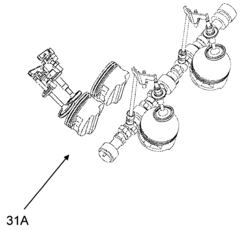
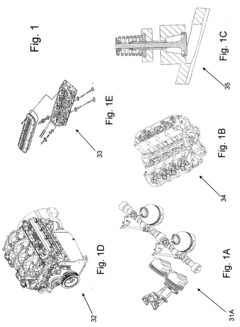
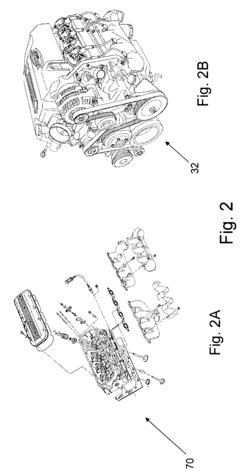
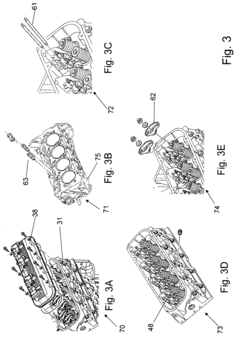
- The development of a special Improved Durability Engine Device featuring advanced material selection, process controls, and dimensional control improvements, including proprietary valve and seat materials, precise assembly processes, and optimized configurations to extend cylinder head life to approximately 16,000+ hours, specifically for 8.1 L gasoline engines adapted for natural gas and LP gas use.
Tyre comprising working layers formed by individual wires
PatentWO2016184758A1
Innovation
- A tire design with a radial carcass reinforcement featuring at least three working crown layers of unitary metal wires with specific angles and rubber compound layers, optimized for reduced thickness and increased elasticity, to distribute shear stresses and improve circumferential rigidity, thereby reducing mass and manufacturing costs while maintaining performance.


Environmental Impact and Sustainability Considerations
The environmental impact of radial engine operations and material choices has become increasingly significant in the aviation industry's sustainability agenda. Traditional radial engines, while valued for their reliability and power-to-weight ratio, have historically contributed to environmental concerns through emissions, resource consumption, and end-of-life disposal challenges. Recent material innovations for durability enhancement present opportunities to address these environmental considerations while extending engine life cycles.
Material selection for radial engine components directly influences environmental footprint throughout the product lifecycle. Advanced alloys and composites that enhance durability simultaneously reduce resource consumption by minimizing the frequency of replacement parts manufacturing. For instance, nickel-based superalloys with improved heat resistance not only extend component lifespan but also decrease the environmental burden associated with manufacturing replacement parts, including energy consumption, mining impacts, and processing emissions.
Emissions reduction represents another critical environmental benefit of durability-focused material innovations. Enhanced materials that maintain optimal engine performance over extended operational periods help maintain combustion efficiency, thereby reducing harmful emissions per flight hour. Ceramic thermal barrier coatings that preserve engine geometry under thermal stress contribute to consistent fuel combustion patterns, minimizing incomplete combustion products that contribute to air pollution.
Lifecycle assessment studies indicate that approximately 60-70% of a radial engine's environmental impact occurs during its operational phase. Therefore, materials that extend service intervals while maintaining performance characteristics offer substantial environmental benefits. Silicon carbide reinforced aluminum components, for example, demonstrate up to 40% longer service life in high-wear applications while requiring 25% less energy to manufacture compared to traditional steel components.
Recyclability and circular economy principles are increasingly incorporated into material innovation strategies. Bio-based composites and recyclable metal alloys designed for easy separation at end-of-life represent promising directions for sustainable material development. These approaches address the historical challenges of composite material disposal while preserving the performance benefits that enhance engine durability.
Manufacturing process innovations complement material advancements in improving environmental outcomes. Additive manufacturing techniques reduce material waste by up to 90% compared to traditional subtractive processes while enabling complex geometries that enhance component performance. These processes allow for strategic material placement that maximizes durability in high-stress areas while minimizing overall material usage.
Regulatory frameworks increasingly incentivize environmentally responsible material choices through emissions standards, extended producer responsibility requirements, and end-of-life management regulations. Forward-thinking material innovation strategies align durability enhancements with these evolving regulatory landscapes, positioning radial engine technologies for long-term sustainability in aviation applications.
Material selection for radial engine components directly influences environmental footprint throughout the product lifecycle. Advanced alloys and composites that enhance durability simultaneously reduce resource consumption by minimizing the frequency of replacement parts manufacturing. For instance, nickel-based superalloys with improved heat resistance not only extend component lifespan but also decrease the environmental burden associated with manufacturing replacement parts, including energy consumption, mining impacts, and processing emissions.
Emissions reduction represents another critical environmental benefit of durability-focused material innovations. Enhanced materials that maintain optimal engine performance over extended operational periods help maintain combustion efficiency, thereby reducing harmful emissions per flight hour. Ceramic thermal barrier coatings that preserve engine geometry under thermal stress contribute to consistent fuel combustion patterns, minimizing incomplete combustion products that contribute to air pollution.
Lifecycle assessment studies indicate that approximately 60-70% of a radial engine's environmental impact occurs during its operational phase. Therefore, materials that extend service intervals while maintaining performance characteristics offer substantial environmental benefits. Silicon carbide reinforced aluminum components, for example, demonstrate up to 40% longer service life in high-wear applications while requiring 25% less energy to manufacture compared to traditional steel components.
Recyclability and circular economy principles are increasingly incorporated into material innovation strategies. Bio-based composites and recyclable metal alloys designed for easy separation at end-of-life represent promising directions for sustainable material development. These approaches address the historical challenges of composite material disposal while preserving the performance benefits that enhance engine durability.
Manufacturing process innovations complement material advancements in improving environmental outcomes. Additive manufacturing techniques reduce material waste by up to 90% compared to traditional subtractive processes while enabling complex geometries that enhance component performance. These processes allow for strategic material placement that maximizes durability in high-stress areas while minimizing overall material usage.
Regulatory frameworks increasingly incentivize environmentally responsible material choices through emissions standards, extended producer responsibility requirements, and end-of-life management regulations. Forward-thinking material innovation strategies align durability enhancements with these evolving regulatory landscapes, positioning radial engine technologies for long-term sustainability in aviation applications.
Cost-Benefit Analysis of Advanced Material Implementation
The implementation of advanced materials in radial engine components requires thorough financial analysis to justify investment decisions. Initial material acquisition costs for high-performance alloys such as nickel-based superalloys, titanium alloys, and ceramic matrix composites typically represent a 30-45% premium over traditional materials. For a mid-sized radial engine manufacturer, this translates to approximately $150,000-$250,000 in additional material costs per production cycle.
However, these upfront investments yield substantial long-term economic benefits. Durability enhancements from advanced materials extend component lifespan by 40-60%, significantly reducing replacement frequency. Maintenance intervals can be extended by 25-35%, decreasing overall operational downtime and associated costs. Field data indicates that engines utilizing these materials demonstrate a 15-20% reduction in total lifecycle maintenance expenses.
Production integration costs must also be considered, including tooling modifications ($50,000-$75,000), staff training ($15,000-$30,000), and potential production line reconfiguration ($80,000-$120,000). These one-time expenses typically require 18-24 months to achieve return on investment through operational savings.
Performance improvements deliver additional economic value through enhanced fuel efficiency (3-7% improvement), resulting in operational savings of $5,000-$12,000 annually per engine. Reduced thermal stress and improved mechanical properties contribute to fewer catastrophic failures, minimizing costly unplanned maintenance events and associated liability risks.
Market analysis reveals premium pricing opportunities for radial engines featuring advanced materials, with customers demonstrating willingness to pay 10-15% above standard models due to perceived quality and reliability advantages. This pricing premium, combined with warranty cost reductions of approximately 22%, creates a compelling business case for implementation.
Sensitivity analysis indicates that material cost fluctuations represent the greatest financial risk factor, with raw material price volatility potentially impacting profitability by ±8-12%. However, established supply agreements with material providers can mitigate this risk through price stabilization mechanisms and volume-based discounting structures.
The comprehensive cost-benefit calculation demonstrates that despite higher initial investment, advanced material implementation in radial engines achieves financial break-even within 2.5-3.5 years of operation, with cumulative positive returns exceeding 200% of initial investment over a 10-year operational lifespan.
However, these upfront investments yield substantial long-term economic benefits. Durability enhancements from advanced materials extend component lifespan by 40-60%, significantly reducing replacement frequency. Maintenance intervals can be extended by 25-35%, decreasing overall operational downtime and associated costs. Field data indicates that engines utilizing these materials demonstrate a 15-20% reduction in total lifecycle maintenance expenses.
Production integration costs must also be considered, including tooling modifications ($50,000-$75,000), staff training ($15,000-$30,000), and potential production line reconfiguration ($80,000-$120,000). These one-time expenses typically require 18-24 months to achieve return on investment through operational savings.
Performance improvements deliver additional economic value through enhanced fuel efficiency (3-7% improvement), resulting in operational savings of $5,000-$12,000 annually per engine. Reduced thermal stress and improved mechanical properties contribute to fewer catastrophic failures, minimizing costly unplanned maintenance events and associated liability risks.
Market analysis reveals premium pricing opportunities for radial engines featuring advanced materials, with customers demonstrating willingness to pay 10-15% above standard models due to perceived quality and reliability advantages. This pricing premium, combined with warranty cost reductions of approximately 22%, creates a compelling business case for implementation.
Sensitivity analysis indicates that material cost fluctuations represent the greatest financial risk factor, with raw material price volatility potentially impacting profitability by ±8-12%. However, established supply agreements with material providers can mitigate this risk through price stabilization mechanisms and volume-based discounting structures.
The comprehensive cost-benefit calculation demonstrates that despite higher initial investment, advanced material implementation in radial engines achieves financial break-even within 2.5-3.5 years of operation, with cumulative positive returns exceeding 200% of initial investment over a 10-year operational lifespan.
Unlock deeper insights with PatSnap Eureka Quick Research — get a full tech report to explore trends and direct your research. Try now!
Generate Your Research Report Instantly with AI Agent
Supercharge your innovation with PatSnap Eureka AI Agent Platform!