Maximize mmWave Utility in Transportation Systems
SEP 22, 20259 MIN READ
Generate Your Research Report Instantly with AI Agent
PatSnap Eureka helps you evaluate technical feasibility & market potential.
mmWave Technology Evolution and Transportation Goals
Millimeter wave (mmWave) technology has evolved significantly over the past two decades, transitioning from primarily military and scientific applications to becoming a cornerstone of next-generation communication systems. Initially developed for radar systems in the 1970s, mmWave technology operates in the frequency range of 30-300 GHz, offering substantial bandwidth advantages compared to traditional sub-6 GHz systems.
The evolution of mmWave technology has been marked by several key milestones. In the early 2000s, semiconductor advancements enabled more efficient mmWave circuit designs. By 2010, the first commercial mmWave applications emerged in point-to-point backhaul links. The standardization of 5G in 2018 represented a watershed moment, as mmWave bands were officially incorporated into global telecommunications frameworks, particularly in the 24-28 GHz and 37-40 GHz ranges.
In transportation systems, mmWave technology aims to revolutionize multiple aspects of mobility infrastructure. The primary goal is to enhance vehicle-to-everything (V2X) communications, enabling ultra-reliable, low-latency connectivity between vehicles, infrastructure, pedestrians, and networks. This connectivity forms the foundation for advanced transportation applications including autonomous driving, smart traffic management, and enhanced safety systems.
Another critical objective is leveraging mmWave's high-resolution sensing capabilities. The short wavelength characteristics of mmWave signals allow for centimeter-level accuracy in object detection and tracking, which is essential for collision avoidance systems and precise positioning in complex traffic environments. This represents a significant improvement over traditional radar systems operating at lower frequencies.
The integration of mmWave technology into transportation infrastructure also targets bandwidth optimization. With data rates potentially reaching multiple gigabits per second, mmWave can support bandwidth-intensive applications such as real-time high-definition mapping, over-the-air software updates, and immersive in-vehicle entertainment systems without compromising critical safety communications.
Looking forward, the technical roadmap for mmWave in transportation systems focuses on overcoming propagation challenges in diverse environmental conditions. Research efforts are concentrated on developing adaptive beamforming techniques, advanced signal processing algorithms, and hybrid network architectures that combine mmWave with sub-6 GHz technologies to ensure consistent performance across varying weather and traffic scenarios.
The ultimate goal is to create a seamless, high-capacity communication fabric that underpins future intelligent transportation systems, supporting everything from basic safety messages to complex cooperative driving maneuvers, while maintaining strict reliability and latency requirements essential for life-critical applications.
The evolution of mmWave technology has been marked by several key milestones. In the early 2000s, semiconductor advancements enabled more efficient mmWave circuit designs. By 2010, the first commercial mmWave applications emerged in point-to-point backhaul links. The standardization of 5G in 2018 represented a watershed moment, as mmWave bands were officially incorporated into global telecommunications frameworks, particularly in the 24-28 GHz and 37-40 GHz ranges.
In transportation systems, mmWave technology aims to revolutionize multiple aspects of mobility infrastructure. The primary goal is to enhance vehicle-to-everything (V2X) communications, enabling ultra-reliable, low-latency connectivity between vehicles, infrastructure, pedestrians, and networks. This connectivity forms the foundation for advanced transportation applications including autonomous driving, smart traffic management, and enhanced safety systems.
Another critical objective is leveraging mmWave's high-resolution sensing capabilities. The short wavelength characteristics of mmWave signals allow for centimeter-level accuracy in object detection and tracking, which is essential for collision avoidance systems and precise positioning in complex traffic environments. This represents a significant improvement over traditional radar systems operating at lower frequencies.
The integration of mmWave technology into transportation infrastructure also targets bandwidth optimization. With data rates potentially reaching multiple gigabits per second, mmWave can support bandwidth-intensive applications such as real-time high-definition mapping, over-the-air software updates, and immersive in-vehicle entertainment systems without compromising critical safety communications.
Looking forward, the technical roadmap for mmWave in transportation systems focuses on overcoming propagation challenges in diverse environmental conditions. Research efforts are concentrated on developing adaptive beamforming techniques, advanced signal processing algorithms, and hybrid network architectures that combine mmWave with sub-6 GHz technologies to ensure consistent performance across varying weather and traffic scenarios.
The ultimate goal is to create a seamless, high-capacity communication fabric that underpins future intelligent transportation systems, supporting everything from basic safety messages to complex cooperative driving maneuvers, while maintaining strict reliability and latency requirements essential for life-critical applications.
Market Demand Analysis for mmWave in Transportation
The millimeter wave (mmWave) technology market in transportation systems is experiencing robust growth, driven by increasing demands for advanced communication, sensing, and safety applications. Current market projections indicate that the global mmWave in transportation sector will reach approximately $4.7 billion by 2027, with a compound annual growth rate of 21.3% from 2022. This significant growth trajectory reflects the expanding recognition of mmWave's critical role in next-generation transportation infrastructure.
Primary market demand stems from intelligent transportation systems (ITS) that require high-bandwidth, low-latency communications. Urban centers worldwide are investing heavily in smart city initiatives, with transportation management forming a cornerstone of these projects. The demand for real-time traffic monitoring, adaptive signal control, and vehicle-to-infrastructure (V2I) communications has created a substantial market opportunity for mmWave technology deployment.
Automotive manufacturers represent another major demand segment, incorporating mmWave radar systems for advanced driver assistance systems (ADAS) and autonomous vehicle development. The high resolution and accuracy of mmWave sensors make them ideal for applications such as collision avoidance, blind spot detection, and parking assistance. Industry analysts report that approximately 78% of new premium vehicles now include some form of mmWave radar technology, with mid-range vehicles rapidly adopting these systems as costs decrease.
Public transportation networks are increasingly seeking mmWave solutions for passenger connectivity, operational efficiency, and safety enhancements. Railway operators in particular have demonstrated strong interest in mmWave technology for trackside communications, train control systems, and passenger broadband services. The market for mmWave in rail transportation alone is projected to grow at 24.7% annually through 2026.
Aviation and maritime sectors also contribute significantly to market demand, with airports implementing mmWave systems for security screening, passenger flow management, and aircraft communications. Ports are adopting similar technologies for vessel tracking, cargo management, and harbor security applications.
Regional analysis reveals that North America currently leads in mmWave transportation applications, accounting for 38% of the global market share, followed by Europe (29%) and Asia-Pacific (24%). However, the Asia-Pacific region is expected to demonstrate the fastest growth rate over the next five years due to massive infrastructure investments in countries like China, Japan, and South Korea.
Key market constraints include implementation costs, regulatory hurdles regarding spectrum allocation, and technical challenges related to signal propagation in diverse environmental conditions. Despite these challenges, the compelling benefits of mmWave technology—including superior data rates, reduced latency, and enhanced sensing capabilities—continue to drive strong market demand across the transportation ecosystem.
Primary market demand stems from intelligent transportation systems (ITS) that require high-bandwidth, low-latency communications. Urban centers worldwide are investing heavily in smart city initiatives, with transportation management forming a cornerstone of these projects. The demand for real-time traffic monitoring, adaptive signal control, and vehicle-to-infrastructure (V2I) communications has created a substantial market opportunity for mmWave technology deployment.
Automotive manufacturers represent another major demand segment, incorporating mmWave radar systems for advanced driver assistance systems (ADAS) and autonomous vehicle development. The high resolution and accuracy of mmWave sensors make them ideal for applications such as collision avoidance, blind spot detection, and parking assistance. Industry analysts report that approximately 78% of new premium vehicles now include some form of mmWave radar technology, with mid-range vehicles rapidly adopting these systems as costs decrease.
Public transportation networks are increasingly seeking mmWave solutions for passenger connectivity, operational efficiency, and safety enhancements. Railway operators in particular have demonstrated strong interest in mmWave technology for trackside communications, train control systems, and passenger broadband services. The market for mmWave in rail transportation alone is projected to grow at 24.7% annually through 2026.
Aviation and maritime sectors also contribute significantly to market demand, with airports implementing mmWave systems for security screening, passenger flow management, and aircraft communications. Ports are adopting similar technologies for vessel tracking, cargo management, and harbor security applications.
Regional analysis reveals that North America currently leads in mmWave transportation applications, accounting for 38% of the global market share, followed by Europe (29%) and Asia-Pacific (24%). However, the Asia-Pacific region is expected to demonstrate the fastest growth rate over the next five years due to massive infrastructure investments in countries like China, Japan, and South Korea.
Key market constraints include implementation costs, regulatory hurdles regarding spectrum allocation, and technical challenges related to signal propagation in diverse environmental conditions. Despite these challenges, the compelling benefits of mmWave technology—including superior data rates, reduced latency, and enhanced sensing capabilities—continue to drive strong market demand across the transportation ecosystem.
Current State and Challenges of mmWave Implementation
Millimeter wave (mmWave) technology has gained significant traction in transportation systems due to its high bandwidth and data transmission capabilities. Currently, mmWave implementations in transportation primarily focus on vehicle-to-everything (V2X) communications, advanced driver assistance systems (ADAS), and intelligent transportation infrastructure. The frequency bands typically utilized range from 24 GHz to 86 GHz, with 24 GHz, 60 GHz, and 77 GHz being the most common for transportation applications.
Despite promising advancements, mmWave implementation in transportation systems faces substantial technical challenges. Signal propagation remains a critical issue as mmWaves experience severe attenuation due to atmospheric absorption, rain fade, and physical obstacles. In transportation environments, this is particularly problematic as vehicles move at high speeds through varying terrains and weather conditions, causing frequent signal blockages and fluctuations in link quality.
Beam management presents another significant challenge. The highly directional nature of mmWave signals requires sophisticated beam steering and tracking mechanisms to maintain reliable connections between moving vehicles or between vehicles and infrastructure. Current beam management protocols struggle to achieve the sub-millisecond response times needed for safety-critical applications in high-mobility scenarios.
Hardware limitations further constrain mmWave adoption in transportation. The power consumption of mmWave transceivers remains high, creating thermal management issues in compact automotive designs. Additionally, the cost of mmWave components, particularly phased array antennas and specialized RF front-ends, remains prohibitive for mass-market implementation across all vehicle segments.
Standardization efforts are still evolving, with competing frameworks from IEEE 802.11ad/ay, 3GPP 5G NR, and automotive-specific consortia. This fragmentation complicates interoperability between different vehicle manufacturers and infrastructure providers, hindering widespread deployment.
Geographically, mmWave technology development for transportation applications is concentrated in North America, Europe, East Asia (particularly Japan and South Korea), and China. These regions have established testing corridors and regulatory frameworks that facilitate mmWave research and implementation. However, significant disparities exist in deployment readiness across different countries due to varying regulatory approaches to spectrum allocation and infrastructure investment.
The integration of mmWave with existing transportation communication systems presents compatibility challenges, as legacy systems operating at lower frequencies must coexist with new mmWave implementations. This necessitates complex hybrid architectures that can seamlessly transition between different frequency bands based on environmental conditions and application requirements.
Despite promising advancements, mmWave implementation in transportation systems faces substantial technical challenges. Signal propagation remains a critical issue as mmWaves experience severe attenuation due to atmospheric absorption, rain fade, and physical obstacles. In transportation environments, this is particularly problematic as vehicles move at high speeds through varying terrains and weather conditions, causing frequent signal blockages and fluctuations in link quality.
Beam management presents another significant challenge. The highly directional nature of mmWave signals requires sophisticated beam steering and tracking mechanisms to maintain reliable connections between moving vehicles or between vehicles and infrastructure. Current beam management protocols struggle to achieve the sub-millisecond response times needed for safety-critical applications in high-mobility scenarios.
Hardware limitations further constrain mmWave adoption in transportation. The power consumption of mmWave transceivers remains high, creating thermal management issues in compact automotive designs. Additionally, the cost of mmWave components, particularly phased array antennas and specialized RF front-ends, remains prohibitive for mass-market implementation across all vehicle segments.
Standardization efforts are still evolving, with competing frameworks from IEEE 802.11ad/ay, 3GPP 5G NR, and automotive-specific consortia. This fragmentation complicates interoperability between different vehicle manufacturers and infrastructure providers, hindering widespread deployment.
Geographically, mmWave technology development for transportation applications is concentrated in North America, Europe, East Asia (particularly Japan and South Korea), and China. These regions have established testing corridors and regulatory frameworks that facilitate mmWave research and implementation. However, significant disparities exist in deployment readiness across different countries due to varying regulatory approaches to spectrum allocation and infrastructure investment.
The integration of mmWave with existing transportation communication systems presents compatibility challenges, as legacy systems operating at lower frequencies must coexist with new mmWave implementations. This necessitates complex hybrid architectures that can seamlessly transition between different frequency bands based on environmental conditions and application requirements.
Existing mmWave Solutions for Transportation Applications
01 mmWave technology in wireless communications
Millimeter wave (mmWave) technology enables high-speed wireless communications by utilizing frequency bands between 30 GHz and 300 GHz. This technology provides significantly higher bandwidth compared to traditional cellular frequencies, allowing for multi-gigabit data rates. The implementation of mmWave in 5G and beyond networks facilitates enhanced mobile broadband services, ultra-reliable low-latency communications, and massive machine-type communications. Despite challenges like signal attenuation and limited range, advanced beamforming techniques and antenna arrays help overcome these limitations.- mmWave technology in wireless communications: Millimeter wave (mmWave) technology enables high-speed wireless communications by utilizing frequency bands between 30 GHz and 300 GHz. These frequencies offer significantly higher bandwidth compared to traditional cellular bands, allowing for multi-gigabit data rates. The technology is particularly valuable for 5G networks, enabling low-latency communications, massive device connectivity, and enhanced mobile broadband services. Despite challenges like signal attenuation and limited range, advanced beamforming techniques help overcome these limitations for effective deployment in next-generation wireless networks.
- mmWave radar systems for sensing applications: Millimeter wave radar systems provide high-resolution sensing capabilities for various applications including automotive, industrial, and security sectors. These systems can detect objects with precise distance, velocity, and angular measurements even in challenging environmental conditions such as fog, smoke, or darkness. The compact size of mmWave sensors enables their integration into small devices while maintaining high performance. Advanced signal processing techniques further enhance their detection capabilities, making them suitable for applications ranging from autonomous vehicles to gesture recognition systems.
- mmWave technology in medical and healthcare applications: Millimeter wave technology offers non-invasive solutions for medical diagnostics and healthcare monitoring. The non-ionizing nature of mmWave radiation makes it safer than X-rays for certain imaging applications, while its ability to penetrate clothing but reflect off human tissue enables applications like contactless vital sign monitoring. These systems can detect subtle physiological changes including respiration rate, heart rate, and even blood glucose levels. The technology also shows promise in early detection of certain medical conditions and in telemedicine applications where remote monitoring is essential.
- mmWave technology for power transmission and energy applications: Millimeter wave technology enables wireless power transmission over distances that were previously impractical. By focusing energy in narrow beams, mmWave systems can efficiently transfer power to devices without physical connections. This capability is particularly valuable for charging electronic devices in smart environments, powering IoT sensors in hard-to-reach locations, and enabling more flexible power distribution systems. The technology also has applications in energy harvesting from ambient mmWave signals, potentially extending the battery life of low-power devices in mmWave-rich environments.
- mmWave technology in security and imaging systems: Millimeter wave technology provides advanced security screening and imaging capabilities that can detect concealed objects through clothing and certain materials. The high-frequency signals can create detailed images with resolution sufficient to identify potential threats while maintaining privacy considerations. These systems are deployed in airports, border crossings, and high-security facilities. Beyond security applications, mmWave imaging enables non-destructive testing in industrial settings, allowing for inspection of materials and products without physical contact or damage, which is particularly valuable in quality control processes.
02 mmWave radar systems for sensing applications
mmWave radar technology utilizes high-frequency electromagnetic waves for precise object detection, tracking, and imaging. These systems offer advantages including high resolution, weather resistance, and the ability to penetrate certain materials. Applications include automotive radar for advanced driver assistance systems (ADAS), industrial automation for object detection and process monitoring, security screening, and gesture recognition for touchless human-machine interfaces. The compact size of mmWave radar components allows for integration into various devices while maintaining high performance sensing capabilities.Expand Specific Solutions03 mmWave technology in medical and healthcare applications
Millimeter wave technology offers unique capabilities for medical diagnostics and healthcare monitoring. The non-ionizing nature of mmWave radiation makes it safer than X-rays for certain imaging applications, while its ability to detect subtle physiological changes enables non-invasive vital sign monitoring. Applications include early detection of skin abnormalities, remote patient monitoring systems that can track breathing and heart rate without contact, and high-resolution medical imaging. The technology also shows promise for targeted therapeutic applications where precise energy delivery is required.Expand Specific Solutions04 mmWave technology for power transmission and energy applications
Millimeter wave technology enables wireless power transmission over distances through focused beamforming techniques. This approach allows for efficient power delivery to devices without physical connections, supporting applications like wireless charging of electronic devices, powering of IoT sensors in hard-to-reach locations, and energy harvesting systems. The directional nature of mmWave beams provides advantages in terms of efficiency and reduced electromagnetic interference compared to lower frequency wireless power solutions. Emerging applications include integration with renewable energy systems and smart grid infrastructure.Expand Specific Solutions05 mmWave technology in security and defense systems
Millimeter wave technology provides advanced capabilities for security screening, surveillance, and defense applications. The high-resolution imaging properties of mmWave systems enable detection of concealed objects through clothing and certain materials without physical contact. In defense applications, mmWave radar systems offer advantages in target acquisition, tracking, and identification even in adverse weather conditions or low visibility environments. The technology also supports secure communications with high directivity and low probability of intercept, making it valuable for tactical communications in defense scenarios.Expand Specific Solutions
Key Industry Players and Competitive Landscape
The mmWave technology in transportation systems is currently in a growth phase, with the market expected to expand significantly as smart mobility applications increase. The global market size is projected to reach several billion dollars by 2025, driven by autonomous vehicle communications, traffic management systems, and vehicle-to-everything (V2X) connectivity. Technology maturity varies across applications, with key players advancing different aspects: Qualcomm and Huawei lead in chipset development; automotive manufacturers like Toyota focus on vehicle integration; telecom giants including Ericsson, Nokia, and NTT Docomo develop infrastructure solutions; while Samsung and MediaTek contribute to device connectivity. Academic institutions such as Southeast University and Beijing University of Posts & Telecommunications are conducting foundational research to overcome propagation challenges in transportation environments.
QUALCOMM, Inc.
Technical Solution: Qualcomm has developed a comprehensive mmWave solution for transportation systems built around their Snapdragon Automotive 5G Platform. Their approach integrates specialized mmWave modem technology with automotive-grade hardware designed to withstand the harsh conditions of transportation environments. Qualcomm's system utilizes their QTM527 mmWave antenna modules that support frequencies from 26GHz to 41GHz, providing flexibility across different regional spectrum allocations[2]. Their solution implements advanced beam steering technology capable of maintaining connectivity at vehicle speeds exceeding 250 km/h through predictive algorithms that anticipate signal path changes[5]. Qualcomm has developed specialized C-V2X (Cellular Vehicle-to-Everything) capabilities that leverage mmWave bands for ultra-high bandwidth, low-latency communications between vehicles and infrastructure. Their platform supports multi-gigabit throughput with latencies below 1ms, enabling advanced applications like high-definition mapping updates, remote driving assistance, and augmented reality navigation[8]. Qualcomm's solution also incorporates edge computing capabilities within roadside units to process data locally, reducing backhaul requirements and enabling time-sensitive applications.
Strengths: Unparalleled expertise in mmWave chipset development; comprehensive integration with automotive systems; extensive ecosystem of partners across the transportation industry. Weaknesses: Primarily focused on in-vehicle technology rather than infrastructure; higher component costs compared to sub-6GHz solutions; deployment complexity requiring coordination with infrastructure providers.
Huawei Technologies Co., Ltd.
Technical Solution: Huawei has developed a comprehensive mmWave solution for transportation systems that integrates their 5G mmWave technology with intelligent transportation infrastructure. Their approach utilizes beamforming technology with up to 256 antenna elements to achieve high-gain directional transmission[1], enabling data rates exceeding 10 Gbps in transportation corridors. Huawei's system employs dynamic beam tracking algorithms that continuously adjust to high-speed vehicles, maintaining stable connections even at speeds over 500 km/h[3]. Their transportation-specific deployment strategy includes dense small cell networks along major transportation routes with seamless handover mechanisms optimized for high mobility scenarios. Huawei has also developed specialized hardware including roadside units (RSUs) that operate in the 26GHz, 28GHz and 39GHz bands to provide comprehensive coverage for vehicle-to-everything (V2X) communications[5]. Their solution incorporates AI-driven predictive resource allocation that anticipates connectivity needs based on traffic patterns and vehicle trajectories.
Strengths: Superior beam tracking technology enabling reliable connectivity at very high speeds; comprehensive end-to-end solution from infrastructure to devices; extensive field testing in real-world transportation environments. Weaknesses: Higher implementation costs compared to sub-6GHz solutions; potential challenges with regulatory approvals in some markets; requires significant infrastructure deployment along transportation corridors.
Core Patents and Technical Innovations in mmWave
Service location method and system for mmwave cellular environments
PatentActiveUS20210227488A1
Innovation
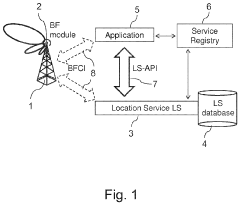
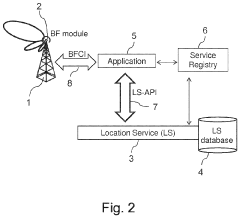
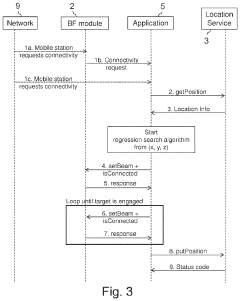
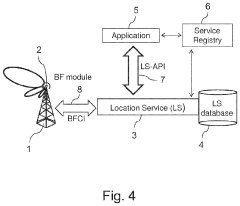
- A method and system that decouples the beamforming module from the application layer, utilizing a location service to provide and update user terminal location information, enabling improved beam steering and association procedures through a location service entity connected to mmWave access points, facilitating faster terminal discovery and communication.
Vehicular millimeter wave communication for non-line of sight scenarios
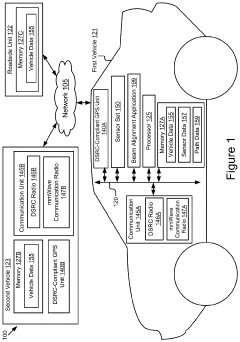
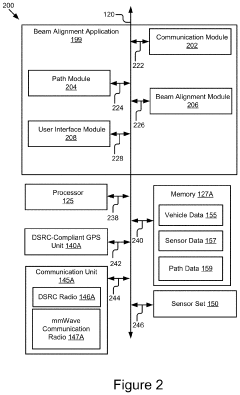
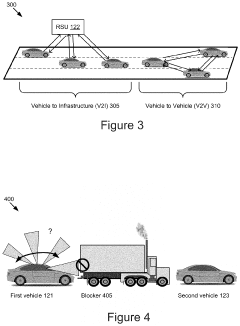
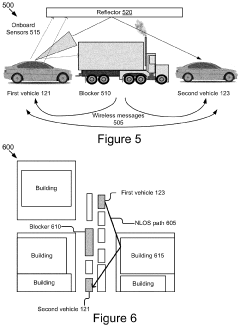
PatentActiveUS20200068044A1
Innovation
- A method that involves determining a non-line of sight (NLOS) path based on vehicle and sensor data to avoid potential blockages by reflecting beams off suitable objects, with beam alignment performed before the blockage occurs, and adapting transmission schemes like modulation and beam width adjustments to ensure successful communication, switching to line-of-sight paths if NLOS paths fail.
Regulatory Framework for mmWave in Transportation
The regulatory landscape for mmWave technology in transportation systems presents a complex framework that varies significantly across global jurisdictions. In the United States, the Federal Communications Commission (FCC) has allocated specific frequency bands for transportation applications, particularly in the 76-81 GHz range for vehicular radar systems and 57-71 GHz for short-range communications. These allocations enable critical safety applications while managing potential interference with existing services. The FCC has also established power limits and out-of-band emission requirements to minimize interference risks while maximizing utility.
The European Union, through the European Telecommunications Standards Institute (ETSI), has developed harmonized standards for mmWave applications in transportation, focusing on the 76-77 GHz band for automotive radar and 63-64 GHz for intelligent transport systems. These regulations emphasize both safety and interoperability across member states, creating a unified market for mmWave transportation technologies while addressing spectrum sharing concerns.
In Asia, regulatory approaches vary considerably. Japan's Ministry of Internal Affairs and Communications has allocated the 77-81 GHz band for automotive radar applications with specific technical parameters. China's Ministry of Industry and Information Technology has implemented a more controlled approach, with phased allocation of mmWave spectrum for transportation applications, prioritizing national infrastructure projects and domestic technology development.
Regulatory challenges persist across all jurisdictions regarding the balance between innovation and safety. Concerns about potential interference with existing services, particularly satellite communications and radio astronomy in adjacent bands, have led to stringent technical requirements. Additionally, privacy and security regulations intersect with mmWave deployment, as high-resolution sensing capabilities raise questions about data collection and protection.
International harmonization efforts are underway through the International Telecommunication Union (ITU), which has established working groups focused on global spectrum allocation for intelligent transportation systems. These efforts aim to create compatible regulatory frameworks that facilitate cross-border operations while respecting national sovereignty over spectrum management.
Emerging regulatory trends include dynamic spectrum sharing frameworks that allow for more efficient use of mmWave bands, performance-based rather than technology-specific regulations, and streamlined certification processes for transportation-specific mmWave equipment. These developments reflect regulators' recognition of mmWave technology's transformative potential in transportation systems while acknowledging the need for appropriate safeguards.
The European Union, through the European Telecommunications Standards Institute (ETSI), has developed harmonized standards for mmWave applications in transportation, focusing on the 76-77 GHz band for automotive radar and 63-64 GHz for intelligent transport systems. These regulations emphasize both safety and interoperability across member states, creating a unified market for mmWave transportation technologies while addressing spectrum sharing concerns.
In Asia, regulatory approaches vary considerably. Japan's Ministry of Internal Affairs and Communications has allocated the 77-81 GHz band for automotive radar applications with specific technical parameters. China's Ministry of Industry and Information Technology has implemented a more controlled approach, with phased allocation of mmWave spectrum for transportation applications, prioritizing national infrastructure projects and domestic technology development.
Regulatory challenges persist across all jurisdictions regarding the balance between innovation and safety. Concerns about potential interference with existing services, particularly satellite communications and radio astronomy in adjacent bands, have led to stringent technical requirements. Additionally, privacy and security regulations intersect with mmWave deployment, as high-resolution sensing capabilities raise questions about data collection and protection.
International harmonization efforts are underway through the International Telecommunication Union (ITU), which has established working groups focused on global spectrum allocation for intelligent transportation systems. These efforts aim to create compatible regulatory frameworks that facilitate cross-border operations while respecting national sovereignty over spectrum management.
Emerging regulatory trends include dynamic spectrum sharing frameworks that allow for more efficient use of mmWave bands, performance-based rather than technology-specific regulations, and streamlined certification processes for transportation-specific mmWave equipment. These developments reflect regulators' recognition of mmWave technology's transformative potential in transportation systems while acknowledging the need for appropriate safeguards.
Safety and Security Considerations for mmWave Deployment
The deployment of millimeter wave (mmWave) technology in transportation systems introduces significant safety and security considerations that must be addressed comprehensively. Physical safety concerns arise from the high-frequency electromagnetic radiation, which, although non-ionizing, requires careful management to ensure compliance with international exposure standards. Transportation environments present unique challenges due to the density of users and extended exposure periods for both passengers and operators.
Infrastructure security represents another critical dimension, as mmWave systems become integral to transportation operations. These networks must be hardened against both physical tampering and cyber attacks. The potential for signal jamming, spoofing, or unauthorized access could compromise not only communication systems but also safety-critical applications like collision avoidance or automated vehicle control.
Data privacy considerations are particularly acute in mmWave deployments due to the technology's high-resolution sensing capabilities. The detailed environmental mapping and passenger monitoring enabled by mmWave systems create substantial privacy implications. Transportation authorities must implement robust data governance frameworks that balance operational requirements with individual privacy rights, including clear policies on data collection, storage, and access controls.
Weather resilience presents a significant operational safety challenge for mmWave systems. Signal attenuation during adverse weather conditions such as heavy rain, snow, or fog can degrade system performance. Transportation applications must incorporate redundancy mechanisms and degradation protocols to maintain minimum safety thresholds even when mmWave capabilities are compromised.
Electromagnetic interference (EMI) management is essential in complex transportation environments where multiple wireless systems operate simultaneously. Careful frequency planning and shielding strategies must be implemented to prevent mmWave systems from interfering with safety-critical equipment or being disrupted by other systems.
Regulatory compliance adds another layer of complexity, with varying standards across jurisdictions governing both radio frequency emissions and transportation safety. System designers must navigate this complex regulatory landscape while ensuring interoperability across geographical boundaries, particularly for cross-border transportation services.
Fail-safe design principles must be incorporated throughout mmWave transportation applications. Systems should be engineered to detect failures and gracefully degrade rather than catastrophically fail, with clear procedures for manual override when automated systems encounter anomalies. This approach is particularly crucial for applications supporting autonomous vehicle operations or high-density traffic management.
Infrastructure security represents another critical dimension, as mmWave systems become integral to transportation operations. These networks must be hardened against both physical tampering and cyber attacks. The potential for signal jamming, spoofing, or unauthorized access could compromise not only communication systems but also safety-critical applications like collision avoidance or automated vehicle control.
Data privacy considerations are particularly acute in mmWave deployments due to the technology's high-resolution sensing capabilities. The detailed environmental mapping and passenger monitoring enabled by mmWave systems create substantial privacy implications. Transportation authorities must implement robust data governance frameworks that balance operational requirements with individual privacy rights, including clear policies on data collection, storage, and access controls.
Weather resilience presents a significant operational safety challenge for mmWave systems. Signal attenuation during adverse weather conditions such as heavy rain, snow, or fog can degrade system performance. Transportation applications must incorporate redundancy mechanisms and degradation protocols to maintain minimum safety thresholds even when mmWave capabilities are compromised.
Electromagnetic interference (EMI) management is essential in complex transportation environments where multiple wireless systems operate simultaneously. Careful frequency planning and shielding strategies must be implemented to prevent mmWave systems from interfering with safety-critical equipment or being disrupted by other systems.
Regulatory compliance adds another layer of complexity, with varying standards across jurisdictions governing both radio frequency emissions and transportation safety. System designers must navigate this complex regulatory landscape while ensuring interoperability across geographical boundaries, particularly for cross-border transportation services.
Fail-safe design principles must be incorporated throughout mmWave transportation applications. Systems should be engineered to detect failures and gracefully degrade rather than catastrophically fail, with clear procedures for manual override when automated systems encounter anomalies. This approach is particularly crucial for applications supporting autonomous vehicle operations or high-density traffic management.
Unlock deeper insights with PatSnap Eureka Quick Research — get a full tech report to explore trends and direct your research. Try now!
Generate Your Research Report Instantly with AI Agent
Supercharge your innovation with PatSnap Eureka AI Agent Platform!