

Measure Material Reduction in Topology Optimization Designs — Efficiency Analysis
SEP 15, 20259 MIN READ
Generate Your Research Report Instantly with AI Agent
PatSnap Eureka helps you evaluate technical feasibility & market potential.
Topology Optimization Background and Objectives
Topology optimization has emerged as a revolutionary approach in engineering design since its inception in the late 1980s. Originally developed as a mathematical method to distribute material within a design space while satisfying specific constraints, this technique has evolved significantly over the past three decades. The fundamental principle involves removing unnecessary material from a design domain while maintaining structural integrity, thereby creating lightweight yet robust structures that would be difficult or impossible to conceive using traditional design methodologies.
The evolution of topology optimization has been closely tied to advancements in computational capabilities. Early implementations were limited to simple 2D problems with basic loading conditions, but modern algorithms can handle complex 3D geometries with multiple load cases, manufacturing constraints, and multi-physics considerations. This progression has transformed topology optimization from an academic curiosity to an essential tool in industries ranging from aerospace and automotive to medical device manufacturing and civil engineering.
Current research trends in topology optimization focus on integrating additional design considerations such as manufacturing constraints, multi-material designs, and non-linear behaviors. The integration with additive manufacturing technologies has been particularly synergistic, as 3D printing enables the fabrication of complex geometries that were previously impossible to manufacture using conventional methods.
The primary objective of material reduction measurement in topology optimization is to quantify the efficiency gains achieved through this design approach. This involves developing robust metrics and methodologies to accurately assess material savings while maintaining or enhancing performance characteristics. Such measurements are crucial for industries seeking to reduce weight, minimize material costs, and decrease environmental impact without compromising structural integrity or functionality.
Secondary objectives include establishing standardized benchmarks for comparing different topology optimization algorithms and approaches, developing tools for predicting material reduction potential early in the design process, and creating frameworks for balancing material reduction against other design considerations such as manufacturability, cost, and time-to-market.
The long-term technological goal is to develop fully automated design systems that can intelligently optimize material distribution across multiple scales and physics domains, while seamlessly integrating with existing design workflows and manufacturing processes. This would enable engineers to rapidly explore design alternatives and make informed decisions based on quantifiable material efficiency metrics, ultimately leading to more sustainable and economically viable products.
The evolution of topology optimization has been closely tied to advancements in computational capabilities. Early implementations were limited to simple 2D problems with basic loading conditions, but modern algorithms can handle complex 3D geometries with multiple load cases, manufacturing constraints, and multi-physics considerations. This progression has transformed topology optimization from an academic curiosity to an essential tool in industries ranging from aerospace and automotive to medical device manufacturing and civil engineering.
Current research trends in topology optimization focus on integrating additional design considerations such as manufacturing constraints, multi-material designs, and non-linear behaviors. The integration with additive manufacturing technologies has been particularly synergistic, as 3D printing enables the fabrication of complex geometries that were previously impossible to manufacture using conventional methods.
The primary objective of material reduction measurement in topology optimization is to quantify the efficiency gains achieved through this design approach. This involves developing robust metrics and methodologies to accurately assess material savings while maintaining or enhancing performance characteristics. Such measurements are crucial for industries seeking to reduce weight, minimize material costs, and decrease environmental impact without compromising structural integrity or functionality.
Secondary objectives include establishing standardized benchmarks for comparing different topology optimization algorithms and approaches, developing tools for predicting material reduction potential early in the design process, and creating frameworks for balancing material reduction against other design considerations such as manufacturability, cost, and time-to-market.
The long-term technological goal is to develop fully automated design systems that can intelligently optimize material distribution across multiple scales and physics domains, while seamlessly integrating with existing design workflows and manufacturing processes. This would enable engineers to rapidly explore design alternatives and make informed decisions based on quantifiable material efficiency metrics, ultimately leading to more sustainable and economically viable products.
Market Demand for Material Efficiency Solutions
The global market for material efficiency solutions in design and manufacturing has witnessed significant growth in recent years, driven by increasing environmental concerns, regulatory pressures, and economic incentives. Topology optimization, as a key technology enabling material reduction while maintaining structural integrity, has emerged as a critical solution addressing these market demands.
Manufacturing industries, particularly aerospace, automotive, and medical device sectors, are actively seeking advanced material efficiency technologies to reduce production costs while meeting sustainability targets. According to industry analyses, material costs typically represent 40-60% of manufacturing expenses in these sectors, creating substantial economic motivation for material reduction technologies.
Environmental regulations worldwide are increasingly mandating reduced carbon footprints and material consumption. The European Union's Circular Economy Action Plan, China's industrial efficiency standards, and similar frameworks in North America have created regulatory environments that favor material-efficient design approaches. Companies implementing topology optimization solutions report compliance advantages and reduced environmental impact reporting burdens.
Consumer preferences have shifted dramatically toward sustainable products, with market research indicating that sustainability features influence purchasing decisions for over 60% of consumers in developed markets. This trend has pushed manufacturers to prominently feature material efficiency in their marketing and product development strategies.
The economic case for material efficiency solutions is compelling. Case studies from automotive and aerospace implementations demonstrate weight reductions of 20-30% through topology optimization, translating to significant operational cost savings. For example, in aerospace applications, each kilogram of weight reduction can save thousands of dollars in fuel costs over an aircraft's lifetime.
Supply chain vulnerabilities exposed during recent global disruptions have intensified interest in material efficiency technologies. Companies are increasingly viewing material reduction not only as a cost-saving measure but as a strategic approach to mitigate supply chain risks related to raw material availability and price volatility.
The market for topology optimization software and related consulting services has expanded at a compound annual growth rate exceeding 15% since 2018. This growth trajectory is expected to continue as more industries recognize the competitive advantages of material-efficient design approaches and as the technology becomes more accessible to small and medium enterprises through cloud-based solutions and improved user interfaces.
Manufacturing industries, particularly aerospace, automotive, and medical device sectors, are actively seeking advanced material efficiency technologies to reduce production costs while meeting sustainability targets. According to industry analyses, material costs typically represent 40-60% of manufacturing expenses in these sectors, creating substantial economic motivation for material reduction technologies.
Environmental regulations worldwide are increasingly mandating reduced carbon footprints and material consumption. The European Union's Circular Economy Action Plan, China's industrial efficiency standards, and similar frameworks in North America have created regulatory environments that favor material-efficient design approaches. Companies implementing topology optimization solutions report compliance advantages and reduced environmental impact reporting burdens.
Consumer preferences have shifted dramatically toward sustainable products, with market research indicating that sustainability features influence purchasing decisions for over 60% of consumers in developed markets. This trend has pushed manufacturers to prominently feature material efficiency in their marketing and product development strategies.
The economic case for material efficiency solutions is compelling. Case studies from automotive and aerospace implementations demonstrate weight reductions of 20-30% through topology optimization, translating to significant operational cost savings. For example, in aerospace applications, each kilogram of weight reduction can save thousands of dollars in fuel costs over an aircraft's lifetime.
Supply chain vulnerabilities exposed during recent global disruptions have intensified interest in material efficiency technologies. Companies are increasingly viewing material reduction not only as a cost-saving measure but as a strategic approach to mitigate supply chain risks related to raw material availability and price volatility.
The market for topology optimization software and related consulting services has expanded at a compound annual growth rate exceeding 15% since 2018. This growth trajectory is expected to continue as more industries recognize the competitive advantages of material-efficient design approaches and as the technology becomes more accessible to small and medium enterprises through cloud-based solutions and improved user interfaces.
Current State and Challenges in Material Reduction Measurement
The measurement of material reduction in topology optimization designs currently faces significant challenges despite notable advancements in recent years. Globally, researchers and industry practitioners have made substantial progress in developing algorithms and methodologies for topology optimization, yet quantifying the efficiency of material reduction remains complex and inconsistent across different applications and industries.
Current measurement approaches typically rely on volume comparison between initial design spaces and final optimized structures. However, these methods often fail to account for manufacturing constraints, functional requirements, and real-world performance parameters. This creates a disconnect between theoretical material savings and practical implementation benefits, leading to potentially misleading efficiency metrics.
A major challenge in the field is the lack of standardized benchmarks and metrics for evaluating material reduction efficiency. Different industries and applications employ varied criteria, making cross-sector comparisons difficult and hindering the establishment of universal best practices. For instance, aerospace applications prioritize weight reduction while maintaining structural integrity, whereas automotive industries may balance material reduction against manufacturing costs and production scalability.
Computational limitations present another significant obstacle. As design complexity increases, the computational resources required for accurate measurement and validation grow exponentially. This is particularly evident in multi-material optimization scenarios where interface behaviors and material property gradients must be precisely modeled to ensure reliable efficiency measurements.
Geographically, material reduction measurement technologies show distinct regional characteristics. North American and European research institutions focus predominantly on theoretical frameworks and academic validation, while Asian manufacturing hubs emphasize practical implementation metrics tied directly to production efficiency. This geographical disparity creates knowledge silos that impede global standardization efforts.
Recent technological advancements in machine learning and artificial intelligence have begun addressing some of these challenges by enabling more sophisticated analysis of material distribution patterns and structural performance. However, these approaches remain in early development stages and require further validation across diverse application scenarios.
The integration of life cycle assessment (LCA) methodologies with material reduction measurements represents an emerging trend, aiming to provide more holistic efficiency metrics that consider environmental impact alongside pure material savings. This approach, though promising, introduces additional complexity to measurement protocols and requires interdisciplinary expertise that many organizations currently lack.
Current measurement approaches typically rely on volume comparison between initial design spaces and final optimized structures. However, these methods often fail to account for manufacturing constraints, functional requirements, and real-world performance parameters. This creates a disconnect between theoretical material savings and practical implementation benefits, leading to potentially misleading efficiency metrics.
A major challenge in the field is the lack of standardized benchmarks and metrics for evaluating material reduction efficiency. Different industries and applications employ varied criteria, making cross-sector comparisons difficult and hindering the establishment of universal best practices. For instance, aerospace applications prioritize weight reduction while maintaining structural integrity, whereas automotive industries may balance material reduction against manufacturing costs and production scalability.
Computational limitations present another significant obstacle. As design complexity increases, the computational resources required for accurate measurement and validation grow exponentially. This is particularly evident in multi-material optimization scenarios where interface behaviors and material property gradients must be precisely modeled to ensure reliable efficiency measurements.
Geographically, material reduction measurement technologies show distinct regional characteristics. North American and European research institutions focus predominantly on theoretical frameworks and academic validation, while Asian manufacturing hubs emphasize practical implementation metrics tied directly to production efficiency. This geographical disparity creates knowledge silos that impede global standardization efforts.
Recent technological advancements in machine learning and artificial intelligence have begun addressing some of these challenges by enabling more sophisticated analysis of material distribution patterns and structural performance. However, these approaches remain in early development stages and require further validation across diverse application scenarios.
The integration of life cycle assessment (LCA) methodologies with material reduction measurements represents an emerging trend, aiming to provide more holistic efficiency metrics that consider environmental impact alongside pure material savings. This approach, though promising, introduces additional complexity to measurement protocols and requires interdisciplinary expertise that many organizations currently lack.
Existing Measurement Techniques for Material Reduction Assessment
01 Computational methods for topology optimization
Various computational methods are employed in topology optimization to achieve material reduction. These include finite element analysis, mathematical modeling, and iterative algorithms that systematically remove material from non-critical areas while maintaining structural integrity. These computational approaches enable designers to identify optimal material distribution patterns that minimize weight while meeting performance requirements.- Structural optimization algorithms for material reduction: Advanced algorithms are employed in topology optimization to systematically reduce material usage while maintaining structural integrity. These computational methods identify areas where material can be removed without compromising performance, resulting in lightweight designs that use less raw material. The algorithms typically analyze stress distribution, load paths, and structural requirements to determine optimal material distribution, enabling significant weight reduction in components across various industries.
- Lattice and cellular structure design for weight reduction: Topology optimization techniques can generate lattice and cellular structures that significantly reduce material usage while maintaining mechanical properties. These structures feature internal geometries with strategically placed voids and reinforcements, creating lightweight components with high strength-to-weight ratios. The optimization process determines the ideal configuration of these cellular structures based on specific load conditions and performance requirements, resulting in material-efficient designs for applications ranging from aerospace components to medical implants.
- Multi-objective optimization for material efficiency: Multi-objective topology optimization approaches balance material reduction with other critical design factors such as manufacturability, cost, and performance requirements. These methods simultaneously consider multiple competing objectives to achieve optimal material distribution. By incorporating constraints related to manufacturing processes, thermal performance, and structural integrity, the optimization can deliver practical designs that minimize material usage while satisfying all functional requirements, leading to more sustainable and economically viable products.
- Additive manufacturing integration with topology optimization: The integration of topology optimization with additive manufacturing technologies enables the production of complex, material-efficient designs that would be impossible to create using traditional manufacturing methods. This combination allows for the fabrication of components with intricate internal structures, optimized material distribution, and functionally graded properties. The design process specifically targets material reduction by removing unnecessary mass while maintaining structural performance, resulting in components that use significantly less material without compromising functionality.
- Machine learning approaches for material optimization: Machine learning techniques are increasingly applied to topology optimization to enhance material reduction strategies. These approaches use data-driven models to predict optimal material distribution patterns based on performance requirements and design constraints. By leveraging artificial intelligence algorithms, the optimization process can more efficiently explore design spaces, identify non-intuitive material-saving solutions, and accelerate the development of lightweight structures. This results in more effective material reduction while maintaining or improving component performance.
02 Lattice and cellular structure optimization
Topology optimization can be applied to create lightweight lattice and cellular structures that significantly reduce material usage. By strategically placing material only where needed for load-bearing, these structures maintain mechanical performance while achieving substantial weight reduction. The optimization process determines the ideal configuration of voids and solid material to create efficient internal architectures.Expand Specific Solutions03 Additive manufacturing integration with topology optimization
Topology optimization is increasingly integrated with additive manufacturing technologies to produce complex, material-efficient designs that would be impossible to manufacture using traditional methods. This integration allows for the fabrication of components with intricate internal structures, optimized material distribution, and customized mechanical properties, resulting in significant material reduction while maintaining or improving performance.Expand Specific Solutions04 Multi-objective optimization for material reduction
Multi-objective topology optimization approaches balance material reduction with other design considerations such as thermal performance, manufacturability, and cost. These methods employ algorithms that simultaneously evaluate multiple performance criteria to identify optimal material distribution patterns. By considering various constraints and objectives in the optimization process, designers can achieve material reduction while ensuring the component meets all functional requirements.Expand Specific Solutions05 Machine learning approaches for topology optimization
Machine learning techniques are being applied to topology optimization to accelerate the design process and discover novel material-efficient structures. These approaches use neural networks, genetic algorithms, and other AI methods to explore vast design spaces and identify optimal material distributions more efficiently than traditional methods. Machine learning can also help predict performance characteristics of optimized designs, enabling faster iteration and more effective material reduction.Expand Specific Solutions
Leading Players in Topology Optimization Software and Applications
Topology optimization for material reduction is currently in a growth phase, with the market expanding due to increasing focus on sustainability and efficiency in manufacturing. The technology is maturing rapidly, with key players like Siemens AG, Autodesk, and ANSYS leading commercial implementation through advanced simulation software. Academic institutions including Massachusetts Institute of Technology and Georgia Tech Research Corp. are driving fundamental research advancements. Automotive manufacturers such as Honda and Toyota are applying these techniques to lightweight vehicle components, while aerospace and industrial equipment companies leverage the technology for performance optimization. The competitive landscape shows collaboration between software providers, academic institutions, and industrial end-users, with increasing integration of AI and machine learning to enhance optimization algorithms.
Siemens AG
Technical Solution: Siemens AG has developed a comprehensive topology optimization framework specifically focused on material reduction efficiency analysis. Their solution integrates parametric design optimization with advanced simulation capabilities in their NX and Simcenter software suites. The approach utilizes Non-Uniform Rational B-Splines (NURBS) to represent complex geometries while maintaining manufacturability constraints. Their methodology incorporates multi-objective optimization algorithms that simultaneously evaluate material reduction, structural performance, and manufacturing costs. Siemens' platform includes automated workflows that can quantify material savings with precise volume calculations between initial and optimized designs, providing percentage-based efficiency metrics. The system also features specialized visualization tools that highlight material distribution changes and stress concentration areas, enabling engineers to make informed decisions about design modifications. Their latest developments include machine learning algorithms that can predict optimization outcomes based on historical data, significantly reducing computation time for complex industrial components.
Strengths: Seamless integration with existing CAD/CAE workflows, comprehensive manufacturing constraints handling, and industry-leading visualization capabilities. Weaknesses: Computationally intensive for very large assemblies, requires significant expertise to fully leverage advanced features, and optimization parameters often need manual tuning for specific applications.
Autodesk, Inc.
Technical Solution: Autodesk has pioneered generative design approaches for topology optimization with specific focus on material efficiency metrics. Their Fusion 360 platform incorporates advanced algorithms that can automatically generate multiple design alternatives based on specified constraints and performance requirements. The system employs cloud-based computing resources to perform parallel optimization studies, evaluating hundreds of design iterations simultaneously. Autodesk's approach uniquely quantifies material reduction through comparative analysis between conventional and optimized designs, providing detailed reports on volume reduction, weight savings, and material distribution efficiency. Their technology incorporates manufacturing process constraints (such as minimum feature size, draft angles, and tool accessibility) directly into the optimization process, ensuring that material reduction doesn't compromise manufacturability. Recent enhancements include sustainability metrics that calculate the environmental impact of material savings, including carbon footprint reduction and energy savings throughout the product lifecycle. The platform also features automated validation tools that verify structural integrity of optimized designs under various loading conditions.
Strengths: User-friendly interface accessible to non-specialists, excellent cloud computing integration for handling complex problems, and comprehensive sustainability metrics. Weaknesses: Limited control over optimization algorithms compared to specialized FEA tools, occasional challenges with complex constraint handling, and subscription-based pricing model that may be costly for smaller organizations.
Key Technologies for Efficiency Analysis in Optimized Designs
Method for structural optimization of a design and cost of a physical object
PatentActiveUS20230196290A1
Innovation
- A computer-implemented method that uses element clustering and numerical estimation to optimize material density distribution, integrating manufacturing costs as an objective function within the topology optimization algorithm, allowing for iterative material density adjustments based on analytical and numerical derivatives to minimize manufacturing costs while maintaining structural performance.
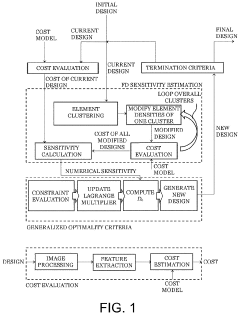
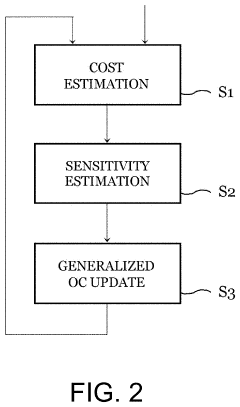
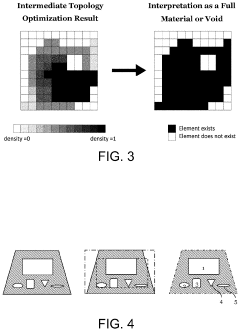
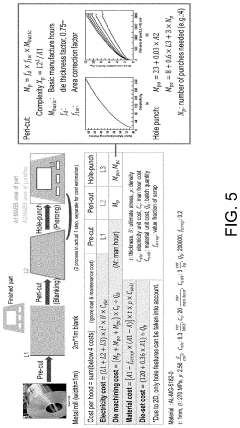
Topology optimization using reduced length boundaries on structure segments of different thicknesses
PatentWO2017096259A1
Innovation
- The development of an algorithm-based method that simultaneously optimizes topology and thickness distribution using finite element models, allowing for the creation of structures with segments and layers of varying thicknesses by iteratively adjusting material density values to achieve optimal structural performance.


Sustainability Impact and Environmental Benefits
Topology optimization's material reduction capabilities represent a significant contribution to sustainable manufacturing and environmental conservation efforts. The quantifiable reduction in material usage directly translates to decreased resource extraction, lower energy consumption in material processing, and reduced waste generation throughout the product lifecycle. Studies indicate that topology-optimized designs typically achieve 30-60% material reduction compared to traditional designs while maintaining functional requirements, resulting in proportional decreases in embodied carbon and energy.
The environmental benefits extend beyond raw material conservation. Lightweight structures produced through topology optimization contribute to operational efficiency gains, particularly in transportation applications. For automotive and aerospace industries, weight reduction directly correlates with fuel efficiency improvements, with estimates suggesting that a 10% weight reduction can yield 6-8% fuel economy enhancement. This translates to substantial lifetime emissions reductions and operational cost savings.
Manufacturing processes for topology-optimized components, particularly additive manufacturing, demonstrate improved sustainability metrics compared to traditional subtractive methods. Additive manufacturing generates significantly less waste material—typically 5-10% compared to 70-90% in conventional machining processes. When combined with topology optimization, this manufacturing approach creates a synergistic effect for sustainability, enabling complex geometries that would be impossible or prohibitively expensive with traditional manufacturing methods.
Life cycle assessment (LCA) studies of topology-optimized components reveal favorable environmental profiles across multiple impact categories. Beyond carbon footprint reductions, these components show improvements in acidification potential, water usage, and human toxicity indicators. The holistic environmental benefits become particularly pronounced when considering the entire product lifecycle, including raw material extraction, manufacturing, use phase, and end-of-life scenarios.
The circular economy potential of topology-optimized designs presents another sustainability dimension. The precise material allocation in these designs facilitates easier separation of materials at end-of-life, enhancing recyclability. Additionally, the reduced material complexity often found in topology-optimized components can simplify recycling processes and improve material recovery rates, contributing to closed-loop material systems.
Policy implications of widespread topology optimization adoption include potential contributions to national and international sustainability targets. The material efficiency improvements align with resource efficiency directives and carbon reduction commitments, positioning topology optimization as a valuable tool in sustainable industrial policy frameworks and environmental compliance strategies.
The environmental benefits extend beyond raw material conservation. Lightweight structures produced through topology optimization contribute to operational efficiency gains, particularly in transportation applications. For automotive and aerospace industries, weight reduction directly correlates with fuel efficiency improvements, with estimates suggesting that a 10% weight reduction can yield 6-8% fuel economy enhancement. This translates to substantial lifetime emissions reductions and operational cost savings.
Manufacturing processes for topology-optimized components, particularly additive manufacturing, demonstrate improved sustainability metrics compared to traditional subtractive methods. Additive manufacturing generates significantly less waste material—typically 5-10% compared to 70-90% in conventional machining processes. When combined with topology optimization, this manufacturing approach creates a synergistic effect for sustainability, enabling complex geometries that would be impossible or prohibitively expensive with traditional manufacturing methods.
Life cycle assessment (LCA) studies of topology-optimized components reveal favorable environmental profiles across multiple impact categories. Beyond carbon footprint reductions, these components show improvements in acidification potential, water usage, and human toxicity indicators. The holistic environmental benefits become particularly pronounced when considering the entire product lifecycle, including raw material extraction, manufacturing, use phase, and end-of-life scenarios.
The circular economy potential of topology-optimized designs presents another sustainability dimension. The precise material allocation in these designs facilitates easier separation of materials at end-of-life, enhancing recyclability. Additionally, the reduced material complexity often found in topology-optimized components can simplify recycling processes and improve material recovery rates, contributing to closed-loop material systems.
Policy implications of widespread topology optimization adoption include potential contributions to national and international sustainability targets. The material efficiency improvements align with resource efficiency directives and carbon reduction commitments, positioning topology optimization as a valuable tool in sustainable industrial policy frameworks and environmental compliance strategies.
Cost-Benefit Analysis of Optimized Designs
The economic implications of topology optimization extend far beyond the immediate material savings. When evaluating optimized designs from a cost-benefit perspective, organizations must consider both direct and indirect financial impacts across the product lifecycle.
Material cost reduction represents the most visible benefit, with optimized components typically achieving 30-50% weight reduction compared to traditional designs. For industries like aerospace, where each kilogram saved can translate to approximately $3,000 in lifetime fuel savings per aircraft, these reductions deliver substantial return on investment. Automotive manufacturers similarly report that a 10% weight reduction in vehicles can improve fuel efficiency by 6-8%, creating cascading economic benefits.
Production expenses also decrease significantly with optimized designs. Less material consumption means reduced raw material costs, while the simplified geometries often enable faster manufacturing cycles. Case studies from industrial equipment manufacturers indicate that topology-optimized components can reduce material costs by 25-40% while simultaneously decreasing production time by 15-20%.
However, these benefits must be balanced against increased computational and design costs. The sophisticated software required for topology optimization represents a significant investment, with enterprise-level licenses ranging from $15,000 to $50,000 annually. Additionally, the specialized engineering expertise needed to effectively utilize these tools commands premium compensation, with topology optimization specialists earning 15-25% more than traditional design engineers.
Implementation costs must also be considered, particularly when transitioning from conventional manufacturing to additive manufacturing methods that better accommodate complex geometries. Initial equipment investments for industrial-grade 3D printers range from $100,000 to several million dollars, though these costs continue to decrease as the technology matures.
Long-term operational benefits frequently outweigh these initial investments. Enhanced performance characteristics—such as improved thermal management, better vibration dampening, or increased structural integrity—deliver ongoing value throughout the product lifecycle. Maintenance costs typically decrease by 10-30% due to the reduced mechanical stress on optimized components, while extended product lifespans further enhance return on investment.
The most comprehensive cost-benefit analyses incorporate sustainability metrics, recognizing that material reduction translates directly to reduced environmental impact. Organizations increasingly monetize these benefits through carbon credits, regulatory compliance advantages, and enhanced brand value associated with sustainable design practices.
Material cost reduction represents the most visible benefit, with optimized components typically achieving 30-50% weight reduction compared to traditional designs. For industries like aerospace, where each kilogram saved can translate to approximately $3,000 in lifetime fuel savings per aircraft, these reductions deliver substantial return on investment. Automotive manufacturers similarly report that a 10% weight reduction in vehicles can improve fuel efficiency by 6-8%, creating cascading economic benefits.
Production expenses also decrease significantly with optimized designs. Less material consumption means reduced raw material costs, while the simplified geometries often enable faster manufacturing cycles. Case studies from industrial equipment manufacturers indicate that topology-optimized components can reduce material costs by 25-40% while simultaneously decreasing production time by 15-20%.
However, these benefits must be balanced against increased computational and design costs. The sophisticated software required for topology optimization represents a significant investment, with enterprise-level licenses ranging from $15,000 to $50,000 annually. Additionally, the specialized engineering expertise needed to effectively utilize these tools commands premium compensation, with topology optimization specialists earning 15-25% more than traditional design engineers.
Implementation costs must also be considered, particularly when transitioning from conventional manufacturing to additive manufacturing methods that better accommodate complex geometries. Initial equipment investments for industrial-grade 3D printers range from $100,000 to several million dollars, though these costs continue to decrease as the technology matures.
Long-term operational benefits frequently outweigh these initial investments. Enhanced performance characteristics—such as improved thermal management, better vibration dampening, or increased structural integrity—deliver ongoing value throughout the product lifecycle. Maintenance costs typically decrease by 10-30% due to the reduced mechanical stress on optimized components, while extended product lifespans further enhance return on investment.
The most comprehensive cost-benefit analyses incorporate sustainability metrics, recognizing that material reduction translates directly to reduced environmental impact. Organizations increasingly monetize these benefits through carbon credits, regulatory compliance advantages, and enhanced brand value associated with sustainable design practices.
Unlock deeper insights with PatSnap Eureka Quick Research — get a full tech report to explore trends and direct your research. Try now!
Generate Your Research Report Instantly with AI Agent
Supercharge your innovation with PatSnap Eureka AI Agent Platform!