

Optimize Direct Lithium Extraction to Lower Operational Emissions
SEP 12, 20259 MIN READ
Generate Your Research Report Instantly with AI Agent
Patsnap Eureka helps you evaluate technical feasibility & market potential.
DLE Technology Background and Emission Reduction Goals
Direct Lithium Extraction (DLE) emerged in the late 1990s as an alternative to traditional lithium extraction methods, which primarily relied on evaporation ponds or hard rock mining. The technology gained significant attention in the 2010s as global demand for lithium surged due to the rapid growth of electric vehicle and energy storage markets. DLE represents a paradigm shift in lithium production by offering a more environmentally conscious approach that can extract lithium directly from brine resources without extensive land use or water evaporation.
Traditional lithium extraction methods face considerable environmental challenges, including high water consumption (approximately 500,000 gallons per ton of lithium), extensive land use (several square kilometers of evaporation ponds), and production cycles lasting 18-24 months. These methods contribute significantly to carbon emissions through energy-intensive processes and transportation requirements. The lithium industry's carbon footprint has become increasingly problematic as the world transitions to clean energy solutions.
The evolution of DLE technologies has been driven by the need to address these environmental concerns while meeting growing demand. Early DLE systems focused primarily on extraction efficiency, while recent innovations have increasingly prioritized emission reduction and sustainability. Current DLE technologies include adsorption-based systems, ion exchange processes, solvent extraction methods, and membrane separation techniques, each with varying degrees of environmental impact and operational efficiency.
The primary emission reduction goals for optimized DLE technologies include decreasing energy consumption by 30-50% compared to conventional methods, reducing freshwater usage by up to 90%, minimizing chemical reagent requirements, and achieving carbon footprint reductions of 30-60% across the lithium production lifecycle. Additionally, there are targets to decrease land disturbance by over 70% and accelerate production timelines from years to days or weeks.
Recent technological breakthroughs have demonstrated promising results, with some pilot projects achieving energy reductions of 25-40% and water consumption decreases of up to 85%. However, scaling these technologies to commercial production while maintaining emission benefits remains challenging. The industry is working toward standardized metrics for measuring and comparing the environmental performance of different DLE approaches.
The trajectory of DLE technology development indicates a clear trend toward more sustainable practices, with increasing investment in research focused specifically on emission reduction. As regulatory pressures mount and consumers demand more environmentally responsible supply chains, optimizing DLE to lower operational emissions has become not just an environmental imperative but also a competitive advantage in the rapidly evolving lithium market.
Traditional lithium extraction methods face considerable environmental challenges, including high water consumption (approximately 500,000 gallons per ton of lithium), extensive land use (several square kilometers of evaporation ponds), and production cycles lasting 18-24 months. These methods contribute significantly to carbon emissions through energy-intensive processes and transportation requirements. The lithium industry's carbon footprint has become increasingly problematic as the world transitions to clean energy solutions.
The evolution of DLE technologies has been driven by the need to address these environmental concerns while meeting growing demand. Early DLE systems focused primarily on extraction efficiency, while recent innovations have increasingly prioritized emission reduction and sustainability. Current DLE technologies include adsorption-based systems, ion exchange processes, solvent extraction methods, and membrane separation techniques, each with varying degrees of environmental impact and operational efficiency.
The primary emission reduction goals for optimized DLE technologies include decreasing energy consumption by 30-50% compared to conventional methods, reducing freshwater usage by up to 90%, minimizing chemical reagent requirements, and achieving carbon footprint reductions of 30-60% across the lithium production lifecycle. Additionally, there are targets to decrease land disturbance by over 70% and accelerate production timelines from years to days or weeks.
Recent technological breakthroughs have demonstrated promising results, with some pilot projects achieving energy reductions of 25-40% and water consumption decreases of up to 85%. However, scaling these technologies to commercial production while maintaining emission benefits remains challenging. The industry is working toward standardized metrics for measuring and comparing the environmental performance of different DLE approaches.
The trajectory of DLE technology development indicates a clear trend toward more sustainable practices, with increasing investment in research focused specifically on emission reduction. As regulatory pressures mount and consumers demand more environmentally responsible supply chains, optimizing DLE to lower operational emissions has become not just an environmental imperative but also a competitive advantage in the rapidly evolving lithium market.
Market Analysis for Low-Carbon Lithium Production
The global lithium market is experiencing unprecedented growth driven by the rapid expansion of electric vehicle (EV) production and renewable energy storage systems. Current projections indicate the lithium market will reach approximately $8.2 billion by 2027, with a compound annual growth rate exceeding 14%. This growth trajectory is creating significant demand for environmentally responsible lithium extraction methods, particularly as sustainability becomes a central concern for both consumers and regulatory bodies.
Direct Lithium Extraction (DLE) technologies are emerging as a critical solution within this evolving marketplace. Traditional lithium extraction methods—evaporation ponds and hard-rock mining—carry substantial environmental footprints, including high water consumption, land disruption, and significant carbon emissions. In contrast, optimized DLE processes can reduce water usage by up to 70% and decrease the physical footprint by over 90% compared to conventional methods.
Market research indicates that automotive manufacturers and battery producers are increasingly prioritizing low-carbon lithium sources in their procurement strategies. Major automotive companies including Tesla, Volkswagen, and BMW have publicly committed to reducing the carbon footprint of their supply chains, with specific targets for battery materials. This shift is creating premium pricing opportunities for low-carbon lithium, with early market indicators suggesting price premiums of 10-15% for verifiably low-emission lithium products.
Geographically, the market for low-carbon lithium extraction technologies shows particular strength in regions with established environmental regulations. The European Union's proposed Battery Regulation includes carbon footprint declarations and maximum thresholds, while North American manufacturers face increasing pressure from investors and consumers to demonstrate environmental responsibility throughout their supply chains.
The investment landscape further validates market interest, with venture capital and corporate investment in low-carbon lithium extraction technologies exceeding $1.2 billion in 2022 alone. Companies demonstrating scalable, low-emission DLE technologies are attracting significant funding, reflecting market confidence in the commercial viability of these approaches.
End-user industries are increasingly incorporating carbon footprint metrics into their purchasing decisions. Battery manufacturers report that automotive customers are now routinely requesting carbon intensity data for battery materials, with several major manufacturers establishing formal carbon budgets for their battery supply chains. This trend is expected to accelerate as carbon pricing mechanisms expand globally and as consumer awareness of battery production impacts grows.
Direct Lithium Extraction (DLE) technologies are emerging as a critical solution within this evolving marketplace. Traditional lithium extraction methods—evaporation ponds and hard-rock mining—carry substantial environmental footprints, including high water consumption, land disruption, and significant carbon emissions. In contrast, optimized DLE processes can reduce water usage by up to 70% and decrease the physical footprint by over 90% compared to conventional methods.
Market research indicates that automotive manufacturers and battery producers are increasingly prioritizing low-carbon lithium sources in their procurement strategies. Major automotive companies including Tesla, Volkswagen, and BMW have publicly committed to reducing the carbon footprint of their supply chains, with specific targets for battery materials. This shift is creating premium pricing opportunities for low-carbon lithium, with early market indicators suggesting price premiums of 10-15% for verifiably low-emission lithium products.
Geographically, the market for low-carbon lithium extraction technologies shows particular strength in regions with established environmental regulations. The European Union's proposed Battery Regulation includes carbon footprint declarations and maximum thresholds, while North American manufacturers face increasing pressure from investors and consumers to demonstrate environmental responsibility throughout their supply chains.
The investment landscape further validates market interest, with venture capital and corporate investment in low-carbon lithium extraction technologies exceeding $1.2 billion in 2022 alone. Companies demonstrating scalable, low-emission DLE technologies are attracting significant funding, reflecting market confidence in the commercial viability of these approaches.
End-user industries are increasingly incorporating carbon footprint metrics into their purchasing decisions. Battery manufacturers report that automotive customers are now routinely requesting carbon intensity data for battery materials, with several major manufacturers establishing formal carbon budgets for their battery supply chains. This trend is expected to accelerate as carbon pricing mechanisms expand globally and as consumer awareness of battery production impacts grows.
Current DLE Methods and Environmental Challenges
Direct Lithium Extraction (DLE) technologies have emerged as promising alternatives to traditional lithium extraction methods, primarily addressing environmental concerns associated with conventional approaches. Currently, three main DLE methodologies dominate the industry: adsorption-based systems, ion exchange processes, and membrane separation technologies.
Adsorption-based DLE utilizes specialized materials that selectively capture lithium ions from brine solutions. While this method significantly reduces water consumption compared to evaporation ponds, it faces challenges related to high energy requirements for regeneration cycles and the production of chemical waste during adsorbent regeneration. These processes typically consume between 15-25 kWh per kilogram of lithium carbonate equivalent (LCE) produced.
Ion exchange technologies employ engineered resins or inorganic materials to selectively extract lithium ions from solution by exchanging them with other ions. Though effective in achieving high lithium recovery rates (often 80-90%), these systems require substantial quantities of acids, bases, or other chemicals for regeneration, contributing to their environmental footprint. Chemical consumption can reach 8-12 tons per ton of lithium produced.
Membrane-based separation methods, including nanofiltration and electrodialysis, represent newer approaches that physically separate lithium from other constituents. While promising in their selectivity, these technologies often demand significant electrical energy inputs, with some systems requiring 30-40 kWh per kilogram of LCE.
The environmental challenges associated with current DLE methods are multifaceted. First, the high energy consumption across all DLE technologies translates to substantial carbon emissions when powered by fossil fuel sources. Estimates suggest that DLE operations can generate 5-15 tons of CO2 equivalent per ton of lithium produced, depending on the energy source.
Chemical usage presents another significant environmental concern, with regeneration chemicals potentially causing soil contamination and water pollution if not properly managed. Additionally, the disposal of spent materials, including exhausted adsorbents and membranes, creates waste management challenges that have not been fully addressed by the industry.
Water usage, while significantly reduced compared to evaporation methods, remains substantial in many DLE operations, particularly in water-stressed regions where lithium-rich brines are often located. Some DLE processes still require 15-70 cubic meters of water per ton of lithium produced.
Furthermore, the extraction of lithium from subsurface brines raises concerns about potential impacts on local hydrogeology, including possible land subsidence and disruption of freshwater aquifers. These geophysical impacts remain poorly understood and require further research to develop appropriate mitigation strategies.
Adsorption-based DLE utilizes specialized materials that selectively capture lithium ions from brine solutions. While this method significantly reduces water consumption compared to evaporation ponds, it faces challenges related to high energy requirements for regeneration cycles and the production of chemical waste during adsorbent regeneration. These processes typically consume between 15-25 kWh per kilogram of lithium carbonate equivalent (LCE) produced.
Ion exchange technologies employ engineered resins or inorganic materials to selectively extract lithium ions from solution by exchanging them with other ions. Though effective in achieving high lithium recovery rates (often 80-90%), these systems require substantial quantities of acids, bases, or other chemicals for regeneration, contributing to their environmental footprint. Chemical consumption can reach 8-12 tons per ton of lithium produced.
Membrane-based separation methods, including nanofiltration and electrodialysis, represent newer approaches that physically separate lithium from other constituents. While promising in their selectivity, these technologies often demand significant electrical energy inputs, with some systems requiring 30-40 kWh per kilogram of LCE.
The environmental challenges associated with current DLE methods are multifaceted. First, the high energy consumption across all DLE technologies translates to substantial carbon emissions when powered by fossil fuel sources. Estimates suggest that DLE operations can generate 5-15 tons of CO2 equivalent per ton of lithium produced, depending on the energy source.
Chemical usage presents another significant environmental concern, with regeneration chemicals potentially causing soil contamination and water pollution if not properly managed. Additionally, the disposal of spent materials, including exhausted adsorbents and membranes, creates waste management challenges that have not been fully addressed by the industry.
Water usage, while significantly reduced compared to evaporation methods, remains substantial in many DLE operations, particularly in water-stressed regions where lithium-rich brines are often located. Some DLE processes still require 15-70 cubic meters of water per ton of lithium produced.
Furthermore, the extraction of lithium from subsurface brines raises concerns about potential impacts on local hydrogeology, including possible land subsidence and disruption of freshwater aquifers. These geophysical impacts remain poorly understood and require further research to develop appropriate mitigation strategies.
Current Emission Reduction Solutions in DLE
01 Carbon capture and emission reduction in DLE processes
Direct Lithium Extraction (DLE) processes can be designed with integrated carbon capture technologies to reduce operational emissions. These systems capture CO2 generated during extraction and processing, significantly lowering the carbon footprint of lithium production. Advanced methods include using renewable energy sources to power extraction operations and implementing closed-loop systems that minimize greenhouse gas emissions throughout the extraction process.- Carbon capture and emission reduction in DLE processes: Direct Lithium Extraction (DLE) processes can be designed with integrated carbon capture technologies to reduce operational emissions. These systems capture CO2 generated during extraction and processing, significantly lowering the carbon footprint of lithium production. Advanced filtration and absorption methods can be employed to trap greenhouse gases before they are released into the atmosphere, making the overall DLE process more environmentally sustainable.
- Energy-efficient extraction technologies: Energy consumption is a major source of operational emissions in Direct Lithium Extraction. Innovative technologies focus on reducing energy requirements through optimized heating processes, efficient pumping systems, and advanced heat recovery mechanisms. These technologies include low-temperature extraction methods, renewable energy integration, and process intensification techniques that minimize the overall energy footprint while maintaining extraction efficiency.
- Water management and closed-loop systems: Water usage in Direct Lithium Extraction contributes significantly to operational emissions through pumping, treatment, and disposal processes. Closed-loop water systems recycle process water, reducing freshwater consumption and wastewater generation. Advanced filtration, membrane technologies, and water recovery systems minimize the environmental impact associated with water management in DLE operations, leading to lower energy consumption and reduced emissions.
- Chemical optimization and reagent recovery: The production and use of chemicals in Direct Lithium Extraction processes contribute to operational emissions. Innovations focus on developing environmentally friendly reagents, optimizing chemical usage, and implementing efficient recovery systems. These approaches reduce the carbon footprint associated with chemical manufacturing and transportation while minimizing waste generation and improving the sustainability of the extraction process.
- Renewable energy integration and electrification: Integration of renewable energy sources into Direct Lithium Extraction operations significantly reduces greenhouse gas emissions. Solar, wind, and geothermal energy can power extraction facilities, while electrification of previously fossil fuel-dependent processes further decreases the carbon footprint. Smart grid technologies and energy storage solutions enable consistent operation with intermittent renewable sources, making DLE processes more environmentally sustainable.
02 Water management and emission control in lithium extraction
Water management systems in Direct Lithium Extraction can significantly reduce operational emissions by minimizing water consumption and treating wastewater efficiently. These technologies include water recycling systems, advanced filtration methods, and closed-loop water circuits that reduce the environmental impact of lithium extraction. By optimizing water usage, these systems also reduce the energy required for pumping and processing, further decreasing greenhouse gas emissions associated with lithium production.Expand Specific Solutions03 Energy-efficient extraction technologies
Energy-efficient technologies for Direct Lithium Extraction focus on reducing operational emissions through optimized extraction processes. These include advanced sorbent materials that require less energy for regeneration, improved heat exchange systems that recover thermal energy, and process intensification techniques that reduce overall energy consumption. By minimizing energy requirements, these technologies significantly reduce the greenhouse gas emissions associated with lithium production while maintaining or improving extraction efficiency.Expand Specific Solutions04 Renewable energy integration in DLE operations
Integration of renewable energy sources in Direct Lithium Extraction operations significantly reduces operational emissions. These systems utilize solar, wind, or geothermal energy to power extraction processes, eliminating or reducing dependence on fossil fuels. Some advanced designs incorporate energy storage solutions to ensure continuous operation despite the intermittent nature of renewable sources. By transitioning to clean energy, lithium extraction facilities can substantially decrease their carbon footprint while potentially reducing operational costs in the long term.Expand Specific Solutions05 Monitoring and optimization systems for emission control
Advanced monitoring and optimization systems are employed in Direct Lithium Extraction to control and reduce operational emissions. These technologies include real-time emission monitoring sensors, AI-driven process optimization algorithms, and predictive maintenance systems that prevent equipment failures that could lead to increased emissions. By continuously monitoring and adjusting operational parameters, these systems ensure that lithium extraction processes operate at maximum efficiency with minimal environmental impact, reducing both direct and indirect greenhouse gas emissions.Expand Specific Solutions
Key Industry Players in DLE Innovation
Direct Lithium Extraction (DLE) technology is currently in an early growth phase, with the global market expected to expand significantly as demand for lithium increases for battery production. The market size is projected to reach several billion dollars by 2030, driven by the electric vehicle revolution and energy storage needs. Technologically, DLE is advancing rapidly but remains in development, with varying degrees of maturity across different approaches. Leading players include Koch Technology Solutions and Schlumberger Technologies developing membrane-based solutions, Lilac Solutions and Energy Exploration Technologies pioneering ion-exchange technologies, while academic institutions like Xi'an Jiaotong University and The University of Manchester contribute fundamental research. Chinese companies like Guangdong Bangpu and Ningbo Ronbay are focusing on integrated extraction and battery material production to reduce emissions across the value chain.
Koch Technology Solutions LLC
Technical Solution: Koch Technology Solutions has developed an advanced direct lithium extraction (DLE) technology that utilizes a proprietary ion-exchange process optimized for minimal environmental impact. Their system employs selective adsorbent materials that can extract lithium from various brine sources with high efficiency while significantly reducing water consumption and land use compared to traditional evaporation methods. The process operates in a continuous flow system where lithium is selectively captured from the brine and then eluted into a concentrated solution for further processing. Koch's technology incorporates energy recovery systems and process optimization to minimize operational emissions, achieving up to 70% reduction in carbon footprint compared to conventional extraction methods. Their modular design allows for scalable implementation across different brine compositions and concentrations, with units that can be powered by renewable energy sources to further reduce environmental impact. The system also features advanced water recycling capabilities, recovering up to 98% of process water for reuse, dramatically reducing freshwater requirements in often water-stressed regions where lithium extraction occurs.
Strengths: Highly efficient lithium recovery rates exceeding 90%; significantly reduced water and land footprint; modular and scalable design adaptable to various brine chemistries; advanced water recycling capabilities; lower energy consumption compared to traditional methods. Weaknesses: Higher initial capital investment compared to conventional evaporation ponds; requires specialized adsorbent materials that need periodic replacement; technology still being scaled to full commercial implementation.
Schlumberger Technologies, Inc.
Technical Solution: Schlumberger has developed NeoLith Energy, an advanced direct lithium extraction technology that significantly reduces environmental impact compared to traditional evaporation methods. Their process utilizes a selective extraction technique that can recover lithium from various brine resources with high efficiency while minimizing water consumption and land use. The NeoLith system employs a closed-loop design that extracts lithium in hours rather than the months required for conventional evaporation ponds, dramatically reducing operational emissions through improved process efficiency. Schlumberger's technology incorporates advanced water management systems that recycle up to 98% of process water, addressing a critical environmental concern in lithium production. The system is designed with modular, scalable units that can be deployed based on resource characteristics and production requirements, allowing for optimized energy usage. Their process achieves lithium recovery rates exceeding 90%, compared to 30-40% for traditional methods, while producing a higher purity lithium chloride solution that requires less downstream processing. Schlumberger has also integrated digital monitoring and control systems that continuously optimize operational parameters to minimize energy consumption and emissions while maximizing lithium recovery.
Strengths: Significantly higher lithium recovery rates compared to conventional methods; dramatically reduced water consumption and land footprint; modular design allowing for scalable implementation; advanced process control systems for operational optimization; substantial reduction in processing time from months to hours. Weaknesses: Higher upfront capital costs compared to traditional evaporation methods; requires specialized extraction materials that need periodic replacement; technology still being scaled to full commercial implementation; energy requirements for regeneration of extraction media.
Critical Patents and Research in Low-Carbon DLE
Method and apparatus for mineral extraction
PatentWO2023152511A1
Innovation
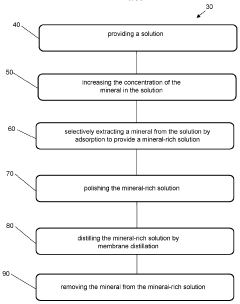
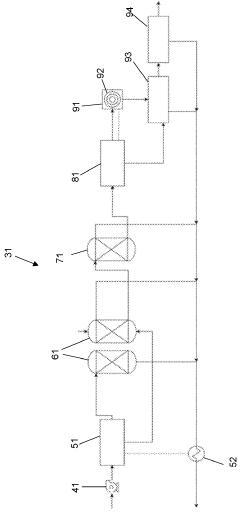
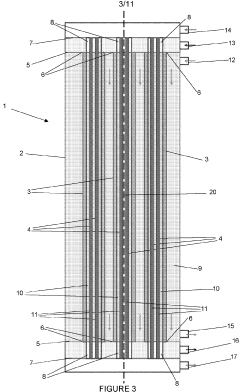
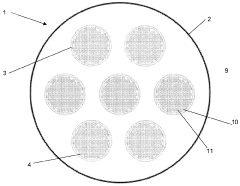
- A method and apparatus utilizing membrane distillation and adsorption to selectively extract lithium from brine by increasing lithium concentration through membrane distillation, followed by crystallization and desorption using a material with selective affinity for lithium, allowing for improved lithium recovery and reduced environmental impact.
Leaching of lithium concentrates
PatentWO2025120255A1
Innovation
- A process that leverages optimized pressure leaching conditions to convert lithium in uncalcined lithium-containing minerals into a partially soluble form, allowing for lithium extraction without the need for calcination or roasting pretreatments, and utilizing short leaching times of less than 30 minutes.


Life Cycle Assessment of DLE Technologies
Life Cycle Assessment (LCA) of Direct Lithium Extraction (DLE) technologies provides critical insights into the environmental impacts across the entire process chain. Current assessments indicate that DLE methods generally demonstrate lower carbon footprints compared to traditional evaporation pond techniques, with potential reductions of 30-60% in greenhouse gas emissions depending on the specific technology employed.
The system boundaries for DLE life cycle assessments typically encompass raw material extraction, chemical reagent production, energy consumption during operation, water usage, waste management, and transportation logistics. Energy consumption remains the dominant contributor to environmental impacts, accounting for approximately 40-65% of the total carbon footprint in most DLE operations.
Comparative analyses between different DLE technologies reveal significant variations in environmental performance. Ion exchange-based systems generally exhibit lower energy requirements (3-7 GJ/tonne Li) compared to membrane-based processes (5-12 GJ/tonne Li), though this advantage may be offset by higher chemical consumption. Adsorption-based technologies demonstrate promising results with moderate energy demands (4-8 GJ/tonne Li) and reduced chemical usage, particularly when utilizing novel selective adsorbents.
Water consumption metrics show that DLE technologies require substantially less water than evaporation ponds, with reductions of up to 90% possible in optimized systems. However, water quality impacts remain a concern, particularly regarding potential contamination from process chemicals and the management of reject brine streams.
Regional variations significantly influence LCA outcomes. DLE operations powered by renewable energy sources demonstrate dramatically lower emissions profiles, with potential reductions of up to 80% compared to fossil fuel-powered equivalents. This highlights the importance of considering local energy grid composition when evaluating environmental performance.
Recent technological innovations, including closed-loop reagent recycling and energy recovery systems, have demonstrated potential to further reduce environmental impacts by 15-25%. These improvements primarily target the most emission-intensive aspects of DLE operations, including heating/cooling cycles and chemical regeneration processes.
Future LCA research priorities should focus on standardizing assessment methodologies specific to lithium extraction, improving data quality for emerging DLE technologies, and developing region-specific impact factors that account for local environmental sensitivities and resource availability.
The system boundaries for DLE life cycle assessments typically encompass raw material extraction, chemical reagent production, energy consumption during operation, water usage, waste management, and transportation logistics. Energy consumption remains the dominant contributor to environmental impacts, accounting for approximately 40-65% of the total carbon footprint in most DLE operations.
Comparative analyses between different DLE technologies reveal significant variations in environmental performance. Ion exchange-based systems generally exhibit lower energy requirements (3-7 GJ/tonne Li) compared to membrane-based processes (5-12 GJ/tonne Li), though this advantage may be offset by higher chemical consumption. Adsorption-based technologies demonstrate promising results with moderate energy demands (4-8 GJ/tonne Li) and reduced chemical usage, particularly when utilizing novel selective adsorbents.
Water consumption metrics show that DLE technologies require substantially less water than evaporation ponds, with reductions of up to 90% possible in optimized systems. However, water quality impacts remain a concern, particularly regarding potential contamination from process chemicals and the management of reject brine streams.
Regional variations significantly influence LCA outcomes. DLE operations powered by renewable energy sources demonstrate dramatically lower emissions profiles, with potential reductions of up to 80% compared to fossil fuel-powered equivalents. This highlights the importance of considering local energy grid composition when evaluating environmental performance.
Recent technological innovations, including closed-loop reagent recycling and energy recovery systems, have demonstrated potential to further reduce environmental impacts by 15-25%. These improvements primarily target the most emission-intensive aspects of DLE operations, including heating/cooling cycles and chemical regeneration processes.
Future LCA research priorities should focus on standardizing assessment methodologies specific to lithium extraction, improving data quality for emerging DLE technologies, and developing region-specific impact factors that account for local environmental sensitivities and resource availability.
Regulatory Framework for Sustainable Lithium Mining
The regulatory landscape for lithium mining is evolving rapidly as governments worldwide recognize the strategic importance of lithium for energy transition while acknowledging environmental concerns. At the international level, the United Nations Framework Convention on Climate Change (UNFCCC) and the Paris Agreement indirectly influence lithium extraction by setting carbon reduction targets that promote cleaner extraction methods. The International Energy Agency (IEA) has established guidelines specifically addressing sustainable mining practices for critical minerals including lithium.
In North America, the United States has recently enacted the Inflation Reduction Act, which provides significant incentives for domestic lithium production while imposing stricter environmental standards. The Environmental Protection Agency (EPA) has developed specific guidelines for Direct Lithium Extraction (DLE) operations, focusing on water usage, chemical handling, and emissions monitoring. Canada has implemented the Critical Minerals Strategy with comprehensive environmental assessment requirements for new lithium projects, particularly emphasizing water conservation in DLE operations.
The European Union has established the European Battery Alliance and the European Raw Materials Alliance, both incorporating regulatory frameworks that prioritize sustainable lithium sourcing. The EU Taxonomy for Sustainable Activities specifically addresses lithium extraction, setting technical screening criteria for operations to be considered environmentally sustainable. These regulations emphasize carbon footprint reduction throughout the supply chain and mandate life-cycle assessments for lithium projects.
In Latin America's "Lithium Triangle" (Argentina, Bolivia, Chile), each country has developed distinct regulatory approaches. Chile has implemented a quota system for lithium extraction with specific environmental performance requirements, including mandatory water recycling in DLE operations. Argentina has decentralized regulations with provincial governments establishing varying sustainability requirements, while Bolivia maintains strict state control over its lithium resources with environmental protection written into its constitution.
Asian markets, particularly China, Japan, and South Korea, have focused regulations on securing lithium supply chains while gradually incorporating sustainability criteria. China's 14th Five-Year Plan includes specific provisions for cleaner lithium processing technologies, with emissions targets for domestic operations and imported materials.
Emerging regulatory trends include carbon border adjustment mechanisms that may impact international lithium trade, standardized sustainability certification schemes for battery materials, and increased requirements for community consultation and benefit-sharing with indigenous populations affected by lithium mining operations.
In North America, the United States has recently enacted the Inflation Reduction Act, which provides significant incentives for domestic lithium production while imposing stricter environmental standards. The Environmental Protection Agency (EPA) has developed specific guidelines for Direct Lithium Extraction (DLE) operations, focusing on water usage, chemical handling, and emissions monitoring. Canada has implemented the Critical Minerals Strategy with comprehensive environmental assessment requirements for new lithium projects, particularly emphasizing water conservation in DLE operations.
The European Union has established the European Battery Alliance and the European Raw Materials Alliance, both incorporating regulatory frameworks that prioritize sustainable lithium sourcing. The EU Taxonomy for Sustainable Activities specifically addresses lithium extraction, setting technical screening criteria for operations to be considered environmentally sustainable. These regulations emphasize carbon footprint reduction throughout the supply chain and mandate life-cycle assessments for lithium projects.
In Latin America's "Lithium Triangle" (Argentina, Bolivia, Chile), each country has developed distinct regulatory approaches. Chile has implemented a quota system for lithium extraction with specific environmental performance requirements, including mandatory water recycling in DLE operations. Argentina has decentralized regulations with provincial governments establishing varying sustainability requirements, while Bolivia maintains strict state control over its lithium resources with environmental protection written into its constitution.
Asian markets, particularly China, Japan, and South Korea, have focused regulations on securing lithium supply chains while gradually incorporating sustainability criteria. China's 14th Five-Year Plan includes specific provisions for cleaner lithium processing technologies, with emissions targets for domestic operations and imported materials.
Emerging regulatory trends include carbon border adjustment mechanisms that may impact international lithium trade, standardized sustainability certification schemes for battery materials, and increased requirements for community consultation and benefit-sharing with indigenous populations affected by lithium mining operations.
Unlock deeper insights with Patsnap Eureka Quick Research — get a full tech report to explore trends and direct your research. Try now!
Generate Your Research Report Instantly with AI Agent
Supercharge your innovation with Patsnap Eureka AI Agent Platform!