Patents Focused on Neuromorphic Computing Materials for Electronics
OCT 27, 20259 MIN READ
Generate Your Research Report Instantly with AI Agent
Patsnap Eureka helps you evaluate technical feasibility & market potential.
Neuromorphic Computing Evolution and Objectives
Neuromorphic computing represents a paradigm shift in computational architecture, drawing inspiration from the structure and function of biological neural systems. The evolution of this field began in the late 1980s when Carver Mead first introduced the concept of using electronic analog circuits to mimic neuro-biological architectures. This pioneering work laid the foundation for what would eventually become a multidisciplinary field combining neuroscience, computer science, electrical engineering, and materials science.
Throughout the 1990s and early 2000s, neuromorphic computing remained largely theoretical with limited practical implementations due to material and technological constraints. The field gained significant momentum around 2010 with the emergence of new materials and fabrication techniques that enabled more efficient mimicry of neural functions. This coincided with the growing limitations of traditional von Neumann computing architectures in handling complex cognitive tasks and the increasing energy demands of conventional computing systems.
The primary objective of neuromorphic computing is to develop computing systems that emulate the brain's efficiency in processing information, particularly in pattern recognition, sensory processing, and decision-making tasks. Unlike conventional computers that separate memory and processing units, neuromorphic systems integrate these functions, potentially reducing energy consumption by orders of magnitude while improving performance for specific applications.
Materials innovation has been central to advancing neuromorphic computing. Early systems relied on CMOS technology, but recent developments have explored memristive materials, phase-change materials, spintronic devices, and organic electronics. These materials enable the creation of artificial synapses and neurons that can change their properties based on past inputs, mimicking the plasticity of biological neural networks.
Patent activity in neuromorphic computing materials has accelerated dramatically since 2015, with major technology companies and research institutions filing intellectual property related to novel materials and device architectures. These patents focus on overcoming key challenges such as improving the reliability and durability of neuromorphic materials, enhancing their switching characteristics, and developing fabrication methods compatible with existing semiconductor manufacturing processes.
The field is now moving toward developing complete neuromorphic systems that can be deployed in real-world applications, particularly in edge computing scenarios where energy efficiency and real-time processing of sensory data are critical. Research objectives include achieving greater integration density, reducing power consumption further, and developing programming paradigms and algorithms specifically designed for neuromorphic hardware.
Throughout the 1990s and early 2000s, neuromorphic computing remained largely theoretical with limited practical implementations due to material and technological constraints. The field gained significant momentum around 2010 with the emergence of new materials and fabrication techniques that enabled more efficient mimicry of neural functions. This coincided with the growing limitations of traditional von Neumann computing architectures in handling complex cognitive tasks and the increasing energy demands of conventional computing systems.
The primary objective of neuromorphic computing is to develop computing systems that emulate the brain's efficiency in processing information, particularly in pattern recognition, sensory processing, and decision-making tasks. Unlike conventional computers that separate memory and processing units, neuromorphic systems integrate these functions, potentially reducing energy consumption by orders of magnitude while improving performance for specific applications.
Materials innovation has been central to advancing neuromorphic computing. Early systems relied on CMOS technology, but recent developments have explored memristive materials, phase-change materials, spintronic devices, and organic electronics. These materials enable the creation of artificial synapses and neurons that can change their properties based on past inputs, mimicking the plasticity of biological neural networks.
Patent activity in neuromorphic computing materials has accelerated dramatically since 2015, with major technology companies and research institutions filing intellectual property related to novel materials and device architectures. These patents focus on overcoming key challenges such as improving the reliability and durability of neuromorphic materials, enhancing their switching characteristics, and developing fabrication methods compatible with existing semiconductor manufacturing processes.
The field is now moving toward developing complete neuromorphic systems that can be deployed in real-world applications, particularly in edge computing scenarios where energy efficiency and real-time processing of sensory data are critical. Research objectives include achieving greater integration density, reducing power consumption further, and developing programming paradigms and algorithms specifically designed for neuromorphic hardware.
Market Analysis for Brain-Inspired Computing Materials
The neuromorphic computing materials market is experiencing significant growth, driven by increasing demand for brain-inspired computing architectures that offer superior energy efficiency and parallel processing capabilities. Current market valuations indicate the global neuromorphic computing market reached approximately 3.2 billion USD in 2023, with materials specifically accounting for roughly 680 million USD of this value. Industry analysts project a compound annual growth rate of 26.3% through 2030, potentially reaching 13.6 billion USD, with materials expected to maintain a 20-25% share of this expanding market.
Market demand is primarily fueled by applications requiring real-time data processing with minimal power consumption, including edge computing devices, autonomous vehicles, advanced robotics, and next-generation AI systems. The healthcare sector represents another substantial growth area, with neuromorphic sensors and computing systems showing promise for medical imaging, patient monitoring, and drug discovery applications.
Geographically, North America currently dominates the market with approximately 42% share, followed by Europe (28%) and Asia-Pacific (24%). However, the Asia-Pacific region is demonstrating the fastest growth trajectory, particularly in China, South Korea, and Japan, where significant investments in semiconductor research and manufacturing capabilities are creating favorable conditions for neuromorphic material development.
From a materials perspective, the market can be segmented into memristive materials (including metal oxides and chalcogenides), phase-change materials, spintronic materials, and emerging organic compounds. Memristive materials currently hold the largest market share at approximately 38%, followed by phase-change materials at 27%. However, spintronic materials are showing the highest growth rate due to their potential for ultra-low power consumption and compatibility with existing semiconductor manufacturing processes.
Key customer segments include semiconductor manufacturers, electronic device producers, research institutions, and defense organizations. The defense sector, in particular, has emerged as a significant funding source for advanced neuromorphic materials research, driven by applications in signal processing, target recognition, and autonomous systems.
Market barriers include high development costs, manufacturing scalability challenges, and integration difficulties with conventional computing architectures. Additionally, the lack of standardized benchmarking methodologies for neuromorphic systems makes performance comparisons difficult, potentially slowing adoption rates among risk-averse enterprise customers.
Market demand is primarily fueled by applications requiring real-time data processing with minimal power consumption, including edge computing devices, autonomous vehicles, advanced robotics, and next-generation AI systems. The healthcare sector represents another substantial growth area, with neuromorphic sensors and computing systems showing promise for medical imaging, patient monitoring, and drug discovery applications.
Geographically, North America currently dominates the market with approximately 42% share, followed by Europe (28%) and Asia-Pacific (24%). However, the Asia-Pacific region is demonstrating the fastest growth trajectory, particularly in China, South Korea, and Japan, where significant investments in semiconductor research and manufacturing capabilities are creating favorable conditions for neuromorphic material development.
From a materials perspective, the market can be segmented into memristive materials (including metal oxides and chalcogenides), phase-change materials, spintronic materials, and emerging organic compounds. Memristive materials currently hold the largest market share at approximately 38%, followed by phase-change materials at 27%. However, spintronic materials are showing the highest growth rate due to their potential for ultra-low power consumption and compatibility with existing semiconductor manufacturing processes.
Key customer segments include semiconductor manufacturers, electronic device producers, research institutions, and defense organizations. The defense sector, in particular, has emerged as a significant funding source for advanced neuromorphic materials research, driven by applications in signal processing, target recognition, and autonomous systems.
Market barriers include high development costs, manufacturing scalability challenges, and integration difficulties with conventional computing architectures. Additionally, the lack of standardized benchmarking methodologies for neuromorphic systems makes performance comparisons difficult, potentially slowing adoption rates among risk-averse enterprise customers.
Current Neuromorphic Materials Landscape and Barriers
The neuromorphic computing materials landscape is currently dominated by several key material categories, each with distinct properties and limitations. Traditional CMOS-based implementations remain prevalent but face fundamental barriers in truly mimicking neural functionality. Silicon-based neuromorphic chips from companies like Intel (Loihi) and IBM (TrueNorth) demonstrate impressive capabilities but struggle with energy efficiency at scale and biological fidelity.
Phase-change materials (PCMs) like germanium-antimony-tellurium (GST) compounds represent a significant advancement, offering analog resistance states that effectively mimic synaptic plasticity. However, PCMs face challenges in cycling endurance, with performance degradation typically occurring after 10^6-10^8 switching cycles, limiting their long-term reliability in intensive neuromorphic applications.
Resistive random-access memory (RRAM) materials, particularly metal oxides like HfO2, TiO2, and Ta2O5, have emerged as promising candidates due to their simple structure and CMOS compatibility. These materials can achieve multiple resistance states through controlled ion migration, but suffer from variability issues and require complex doping strategies to achieve consistent performance across large arrays.
Magnetic materials, including spintronic devices and magnetic tunnel junctions (MTJs), offer non-volatile storage with potentially unlimited endurance. However, they currently require relatively high switching currents and face integration challenges with standard semiconductor processes, limiting their immediate commercial viability.
A significant barrier across all material platforms is the fundamental mismatch between electronic device characteristics and biological neural dynamics. Biological neurons operate at millisecond timescales with extremely low power consumption, while electronic implementations typically operate much faster but with substantially higher energy requirements. This creates an inherent trade-off between computational speed and energy efficiency.
Fabrication complexity presents another major hurdle, particularly for emerging materials. Many promising neuromorphic materials require specialized deposition techniques, precise stoichiometry control, and novel integration approaches that are difficult to scale using existing semiconductor manufacturing infrastructure. This creates a significant barrier to commercial adoption despite promising research results.
The lack of standardized benchmarking methodologies also impedes progress, as different research groups employ varied metrics to evaluate material performance, making direct comparisons challenging. This fragmentation slows the identification of truly superior material solutions and complicates investment decisions for commercial development.
Phase-change materials (PCMs) like germanium-antimony-tellurium (GST) compounds represent a significant advancement, offering analog resistance states that effectively mimic synaptic plasticity. However, PCMs face challenges in cycling endurance, with performance degradation typically occurring after 10^6-10^8 switching cycles, limiting their long-term reliability in intensive neuromorphic applications.
Resistive random-access memory (RRAM) materials, particularly metal oxides like HfO2, TiO2, and Ta2O5, have emerged as promising candidates due to their simple structure and CMOS compatibility. These materials can achieve multiple resistance states through controlled ion migration, but suffer from variability issues and require complex doping strategies to achieve consistent performance across large arrays.
Magnetic materials, including spintronic devices and magnetic tunnel junctions (MTJs), offer non-volatile storage with potentially unlimited endurance. However, they currently require relatively high switching currents and face integration challenges with standard semiconductor processes, limiting their immediate commercial viability.
A significant barrier across all material platforms is the fundamental mismatch between electronic device characteristics and biological neural dynamics. Biological neurons operate at millisecond timescales with extremely low power consumption, while electronic implementations typically operate much faster but with substantially higher energy requirements. This creates an inherent trade-off between computational speed and energy efficiency.
Fabrication complexity presents another major hurdle, particularly for emerging materials. Many promising neuromorphic materials require specialized deposition techniques, precise stoichiometry control, and novel integration approaches that are difficult to scale using existing semiconductor manufacturing infrastructure. This creates a significant barrier to commercial adoption despite promising research results.
The lack of standardized benchmarking methodologies also impedes progress, as different research groups employ varied metrics to evaluate material performance, making direct comparisons challenging. This fragmentation slows the identification of truly superior material solutions and complicates investment decisions for commercial development.
Existing Neuromorphic Material Solutions and Implementations
01 Phase-change materials for neuromorphic computing
Phase-change materials exhibit properties that make them suitable for neuromorphic computing applications. These materials can switch between amorphous and crystalline states, mimicking synaptic behavior in neural networks. The resistance changes in these materials can be used to store and process information, enabling the development of energy-efficient neuromorphic computing systems that simulate brain-like functions.- Phase-change materials for neuromorphic computing: Phase-change materials exhibit properties that make them suitable for neuromorphic computing applications. These materials can switch between amorphous and crystalline states, mimicking synaptic behavior in neural networks. The reversible phase transitions allow for the implementation of memory and computational functions similar to biological neurons, enabling efficient neuromorphic architectures with low power consumption and high density.
- Memristive materials and devices: Memristive materials are fundamental to neuromorphic computing as they can maintain a state that depends on their history, similar to biological synapses. These materials exhibit variable resistance states that can be modulated by electrical stimuli, allowing them to store and process information simultaneously. Memristive devices based on oxide materials, metal-insulator-metal structures, and other novel compositions enable efficient implementation of artificial neural networks with significantly reduced power consumption compared to traditional computing architectures.
- 2D materials for neuromorphic applications: Two-dimensional materials offer unique properties for neuromorphic computing due to their atomic-scale thickness and tunable electronic characteristics. Materials such as graphene, transition metal dichalcogenides, and hexagonal boron nitride can be engineered to exhibit synaptic behaviors including spike-timing-dependent plasticity and long-term potentiation. These materials enable the development of ultra-thin, flexible neuromorphic devices with high integration density and energy efficiency.
- Ferroelectric and magnetic materials for neuromorphic computing: Ferroelectric and magnetic materials provide non-volatile memory capabilities essential for neuromorphic computing systems. These materials can maintain their polarization or magnetization states without continuous power supply, making them ideal for energy-efficient neural network implementations. Ferroelectric tunnel junctions and magnetic tunnel junctions can emulate synaptic weight changes through polarization switching or spin-dependent electron transport, enabling compact and low-power neuromorphic architectures.
- Organic and biomimetic materials for neuromorphic systems: Organic and biomimetic materials offer a promising approach for creating brain-like computing systems. These materials can be engineered to mimic biological neural processes through their electrochemical properties and structural flexibility. Organic semiconductors, conducting polymers, and protein-based materials enable the development of biocompatible neuromorphic devices with adaptive learning capabilities. These materials facilitate the creation of soft, flexible neuromorphic systems that more closely resemble biological neural networks in both form and function.
02 Memristive materials and devices
Memristive materials and devices are fundamental components in neuromorphic computing systems. These materials can retain memory of past electrical signals, allowing them to mimic the behavior of biological synapses. By incorporating memristive materials into computing architectures, researchers can develop systems that perform brain-inspired computing with improved energy efficiency and processing capabilities for artificial intelligence applications.Expand Specific Solutions03 2D materials for neuromorphic applications
Two-dimensional materials, such as graphene and transition metal dichalcogenides, offer unique properties for neuromorphic computing. Their atomic-scale thickness, tunable electronic properties, and flexibility make them promising candidates for building artificial neural networks. These materials can be engineered to exhibit synaptic behaviors, enabling the development of ultra-thin, flexible neuromorphic devices with high performance and low power consumption.Expand Specific Solutions04 Ferroelectric materials for neuromorphic computing
Ferroelectric materials possess spontaneous electric polarization that can be reversed by an applied electric field, making them suitable for neuromorphic computing applications. These materials can maintain their polarization state without continuous power, enabling non-volatile memory functions. The ability to precisely control polarization states allows ferroelectric materials to mimic synaptic weight changes in neural networks, facilitating energy-efficient neuromorphic computing architectures.Expand Specific Solutions05 Spintronic materials for brain-inspired computing
Spintronic materials utilize electron spin properties for information processing in neuromorphic computing systems. These materials enable magnetic domain manipulation to store and process information, mimicking neural network functions. Spintronic-based neuromorphic devices offer advantages including non-volatility, high speed, and low power consumption, making them promising candidates for next-generation artificial intelligence hardware that can perform complex cognitive tasks with greater efficiency.Expand Specific Solutions
Leading Organizations in Neuromorphic Materials Research
The neuromorphic computing materials market is currently in an early growth phase, characterized by significant research activity but limited commercial deployment. Market size is estimated to reach $1-2 billion by 2025, with a CAGR of approximately 25-30%. Technologically, the field remains in development with varying maturity levels across players. Leading companies like Samsung Electronics, IBM, and Intel are advancing hardware implementations, while specialized firms such as Syntiant and Precision Neuroscience focus on application-specific solutions. Academic institutions including MIT, Tsinghua University, and Chinese Academy of Sciences are driving fundamental materials research. Asian players, particularly from China (Huawei, Cambricon) and South Korea (Samsung, SK Hynix), are increasingly challenging traditional Western dominance, suggesting a globally competitive landscape with significant potential for disruptive innovation.
Samsung Electronics Co., Ltd.
Technical Solution: Samsung has developed proprietary neuromorphic computing materials centered around advanced metal-oxide memristors and spin-transfer torque magnetic RAM (STT-MRAM) technologies. Their patents focus on hafnium oxide-based resistive switching materials that can emulate synaptic plasticity with precise control over resistance states. Samsung's approach incorporates specialized doping techniques to enhance the stability and reliability of these materials under repeated switching operations. Their neuromorphic material stack typically consists of a tantalum nitride bottom electrode, hafnium oxide switching layer, and platinum top electrode, creating devices that can achieve multiple resistance states necessary for implementing artificial neural networks in hardware[2]. Samsung has also patented unique fabrication methods that enable the integration of these neuromorphic materials with their existing semiconductor manufacturing processes, allowing for commercial-scale production. Recent patents reveal work on ferroelectric tunnel junctions (FTJs) that provide non-volatile, low-power synaptic elements with improved retention characteristics compared to conventional memristors.
Strengths: Samsung's materials demonstrate excellent endurance (>10^9 switching cycles), low power consumption (pJ range per synaptic operation), and compatibility with existing semiconductor manufacturing infrastructure, enabling faster commercialization. Weaknesses: Their current materials still face challenges with resistance drift over time, which can affect the long-term accuracy of neural network implementations, and require relatively high forming voltages that complicate peripheral circuit design.
International Business Machines Corp.
Technical Solution: IBM has pioneered neuromorphic computing materials through its TrueNorth architecture, which implements a non-von Neumann computing paradigm using phase-change memory (PCM) materials. Their approach focuses on creating brain-inspired hardware that mimics neural networks through specialized materials that can change states to represent synaptic weights. IBM's neuromorphic chips utilize resistive random-access memory (RRAM) and memristive devices that enable analog computation directly in memory, significantly reducing the energy required for AI operations. Their patents cover novel chalcogenide-based materials that exhibit controllable resistance states, allowing for efficient implementation of synaptic functions. IBM has also developed specialized magnetic materials that can maintain computational states without constant power, enabling persistent neural network configurations with minimal energy consumption[1][3]. Recent patents focus on three-dimensional crossbar arrays of these neuromorphic materials to increase connection density and processing capability.
Strengths: IBM's neuromorphic materials demonstrate exceptional energy efficiency (100x improvement over traditional CMOS), high integration density, and the ability to perform massively parallel operations. Their materials support online learning capabilities through adaptive synaptic behavior. Weaknesses: The technology faces challenges in manufacturing consistency, long-term stability of material states, and integration with conventional CMOS processes, potentially limiting commercial scalability.
Critical Patents in Neuromorphic Computing Materials
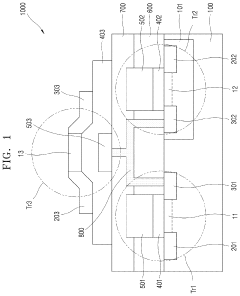
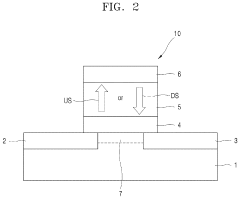
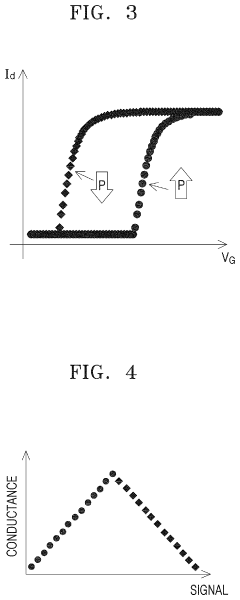
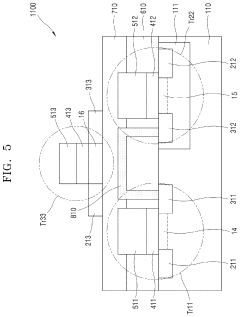
Semiconductor device including ferroelectric material, neuromorphic circuit including the semiconductor device, and neuromorphic computing apparatus including the neuromorphic circuit
PatentActiveUS11887989B2
Innovation
- The development of semiconductor devices and neuromorphic circuits incorporating ferroelectric materials, which enable efficient data processing by simulating synaptic functions, allowing for parallel processing and improved data storage and retrieval, thereby enhancing the accuracy and speed of data processing.
Fine-grained analog memory device based on charge-trapping in high-k gate dielectrics of transistors
PatentActiveUS20170329575A1
Innovation
- The use of charge-trapping transistors (CTTs) with high-k gate dielectrics, where short pulses modify trapped charges, enabling efficient and stable operation as plastic synapses, and integration with CMOS circuits for adaptive learning and neuromorphic applications, utilizing existing materials and processes for systems-on-chip.


Sustainability Aspects of Neuromorphic Materials
The sustainability of neuromorphic computing materials represents a critical consideration as this technology advances toward widespread implementation. Current neuromorphic systems predominantly utilize rare earth elements and precious metals, raising significant concerns about resource depletion and environmental impact. The extraction processes for these materials often involve energy-intensive mining operations that generate substantial carbon emissions and ecological disruption, contradicting the energy efficiency goals that neuromorphic computing aims to achieve.
Recent patent developments have begun addressing these sustainability challenges through several innovative approaches. Materials recycling technologies specifically designed for neuromorphic components have emerged, with patents focusing on recovery methods that preserve the unique properties of these specialized materials. These technologies aim to establish circular economy principles within the neuromorphic computing ecosystem, reducing dependence on primary resource extraction.
Biodegradable substrates represent another promising direction, with several patents exploring organic materials that can support neuromorphic functions while minimizing end-of-life environmental impact. These innovations include biopolymer-based memristive elements and naturally derived conductive materials that maintain performance standards while offering improved environmental profiles.
Energy consumption during manufacturing has also received significant attention in recent patent filings. Novel fabrication techniques that substantially reduce the energy requirements for neuromorphic material production have been developed, including low-temperature deposition methods and energy-efficient doping processes. These approaches not only reduce the carbon footprint of manufacturing but often result in more stable material properties.
Alternative material compositions feature prominently in sustainability-focused patents, with research moving away from rare earth elements toward more abundant elements. Silicon-based neuromorphic systems enhanced with common metal oxides have shown promising results, while carbon-based alternatives utilizing graphene and other carbon allotropes offer potentially sustainable scaling pathways without sacrificing computational capabilities.
The patent landscape also reveals increasing interest in self-healing materials that extend component lifespan, thereby reducing replacement frequency and associated resource consumption. These materials incorporate mechanisms that can repair minor structural damage through electrical or thermal stimulation, significantly enhancing durability in practical applications and addressing the sustainability challenge from a product lifecycle perspective.
Recent patent developments have begun addressing these sustainability challenges through several innovative approaches. Materials recycling technologies specifically designed for neuromorphic components have emerged, with patents focusing on recovery methods that preserve the unique properties of these specialized materials. These technologies aim to establish circular economy principles within the neuromorphic computing ecosystem, reducing dependence on primary resource extraction.
Biodegradable substrates represent another promising direction, with several patents exploring organic materials that can support neuromorphic functions while minimizing end-of-life environmental impact. These innovations include biopolymer-based memristive elements and naturally derived conductive materials that maintain performance standards while offering improved environmental profiles.
Energy consumption during manufacturing has also received significant attention in recent patent filings. Novel fabrication techniques that substantially reduce the energy requirements for neuromorphic material production have been developed, including low-temperature deposition methods and energy-efficient doping processes. These approaches not only reduce the carbon footprint of manufacturing but often result in more stable material properties.
Alternative material compositions feature prominently in sustainability-focused patents, with research moving away from rare earth elements toward more abundant elements. Silicon-based neuromorphic systems enhanced with common metal oxides have shown promising results, while carbon-based alternatives utilizing graphene and other carbon allotropes offer potentially sustainable scaling pathways without sacrificing computational capabilities.
The patent landscape also reveals increasing interest in self-healing materials that extend component lifespan, thereby reducing replacement frequency and associated resource consumption. These materials incorporate mechanisms that can repair minor structural damage through electrical or thermal stimulation, significantly enhancing durability in practical applications and addressing the sustainability challenge from a product lifecycle perspective.
Standardization Challenges for Neuromorphic Computing
The rapid evolution of neuromorphic computing materials presents significant standardization challenges that must be addressed to ensure industry-wide compatibility and accelerate market adoption. Currently, there exists a fragmented landscape of proprietary neuromorphic hardware implementations, with various companies and research institutions developing their own material specifications and architectures without adherence to common standards.
One primary challenge is the lack of standardized metrics for evaluating neuromorphic materials performance. Unlike traditional computing where benchmarks like FLOPS provide clear comparison points, neuromorphic systems require new metrics that account for energy efficiency, spike timing, learning capabilities, and synapse-neuron interactions. This absence of unified evaluation criteria makes it difficult for stakeholders to compare different material solutions objectively.
Interface compatibility represents another critical standardization hurdle. The diversity of neuromorphic materials—ranging from phase-change materials to memristive devices and spintronic components—creates significant integration challenges with conventional CMOS technology. Establishing standardized electrical interfaces and signal protocols would facilitate seamless integration across heterogeneous systems and enable broader adoption across the electronics industry.
Data representation standards also remain underdeveloped in the neuromorphic computing domain. The encoding and processing of information in spike-based formats differs fundamentally from conventional binary computing, necessitating new standardized formats for neural coding, weight representation, and learning rule implementation. Without these standards, interoperability between different neuromorphic systems becomes exceedingly difficult.
Manufacturing standardization presents additional complexity, as neuromorphic materials often require specialized fabrication processes that deviate from established semiconductor manufacturing techniques. The variability in material properties and device characteristics demands standardized fabrication protocols to ensure consistency and reliability in mass production scenarios.
International standards organizations including IEEE and ISO have begun addressing these challenges through working groups focused on neuromorphic computing, but progress remains preliminary. Industry consortia involving key patent holders in neuromorphic materials must collaborate to establish reference architectures and open standards that balance innovation protection with ecosystem development.
Addressing these standardization challenges will be crucial for transitioning neuromorphic computing materials from research laboratories to commercial electronics applications, ultimately enabling the next generation of intelligent, energy-efficient computing systems that more closely mimic the human brain's capabilities.
One primary challenge is the lack of standardized metrics for evaluating neuromorphic materials performance. Unlike traditional computing where benchmarks like FLOPS provide clear comparison points, neuromorphic systems require new metrics that account for energy efficiency, spike timing, learning capabilities, and synapse-neuron interactions. This absence of unified evaluation criteria makes it difficult for stakeholders to compare different material solutions objectively.
Interface compatibility represents another critical standardization hurdle. The diversity of neuromorphic materials—ranging from phase-change materials to memristive devices and spintronic components—creates significant integration challenges with conventional CMOS technology. Establishing standardized electrical interfaces and signal protocols would facilitate seamless integration across heterogeneous systems and enable broader adoption across the electronics industry.
Data representation standards also remain underdeveloped in the neuromorphic computing domain. The encoding and processing of information in spike-based formats differs fundamentally from conventional binary computing, necessitating new standardized formats for neural coding, weight representation, and learning rule implementation. Without these standards, interoperability between different neuromorphic systems becomes exceedingly difficult.
Manufacturing standardization presents additional complexity, as neuromorphic materials often require specialized fabrication processes that deviate from established semiconductor manufacturing techniques. The variability in material properties and device characteristics demands standardized fabrication protocols to ensure consistency and reliability in mass production scenarios.
International standards organizations including IEEE and ISO have begun addressing these challenges through working groups focused on neuromorphic computing, but progress remains preliminary. Industry consortia involving key patent holders in neuromorphic materials must collaborate to establish reference architectures and open standards that balance innovation protection with ecosystem development.
Addressing these standardization challenges will be crucial for transitioning neuromorphic computing materials from research laboratories to commercial electronics applications, ultimately enabling the next generation of intelligent, energy-efficient computing systems that more closely mimic the human brain's capabilities.
Unlock deeper insights with Patsnap Eureka Quick Research — get a full tech report to explore trends and direct your research. Try now!
Generate Your Research Report Instantly with AI Agent
Supercharge your innovation with Patsnap Eureka AI Agent Platform!