

Quantum Interconnects: Regulatory and Standardization Challenges
SEP 29, 202510 MIN READ
Generate Your Research Report Instantly with AI Agent
PatSnap Eureka helps you evaluate technical feasibility & market potential.
Quantum Interconnect Evolution and Objectives
Quantum interconnects represent a critical infrastructure component for the future of quantum computing and quantum information networks. The evolution of quantum interconnect technology can be traced back to the early theoretical work on quantum entanglement in the 1930s, though practical implementations only began to emerge in the late 1990s with the first successful quantum teleportation experiments. Since then, the field has progressed through several key developmental phases, from proof-of-concept demonstrations to increasingly sophisticated implementations across various physical platforms.
The technological trajectory has been shaped by advances in multiple domains, including photonics, superconducting circuits, trapped ions, and spin qubits. Early quantum interconnect solutions focused primarily on short-distance connections within laboratory environments, while current research aims to extend these capabilities to metropolitan and eventually global scales. This evolution reflects the growing recognition that quantum networks will require robust interconnection technologies that can maintain quantum coherence across diverse physical implementations and transmission media.
Recent breakthroughs in quantum repeater technology, entanglement distribution, and quantum memory have accelerated progress toward practical quantum interconnects. The development of hybrid quantum systems that leverage the strengths of different physical platforms has emerged as a particularly promising approach for overcoming the inherent limitations of any single quantum technology. These advances suggest that quantum interconnects are transitioning from purely academic research to early-stage technological development with commercial potential.
The primary objectives for quantum interconnect technology development include achieving higher fidelity quantum state transfer, extending coherence times, increasing bandwidth, and ensuring compatibility between heterogeneous quantum systems. Additionally, there is growing emphasis on developing quantum interconnects that can interface effectively with classical computing infrastructure, recognizing that hybrid classical-quantum systems will dominate the near to medium-term landscape.
Standardization represents a crucial objective for the quantum interconnect community, as the establishment of common protocols and interfaces will be essential for creating interoperable quantum networks. This standardization effort faces unique challenges due to the diversity of physical implementations and the rapidly evolving nature of the underlying technologies. Regulatory frameworks must also evolve to address the novel security implications, spectrum allocation requirements, and international governance considerations that quantum interconnects introduce.
The long-term vision for quantum interconnects encompasses the creation of a global quantum internet capable of supporting distributed quantum computing, secure communications, and novel applications that leverage uniquely quantum resources such as entanglement. Achieving this vision will require sustained investment in fundamental research, engineering development, and the creation of appropriate regulatory and standardization frameworks.
The technological trajectory has been shaped by advances in multiple domains, including photonics, superconducting circuits, trapped ions, and spin qubits. Early quantum interconnect solutions focused primarily on short-distance connections within laboratory environments, while current research aims to extend these capabilities to metropolitan and eventually global scales. This evolution reflects the growing recognition that quantum networks will require robust interconnection technologies that can maintain quantum coherence across diverse physical implementations and transmission media.
Recent breakthroughs in quantum repeater technology, entanglement distribution, and quantum memory have accelerated progress toward practical quantum interconnects. The development of hybrid quantum systems that leverage the strengths of different physical platforms has emerged as a particularly promising approach for overcoming the inherent limitations of any single quantum technology. These advances suggest that quantum interconnects are transitioning from purely academic research to early-stage technological development with commercial potential.
The primary objectives for quantum interconnect technology development include achieving higher fidelity quantum state transfer, extending coherence times, increasing bandwidth, and ensuring compatibility between heterogeneous quantum systems. Additionally, there is growing emphasis on developing quantum interconnects that can interface effectively with classical computing infrastructure, recognizing that hybrid classical-quantum systems will dominate the near to medium-term landscape.
Standardization represents a crucial objective for the quantum interconnect community, as the establishment of common protocols and interfaces will be essential for creating interoperable quantum networks. This standardization effort faces unique challenges due to the diversity of physical implementations and the rapidly evolving nature of the underlying technologies. Regulatory frameworks must also evolve to address the novel security implications, spectrum allocation requirements, and international governance considerations that quantum interconnects introduce.
The long-term vision for quantum interconnects encompasses the creation of a global quantum internet capable of supporting distributed quantum computing, secure communications, and novel applications that leverage uniquely quantum resources such as entanglement. Achieving this vision will require sustained investment in fundamental research, engineering development, and the creation of appropriate regulatory and standardization frameworks.
Market Demand Analysis for Quantum Communication Networks
The quantum communication market is experiencing unprecedented growth, driven by escalating cybersecurity concerns and the looming threat of quantum computers breaking classical encryption. Current market projections indicate the global quantum communication market will reach approximately $3.2 billion by 2030, with a compound annual growth rate exceeding 23% from 2023 to 2030. This remarkable growth trajectory reflects the critical importance of quantum-secure communications in an increasingly vulnerable digital landscape.
Financial institutions represent the most urgent market segment demanding quantum communication networks, as they face imminent threats to transaction security and data protection. Banking systems worldwide are actively exploring quantum key distribution (QKD) implementations to safeguard financial data transfers. Several major banks in Europe and Asia have already initiated pilot programs integrating quantum communication protocols into their security infrastructure.
Government and defense sectors constitute another significant market driver, with national security agencies investing heavily in quantum communication infrastructure. China's quantum satellite program and the European Quantum Communication Infrastructure initiative exemplify large-scale government commitments, with combined investments exceeding $15 billion over the next decade.
Healthcare organizations handling sensitive patient data represent an emerging market segment with substantial growth potential. As healthcare systems digitize and share more patient information across networks, quantum-secure communication becomes essential for regulatory compliance and data protection. Market analysis indicates healthcare quantum communication applications could grow at 27% annually through 2028.
Telecommunications providers are positioning themselves as both implementers and service providers in the quantum communication ecosystem. Major telecom companies are developing quantum network services to offer to enterprise clients, creating a secondary market for quantum communication as a service (QCaaS). This business model is projected to capture 40% of the total quantum communication market by 2028.
The industrial sector, particularly critical infrastructure operators in energy, transportation, and manufacturing, shows increasing demand for quantum-secure communication networks to protect operational technology systems from sophisticated cyber threats. These sectors require specialized quantum interconnect solutions that can integrate with existing industrial control systems while providing quantum-level security.
Regional market analysis reveals Asia-Pacific leading in quantum communication network deployment, followed by North America and Europe. China's significant government backing has accelerated market development in the region, while North American growth is primarily driven by private sector investment in quantum communication startups and research initiatives.
Financial institutions represent the most urgent market segment demanding quantum communication networks, as they face imminent threats to transaction security and data protection. Banking systems worldwide are actively exploring quantum key distribution (QKD) implementations to safeguard financial data transfers. Several major banks in Europe and Asia have already initiated pilot programs integrating quantum communication protocols into their security infrastructure.
Government and defense sectors constitute another significant market driver, with national security agencies investing heavily in quantum communication infrastructure. China's quantum satellite program and the European Quantum Communication Infrastructure initiative exemplify large-scale government commitments, with combined investments exceeding $15 billion over the next decade.
Healthcare organizations handling sensitive patient data represent an emerging market segment with substantial growth potential. As healthcare systems digitize and share more patient information across networks, quantum-secure communication becomes essential for regulatory compliance and data protection. Market analysis indicates healthcare quantum communication applications could grow at 27% annually through 2028.
Telecommunications providers are positioning themselves as both implementers and service providers in the quantum communication ecosystem. Major telecom companies are developing quantum network services to offer to enterprise clients, creating a secondary market for quantum communication as a service (QCaaS). This business model is projected to capture 40% of the total quantum communication market by 2028.
The industrial sector, particularly critical infrastructure operators in energy, transportation, and manufacturing, shows increasing demand for quantum-secure communication networks to protect operational technology systems from sophisticated cyber threats. These sectors require specialized quantum interconnect solutions that can integrate with existing industrial control systems while providing quantum-level security.
Regional market analysis reveals Asia-Pacific leading in quantum communication network deployment, followed by North America and Europe. China's significant government backing has accelerated market development in the region, while North American growth is primarily driven by private sector investment in quantum communication startups and research initiatives.
Current Quantum Interconnect Limitations and Barriers
Quantum interconnects face significant technical limitations that currently impede the development of scalable quantum networks. The primary challenge lies in maintaining quantum coherence during information transfer between quantum systems. Quantum states are extremely fragile and susceptible to decoherence from environmental interactions, resulting in information loss. This fundamental issue becomes more pronounced as transmission distances increase, creating a significant barrier to long-distance quantum communication.
The absence of standardized interfaces between different quantum technologies presents another major obstacle. Current quantum systems utilize diverse physical implementations—including superconducting qubits, trapped ions, and photonic systems—each operating under different principles and requirements. This heterogeneity complicates the development of universal interconnect solutions that can seamlessly bridge these disparate quantum platforms, hindering interoperability in quantum networks.
Material limitations further constrain quantum interconnect development. Quantum interconnects require materials with exceptional properties, such as ultra-low loss for photonic channels or perfect superconductivity for certain interfaces. Manufacturing these materials with the necessary precision and purity remains challenging, often resulting in performance degradation that undermines quantum information integrity during transmission.
Scalability represents perhaps the most significant barrier to practical quantum networks. Current laboratory demonstrations typically involve small numbers of qubits or limited distances. Scaling these systems to the thousands or millions of interconnected qubits necessary for practical quantum computing applications introduces exponential complexity in maintaining coherence and managing quantum state transfer across the network.
Technical challenges extend to the integration of classical and quantum systems. Quantum interconnects must interface with classical control electronics and communication infrastructure, requiring precise signal conversion between quantum and classical domains without disrupting delicate quantum states. This quantum-classical boundary presents unique engineering challenges that have not been fully resolved.
Measurement and verification of quantum interconnect performance pose additional difficulties. Unlike classical interconnects where bit error rates provide clear performance metrics, quantum interconnects require sophisticated characterization techniques such as quantum state tomography or entanglement verification. These procedures are resource-intensive and difficult to standardize across different quantum technologies, complicating quality assessment and performance comparison.
The current limitations in quantum repeater technology also restrict the practical range of quantum networks. Without effective quantum repeaters to amplify and refresh quantum signals without measurement, the distance over which quantum information can be reliably transmitted remains severely limited, typically to tens or hundreds of kilometers using current fiber optic technologies.
The absence of standardized interfaces between different quantum technologies presents another major obstacle. Current quantum systems utilize diverse physical implementations—including superconducting qubits, trapped ions, and photonic systems—each operating under different principles and requirements. This heterogeneity complicates the development of universal interconnect solutions that can seamlessly bridge these disparate quantum platforms, hindering interoperability in quantum networks.
Material limitations further constrain quantum interconnect development. Quantum interconnects require materials with exceptional properties, such as ultra-low loss for photonic channels or perfect superconductivity for certain interfaces. Manufacturing these materials with the necessary precision and purity remains challenging, often resulting in performance degradation that undermines quantum information integrity during transmission.
Scalability represents perhaps the most significant barrier to practical quantum networks. Current laboratory demonstrations typically involve small numbers of qubits or limited distances. Scaling these systems to the thousands or millions of interconnected qubits necessary for practical quantum computing applications introduces exponential complexity in maintaining coherence and managing quantum state transfer across the network.
Technical challenges extend to the integration of classical and quantum systems. Quantum interconnects must interface with classical control electronics and communication infrastructure, requiring precise signal conversion between quantum and classical domains without disrupting delicate quantum states. This quantum-classical boundary presents unique engineering challenges that have not been fully resolved.
Measurement and verification of quantum interconnect performance pose additional difficulties. Unlike classical interconnects where bit error rates provide clear performance metrics, quantum interconnects require sophisticated characterization techniques such as quantum state tomography or entanglement verification. These procedures are resource-intensive and difficult to standardize across different quantum technologies, complicating quality assessment and performance comparison.
The current limitations in quantum repeater technology also restrict the practical range of quantum networks. Without effective quantum repeaters to amplify and refresh quantum signals without measurement, the distance over which quantum information can be reliably transmitted remains severely limited, typically to tens or hundreds of kilometers using current fiber optic technologies.
Current Quantum Interconnect Implementation Approaches
01 Quantum Communication Standards and Protocols
Standards and protocols for quantum communication networks are being developed to ensure interoperability between quantum devices. These standards address quantum key distribution, quantum repeaters, and quantum network architectures. They establish common interfaces and protocols for secure quantum information exchange across different platforms and vendors, enabling the creation of scalable quantum networks.- Quantum Communication Standards and Protocols: Standards and protocols for quantum communication systems are being developed to ensure interoperability and security. These include specifications for quantum key distribution (QKD), quantum networks, and quantum-resistant cryptography. Standardization efforts focus on establishing common interfaces, security requirements, and performance metrics for quantum communication technologies to enable secure data transmission across quantum interconnects.
- Quantum Computing Hardware Regulation: Regulatory frameworks are emerging for quantum computing hardware, particularly focusing on quantum processors, quantum memory, and quantum interconnects. These regulations address manufacturing standards, performance benchmarks, and compatibility requirements for quantum computing components. The aim is to ensure that quantum hardware meets specific quality and reliability standards while facilitating integration between different quantum computing systems.
- Quantum Network Infrastructure Standards: Standards for quantum network infrastructure are being established to guide the development of quantum internet and distributed quantum computing systems. These standards cover quantum repeaters, quantum routers, and other network components necessary for long-distance quantum communication. The focus is on creating a standardized approach to building scalable quantum networks that can reliably transmit quantum information across various distances and topologies.
- Quantum Security Certification and Compliance: Certification frameworks and compliance requirements for quantum security technologies are being developed to ensure that quantum systems meet specific security standards. These include certification processes for quantum random number generators, quantum key distribution systems, and post-quantum cryptographic algorithms. The goal is to establish trusted certification mechanisms that verify the security claims of quantum technologies and ensure they meet regulatory requirements for various applications.
- International Quantum Technology Governance: International governance frameworks for quantum technologies are being established to coordinate global standardization efforts and regulatory approaches. These frameworks address cross-border quantum communication, export controls for quantum technologies, and international collaboration on quantum research and development. The aim is to create harmonized international standards and regulations that facilitate global adoption of quantum technologies while addressing security and ethical concerns.
02 Regulatory Frameworks for Quantum Technologies
Regulatory frameworks are being established to govern the development, deployment, and use of quantum technologies. These frameworks address issues such as quantum encryption standards, export controls for quantum technologies, and certification requirements for quantum devices. They aim to balance innovation with security concerns, ensuring that quantum technologies are developed and used responsibly.Expand Specific Solutions03 Quantum Hardware Interconnect Specifications
Technical specifications for quantum hardware interconnects are being developed to enable the integration of quantum processors with classical computing systems. These specifications define the physical and logical interfaces between quantum and classical components, addressing challenges such as signal integrity, cryogenic compatibility, and timing synchronization. They facilitate the creation of hybrid quantum-classical computing architectures.Expand Specific Solutions04 Quantum Internet Security Standards
Security standards for the quantum internet are being developed to ensure the confidentiality, integrity, and availability of quantum information. These standards address quantum-resistant cryptography, authentication protocols for quantum networks, and security requirements for quantum repeaters. They aim to protect quantum communications from both classical and quantum attacks.Expand Specific Solutions05 International Collaboration on Quantum Standardization
International organizations and consortia are collaborating to develop global standards for quantum technologies. These collaborative efforts involve standards development organizations, industry stakeholders, academic institutions, and government agencies. They aim to harmonize quantum technology standards across different regions and prevent fragmentation of the quantum ecosystem.Expand Specific Solutions
Key Industry Players in Quantum Networking Ecosystem
Quantum interconnects technology is currently in an early development phase, characterized by significant research activity but limited commercial deployment. The market is projected to grow substantially as quantum computing advances, with estimates suggesting a multi-billion dollar opportunity by 2030. Technologically, companies are at varying maturity levels: established players like Intel, Microsoft, and Huawei are investing heavily in foundational research, while specialized quantum companies such as D-Wave, IQM Finland, and PsiQuantum are developing proprietary interconnect solutions. Academic institutions including Delft University, Tsinghua University, and Harvard College are contributing fundamental breakthroughs. The competitive landscape reveals a mix of hardware-focused companies (Quantum Machines, ORCA Computing) and full-stack providers (Origin Quantum, Rigetti), with standardization efforts emerging but still fragmented across regional ecosystems.
D-Wave Systems, Inc.
Technical Solution: D-Wave has developed a comprehensive approach to quantum interconnects through their Advantage quantum system architecture, which features over 5,000 qubits and 15-way connectivity. Their proprietary Pegasus topology enables more complex problem solving by increasing qubit interconnectivity. D-Wave has been actively participating in standardization efforts through the IEEE Quantum Computing Standards Working Group, contributing to the development of standards for quantum computing interconnects. Their quantum annealing technology uses superconducting flux qubits connected through programmable couplers that allow for precise control of qubit interactions. D-Wave has also developed the Quantum Cloud Service (QCS) that standardizes access protocols for their quantum processors, addressing the regulatory challenges of secure quantum computing access across international boundaries.
Strengths: Industry-leading connectivity in quantum annealing systems; established commercial deployment experience; practical approach to standardization based on real-world implementations. Weaknesses: Limited to quantum annealing rather than universal quantum computing; proprietary interconnect architecture may not align with emerging industry standards; faces challenges in scaling connectivity as system size increases.
Quantum Machines Ltd.
Technical Solution: Quantum Machines has developed the Quantum Orchestration Platform (QOP), a comprehensive solution for quantum control and interconnects that addresses both hardware and software standardization challenges. Their OPX+ quantum control system provides ultra-low latency (as low as 100ns) feedback capabilities essential for quantum error correction protocols across interconnected quantum systems. The company has pioneered a universal language for quantum control called QUA, which serves as a potential standardization framework for quantum interconnect protocols. Quantum Machines actively participates in the European Quantum Industry Consortium (QuIC) to help shape regulatory frameworks for quantum technologies. Their technology enables seamless integration between different quantum computing modalities (superconducting, trapped ions, etc.) through standardized control interfaces, addressing one of the key challenges in quantum interconnects - compatibility between heterogeneous quantum systems.
Strengths: Platform-agnostic approach allows for integration across different quantum technologies; real-time classical processing capabilities enable sophisticated quantum interconnect protocols; established presence in multiple quantum computing ecosystems worldwide. Weaknesses: Primarily focused on control systems rather than the physical interconnect layer; dependent on third-party quantum hardware development; faces challenges in scaling to very large quantum systems with complex interconnect requirements.
Critical Patents and Research in Quantum Link Technologies
Bi-directional quantum interconnects
PatentActiveUS12381722B2
Innovation
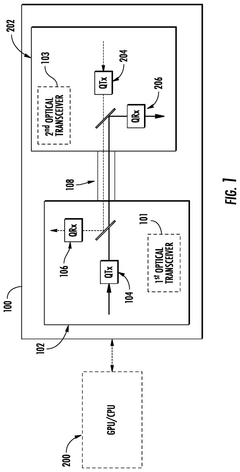
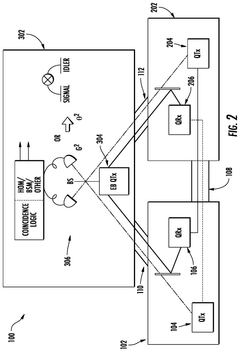
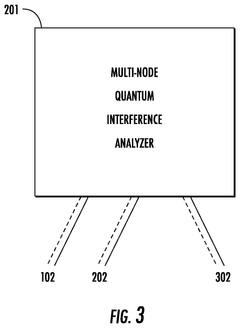
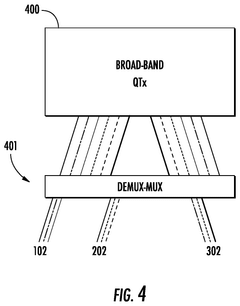
- A bi-directional quantum interconnect system is implemented, where first and second communication modules are coupled via a common communication medium, allowing qubits with different quantum characteristics to be transmitted in opposing directions, thereby increasing exchange rates and enabling flexible network architectures.
QAM receiver with gain control, dc-offset correction, and passband equalisation
PatentInactiveEP1180884A3
Innovation
- An adaptive QAM decoding system that integrates gain and voltage bias compensation with equalization, using the same signal for decoding and feedback to minimize errors, by analyzing significant bits from an analog-to-digital converter to adjust gain and voltage bias, and calculating tap weights for equalization based on correlation between main and delayed signal paths.


Global Regulatory Framework for Quantum Communications
The global regulatory landscape for quantum communications is rapidly evolving as nations recognize the strategic importance of quantum technologies. Currently, the United States leads with initiatives like the National Quantum Initiative Act, which allocates substantial funding for quantum research and development while establishing regulatory frameworks. The European Union follows with its Quantum Flagship program, emphasizing standardized approaches to quantum communication security protocols across member states.
In Asia, China has implemented the most aggressive regulatory framework, integrating quantum communications into its national security strategy with strict controls on quantum technology exports and knowledge transfer. Japan and South Korea have adopted more collaborative approaches, focusing on international partnerships while developing domestic regulatory guidelines that balance innovation with security concerns.
Regulatory divergence presents significant challenges for global quantum interconnect development. Different jurisdictions maintain varying requirements for encryption standards, data sovereignty, and technology transfer restrictions. This fragmentation creates compliance complexities for organizations developing cross-border quantum communication networks and potentially impedes international collaboration on quantum infrastructure projects.
Frequency spectrum allocation represents another critical regulatory challenge. Quantum communications systems often require specific frequency bands for optimal performance, yet these allocations must be coordinated internationally to prevent interference. The International Telecommunication Union (ITU) has begun preliminary discussions on quantum-specific spectrum management, though formal agreements remain nascent.
Export control regulations significantly impact quantum interconnect technologies. Many nations classify advanced quantum components as dual-use technologies subject to strict export limitations. These controls, while necessary for national security, create barriers to establishing global quantum communication networks and slow technology diffusion to developing regions.
Privacy and data protection frameworks also vary substantially across jurisdictions. Quantum communications promise unprecedented security capabilities but raise novel regulatory questions regarding key distribution, authentication protocols, and integration with existing cybersecurity regulations. The EU's GDPR provides some guidance but was not designed with quantum communication capabilities in mind.
International standardization efforts remain in early stages, with organizations like the International Organization for Standardization (ISO) and the Institute of Electrical and Electronics Engineers (IEEE) establishing working groups focused on quantum communication protocols. However, geopolitical tensions have complicated these efforts, with competing standards emerging from different regional blocs.
In Asia, China has implemented the most aggressive regulatory framework, integrating quantum communications into its national security strategy with strict controls on quantum technology exports and knowledge transfer. Japan and South Korea have adopted more collaborative approaches, focusing on international partnerships while developing domestic regulatory guidelines that balance innovation with security concerns.
Regulatory divergence presents significant challenges for global quantum interconnect development. Different jurisdictions maintain varying requirements for encryption standards, data sovereignty, and technology transfer restrictions. This fragmentation creates compliance complexities for organizations developing cross-border quantum communication networks and potentially impedes international collaboration on quantum infrastructure projects.
Frequency spectrum allocation represents another critical regulatory challenge. Quantum communications systems often require specific frequency bands for optimal performance, yet these allocations must be coordinated internationally to prevent interference. The International Telecommunication Union (ITU) has begun preliminary discussions on quantum-specific spectrum management, though formal agreements remain nascent.
Export control regulations significantly impact quantum interconnect technologies. Many nations classify advanced quantum components as dual-use technologies subject to strict export limitations. These controls, while necessary for national security, create barriers to establishing global quantum communication networks and slow technology diffusion to developing regions.
Privacy and data protection frameworks also vary substantially across jurisdictions. Quantum communications promise unprecedented security capabilities but raise novel regulatory questions regarding key distribution, authentication protocols, and integration with existing cybersecurity regulations. The EU's GDPR provides some guidance but was not designed with quantum communication capabilities in mind.
International standardization efforts remain in early stages, with organizations like the International Organization for Standardization (ISO) and the Institute of Electrical and Electronics Engineers (IEEE) establishing working groups focused on quantum communication protocols. However, geopolitical tensions have complicated these efforts, with competing standards emerging from different regional blocs.
Standardization Efforts and Industry Consortiums
The quantum computing industry has recognized the critical need for standardization in quantum interconnects, leading to the formation of several influential consortiums and working groups. The IEEE Quantum Initiative stands as a cornerstone organization, having established the IEEE P1913 working group specifically focused on developing standards for quantum communication technologies. This group brings together experts from academia, industry, and government to create frameworks that address quantum interconnect challenges across different implementation technologies.
The Quantum Economic Development Consortium (QED-C), supported by the U.S. National Institute of Standards and Technology (NIST), has formed specialized technical advisory committees dedicated to quantum interconnect standardization. These committees are working to establish common terminology, performance metrics, and testing methodologies that will enable interoperability between quantum computing systems from different vendors.
In Europe, the Quantum Industry Consortium (QuIC) has launched dedicated working groups addressing quantum interconnect standardization, with particular emphasis on ensuring compatibility with existing classical network infrastructure. Their efforts focus on creating transition pathways that allow quantum and classical systems to operate in hybrid environments during the evolution toward quantum networks.
The International Telecommunication Union (ITU) has established the Focus Group on Quantum Information Technology for Networks (FG-QIT4N), which is developing recommendations for quantum-safe cryptography and quantum key distribution networks. Their work directly impacts how quantum interconnects will function within global telecommunications infrastructure.
Industry leaders including IBM, Google, Microsoft, and Intel have formed the Quantum Development Kit (QDK) Alliance, which is working to establish software interface standards for quantum interconnects. This initiative aims to create programming abstractions that shield developers from the underlying hardware complexities while ensuring optimal performance across different quantum computing architectures.
The Open Quantum Safe project represents a collaborative effort to develop and standardize quantum-resistant cryptographic protocols essential for secure quantum interconnects. This open-source initiative provides libraries and protocols that can be integrated into existing network infrastructure to prepare for quantum-secure communications.
These standardization efforts face significant challenges, including the rapidly evolving nature of quantum technologies, competing commercial interests, and the need to balance innovation with interoperability. Despite these obstacles, the industry recognizes that without robust standards, the quantum computing ecosystem risks fragmentation that could severely limit its practical applications and commercial viability.
The Quantum Economic Development Consortium (QED-C), supported by the U.S. National Institute of Standards and Technology (NIST), has formed specialized technical advisory committees dedicated to quantum interconnect standardization. These committees are working to establish common terminology, performance metrics, and testing methodologies that will enable interoperability between quantum computing systems from different vendors.
In Europe, the Quantum Industry Consortium (QuIC) has launched dedicated working groups addressing quantum interconnect standardization, with particular emphasis on ensuring compatibility with existing classical network infrastructure. Their efforts focus on creating transition pathways that allow quantum and classical systems to operate in hybrid environments during the evolution toward quantum networks.
The International Telecommunication Union (ITU) has established the Focus Group on Quantum Information Technology for Networks (FG-QIT4N), which is developing recommendations for quantum-safe cryptography and quantum key distribution networks. Their work directly impacts how quantum interconnects will function within global telecommunications infrastructure.
Industry leaders including IBM, Google, Microsoft, and Intel have formed the Quantum Development Kit (QDK) Alliance, which is working to establish software interface standards for quantum interconnects. This initiative aims to create programming abstractions that shield developers from the underlying hardware complexities while ensuring optimal performance across different quantum computing architectures.
The Open Quantum Safe project represents a collaborative effort to develop and standardize quantum-resistant cryptographic protocols essential for secure quantum interconnects. This open-source initiative provides libraries and protocols that can be integrated into existing network infrastructure to prepare for quantum-secure communications.
These standardization efforts face significant challenges, including the rapidly evolving nature of quantum technologies, competing commercial interests, and the need to balance innovation with interoperability. Despite these obstacles, the industry recognizes that without robust standards, the quantum computing ecosystem risks fragmentation that could severely limit its practical applications and commercial viability.
Unlock deeper insights with PatSnap Eureka Quick Research — get a full tech report to explore trends and direct your research. Try now!
Generate Your Research Report Instantly with AI Agent
Supercharge your innovation with PatSnap Eureka AI Agent Platform!