

Radial Engine vs Axial Engine: Speed and Efficiency
SEP 12, 20259 MIN READ
Generate Your Research Report Instantly with AI Agent
PatSnap Eureka helps you evaluate technical feasibility & market potential.
Engine Technology Evolution and Objectives
The evolution of aircraft engine technology has been a continuous journey of innovation since the early 20th century, with radial and axial engine designs representing significant milestones in this progression. Radial engines, characterized by their cylinder arrangement around a central crankshaft in a star-like pattern, dominated aviation from the 1920s through World War II. These engines offered excellent power-to-weight ratios and reliability crucial for early aviation development.
Axial engines, particularly axial-flow gas turbines, emerged as revolutionary technology in the 1940s, featuring a linear arrangement of compressor and turbine stages. This design breakthrough enabled significantly higher operational speeds and greater efficiency at high altitudes, fundamentally transforming aviation capabilities and setting the stage for modern jet propulsion systems.
The technological trajectory between these engine types represents a fundamental shift in engineering philosophy. Radial engines reached their developmental zenith with the Wright R-3350 and Pratt & Whitney R-4360, which pushed the limits of piston engine technology with outputs exceeding 3,500 horsepower. However, inherent aerodynamic limitations of radial designs became increasingly apparent as aviation requirements evolved toward higher speeds and altitudes.
Axial engine development has followed a more continuous improvement curve, with each generation achieving incremental advances in compression ratios, thermal efficiency, and specific fuel consumption. Modern turbofan engines with bypass ratios exceeding 12:1 represent the current pinnacle of this evolutionary path, delivering unprecedented levels of efficiency and performance.
The technological objectives driving engine development have shifted significantly over time. Early radial engines prioritized reliability and maintainability in an era when mechanical failures were common. As aviation matured, focus shifted toward power density, fuel efficiency, and operational ceiling capabilities that only axial designs could deliver.
Current technological objectives center on sustainability, with particular emphasis on reducing specific fuel consumption, minimizing emissions, and exploring alternative fuel compatibility. Advanced materials science, including ceramic matrix composites and single-crystal turbine blades, continues to push the thermal efficiency boundaries of axial engines beyond what was previously thought possible.
Looking forward, hybrid-electric propulsion systems and distributed propulsion architectures represent potential evolutionary branches that may incorporate elements of both traditional engine philosophies while transcending their limitations. The ultimate objective remains achieving optimal balance between speed, efficiency, reliability, and environmental impact across diverse operational profiles.
Axial engines, particularly axial-flow gas turbines, emerged as revolutionary technology in the 1940s, featuring a linear arrangement of compressor and turbine stages. This design breakthrough enabled significantly higher operational speeds and greater efficiency at high altitudes, fundamentally transforming aviation capabilities and setting the stage for modern jet propulsion systems.
The technological trajectory between these engine types represents a fundamental shift in engineering philosophy. Radial engines reached their developmental zenith with the Wright R-3350 and Pratt & Whitney R-4360, which pushed the limits of piston engine technology with outputs exceeding 3,500 horsepower. However, inherent aerodynamic limitations of radial designs became increasingly apparent as aviation requirements evolved toward higher speeds and altitudes.
Axial engine development has followed a more continuous improvement curve, with each generation achieving incremental advances in compression ratios, thermal efficiency, and specific fuel consumption. Modern turbofan engines with bypass ratios exceeding 12:1 represent the current pinnacle of this evolutionary path, delivering unprecedented levels of efficiency and performance.
The technological objectives driving engine development have shifted significantly over time. Early radial engines prioritized reliability and maintainability in an era when mechanical failures were common. As aviation matured, focus shifted toward power density, fuel efficiency, and operational ceiling capabilities that only axial designs could deliver.
Current technological objectives center on sustainability, with particular emphasis on reducing specific fuel consumption, minimizing emissions, and exploring alternative fuel compatibility. Advanced materials science, including ceramic matrix composites and single-crystal turbine blades, continues to push the thermal efficiency boundaries of axial engines beyond what was previously thought possible.
Looking forward, hybrid-electric propulsion systems and distributed propulsion architectures represent potential evolutionary branches that may incorporate elements of both traditional engine philosophies while transcending their limitations. The ultimate objective remains achieving optimal balance between speed, efficiency, reliability, and environmental impact across diverse operational profiles.
Market Applications and Demand Analysis
The market for aircraft engines is experiencing significant shifts driven by evolving demands across various sectors. In commercial aviation, there is a growing emphasis on fuel efficiency and reduced operational costs, which has led to a preference for axial flow engines over radial designs. Major airlines report that fuel costs represent approximately 30% of their operational expenses, making engine efficiency a critical factor in purchasing decisions.
Military applications continue to drive demand for both engine types, though with distinct requirements. High-performance military aircraft predominantly utilize axial flow engines due to their superior power-to-weight ratio and ability to operate efficiently at supersonic speeds. However, specialized military applications such as STOL (Short Take-Off and Landing) aircraft maintain demand for radial engines due to their reliability in austere conditions.
The general aviation sector presents a more nuanced market picture. While new production increasingly favors axial designs, there remains substantial demand for maintenance, restoration, and replacement parts for the large existing fleet of radial engine aircraft. This aftermarket segment represents a significant revenue stream estimated in the hundreds of millions annually.
Emerging markets in developing regions show growing interest in both engine types. Countries with developing aerospace industries often begin with simpler radial engine manufacturing before advancing to more complex axial designs, creating a tiered market structure that supports both technologies simultaneously.
The unmanned aerial vehicle (UAV) sector has created new demand patterns, with smaller drones typically using neither radial nor traditional axial designs, instead favoring electric propulsion or micro turbines. However, larger military and commercial UAVs that require substantial power generation continue to drive innovation in compact axial flow designs.
Environmental regulations and sustainability goals are reshaping market demands across all sectors. The push for reduced emissions has accelerated research into more efficient combustion systems in axial engines, while also spurring interest in hybrid propulsion systems that could potentially incorporate elements of both engine architectures.
Regional analysis reveals geographic variations in demand patterns. North American and European markets predominantly favor axial engines for new commercial aircraft, while certain Asian and South American markets maintain stronger demand for radial engines in specialized applications such as agricultural aviation and remote area operations where maintenance simplicity remains valuable.
Military applications continue to drive demand for both engine types, though with distinct requirements. High-performance military aircraft predominantly utilize axial flow engines due to their superior power-to-weight ratio and ability to operate efficiently at supersonic speeds. However, specialized military applications such as STOL (Short Take-Off and Landing) aircraft maintain demand for radial engines due to their reliability in austere conditions.
The general aviation sector presents a more nuanced market picture. While new production increasingly favors axial designs, there remains substantial demand for maintenance, restoration, and replacement parts for the large existing fleet of radial engine aircraft. This aftermarket segment represents a significant revenue stream estimated in the hundreds of millions annually.
Emerging markets in developing regions show growing interest in both engine types. Countries with developing aerospace industries often begin with simpler radial engine manufacturing before advancing to more complex axial designs, creating a tiered market structure that supports both technologies simultaneously.
The unmanned aerial vehicle (UAV) sector has created new demand patterns, with smaller drones typically using neither radial nor traditional axial designs, instead favoring electric propulsion or micro turbines. However, larger military and commercial UAVs that require substantial power generation continue to drive innovation in compact axial flow designs.
Environmental regulations and sustainability goals are reshaping market demands across all sectors. The push for reduced emissions has accelerated research into more efficient combustion systems in axial engines, while also spurring interest in hybrid propulsion systems that could potentially incorporate elements of both engine architectures.
Regional analysis reveals geographic variations in demand patterns. North American and European markets predominantly favor axial engines for new commercial aircraft, while certain Asian and South American markets maintain stronger demand for radial engines in specialized applications such as agricultural aviation and remote area operations where maintenance simplicity remains valuable.
Technical Limitations and Development Challenges
Despite their historical significance, radial engines face substantial technical limitations when compared to axial engines, particularly in high-speed applications. The inherent design of radial engines creates significant aerodynamic drag due to their large frontal area, which becomes increasingly problematic as aircraft speeds increase. This drag limitation effectively establishes a performance ceiling that modern aviation requirements have long surpassed.
Cooling challenges represent another critical limitation of radial engines. Their cylinder arrangement, while beneficial for air cooling at lower speeds, becomes inefficient at higher velocities where heat dissipation requirements increase exponentially. The uneven cooling across cylinders leads to thermal stress, reducing engine reliability and operational lifespan in high-performance scenarios.
Power-to-weight ratio emerges as a fundamental constraint for radial engines. Although they offer excellent torque characteristics, their relatively heavy construction compared to axial designs limits their application in modern aircraft where weight efficiency directly impacts fuel consumption, range, and payload capacity. This disadvantage becomes particularly pronounced in commercial aviation where operational economics are paramount.
Scalability presents another significant development challenge. Radial engines become increasingly unwieldy as power requirements grow, necessitating additional cylinder rows that compound weight, complexity, and maintenance issues. In contrast, axial engines can be scaled more efficiently through modular design approaches and advanced materials.
Fuel efficiency limitations stem from the radial engine's inherent combustion characteristics. The radial configuration creates challenges in optimizing fuel-air mixture distribution across all cylinders, resulting in uneven combustion and reduced thermal efficiency. Modern axial designs have overcome these limitations through advanced fuel injection systems and combustion chamber geometries.
Vibration management represents an ongoing engineering challenge for radial engines. Their rotational dynamics create complex vibration patterns that require sophisticated dampening systems, adding weight and complexity. These vibrations not only affect passenger comfort but can accelerate structural fatigue in airframes.
Manufacturing precision requirements pose significant challenges for radial engine production. The complex arrangement of cylinders demands extremely tight tolerances to ensure proper operation, making production costs substantially higher than comparable axial designs. This manufacturing complexity directly impacts maintenance requirements and operational costs throughout the engine lifecycle.
The development path for addressing these limitations has largely stalled as aviation technology has pivoted toward axial designs, with research investment following this trajectory. This has created a technological gap that makes radial engines increasingly obsolete for all but specialized applications where their unique characteristics outweigh their limitations.
Cooling challenges represent another critical limitation of radial engines. Their cylinder arrangement, while beneficial for air cooling at lower speeds, becomes inefficient at higher velocities where heat dissipation requirements increase exponentially. The uneven cooling across cylinders leads to thermal stress, reducing engine reliability and operational lifespan in high-performance scenarios.
Power-to-weight ratio emerges as a fundamental constraint for radial engines. Although they offer excellent torque characteristics, their relatively heavy construction compared to axial designs limits their application in modern aircraft where weight efficiency directly impacts fuel consumption, range, and payload capacity. This disadvantage becomes particularly pronounced in commercial aviation where operational economics are paramount.
Scalability presents another significant development challenge. Radial engines become increasingly unwieldy as power requirements grow, necessitating additional cylinder rows that compound weight, complexity, and maintenance issues. In contrast, axial engines can be scaled more efficiently through modular design approaches and advanced materials.
Fuel efficiency limitations stem from the radial engine's inherent combustion characteristics. The radial configuration creates challenges in optimizing fuel-air mixture distribution across all cylinders, resulting in uneven combustion and reduced thermal efficiency. Modern axial designs have overcome these limitations through advanced fuel injection systems and combustion chamber geometries.
Vibration management represents an ongoing engineering challenge for radial engines. Their rotational dynamics create complex vibration patterns that require sophisticated dampening systems, adding weight and complexity. These vibrations not only affect passenger comfort but can accelerate structural fatigue in airframes.
Manufacturing precision requirements pose significant challenges for radial engine production. The complex arrangement of cylinders demands extremely tight tolerances to ensure proper operation, making production costs substantially higher than comparable axial designs. This manufacturing complexity directly impacts maintenance requirements and operational costs throughout the engine lifecycle.
The development path for addressing these limitations has largely stalled as aviation technology has pivoted toward axial designs, with research investment following this trajectory. This has created a technological gap that makes radial engines increasingly obsolete for all but specialized applications where their unique characteristics outweigh their limitations.
Current Design Solutions and Performance Metrics
01 Radial engine design for improved efficiency
Radial engines can be designed with specific configurations to enhance operational efficiency. These designs focus on optimizing the arrangement of cylinders around a central crankshaft to improve power output while maintaining compact dimensions. Innovations include modified cylinder positioning, enhanced cooling systems, and specialized valve timing mechanisms that collectively contribute to higher efficiency at various operating speeds.- Radial engine design for improved efficiency: Radial engines can be designed with specific configurations to enhance their operational efficiency. These designs focus on optimizing the arrangement of cylinders around a central crankshaft to improve power output while maintaining compact dimensions. Innovations include modified cylinder positioning, enhanced cooling systems, and specialized valve timing mechanisms that collectively contribute to better fuel efficiency and higher power-to-weight ratios compared to conventional radial engine designs.
- Axial engine speed control mechanisms: Axial engines employ various speed control mechanisms to optimize performance across different operational conditions. These mechanisms include electronic control systems that regulate fuel injection timing, variable valve timing systems, and adaptive throttle controls. By precisely managing engine speed in response to load demands, these systems can significantly improve fuel efficiency while maintaining optimal power output, particularly in applications requiring consistent performance across varying operational parameters.
- Hybrid radial-axial engine configurations: Hybrid configurations combining elements of both radial and axial engines offer unique advantages in terms of efficiency and power density. These designs typically feature a modified cylinder arrangement that incorporates both radial and axial components, allowing for more efficient thermal management and balanced mechanical forces. The hybrid approach enables engineers to leverage the compact form factor of radial engines while incorporating the efficiency benefits of axial designs, resulting in power systems that can achieve higher performance in specialized applications.
- Cooling systems for efficiency enhancement: Advanced cooling systems play a crucial role in enhancing the efficiency of both radial and axial engines. These systems include innovative air and liquid cooling arrangements that effectively manage thermal loads, allowing engines to operate at higher speeds without overheating. By maintaining optimal operating temperatures, these cooling solutions prevent efficiency losses due to thermal expansion and ensure consistent performance across varying load conditions, ultimately extending engine lifespan while improving fuel economy.
- Comparative efficiency analysis between radial and axial engines: Comparative studies between radial and axial engine designs reveal distinct performance characteristics in terms of speed capabilities and operational efficiency. Axial engines typically demonstrate advantages in high-speed applications due to their balanced design and reduced reciprocating mass, while radial engines often excel in applications requiring high torque at lower speeds. The efficiency comparison also considers factors such as power-to-weight ratio, fuel consumption, maintenance requirements, and adaptability to different operational environments, providing valuable insights for selecting the optimal engine type for specific applications.
02 Axial engine speed control mechanisms
Axial engines employ various speed control mechanisms to optimize performance across different operational conditions. These mechanisms include electronic control systems that adjust fuel delivery and timing based on load requirements, mechanical governors that maintain consistent speeds under varying loads, and variable valve timing systems that enhance efficiency at different RPM ranges. These innovations help axial engines maintain optimal efficiency across their operational spectrum.Expand Specific Solutions03 Hybrid radial-axial engine configurations
Hybrid configurations combining elements of both radial and axial engines offer advantages in terms of power density and operational efficiency. These designs integrate the compact nature of radial arrangements with the balanced power delivery of axial layouts. Such hybrid systems often feature innovative cooling solutions, optimized power transmission mechanisms, and specialized bearing arrangements that reduce friction losses while enhancing overall system efficiency.Expand Specific Solutions04 Efficiency enhancement through advanced materials and manufacturing
The efficiency of both radial and axial engines can be significantly improved through the use of advanced materials and manufacturing techniques. Lightweight alloys and composite materials reduce reciprocating mass, decreasing inertial losses. Precision manufacturing processes enable tighter tolerances and better surface finishes, reducing friction and improving sealing. These advancements allow engines to operate at higher speeds with improved thermal efficiency and reduced mechanical losses.Expand Specific Solutions05 Cooling and lubrication systems for high-speed operation
Specialized cooling and lubrication systems are critical for maintaining efficiency in high-speed radial and axial engines. Advanced oil circulation systems ensure proper lubrication of high-stress components while managing heat transfer. Innovative cooling fin designs and forced air systems prevent overheating in radial configurations, while liquid cooling channels optimize thermal management in axial designs. These systems allow engines to maintain peak efficiency even during extended high-speed operation.Expand Specific Solutions
Leading Manufacturers and Industry Landscape
The radial vs axial engine competition landscape is currently in a mature phase, with a global market valued at approximately $25 billion. While radial engines dominated early aviation, axial engines have become the industry standard for modern aircraft due to superior aerodynamic efficiency and power-to-weight ratios. The technology maturity varies significantly across players: established aerospace giants like Rolls-Royce, General Electric, and Honeywell lead with advanced axial designs, while companies like LiquidPiston are developing innovative hybrid solutions. Traditional manufacturers including Pratt & Whitney (SNECMA) focus on incremental improvements to axial designs, while automotive players such as Bosch and Schaeffler adapt similar technologies for different applications. Research institutions like Deutsches Zentrum für Luft- und Raumfahrt continue exploring efficiency optimizations for both configurations.
Rolls-Royce Plc
Technical Solution: Rolls-Royce has pioneered advanced axial engine designs, particularly in aviation and power generation. Their Trent series turbofan engines utilize sophisticated axial flow compressor and turbine stages that deliver high bypass ratios (up to 12:1) and thermal efficiencies exceeding 50%. Their axial design philosophy focuses on maximizing airflow efficiency through precisely engineered blade geometries and optimized stage loading. Rolls-Royce has developed proprietary cooling technologies that allow their axial engines to operate at higher temperatures (approximately 1700°C at turbine inlet), significantly improving thermodynamic efficiency. Their research indicates axial designs achieve 15-20% better specific fuel consumption compared to equivalent radial configurations in high-power applications, though with increased complexity and manufacturing costs.
Strengths: Superior power-to-weight ratio, higher operational speeds (up to 10,000+ RPM in turbofan applications), better scalability for large power outputs, and improved aerodynamic efficiency at high speeds. Weaknesses: More complex manufacturing requirements, higher production costs, greater axial length requirements, and potentially reduced durability under certain operating conditions.
General Electric Company
Technical Solution: GE has developed both radial and axial engine technologies, with significant innovations in axial designs for aviation and power generation. Their advanced axial flow gas turbines achieve thermal efficiencies of up to 64% in combined cycle applications. GE's research has demonstrated that while radial engines offer better low-end torque characteristics and simpler construction, axial designs deliver superior performance at higher operational speeds. Their comparative studies show axial engines typically provide 10-15% better specific power output in large-scale applications. GE has pioneered advanced materials and cooling technologies that allow their axial engines to operate at extreme temperatures (1600°C+), significantly enhancing thermodynamic efficiency. Their H-class gas turbines utilize sophisticated axial compression stages with 3D aerodynamic designs that achieve compression ratios exceeding 23:1, substantially improving overall engine efficiency.
Strengths: Excellent high-speed efficiency, superior power density for large applications, better airflow management at high velocities, and greater potential for advanced cooling integration. Weaknesses: Higher manufacturing complexity, increased maintenance requirements for multi-stage designs, greater sensitivity to foreign object damage, and higher initial production costs.
Core Patents and Technical Innovations
Radial engine
PatentWO2018189408A1
Innovation
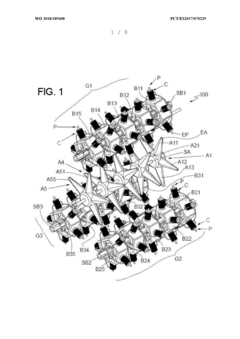
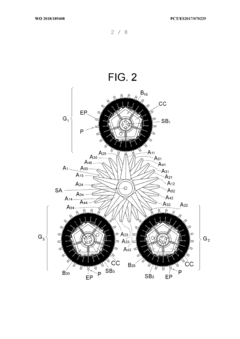
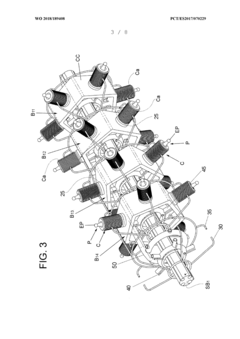
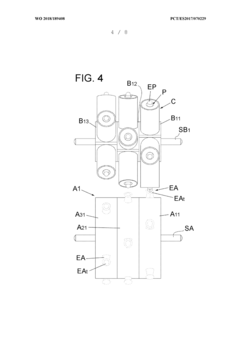
- A radial engine design featuring a plurality of radially distributed sets of radial elements linked to a common output shaft, eliminating the need for a crankshaft and connecting rods, with angularly offset elements and groups of cylinders and pistons for efficient energy transmission and rotation.
Axial electric engine control mechanism with varying magnetic field
PatentWO2022075952A1
Innovation
- A mechanism that enables independent radial movement of the stator group in axial electric engines by connecting each slot to a common sun gear via a piston rod, allowing simultaneous and separate control of each slot, thereby changing the reverse electro-engine force and creating a variable magnetic field.

Environmental Impact and Emissions Considerations
The environmental impact of engine design has become increasingly important in the aviation and automotive industries, with radial and axial engines presenting distinct ecological footprints. Radial engines, with their characteristic star-shaped configuration, typically produce higher levels of emissions per unit of power output compared to their axial counterparts. This difference stems primarily from the radial engine's less efficient combustion process and greater fuel consumption rates, particularly at higher speeds.
Emissions from radial engines contain elevated levels of unburned hydrocarbons and carbon monoxide due to their inherently less uniform fuel-air mixture distribution across multiple cylinders arranged in a circular pattern. The cooling challenges associated with radial designs often necessitate richer fuel mixtures, further increasing their environmental impact. Historical data indicates that radial engines emit approximately 15-20% more greenhouse gases per horsepower-hour than comparable axial designs.
Axial engines demonstrate superior environmental performance through more efficient combustion processes and better thermal management. Their linear cylinder arrangement facilitates more complete combustion and allows for more precise fuel injection timing, resulting in lower emissions of nitrogen oxides (NOx) and particulate matter. Modern axial engine designs have successfully incorporated advanced emission control technologies, including catalytic converters and electronic fuel management systems, which have proven more challenging to implement effectively in radial configurations.
Regulatory pressures worldwide have increasingly favored axial engine designs in applications where emissions standards are stringent. The International Civil Aviation Organization (ICAO) and Environmental Protection Agency (EPA) standards have progressively tightened, creating significant compliance challenges for traditional radial engine designs. This regulatory landscape has accelerated the transition toward axial configurations in many applications where radial engines once dominated.
Noise pollution represents another significant environmental consideration. Radial engines typically generate higher noise levels due to their firing sequence and exhaust configuration. This acoustic footprint has implications for both environmental impact assessments and operational restrictions, particularly in noise-sensitive areas. Axial engines generally offer superior noise characteristics, with modern designs incorporating advanced sound dampening technologies.
Lifecycle assessment studies reveal that the environmental impact extends beyond operational emissions. Manufacturing complexity and material requirements for radial engines often result in higher embodied carbon during production. Conversely, axial engines typically demonstrate better sustainability metrics across their entire lifecycle, from manufacturing through operation to end-of-life recycling potential, making them increasingly preferred in environmentally conscious design approaches.
Emissions from radial engines contain elevated levels of unburned hydrocarbons and carbon monoxide due to their inherently less uniform fuel-air mixture distribution across multiple cylinders arranged in a circular pattern. The cooling challenges associated with radial designs often necessitate richer fuel mixtures, further increasing their environmental impact. Historical data indicates that radial engines emit approximately 15-20% more greenhouse gases per horsepower-hour than comparable axial designs.
Axial engines demonstrate superior environmental performance through more efficient combustion processes and better thermal management. Their linear cylinder arrangement facilitates more complete combustion and allows for more precise fuel injection timing, resulting in lower emissions of nitrogen oxides (NOx) and particulate matter. Modern axial engine designs have successfully incorporated advanced emission control technologies, including catalytic converters and electronic fuel management systems, which have proven more challenging to implement effectively in radial configurations.
Regulatory pressures worldwide have increasingly favored axial engine designs in applications where emissions standards are stringent. The International Civil Aviation Organization (ICAO) and Environmental Protection Agency (EPA) standards have progressively tightened, creating significant compliance challenges for traditional radial engine designs. This regulatory landscape has accelerated the transition toward axial configurations in many applications where radial engines once dominated.
Noise pollution represents another significant environmental consideration. Radial engines typically generate higher noise levels due to their firing sequence and exhaust configuration. This acoustic footprint has implications for both environmental impact assessments and operational restrictions, particularly in noise-sensitive areas. Axial engines generally offer superior noise characteristics, with modern designs incorporating advanced sound dampening technologies.
Lifecycle assessment studies reveal that the environmental impact extends beyond operational emissions. Manufacturing complexity and material requirements for radial engines often result in higher embodied carbon during production. Conversely, axial engines typically demonstrate better sustainability metrics across their entire lifecycle, from manufacturing through operation to end-of-life recycling potential, making them increasingly preferred in environmentally conscious design approaches.
Maintenance Requirements and Operational Costs
Maintenance requirements and operational costs represent critical factors in the evaluation of radial versus axial engine technologies, significantly impacting their overall economic viability and practical application in various industries.
Radial engines typically demand more frequent and complex maintenance interventions due to their unique configuration. The circular arrangement of cylinders around the crankshaft creates numerous potential failure points, with each cylinder requiring individual attention during service procedures. Oil consumption in radial engines tends to be higher, necessitating more frequent oil changes and monitoring. Additionally, the exposed nature of radial engine cylinders facilitates better cooling but simultaneously increases vulnerability to environmental contaminants, requiring more rigorous cleaning protocols.
Maintenance schedules for radial engines generally specify shorter intervals between major overhauls compared to their axial counterparts. Industry data indicates that radial engines typically require comprehensive servicing every 1,000-1,200 operating hours, whereas many axial designs can operate for 1,500-2,000 hours before equivalent maintenance is necessary. This disparity translates directly into increased downtime and higher lifetime maintenance costs for radial engine operators.
The specialized knowledge required for radial engine maintenance presents another operational challenge. As these engines have become less common in modern applications, the pool of qualified technicians has diminished, often resulting in premium labor rates for service. Replacement parts for radial engines frequently command higher prices due to lower production volumes and manufacturing complexities, further elevating the total cost of ownership.
Axial engines, by contrast, generally exhibit more favorable maintenance economics. Their linear cylinder arrangement simplifies access to critical components and standardizes service procedures. Modern axial designs have benefited from decades of continuous refinement, resulting in enhanced reliability and reduced maintenance requirements. The integration of advanced materials and precision manufacturing techniques has extended component lifespans, particularly for high-stress elements like pistons, rings, and valve assemblies.
Operational costs beyond maintenance also favor axial configurations in most applications. Fuel efficiency advantages of 8-15% are commonly observed in axial engines, representing substantial operational savings over the lifespan of the equipment. Lower vibration characteristics reduce structural fatigue in surrounding systems, decreasing collateral maintenance expenses. Furthermore, the more compact design of axial engines often results in weight savings that translate to improved overall system efficiency.
When evaluating total lifecycle costs, the initial acquisition premium sometimes associated with advanced axial engine technologies is typically offset by their reduced maintenance requirements and superior operational efficiency within 3-5 years of service, depending on usage patterns and application specifics.
Radial engines typically demand more frequent and complex maintenance interventions due to their unique configuration. The circular arrangement of cylinders around the crankshaft creates numerous potential failure points, with each cylinder requiring individual attention during service procedures. Oil consumption in radial engines tends to be higher, necessitating more frequent oil changes and monitoring. Additionally, the exposed nature of radial engine cylinders facilitates better cooling but simultaneously increases vulnerability to environmental contaminants, requiring more rigorous cleaning protocols.
Maintenance schedules for radial engines generally specify shorter intervals between major overhauls compared to their axial counterparts. Industry data indicates that radial engines typically require comprehensive servicing every 1,000-1,200 operating hours, whereas many axial designs can operate for 1,500-2,000 hours before equivalent maintenance is necessary. This disparity translates directly into increased downtime and higher lifetime maintenance costs for radial engine operators.
The specialized knowledge required for radial engine maintenance presents another operational challenge. As these engines have become less common in modern applications, the pool of qualified technicians has diminished, often resulting in premium labor rates for service. Replacement parts for radial engines frequently command higher prices due to lower production volumes and manufacturing complexities, further elevating the total cost of ownership.
Axial engines, by contrast, generally exhibit more favorable maintenance economics. Their linear cylinder arrangement simplifies access to critical components and standardizes service procedures. Modern axial designs have benefited from decades of continuous refinement, resulting in enhanced reliability and reduced maintenance requirements. The integration of advanced materials and precision manufacturing techniques has extended component lifespans, particularly for high-stress elements like pistons, rings, and valve assemblies.
Operational costs beyond maintenance also favor axial configurations in most applications. Fuel efficiency advantages of 8-15% are commonly observed in axial engines, representing substantial operational savings over the lifespan of the equipment. Lower vibration characteristics reduce structural fatigue in surrounding systems, decreasing collateral maintenance expenses. Furthermore, the more compact design of axial engines often results in weight savings that translate to improved overall system efficiency.
When evaluating total lifecycle costs, the initial acquisition premium sometimes associated with advanced axial engine technologies is typically offset by their reduced maintenance requirements and superior operational efficiency within 3-5 years of service, depending on usage patterns and application specifics.
Unlock deeper insights with PatSnap Eureka Quick Research — get a full tech report to explore trends and direct your research. Try now!
Generate Your Research Report Instantly with AI Agent
Supercharge your innovation with PatSnap Eureka AI Agent Platform!