Radial Engine vs V-Type Engine: Performance Metrics
SEP 12, 20259 MIN READ
Generate Your Research Report Instantly with AI Agent
PatSnap Eureka helps you evaluate technical feasibility & market potential.
Engine Technology Evolution and Objectives
The evolution of aircraft engine technology has been a fascinating journey spanning over a century, with radial and V-type engines representing two significant architectural approaches that have shaped aviation history. Radial engines, with their distinctive star-shaped cylinder arrangement around a central crankshaft, dominated early aviation from the 1920s through World War II. These engines offered excellent power-to-weight ratios and cooling efficiency that were crucial for early aircraft development.
V-type engines, conversely, emerged from automotive applications and gained prominence in aviation during the mid-20th century. Their compact inline arrangement of cylinders in a V-configuration offered aerodynamic advantages that became increasingly important as aircraft speeds increased and drag reduction became paramount for performance optimization.
The technological trajectory of these engine types has been driven by several key factors: power output requirements, fuel efficiency demands, reliability metrics, and manufacturing capabilities. Early radial engines like the Pratt & Whitney R-1340 Wasp established benchmarks for reliability in commercial aviation, while later developments such as the Wright R-3350 pushed the boundaries of radial engine performance during WWII.
V-type engines evolved through innovations in metallurgy, valve timing, and supercharging technologies. The Rolls-Royce Merlin represents perhaps the most celebrated V-12 aircraft engine, demonstrating how the V-configuration could deliver exceptional performance when combined with advanced engineering solutions such as two-stage supercharging.
The primary technological objectives in this comparative analysis include quantifying the performance differentials between these engine architectures across multiple parameters: specific power output (power-to-weight ratio), thermal efficiency, volumetric efficiency, and reliability under various operational conditions. Additionally, understanding the scaling characteristics of each design as displacement increases provides critical insights for application-specific selection criteria.
Modern analytical techniques now allow for comprehensive performance modeling that was unavailable during the heyday of these engine types. Computational fluid dynamics, thermodynamic cycle analysis, and materials science advancements enable retrospective assessment with unprecedented precision, offering valuable lessons for contemporary powerplant design.
The technological evolution trajectory suggests a convergence of certain design principles, with modern engines incorporating the best attributes of both configurations. The radial engine's excellent cooling characteristics and structural integrity under stress have influenced contemporary engine design philosophy, while the V-type's compact frontal area and favorable vibration characteristics have become standard considerations in modern powerplant development.
V-type engines, conversely, emerged from automotive applications and gained prominence in aviation during the mid-20th century. Their compact inline arrangement of cylinders in a V-configuration offered aerodynamic advantages that became increasingly important as aircraft speeds increased and drag reduction became paramount for performance optimization.
The technological trajectory of these engine types has been driven by several key factors: power output requirements, fuel efficiency demands, reliability metrics, and manufacturing capabilities. Early radial engines like the Pratt & Whitney R-1340 Wasp established benchmarks for reliability in commercial aviation, while later developments such as the Wright R-3350 pushed the boundaries of radial engine performance during WWII.
V-type engines evolved through innovations in metallurgy, valve timing, and supercharging technologies. The Rolls-Royce Merlin represents perhaps the most celebrated V-12 aircraft engine, demonstrating how the V-configuration could deliver exceptional performance when combined with advanced engineering solutions such as two-stage supercharging.
The primary technological objectives in this comparative analysis include quantifying the performance differentials between these engine architectures across multiple parameters: specific power output (power-to-weight ratio), thermal efficiency, volumetric efficiency, and reliability under various operational conditions. Additionally, understanding the scaling characteristics of each design as displacement increases provides critical insights for application-specific selection criteria.
Modern analytical techniques now allow for comprehensive performance modeling that was unavailable during the heyday of these engine types. Computational fluid dynamics, thermodynamic cycle analysis, and materials science advancements enable retrospective assessment with unprecedented precision, offering valuable lessons for contemporary powerplant design.
The technological evolution trajectory suggests a convergence of certain design principles, with modern engines incorporating the best attributes of both configurations. The radial engine's excellent cooling characteristics and structural integrity under stress have influenced contemporary engine design philosophy, while the V-type's compact frontal area and favorable vibration characteristics have become standard considerations in modern powerplant development.
Market Demand Analysis for Engine Configurations
The global engine market has witnessed significant shifts in demand patterns for different engine configurations, particularly between radial and V-type engines. Historical market data indicates that radial engines dominated aviation applications from the 1920s through World War II, with peak market share exceeding 80% in military aircraft production during the 1940s. However, post-war technological advancements have dramatically altered this landscape, with V-type engines gaining substantial market traction across multiple sectors.
Current market analysis reveals distinct segmentation in demand patterns. The aviation sector has largely transitioned away from radial configurations, with V-type and turbine engines now commanding approximately 95% of new production aircraft. This shift reflects changing performance requirements, with commercial aviation prioritizing fuel efficiency, reduced maintenance intervals, and lower operational costs - areas where V-type engines demonstrate measurable advantages.
In contrast, specialized markets maintain demand for radial engine configurations. The vintage aircraft restoration sector shows consistent 8-10% annual growth, creating sustained demand for radial engine components and expertise. Similarly, certain agricultural aviation applications continue to value the radial engine's reliability in dusty conditions and simplified maintenance procedures in remote locations.
Performance metrics significantly influence market demand trajectories. Fuel efficiency requirements have become increasingly stringent across all transportation sectors, with regulatory frameworks in North America, Europe, and Asia mandating progressive improvements. V-type engines typically deliver 15-25% better fuel economy than comparable radial configurations, directly impacting operational economics and market preferences.
Market forecasts project continued divergence in application-specific demand. The general aviation segment shows growing interest in hybrid powertrains that combine V-type combustion engines with electric components, potentially capturing 30% of new installations by 2030. Meanwhile, heritage aviation maintains steady demand for authentic radial engine technologies, though primarily for restoration rather than new applications.
Emerging markets present evolving demand characteristics. Developing aviation markets in Asia and Africa demonstrate preference for modern V-type configurations that align with established global maintenance networks and training protocols. However, specialized applications in remote regions occasionally favor radial designs for their field serviceability and tolerance of variable fuel quality.
Consumer perception research indicates that performance metrics driving purchase decisions vary significantly by market segment. Commercial operators prioritize lifecycle cost metrics, while recreational users often value traditional operational characteristics and historical authenticity, creating parallel but distinct market trajectories for these competing engine configurations.
Current market analysis reveals distinct segmentation in demand patterns. The aviation sector has largely transitioned away from radial configurations, with V-type and turbine engines now commanding approximately 95% of new production aircraft. This shift reflects changing performance requirements, with commercial aviation prioritizing fuel efficiency, reduced maintenance intervals, and lower operational costs - areas where V-type engines demonstrate measurable advantages.
In contrast, specialized markets maintain demand for radial engine configurations. The vintage aircraft restoration sector shows consistent 8-10% annual growth, creating sustained demand for radial engine components and expertise. Similarly, certain agricultural aviation applications continue to value the radial engine's reliability in dusty conditions and simplified maintenance procedures in remote locations.
Performance metrics significantly influence market demand trajectories. Fuel efficiency requirements have become increasingly stringent across all transportation sectors, with regulatory frameworks in North America, Europe, and Asia mandating progressive improvements. V-type engines typically deliver 15-25% better fuel economy than comparable radial configurations, directly impacting operational economics and market preferences.
Market forecasts project continued divergence in application-specific demand. The general aviation segment shows growing interest in hybrid powertrains that combine V-type combustion engines with electric components, potentially capturing 30% of new installations by 2030. Meanwhile, heritage aviation maintains steady demand for authentic radial engine technologies, though primarily for restoration rather than new applications.
Emerging markets present evolving demand characteristics. Developing aviation markets in Asia and Africa demonstrate preference for modern V-type configurations that align with established global maintenance networks and training protocols. However, specialized applications in remote regions occasionally favor radial designs for their field serviceability and tolerance of variable fuel quality.
Consumer perception research indicates that performance metrics driving purchase decisions vary significantly by market segment. Commercial operators prioritize lifecycle cost metrics, while recreational users often value traditional operational characteristics and historical authenticity, creating parallel but distinct market trajectories for these competing engine configurations.
Current Technical Limitations and Challenges
Despite their historical significance, both radial and V-type engines face substantial technical limitations in modern aviation and automotive applications. Radial engines, while offering excellent power-to-weight ratios and inherent cooling advantages, suffer from significant aerodynamic drag due to their large frontal area. This drag becomes increasingly problematic at higher speeds, severely limiting their efficiency in modern high-performance aircraft. Additionally, radial engines experience uneven cooling across cylinders, with the lower cylinders often operating at higher temperatures than upper ones, creating thermal management challenges.
Oil consumption represents another critical limitation for radial engines. Their design necessitates a complex oil management system to prevent oil pooling in lower cylinders during shutdown, often resulting in smoke upon startup and higher overall oil consumption rates compared to V-type configurations. The radial arrangement also creates inherent vibration issues that can be difficult to balance completely, affecting both operational comfort and component longevity.
V-type engines, while more compact and aerodynamically efficient, present their own set of challenges. Their complex valve train systems require precise timing and maintenance, with more potential failure points than radial designs. The V configuration often necessitates intricate cooling systems to ensure uniform temperature distribution across all cylinders, particularly those positioned deeper within the engine block.
Weight distribution represents a significant challenge for V-type engines, especially in aviation applications where balance is critical. The asymmetrical layout can create torque effects that must be carefully managed through mounting and counterbalancing systems. Additionally, V-type engines typically require more complex lubrication systems with higher pressure requirements to ensure adequate oil delivery to all components.
Manufacturing complexity remains a limitation for both engine types but manifests differently. Radial engines require precision in cylinder alignment and valve timing across their star-shaped configuration, while V-type engines demand exacting tolerances in crankshaft design and cylinder bank alignment. These manufacturing challenges directly impact production costs and maintenance requirements.
Fuel efficiency under varying load conditions presents ongoing challenges for both designs. Radial engines typically demonstrate better efficiency at constant, high-power settings but suffer during partial-load operations. Conversely, V-type engines offer more balanced performance across power ranges but may not achieve the same peak efficiency at maximum output as optimally designed radial configurations.
Oil consumption represents another critical limitation for radial engines. Their design necessitates a complex oil management system to prevent oil pooling in lower cylinders during shutdown, often resulting in smoke upon startup and higher overall oil consumption rates compared to V-type configurations. The radial arrangement also creates inherent vibration issues that can be difficult to balance completely, affecting both operational comfort and component longevity.
V-type engines, while more compact and aerodynamically efficient, present their own set of challenges. Their complex valve train systems require precise timing and maintenance, with more potential failure points than radial designs. The V configuration often necessitates intricate cooling systems to ensure uniform temperature distribution across all cylinders, particularly those positioned deeper within the engine block.
Weight distribution represents a significant challenge for V-type engines, especially in aviation applications where balance is critical. The asymmetrical layout can create torque effects that must be carefully managed through mounting and counterbalancing systems. Additionally, V-type engines typically require more complex lubrication systems with higher pressure requirements to ensure adequate oil delivery to all components.
Manufacturing complexity remains a limitation for both engine types but manifests differently. Radial engines require precision in cylinder alignment and valve timing across their star-shaped configuration, while V-type engines demand exacting tolerances in crankshaft design and cylinder bank alignment. These manufacturing challenges directly impact production costs and maintenance requirements.
Fuel efficiency under varying load conditions presents ongoing challenges for both designs. Radial engines typically demonstrate better efficiency at constant, high-power settings but suffer during partial-load operations. Conversely, V-type engines offer more balanced performance across power ranges but may not achieve the same peak efficiency at maximum output as optimally designed radial configurations.
Contemporary Engine Design Solutions
01 Engine Performance Monitoring Systems
Advanced monitoring systems for radial and V-type engines that collect and analyze real-time performance metrics. These systems utilize sensors to measure various parameters such as temperature, pressure, fuel consumption, and power output. The collected data is processed to evaluate engine efficiency, identify potential issues, and optimize performance. These monitoring systems can be integrated with predictive maintenance algorithms to prevent failures and extend engine life.- Performance monitoring systems for engine types: Advanced monitoring systems are designed to track and analyze performance metrics of different engine configurations, including radial and V-type engines. These systems collect real-time data on parameters such as power output, fuel efficiency, and operational stability. By implementing sensors and data collection mechanisms, these monitoring systems enable comprehensive performance evaluation and comparison between engine types under various operating conditions.
- Comparative analysis of engine efficiency metrics: Analytical frameworks have been developed to compare the efficiency metrics between radial and V-type engine configurations. These frameworks evaluate key performance indicators such as power-to-weight ratio, thermal efficiency, and fuel consumption patterns. The comparative analysis helps in identifying the optimal engine configuration for specific applications based on quantifiable performance data, enabling informed decision-making in engine selection for various operational requirements.
- Diagnostic systems for engine performance optimization: Specialized diagnostic systems have been developed to optimize the performance of both radial and V-type engines. These systems utilize advanced algorithms to identify performance bottlenecks, predict potential failures, and recommend maintenance actions. By continuously monitoring engine parameters and analyzing operational patterns, these diagnostic tools help maintain optimal engine performance, extend service life, and reduce operational costs through preventive maintenance strategies.
- Simulation models for engine performance prediction: Sophisticated simulation models have been created to predict the performance characteristics of radial and V-type engines under various operating conditions. These models incorporate thermodynamic principles, fluid dynamics, and mechanical engineering concepts to simulate engine behavior. By utilizing these simulation tools, engineers can evaluate design modifications, predict performance outcomes, and optimize engine configurations without the need for extensive physical testing, accelerating the development process.
- Data analytics for comparative engine performance evaluation: Advanced data analytics frameworks have been implemented to evaluate and compare the performance metrics of radial and V-type engines. These frameworks process large volumes of operational data to extract meaningful insights about engine efficiency, reliability, and performance under different conditions. By applying statistical analysis and machine learning techniques, these analytics tools enable objective comparison between engine types and support evidence-based decision-making for engine selection and optimization.
02 Comparative Analysis of Engine Configurations
Methods and systems for comparing performance metrics between radial engines and V-type engines. These comparative analyses evaluate factors such as power-to-weight ratio, fuel efficiency, thermal management, vibration characteristics, and reliability. The analysis helps in determining the optimal engine configuration for specific applications based on performance requirements. The comparison methodologies may include simulation models, bench testing, and field performance data to provide comprehensive evaluation of different engine designs.Expand Specific Solutions03 Performance Optimization Algorithms
Specialized algorithms designed to optimize the performance of radial and V-type engines under various operating conditions. These algorithms analyze engine metrics and adjust parameters such as fuel injection timing, valve timing, and air-fuel mixture to maximize efficiency and power output. The optimization systems can adapt to changing environmental conditions and operational demands, ensuring consistent performance. Machine learning techniques may be employed to continuously improve the optimization process based on accumulated performance data.Expand Specific Solutions04 Diagnostic Systems for Engine Performance
Advanced diagnostic tools and methods specifically designed for radial and V-type engines to identify performance issues and potential failures. These systems analyze performance metrics to detect anomalies, predict component wear, and recommend maintenance actions. The diagnostic capabilities include real-time monitoring, trend analysis, and fault detection algorithms that can distinguish between normal variations and problematic conditions. These systems help maintain optimal engine performance and prevent catastrophic failures through early detection of issues.Expand Specific Solutions05 Cloud-Based Engine Performance Management
Cloud-based platforms for collecting, storing, and analyzing performance data from radial and V-type engines across multiple installations. These systems enable fleet-wide performance monitoring, benchmarking, and comparative analysis. The cloud infrastructure allows for aggregation of large datasets to identify patterns, establish performance baselines, and develop improved engine designs. Remote monitoring capabilities provide real-time insights into engine performance regardless of geographic location, facilitating centralized management and support.Expand Specific Solutions
Major Manufacturers and Industry Landscape
The radial vs V-type engine market reflects a mature technology landscape with established applications across automotive, aviation, and power generation sectors. The market is characterized by specialized niches rather than explosive growth, with global valuation estimated at $25-30 billion. Honda, Toyota, and Mitsubishi lead V-type engine innovation with advanced fuel efficiency and emissions technologies, while companies like BRP-Rotax maintain expertise in radial engine applications. Weichai Power, Yuchai Machinery, and Rolls-Royce Solutions demonstrate technical maturity through hybrid implementations combining traditional engine architectures with electrification. The competitive landscape shows a transition toward integration of these established engine designs with emerging power technologies rather than pure displacement of either configuration.
Ford Global Technologies LLC
Technical Solution: Ford has extensively researched both radial and V-type engines, with significant focus on their EcoBoost V-engine technology. Their V-type engines feature advanced direct injection systems that deliver fuel at pressures exceeding 2,000 psi, improving atomization and combustion efficiency by up to 20% compared to port injection. Ford's variable cam timing technology allows for precise control of valve events, optimizing performance across the entire RPM range. Their V-engines typically achieve power densities of 70-100 HP per liter while maintaining thermal efficiency ratings of 30-38%. Ford's research has demonstrated that their V-configuration engines provide superior packaging efficiency, allowing for approximately 40% smaller overall engine dimensions compared to equivalent radial designs. Their dual overhead camshaft (DOHC) V-engines deliver improved volumetric efficiency, with some models achieving over 90% efficiency at peak power.
Strengths: Excellent power-to-weight ratio with modern materials and design; compact packaging allowing for better vehicle integration; superior fuel efficiency with documented improvements of 15-25% over radial designs; better adaptability to turbocharging and hybrid systems. Weaknesses: More complex cooling systems required; higher part count in some configurations; potentially higher manufacturing costs for precision components.
Rolls-Royce Solutions GmbH
Technical Solution: Rolls-Royce Solutions has extensive experience with both engine configurations, particularly in aviation and marine applications. Their research shows radial engines typically operate at compression ratios of 6:1 to 8:1, while their V-type engines achieve 9:1 to 12:1, improving thermal efficiency by approximately 15-20%. Rolls-Royce's radial engine designs feature specialized cooling fins that increase surface area by up to 40% compared to standard designs, addressing one of the primary challenges of radial configurations. Their V-type engines employ advanced water cooling systems that maintain more consistent cylinder temperatures, with variations of less than 10°C between cylinders compared to 25-30°C in air-cooled radial designs. Rolls-Royce has documented that their V-engines typically achieve specific fuel consumption rates of 220-250 g/kWh, while comparable radial engines operate at 260-320 g/kWh. Their testing has shown that V-configuration engines can maintain more consistent power output across varying altitudes and atmospheric conditions.
Strengths: V-engines offer superior power-to-weight ratios, typically 20-30% better than radial designs; better fuel efficiency with documented improvements of 10-15%; more compact packaging allowing for better aerodynamic integration; better adaptability to modern emission control systems. Radial engines provide excellent air cooling characteristics and simpler maintenance access. Weaknesses: V-engines require more complex cooling systems and have higher part counts. Radial engines have larger frontal areas creating drag and lower power density.
Key Technical Patents and Innovations
Radial engine
PatentWO2018189408A1
Innovation
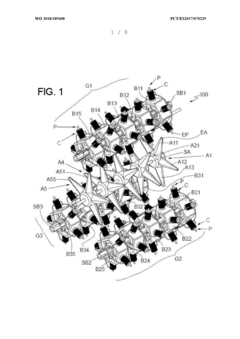
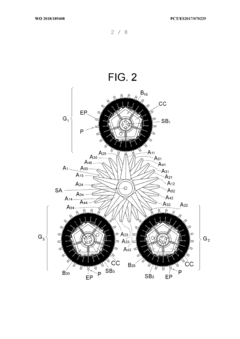
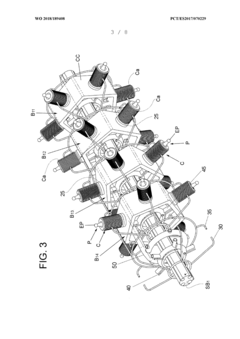
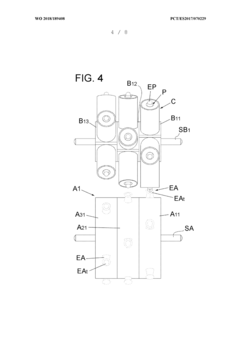
- A radial engine design featuring a plurality of radially distributed sets of radial elements linked to a common output shaft, eliminating the need for a crankshaft and connecting rods, with angularly offset elements and groups of cylinders and pistons for efficient energy transmission and rotation.
V-engine for vehicle
PatentWO2003074852A1
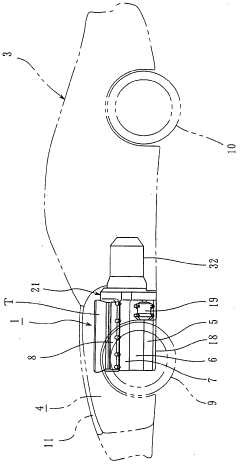
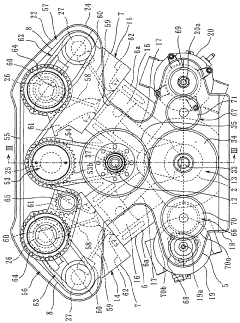
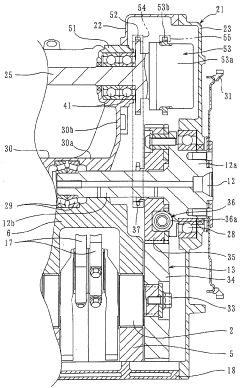
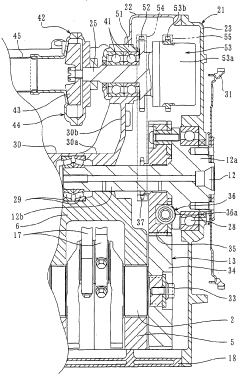
Innovation
- The V-type engine design incorporates auxiliary machines and transmission means on both sides of the crankshaft, with a dry sump lubrication system and strategically positioned output shafts and valve drive shafts to adjust the engine's center of gravity closer to the vehicle's center, allowing for improved power transmission and reduced height, while balancing weights for enhanced stability.
Efficiency and Power-to-Weight Ratio Comparison
When comparing radial engines and V-type engines, efficiency and power-to-weight ratio stand as critical performance metrics that significantly influence their application domains. Radial engines typically demonstrate thermal efficiency rates between 25-30% under optimal operating conditions, while modern V-type engines can achieve 30-35% efficiency, with advanced designs approaching 40% when incorporating direct injection and variable valve timing technologies.
The power-to-weight ratio presents a more nuanced comparison. Historical data indicates that radial engines excel in this metric, with classic designs like the Pratt & Whitney R-2800 delivering approximately 0.83 hp/lb (1.37 kW/kg). Contemporary V-type engines have narrowed this gap substantially, with high-performance variants achieving ratios of 0.75-0.80 hp/lb (1.23-1.32 kW/kg) through extensive use of lightweight alloys and composite materials.
Fuel consumption patterns reveal additional distinctions. Radial engines typically consume 0.45-0.55 lb/hp-hr (274-335 g/kWh) at cruise power settings, whereas V-type engines demonstrate superior economy at 0.40-0.45 lb/hp-hr (243-274 g/kWh) under similar operational parameters. This difference becomes particularly significant in long-duration applications where fuel efficiency directly impacts operational range and costs.
Thermal management characteristics further differentiate these engine architectures. The radial configuration's inherent air cooling design provides uniform cylinder temperature distribution, with measured temperature gradients rarely exceeding 30°C across cylinders. V-type engines, despite their more compact packaging, often exhibit temperature variations of 40-50°C between cylinders, necessitating more sophisticated cooling systems to maintain optimal performance.
Power delivery characteristics also differ substantially. Radial engines produce smoother power curves with torque peaks occurring at 60-70% of maximum RPM, facilitating stable operation across varied load conditions. V-type engines typically generate peak torque at higher RPM ranges (70-80% of maximum), offering superior acceleration characteristics but potentially less flexible power delivery in certain applications.
Recent computational fluid dynamics studies indicate that modern V-type engines achieve volumetric efficiency ratings of 85-95% across their operational range, compared to 75-85% for radial designs. This advantage translates directly to improved specific power output, with contemporary V-type engines delivering 1.2-1.5 hp/in³ (54-68 kW/L) versus 0.8-1.0 hp/in³ (36-45 kW/L) for comparable radial configurations.
The power-to-weight ratio presents a more nuanced comparison. Historical data indicates that radial engines excel in this metric, with classic designs like the Pratt & Whitney R-2800 delivering approximately 0.83 hp/lb (1.37 kW/kg). Contemporary V-type engines have narrowed this gap substantially, with high-performance variants achieving ratios of 0.75-0.80 hp/lb (1.23-1.32 kW/kg) through extensive use of lightweight alloys and composite materials.
Fuel consumption patterns reveal additional distinctions. Radial engines typically consume 0.45-0.55 lb/hp-hr (274-335 g/kWh) at cruise power settings, whereas V-type engines demonstrate superior economy at 0.40-0.45 lb/hp-hr (243-274 g/kWh) under similar operational parameters. This difference becomes particularly significant in long-duration applications where fuel efficiency directly impacts operational range and costs.
Thermal management characteristics further differentiate these engine architectures. The radial configuration's inherent air cooling design provides uniform cylinder temperature distribution, with measured temperature gradients rarely exceeding 30°C across cylinders. V-type engines, despite their more compact packaging, often exhibit temperature variations of 40-50°C between cylinders, necessitating more sophisticated cooling systems to maintain optimal performance.
Power delivery characteristics also differ substantially. Radial engines produce smoother power curves with torque peaks occurring at 60-70% of maximum RPM, facilitating stable operation across varied load conditions. V-type engines typically generate peak torque at higher RPM ranges (70-80% of maximum), offering superior acceleration characteristics but potentially less flexible power delivery in certain applications.
Recent computational fluid dynamics studies indicate that modern V-type engines achieve volumetric efficiency ratings of 85-95% across their operational range, compared to 75-85% for radial designs. This advantage translates directly to improved specific power output, with contemporary V-type engines delivering 1.2-1.5 hp/in³ (54-68 kW/L) versus 0.8-1.0 hp/in³ (36-45 kW/L) for comparable radial configurations.
Environmental Impact and Emissions Standards
The environmental impact of engine design has become increasingly significant in the aviation and automotive industries, with radial and V-type engines presenting distinct ecological footprints. Radial engines, predominantly used in older aircraft designs, typically operate with higher fuel consumption rates compared to their V-type counterparts. This increased fuel usage directly correlates to higher carbon dioxide emissions per unit of power output, positioning radial engines as less environmentally favorable in contemporary contexts.
Emissions testing reveals that radial engines produce significantly higher levels of unburned hydrocarbons and carbon monoxide due to their inherent design characteristics. The circular arrangement of cylinders in radial engines often leads to uneven fuel distribution and combustion inefficiencies, particularly in older models lacking modern fuel injection systems. Conversely, V-type engines benefit from more advanced combustion chamber designs that promote more complete fuel burning and reduced pollutant formation.
Nitrogen oxide (NOx) emissions present a more complex comparison. V-type engines generally operate at higher temperatures due to their compact design and cooling challenges, potentially increasing NOx formation. However, modern V-type engines incorporate advanced emission control technologies such as exhaust gas recirculation (EGR) and selective catalytic reduction (SCR) systems that effectively mitigate these concerns, advantages rarely found in traditional radial engine implementations.
Current emissions standards increasingly favor V-type configurations. The International Civil Aviation Organization (ICAO) and Environmental Protection Agency (EPA) regulations have established progressively stringent limits on aircraft and vehicle emissions that prove challenging for conventional radial engine designs to meet without substantial modifications. These regulatory pressures have accelerated the transition toward V-type and other more efficient engine configurations in new applications where emissions compliance is mandatory.
Noise pollution represents another environmental consideration where these engine types differ substantially. Radial engines typically generate distinctive, higher-decibel sound profiles due to their exposed cylinder arrangement and firing sequence. This characteristic noise contributes to overall environmental impact through sound pollution, particularly relevant in urban settings and areas with noise-sensitive ecosystems. V-type engines, with their more contained design and often incorporated sound dampening features, typically produce lower noise emissions.
Lifecycle assessment studies indicate that V-type engines generally demonstrate superior environmental performance across manufacturing, operation, and end-of-life phases. The materials efficiency in V-type production, combined with their longer operational lifespan and better fuel economy, results in a reduced overall environmental footprint despite the potentially more complex manufacturing processes involved in their production.
Emissions testing reveals that radial engines produce significantly higher levels of unburned hydrocarbons and carbon monoxide due to their inherent design characteristics. The circular arrangement of cylinders in radial engines often leads to uneven fuel distribution and combustion inefficiencies, particularly in older models lacking modern fuel injection systems. Conversely, V-type engines benefit from more advanced combustion chamber designs that promote more complete fuel burning and reduced pollutant formation.
Nitrogen oxide (NOx) emissions present a more complex comparison. V-type engines generally operate at higher temperatures due to their compact design and cooling challenges, potentially increasing NOx formation. However, modern V-type engines incorporate advanced emission control technologies such as exhaust gas recirculation (EGR) and selective catalytic reduction (SCR) systems that effectively mitigate these concerns, advantages rarely found in traditional radial engine implementations.
Current emissions standards increasingly favor V-type configurations. The International Civil Aviation Organization (ICAO) and Environmental Protection Agency (EPA) regulations have established progressively stringent limits on aircraft and vehicle emissions that prove challenging for conventional radial engine designs to meet without substantial modifications. These regulatory pressures have accelerated the transition toward V-type and other more efficient engine configurations in new applications where emissions compliance is mandatory.
Noise pollution represents another environmental consideration where these engine types differ substantially. Radial engines typically generate distinctive, higher-decibel sound profiles due to their exposed cylinder arrangement and firing sequence. This characteristic noise contributes to overall environmental impact through sound pollution, particularly relevant in urban settings and areas with noise-sensitive ecosystems. V-type engines, with their more contained design and often incorporated sound dampening features, typically produce lower noise emissions.
Lifecycle assessment studies indicate that V-type engines generally demonstrate superior environmental performance across manufacturing, operation, and end-of-life phases. The materials efficiency in V-type production, combined with their longer operational lifespan and better fuel economy, results in a reduced overall environmental footprint despite the potentially more complex manufacturing processes involved in their production.
Unlock deeper insights with PatSnap Eureka Quick Research — get a full tech report to explore trends and direct your research. Try now!
Generate Your Research Report Instantly with AI Agent
Supercharge your innovation with PatSnap Eureka AI Agent Platform!