Refining Process Consistency in Direct Lithium Extraction Methods
SEP 12, 20259 MIN READ
Generate Your Research Report Instantly with AI Agent
Patsnap Eureka helps you evaluate technical feasibility & market potential.
DLE Technology Background and Objectives
Direct Lithium Extraction (DLE) has emerged as a transformative technology in the lithium production landscape over the past decade. Traditional lithium extraction methods primarily relied on evaporative processes in salt flats or hard-rock mining, both characterized by lengthy production cycles, significant environmental impacts, and variable product quality. DLE technologies represent a paradigm shift, offering more sustainable and efficient alternatives to conventional extraction methods.
The evolution of DLE began in the early 2000s with rudimentary ion exchange and adsorption techniques. By the 2010s, significant advancements in selective adsorption materials and membrane technologies accelerated development. The past five years have witnessed exponential growth in research and commercial interest, driven by the surging demand for lithium in electric vehicle batteries and energy storage systems.
Despite promising advancements, DLE technologies face a persistent challenge: process consistency. Variations in lithium concentration, extraction efficiency, and product purity across different operational cycles and source brines have hindered widespread commercial adoption. These inconsistencies stem from multiple factors including fluctuating brine compositions, environmental condition variations, and the inherent complexity of selective extraction processes.
The primary objective of refining process consistency in DLE methods is to develop robust extraction protocols that deliver predictable, high-quality lithium products regardless of input variations. This entails standardizing operational parameters, enhancing selective adsorption materials' stability, and implementing advanced process control systems to adapt to fluctuating conditions in real-time.
Technical goals include reducing cycle-to-cycle extraction efficiency variation to below 5%, achieving consistent lithium purity exceeding 99.5% across all production batches, and maintaining these performance metrics across diverse brine sources with varying chemical compositions. Additionally, the technology aims to minimize reagent consumption variability and establish predictable operational costs.
The refinement of process consistency represents a critical inflection point in DLE technology maturation. Success in this domain would catalyze widespread industrial adoption, potentially revolutionizing global lithium supply chains by enabling economically viable extraction from previously untapped resources such as geothermal brines, oilfield produced water, and low-concentration continental brines.
As lithium demand projections continue to outpace supply forecasts, consistent and reliable DLE processes could bridge this gap while simultaneously reducing the environmental footprint of lithium production – aligning with global sustainability objectives and supporting the clean energy transition.
The evolution of DLE began in the early 2000s with rudimentary ion exchange and adsorption techniques. By the 2010s, significant advancements in selective adsorption materials and membrane technologies accelerated development. The past five years have witnessed exponential growth in research and commercial interest, driven by the surging demand for lithium in electric vehicle batteries and energy storage systems.
Despite promising advancements, DLE technologies face a persistent challenge: process consistency. Variations in lithium concentration, extraction efficiency, and product purity across different operational cycles and source brines have hindered widespread commercial adoption. These inconsistencies stem from multiple factors including fluctuating brine compositions, environmental condition variations, and the inherent complexity of selective extraction processes.
The primary objective of refining process consistency in DLE methods is to develop robust extraction protocols that deliver predictable, high-quality lithium products regardless of input variations. This entails standardizing operational parameters, enhancing selective adsorption materials' stability, and implementing advanced process control systems to adapt to fluctuating conditions in real-time.
Technical goals include reducing cycle-to-cycle extraction efficiency variation to below 5%, achieving consistent lithium purity exceeding 99.5% across all production batches, and maintaining these performance metrics across diverse brine sources with varying chemical compositions. Additionally, the technology aims to minimize reagent consumption variability and establish predictable operational costs.
The refinement of process consistency represents a critical inflection point in DLE technology maturation. Success in this domain would catalyze widespread industrial adoption, potentially revolutionizing global lithium supply chains by enabling economically viable extraction from previously untapped resources such as geothermal brines, oilfield produced water, and low-concentration continental brines.
As lithium demand projections continue to outpace supply forecasts, consistent and reliable DLE processes could bridge this gap while simultaneously reducing the environmental footprint of lithium production – aligning with global sustainability objectives and supporting the clean energy transition.
Market Analysis for Direct Lithium Extraction
The global lithium market is experiencing unprecedented growth, primarily driven by the rapid expansion of electric vehicle (EV) production and renewable energy storage systems. Direct Lithium Extraction (DLE) technologies are emerging as critical innovations in meeting this surging demand, offering significant advantages over traditional extraction methods. The market for DLE is projected to grow at a CAGR of 30% between 2023-2030, potentially reaching a market value of $5.7 billion by 2030.
Traditional lithium extraction methods—evaporation ponds and hard-rock mining—currently dominate the market with approximately 95% of global production. However, DLE technologies are gaining traction due to their reduced environmental footprint, higher recovery rates, and ability to access previously uneconomical lithium resources. This shift is creating substantial market opportunities for technology providers, mining companies, and downstream manufacturers.
Geographically, the DLE market shows distinct regional characteristics. North America is emerging as a leader in DLE technology development, with significant investments in the Salton Sea region of California and various brine resources across Nevada and Utah. South America, particularly the "Lithium Triangle" of Argentina, Bolivia, and Chile, represents the largest potential market for DLE implementation due to its vast lithium brine resources. European markets are focusing on DLE as part of their strategic autonomy initiatives, while China continues to secure lithium resources globally while developing proprietary DLE technologies.
Market segmentation reveals diverse applications across multiple sectors. The automotive industry remains the primary demand driver, accounting for approximately 75% of lithium consumption. Energy storage systems represent the fastest-growing segment with 40% year-over-year growth. Consumer electronics constitute a stable but slower-growing market segment.
Key market challenges include high capital expenditure requirements for DLE facilities, technological uncertainties regarding long-term performance, and competition from established extraction methods. The average cost of DLE implementation ranges from $15,000-$30,000 per ton of lithium carbonate equivalent (LCE) capacity, compared to $10,000-$15,000 for traditional methods.
Market adoption is accelerating as major lithium producers and technology companies form strategic partnerships. Recent examples include Eramet's collaboration with Tsingshan Group, Standard Lithium's partnership with Lanxess, and EnergyX's agreements with multiple South American producers. These collaborations are critical for commercializing DLE technologies and scaling production to meet projected demand.
Traditional lithium extraction methods—evaporation ponds and hard-rock mining—currently dominate the market with approximately 95% of global production. However, DLE technologies are gaining traction due to their reduced environmental footprint, higher recovery rates, and ability to access previously uneconomical lithium resources. This shift is creating substantial market opportunities for technology providers, mining companies, and downstream manufacturers.
Geographically, the DLE market shows distinct regional characteristics. North America is emerging as a leader in DLE technology development, with significant investments in the Salton Sea region of California and various brine resources across Nevada and Utah. South America, particularly the "Lithium Triangle" of Argentina, Bolivia, and Chile, represents the largest potential market for DLE implementation due to its vast lithium brine resources. European markets are focusing on DLE as part of their strategic autonomy initiatives, while China continues to secure lithium resources globally while developing proprietary DLE technologies.
Market segmentation reveals diverse applications across multiple sectors. The automotive industry remains the primary demand driver, accounting for approximately 75% of lithium consumption. Energy storage systems represent the fastest-growing segment with 40% year-over-year growth. Consumer electronics constitute a stable but slower-growing market segment.
Key market challenges include high capital expenditure requirements for DLE facilities, technological uncertainties regarding long-term performance, and competition from established extraction methods. The average cost of DLE implementation ranges from $15,000-$30,000 per ton of lithium carbonate equivalent (LCE) capacity, compared to $10,000-$15,000 for traditional methods.
Market adoption is accelerating as major lithium producers and technology companies form strategic partnerships. Recent examples include Eramet's collaboration with Tsingshan Group, Standard Lithium's partnership with Lanxess, and EnergyX's agreements with multiple South American producers. These collaborations are critical for commercializing DLE technologies and scaling production to meet projected demand.
Technical Challenges in DLE Process Consistency
Direct Lithium Extraction (DLE) technologies face significant challenges in maintaining process consistency across different operational scales and brine compositions. The variability in lithium-containing brines presents a fundamental obstacle, with concentrations ranging from 20 to 2,000 mg/L and diverse co-existing elements including sodium, potassium, magnesium, and calcium that interfere with extraction processes.
Process stability remains elusive in DLE operations, with extraction efficiency often fluctuating between 70-90% depending on brine chemistry and operational parameters. This inconsistency creates substantial barriers to commercial viability, as industrial applications require predictable performance to ensure economic feasibility and product quality standards.
Temperature and pH control represent critical variables that significantly impact adsorption kinetics and selectivity in DLE systems. Minor deviations in these parameters can lead to substantial variations in lithium recovery rates. Current control systems struggle to maintain optimal conditions across seasonal changes and during continuous operation, resulting in performance degradation over time.
Scaling issues present another major challenge, with laboratory-proven technologies frequently failing to maintain consistent performance when scaled to pilot or commercial operations. The surface area-to-volume ratio changes dramatically during scaling, altering fluid dynamics and mass transfer characteristics that are essential for efficient lithium capture. Industry data indicates that approximately 60% of promising DLE technologies encounter significant performance drops during scale-up.
Adsorbent material degradation compounds these challenges, with most current materials showing 5-15% capacity reduction after each regeneration cycle. This progressive deterioration necessitates frequent replacement of expensive extraction media, undermining the economic viability of DLE operations. The trade-off between selectivity and durability remains unresolved in current material science approaches.
Process automation and real-time monitoring capabilities are insufficiently developed for DLE applications. The lack of specialized sensors capable of withstanding harsh brine environments limits the ability to implement adaptive control systems that could compensate for variability in feed composition and operational conditions. This technological gap prevents the implementation of machine learning algorithms that could potentially optimize extraction parameters in real-time.
Water management presents an additional consistency challenge, with DLE processes typically requiring 10-20 cubic meters of fresh water per ton of lithium carbonate equivalent produced. Regional water availability fluctuations impact process stability, particularly in arid regions where many lithium resources are located.
Process stability remains elusive in DLE operations, with extraction efficiency often fluctuating between 70-90% depending on brine chemistry and operational parameters. This inconsistency creates substantial barriers to commercial viability, as industrial applications require predictable performance to ensure economic feasibility and product quality standards.
Temperature and pH control represent critical variables that significantly impact adsorption kinetics and selectivity in DLE systems. Minor deviations in these parameters can lead to substantial variations in lithium recovery rates. Current control systems struggle to maintain optimal conditions across seasonal changes and during continuous operation, resulting in performance degradation over time.
Scaling issues present another major challenge, with laboratory-proven technologies frequently failing to maintain consistent performance when scaled to pilot or commercial operations. The surface area-to-volume ratio changes dramatically during scaling, altering fluid dynamics and mass transfer characteristics that are essential for efficient lithium capture. Industry data indicates that approximately 60% of promising DLE technologies encounter significant performance drops during scale-up.
Adsorbent material degradation compounds these challenges, with most current materials showing 5-15% capacity reduction after each regeneration cycle. This progressive deterioration necessitates frequent replacement of expensive extraction media, undermining the economic viability of DLE operations. The trade-off between selectivity and durability remains unresolved in current material science approaches.
Process automation and real-time monitoring capabilities are insufficiently developed for DLE applications. The lack of specialized sensors capable of withstanding harsh brine environments limits the ability to implement adaptive control systems that could compensate for variability in feed composition and operational conditions. This technological gap prevents the implementation of machine learning algorithms that could potentially optimize extraction parameters in real-time.
Water management presents an additional consistency challenge, with DLE processes typically requiring 10-20 cubic meters of fresh water per ton of lithium carbonate equivalent produced. Regional water availability fluctuations impact process stability, particularly in arid regions where many lithium resources are located.
Current DLE Process Consistency Solutions
01 Adsorption-based lithium extraction methods
Adsorption-based methods utilize selective adsorbents to capture lithium ions from brine solutions. These methods typically involve a cycle of adsorption, where lithium ions are selectively captured by the adsorbent material, followed by desorption to recover concentrated lithium. Process consistency is maintained through careful control of adsorption parameters such as contact time, temperature, and pH. Advanced adsorbent materials including ion-exchange resins and inorganic lithium-selective materials help ensure reliable extraction performance across varying brine compositions.- Adsorption-based lithium extraction methods: Adsorption-based methods utilize selective adsorbents to capture lithium ions from brine solutions. These methods typically involve a cycle of adsorption, where lithium ions are captured by the adsorbent material, followed by desorption to recover concentrated lithium. Key factors affecting process consistency include adsorbent selectivity, regeneration efficiency, and operational parameters such as flow rate and contact time. Advanced adsorbents like lithium manganese oxides and titanium-based materials have shown improved selectivity and stability across multiple extraction cycles.
- Membrane and electrochemical extraction technologies: Membrane and electrochemical technologies employ selective membranes or electrochemical cells to separate lithium from other ions in solution. These methods can achieve high lithium recovery rates with consistent purity by controlling electrical potential and membrane properties. Process consistency is maintained through precise control of operating parameters such as current density, membrane fouling prevention, and electrolyte composition. Recent innovations include dual-membrane systems and specialized electrode materials that enhance selectivity while reducing energy consumption.
- Continuous flow processing systems: Continuous flow systems for direct lithium extraction provide advantages in process consistency compared to batch operations. These systems maintain steady-state conditions throughout the extraction process, resulting in more uniform product quality. Key elements include automated control systems, real-time monitoring of process parameters, and integrated feedback loops that adjust operating conditions to maintain optimal performance. Continuous flow designs also facilitate easier scale-up while maintaining consistent lithium recovery rates and purity levels.
- Process monitoring and quality control methods: Advanced monitoring and quality control systems are essential for maintaining consistency in direct lithium extraction processes. These include real-time sensors for measuring lithium concentration, pH, temperature, and other critical parameters throughout the extraction process. Data analytics and machine learning algorithms can identify patterns and predict potential process deviations before they affect product quality. Standardized testing protocols and automated sampling systems ensure consistent evaluation of extraction efficiency and product purity across production batches.
- Pretreatment and impurity management techniques: Effective pretreatment and impurity management are crucial for maintaining consistent lithium extraction performance. These techniques include methods for removing interfering elements such as magnesium, calcium, and boron prior to the main extraction process. Specialized precipitation reactions, selective ion exchange, and multi-stage filtration systems can be employed to standardize feed composition. Consistent impurity removal prevents fouling of extraction media and ensures uniform lithium recovery rates and product quality across varying source material compositions.
02 Membrane-based separation technologies
Membrane-based technologies employ selective membranes to separate lithium ions from other components in brine solutions. These methods include nanofiltration, electrodialysis, and membrane distillation processes. Process consistency is achieved through precise membrane selection, standardized operating procedures, and continuous monitoring of membrane performance. The technology allows for continuous operation with minimal chemical consumption, resulting in more consistent lithium recovery rates and product quality compared to traditional methods.Expand Specific Solutions03 Electrochemical lithium extraction processes
Electrochemical extraction methods utilize electrical potential differences to selectively recover lithium from brines. These processes include electrochemical cells with specialized electrodes that can capture and release lithium ions. Process consistency is maintained through precise control of electrical parameters, electrode materials, and solution chemistry. Automated control systems monitor and adjust operating conditions in real-time to ensure stable performance despite variations in feed composition, resulting in reliable lithium recovery and consistent product quality.Expand Specific Solutions04 Solvent extraction and chemical precipitation methods
Solvent extraction and chemical precipitation methods involve the use of specific chemicals to selectively extract or precipitate lithium from brine solutions. These methods typically include multiple stages of extraction and stripping or controlled precipitation reactions. Process consistency is achieved through precise reagent dosing, standardized reaction conditions, and quality control measures. Advanced process monitoring techniques ensure that extraction efficiency remains stable despite variations in feed composition, resulting in consistent lithium recovery and product purity.Expand Specific Solutions05 Process monitoring and control systems for DLE
Advanced monitoring and control systems are essential for maintaining consistency in direct lithium extraction processes. These systems incorporate real-time sensors, data analytics, and automated control mechanisms to continuously monitor and adjust process parameters. Machine learning algorithms can predict process deviations and recommend corrective actions before they impact extraction efficiency. Standardized operating procedures, coupled with comprehensive quality management systems, ensure that extraction processes remain consistent across different production batches and varying feed compositions, resulting in reliable lithium recovery and consistent product quality.Expand Specific Solutions
Key Industry Players in Lithium Extraction
The direct lithium extraction (DLE) technology market is currently in a growth phase, characterized by increasing demand for efficient lithium production methods to support the expanding electric vehicle and energy storage sectors. The global DLE market is projected to reach significant scale as companies seek alternatives to traditional evaporation methods. Technologically, the field shows varying maturity levels, with companies like Lilac Solutions, EnergyX, and Eramet leading innovation in membrane and ion-exchange technologies. Schlumberger and Koch Technology Solutions are leveraging their extensive extraction expertise to develop industrial-scale solutions, while research institutions such as the Chinese Academy of Sciences and universities are advancing fundamental process consistency. The competitive landscape features established mining corporations, specialized technology startups, and research organizations working to address critical challenges in selectivity, durability, and process standardization.
Koch Technology Solutions LLC
Technical Solution: Koch Technology Solutions has developed a comprehensive Direct Lithium Extraction platform that focuses on process consistency through their advanced separation technologies. Their approach combines selective adsorption materials with proprietary process engineering to maintain stable lithium recovery across varying brine compositions. The Koch system employs a multi-stage extraction process with intermediate purification steps that help buffer against fluctuations in feed brine quality. Their technology incorporates sophisticated process control architecture with predictive modeling capabilities that anticipate and compensate for variations in key parameters such as temperature, pH, and competing ion concentrations. Koch's DLE solution features a unique regeneration process for their adsorption materials that maintains consistent performance characteristics over extended operational periods, minimizing drift in extraction efficiency over time[6]. The system also includes advanced water management technologies that ensure consistent brine pre-treatment and post-processing, further enhancing overall process stability. Field implementations have demonstrated that Koch's technology can maintain lithium recovery rates within ±3% of target values despite significant variations in feed brine composition, with product purity consistently meeting battery-grade specifications across multiple production cycles.
Strengths: Comprehensive integration of extraction, purification, and water management technologies provides robust process stability. Advanced control systems with predictive capabilities enable proactive adjustments to maintain consistent performance. Weaknesses: The multi-stage approach may increase system complexity and capital costs compared to simpler extraction methods. The technology may require significant customization for each specific brine source to achieve optimal performance.
Schlumberger Technologies, Inc.
Technical Solution: Schlumberger has developed advanced Direct Lithium Extraction (DLE) technologies focusing on process consistency through their NeoLith Energy platform. Their approach utilizes selective adsorption materials with precisely engineered pore structures that can selectively capture lithium ions while rejecting competing ions like sodium, magnesium, and calcium. The process employs a continuous countercurrent extraction system that maintains consistent flow dynamics and residence time, ensuring uniform lithium recovery rates across production cycles. Schlumberger's technology incorporates real-time monitoring systems with advanced sensors that track key parameters including pH, temperature, flow rate, and ion concentrations throughout the extraction process. This allows for automated adjustments to maintain optimal operating conditions and consistent lithium recovery. Their process also features a closed-loop regeneration system for the adsorbent materials, which helps maintain consistent performance over thousands of cycles while minimizing chemical consumption and waste generation[1][3]. The technology has demonstrated recovery rates exceeding 90% with minimal variation between batches in field trials.
Strengths: Superior process control systems with real-time monitoring capabilities enable consistent lithium recovery rates. The selective adsorption technology minimizes contamination from competing ions, resulting in higher purity lithium products. Weaknesses: The technology requires significant initial capital investment and specialized expertise for implementation and operation. The system may be less adaptable to brine sources with highly variable compositions without substantial reconfiguration.
Critical Patents in DLE Process Refinement
Process and product
PatentPendingUS20250161879A1
Innovation
- The process involves contacting an aqueous lithium solution with a lithium sorbent to absorb lithium, followed by separation of the loaded sorbent and depleted solution, and subsequent treatment to regenerate the sorbent. This process utilizes pH control to maintain the lithium depleted solution at a pH of about 3 to 7 and employs ultrafiltration or nanofiltration membranes for separation.


Systems and methods for direct lithium extraction
PatentPendingUS20250011957A1
Innovation
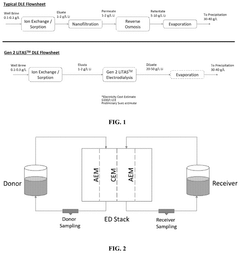
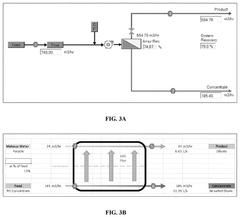
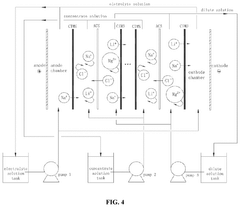
- The integration of selective membrane electrodialysis as a single step to simultaneously concentrate and purify lithium brines, reducing the number of required processing steps, capital and operating costs, and carbon footprint, while eliminating the need for large equipment at remote mining locations.
Environmental Impact Assessment of DLE Methods
Direct Lithium Extraction (DLE) methods have gained significant attention due to their potential for more efficient lithium production compared to traditional evaporation ponds. However, the environmental impacts of these emerging technologies require thorough assessment to ensure sustainable implementation.
The environmental footprint of DLE methods varies significantly based on the specific technology employed. Adsorption-based systems typically consume less water than traditional evaporation methods, potentially reducing water usage by 50-70% in water-stressed regions. However, these systems often require chemical regenerants that may introduce new environmental concerns if not properly managed.
Energy consumption represents another critical environmental factor. Ion exchange and membrane-based DLE technologies generally require substantial electricity for operation, with energy intensities ranging from 5-15 kWh per kilogram of lithium carbonate equivalent (LCE) produced. This energy demand creates indirect environmental impacts through greenhouse gas emissions, particularly in regions dependent on fossil fuel-based electricity generation.
Chemical usage in DLE processes presents additional environmental considerations. Most methods require acids, bases, or specialized solvents for lithium recovery and adsorbent regeneration. These chemicals must be carefully managed to prevent soil contamination and water pollution. Closed-loop systems that recycle process chemicals can significantly reduce these risks but add complexity and cost to operations.
Waste management challenges also emerge from DLE implementation. The concentrated brine streams produced after lithium extraction contain elevated levels of other elements like sodium, potassium, magnesium, and boron. Without proper treatment, these waste streams can damage aquatic ecosystems and contaminate groundwater resources. Some advanced DLE facilities have begun implementing zero liquid discharge (ZLD) systems to address this concern.
Land use impacts of DLE methods are generally favorable compared to traditional evaporation ponds, requiring 50-90% less surface area for equivalent production capacity. This reduced footprint minimizes habitat disruption and allows for more efficient land utilization in sensitive ecological areas.
Biodiversity impacts must also be considered, particularly for DLE operations in sensitive ecosystems like salt flats and high-altitude deserts. While the reduced land footprint helps mitigate some concerns, the extraction of subsurface brines may still alter hydrological patterns that support unique ecological communities.
Carbon footprint assessments of DLE methods indicate potential for lower lifecycle emissions compared to traditional methods, though this advantage depends heavily on energy sources and process optimization. Recent life cycle analyses suggest emissions ranging from 3.5-8 tonnes CO2e per tonne of lithium carbonate produced, representing a potential reduction of 30-60% compared to evaporation pond methods.
The environmental footprint of DLE methods varies significantly based on the specific technology employed. Adsorption-based systems typically consume less water than traditional evaporation methods, potentially reducing water usage by 50-70% in water-stressed regions. However, these systems often require chemical regenerants that may introduce new environmental concerns if not properly managed.
Energy consumption represents another critical environmental factor. Ion exchange and membrane-based DLE technologies generally require substantial electricity for operation, with energy intensities ranging from 5-15 kWh per kilogram of lithium carbonate equivalent (LCE) produced. This energy demand creates indirect environmental impacts through greenhouse gas emissions, particularly in regions dependent on fossil fuel-based electricity generation.
Chemical usage in DLE processes presents additional environmental considerations. Most methods require acids, bases, or specialized solvents for lithium recovery and adsorbent regeneration. These chemicals must be carefully managed to prevent soil contamination and water pollution. Closed-loop systems that recycle process chemicals can significantly reduce these risks but add complexity and cost to operations.
Waste management challenges also emerge from DLE implementation. The concentrated brine streams produced after lithium extraction contain elevated levels of other elements like sodium, potassium, magnesium, and boron. Without proper treatment, these waste streams can damage aquatic ecosystems and contaminate groundwater resources. Some advanced DLE facilities have begun implementing zero liquid discharge (ZLD) systems to address this concern.
Land use impacts of DLE methods are generally favorable compared to traditional evaporation ponds, requiring 50-90% less surface area for equivalent production capacity. This reduced footprint minimizes habitat disruption and allows for more efficient land utilization in sensitive ecological areas.
Biodiversity impacts must also be considered, particularly for DLE operations in sensitive ecosystems like salt flats and high-altitude deserts. While the reduced land footprint helps mitigate some concerns, the extraction of subsurface brines may still alter hydrological patterns that support unique ecological communities.
Carbon footprint assessments of DLE methods indicate potential for lower lifecycle emissions compared to traditional methods, though this advantage depends heavily on energy sources and process optimization. Recent life cycle analyses suggest emissions ranging from 3.5-8 tonnes CO2e per tonne of lithium carbonate produced, representing a potential reduction of 30-60% compared to evaporation pond methods.
Scalability Factors in DLE Implementation
Scaling Direct Lithium Extraction (DLE) technologies from laboratory to commercial implementation presents significant challenges that must be addressed to ensure economic viability. The transition from small-scale proof-of-concept to industrial-scale operations requires careful consideration of multiple factors that influence process efficiency, cost-effectiveness, and environmental sustainability.
Infrastructure requirements represent a primary scalability concern for DLE implementation. Unlike traditional evaporation pond methods, DLE facilities demand sophisticated equipment including ion exchange columns, adsorption media, and advanced filtration systems. The capital expenditure for these components increases non-linearly with capacity, creating economic thresholds that must be overcome for commercial viability. Additionally, the physical footprint of DLE operations, while smaller than evaporation ponds, still requires strategic planning for expansion capabilities.
Energy consumption patterns change dramatically during scale-up of DLE processes. Laboratory-scale demonstrations often underestimate the energy requirements for heating, pumping, and regeneration of extraction media at commercial scales. Recent industry analyses indicate that energy costs can represent 20-35% of operational expenses in full-scale DLE implementations, necessitating careful integration with renewable energy sources to maintain economic competitiveness and environmental credentials.
Process consistency across varying brine compositions presents another critical scalability challenge. DLE technologies that perform effectively with specific lithium concentrations or brine chemistries may experience significant efficiency losses when processing heterogeneous resources. Commercial implementations must incorporate adaptive process controls and flexible operational parameters to maintain extraction efficiency across seasonal variations and as resource quality evolves over the project lifetime.
Water management becomes increasingly complex at scale, particularly in water-stressed regions where many lithium resources are located. While DLE methods generally use less water than evaporation ponds, the absolute water requirements for commercial operations remain substantial. Closed-loop water recycling systems become economically viable only at larger scales, creating a transitional challenge during the scaling process that must be carefully managed.
Supply chain resilience for specialized materials used in DLE processes, particularly selective adsorbents and ion exchange media, represents a frequently overlooked scalability factor. Current production capacity for these materials is limited, potentially creating bottlenecks as multiple DLE projects scale simultaneously. Strategic partnerships with material suppliers and development of alternative media sources are becoming essential components of successful scaling strategies.
Infrastructure requirements represent a primary scalability concern for DLE implementation. Unlike traditional evaporation pond methods, DLE facilities demand sophisticated equipment including ion exchange columns, adsorption media, and advanced filtration systems. The capital expenditure for these components increases non-linearly with capacity, creating economic thresholds that must be overcome for commercial viability. Additionally, the physical footprint of DLE operations, while smaller than evaporation ponds, still requires strategic planning for expansion capabilities.
Energy consumption patterns change dramatically during scale-up of DLE processes. Laboratory-scale demonstrations often underestimate the energy requirements for heating, pumping, and regeneration of extraction media at commercial scales. Recent industry analyses indicate that energy costs can represent 20-35% of operational expenses in full-scale DLE implementations, necessitating careful integration with renewable energy sources to maintain economic competitiveness and environmental credentials.
Process consistency across varying brine compositions presents another critical scalability challenge. DLE technologies that perform effectively with specific lithium concentrations or brine chemistries may experience significant efficiency losses when processing heterogeneous resources. Commercial implementations must incorporate adaptive process controls and flexible operational parameters to maintain extraction efficiency across seasonal variations and as resource quality evolves over the project lifetime.
Water management becomes increasingly complex at scale, particularly in water-stressed regions where many lithium resources are located. While DLE methods generally use less water than evaporation ponds, the absolute water requirements for commercial operations remain substantial. Closed-loop water recycling systems become economically viable only at larger scales, creating a transitional challenge during the scaling process that must be carefully managed.
Supply chain resilience for specialized materials used in DLE processes, particularly selective adsorbents and ion exchange media, represents a frequently overlooked scalability factor. Current production capacity for these materials is limited, potentially creating bottlenecks as multiple DLE projects scale simultaneously. Strategic partnerships with material suppliers and development of alternative media sources are becoming essential components of successful scaling strategies.
Unlock deeper insights with Patsnap Eureka Quick Research — get a full tech report to explore trends and direct your research. Try now!
Generate Your Research Report Instantly with AI Agent
Supercharge your innovation with Patsnap Eureka AI Agent Platform!