

Standardized Test Methods For SALD-Deposited Films
AUG 28, 20259 MIN READ
Generate Your Research Report Instantly with AI Agent
PatSnap Eureka helps you evaluate technical feasibility & market potential.
SALD Film Testing Background and Objectives
Spatial Atomic Layer Deposition (SALD) has emerged as a transformative technology in thin film deposition, evolving from conventional Atomic Layer Deposition (ALD) techniques over the past two decades. Unlike traditional ALD which operates in vacuum chambers with sequential gas pulses, SALD enables continuous deposition at atmospheric pressure through spatial separation of precursors, significantly enhancing throughput capabilities while maintaining precise atomic-level control over film growth.
The development trajectory of SALD technology has been marked by progressive innovations aimed at overcoming the inherent speed limitations of conventional ALD while preserving its hallmark conformality and thickness precision. Early conceptual work in the 2000s laid the theoretical foundation, followed by practical implementations in the 2010s that demonstrated viability for industrial applications, particularly in semiconductor manufacturing, photovoltaics, and flexible electronics.
Current technological trends indicate a growing emphasis on scalability and integration with roll-to-roll manufacturing processes, positioning SALD as a potential enabler for high-volume production of advanced functional materials. The convergence of SALD with Industry 4.0 principles has further accelerated its development, incorporating real-time monitoring and feedback systems for enhanced process control.
Despite these advancements, a critical gap persists in the standardization of test methods specifically designed for SALD-deposited films. While conventional ALD films benefit from established characterization protocols, SALD films present unique challenges due to their distinct deposition kinetics, potential atmospheric contamination pathways, and scaled production environments. This standardization deficit impedes meaningful comparison between research outcomes and creates barriers to industrial adoption.
The primary objective of this technical investigation is to comprehensively evaluate existing test methodologies applicable to SALD films and identify standardization opportunities. Specifically, we aim to establish reproducible protocols for assessing critical film properties including thickness uniformity, compositional homogeneity, defect density, adhesion strength, and long-term stability under various environmental conditions.
Secondary objectives include determining how deposition parameters unique to SALD (such as head-substrate separation distance, translation speed, and atmospheric composition) correlate with resultant film properties, and developing in-line quality control methodologies compatible with high-throughput manufacturing environments. The ultimate goal is to propose a framework of standardized test methods that can facilitate consistent quality assessment across research institutions and manufacturing facilities, thereby accelerating the industrial implementation of SALD technology for next-generation electronic devices and energy systems.
The development trajectory of SALD technology has been marked by progressive innovations aimed at overcoming the inherent speed limitations of conventional ALD while preserving its hallmark conformality and thickness precision. Early conceptual work in the 2000s laid the theoretical foundation, followed by practical implementations in the 2010s that demonstrated viability for industrial applications, particularly in semiconductor manufacturing, photovoltaics, and flexible electronics.
Current technological trends indicate a growing emphasis on scalability and integration with roll-to-roll manufacturing processes, positioning SALD as a potential enabler for high-volume production of advanced functional materials. The convergence of SALD with Industry 4.0 principles has further accelerated its development, incorporating real-time monitoring and feedback systems for enhanced process control.
Despite these advancements, a critical gap persists in the standardization of test methods specifically designed for SALD-deposited films. While conventional ALD films benefit from established characterization protocols, SALD films present unique challenges due to their distinct deposition kinetics, potential atmospheric contamination pathways, and scaled production environments. This standardization deficit impedes meaningful comparison between research outcomes and creates barriers to industrial adoption.
The primary objective of this technical investigation is to comprehensively evaluate existing test methodologies applicable to SALD films and identify standardization opportunities. Specifically, we aim to establish reproducible protocols for assessing critical film properties including thickness uniformity, compositional homogeneity, defect density, adhesion strength, and long-term stability under various environmental conditions.
Secondary objectives include determining how deposition parameters unique to SALD (such as head-substrate separation distance, translation speed, and atmospheric composition) correlate with resultant film properties, and developing in-line quality control methodologies compatible with high-throughput manufacturing environments. The ultimate goal is to propose a framework of standardized test methods that can facilitate consistent quality assessment across research institutions and manufacturing facilities, thereby accelerating the industrial implementation of SALD technology for next-generation electronic devices and energy systems.
Market Demand Analysis for SALD Technology
The global market for Spatial Atomic Layer Deposition (SALD) technology is experiencing significant growth, driven by increasing demand for high-performance thin films in various industries. Current market analysis indicates that the semiconductor industry remains the primary adopter of SALD technology, with an expanding footprint in display manufacturing, photovoltaics, and energy storage applications. The need for precise, uniform, and defect-free thin films at industrial scales has created a substantial market opportunity for SALD solutions.
Consumer electronics manufacturers are increasingly seeking SALD-deposited films for next-generation devices, particularly for flexible displays, advanced batteries, and protective coatings. This demand is fueled by the superior performance characteristics of SALD films, including excellent conformality, precise thickness control, and enhanced material properties compared to conventional deposition methods.
The renewable energy sector represents another significant market driver for SALD technology. Solar cell manufacturers are adopting SALD processes to improve cell efficiency and reduce production costs. The ability of SALD to deposit uniform barrier and passivation layers at high throughput rates aligns perfectly with the industry's need for scalable, cost-effective manufacturing solutions.
Market research reveals growing interest from automotive and aerospace industries, where SALD-deposited films offer potential applications in corrosion protection, thermal management, and lightweight composite materials. The demand for standardized test methods for SALD-deposited films is particularly acute in these sectors, where reliability and performance consistency are paramount concerns.
Healthcare and biomedical applications represent an emerging market segment for SALD technology. The ability to create biocompatible coatings with precisely controlled properties has attracted interest from medical device manufacturers and pharmaceutical companies. This sector's growth potential is substantial, though currently limited by the lack of standardized testing protocols specific to biomedical applications.
Regional market analysis shows Asia-Pacific leading SALD technology adoption, primarily due to the concentration of semiconductor and display manufacturing facilities. North America and Europe follow, with increasing investments in research and development of advanced SALD applications. The market in these regions is characterized by a focus on high-value applications where film quality and performance are prioritized over cost considerations.
Industry stakeholders consistently highlight the need for standardized test methods for SALD-deposited films as a critical factor for market expansion. The absence of universally accepted testing protocols creates barriers to technology adoption, complicates quality assurance processes, and hinders comparative performance evaluation across different SALD systems and processes.
Consumer electronics manufacturers are increasingly seeking SALD-deposited films for next-generation devices, particularly for flexible displays, advanced batteries, and protective coatings. This demand is fueled by the superior performance characteristics of SALD films, including excellent conformality, precise thickness control, and enhanced material properties compared to conventional deposition methods.
The renewable energy sector represents another significant market driver for SALD technology. Solar cell manufacturers are adopting SALD processes to improve cell efficiency and reduce production costs. The ability of SALD to deposit uniform barrier and passivation layers at high throughput rates aligns perfectly with the industry's need for scalable, cost-effective manufacturing solutions.
Market research reveals growing interest from automotive and aerospace industries, where SALD-deposited films offer potential applications in corrosion protection, thermal management, and lightweight composite materials. The demand for standardized test methods for SALD-deposited films is particularly acute in these sectors, where reliability and performance consistency are paramount concerns.
Healthcare and biomedical applications represent an emerging market segment for SALD technology. The ability to create biocompatible coatings with precisely controlled properties has attracted interest from medical device manufacturers and pharmaceutical companies. This sector's growth potential is substantial, though currently limited by the lack of standardized testing protocols specific to biomedical applications.
Regional market analysis shows Asia-Pacific leading SALD technology adoption, primarily due to the concentration of semiconductor and display manufacturing facilities. North America and Europe follow, with increasing investments in research and development of advanced SALD applications. The market in these regions is characterized by a focus on high-value applications where film quality and performance are prioritized over cost considerations.
Industry stakeholders consistently highlight the need for standardized test methods for SALD-deposited films as a critical factor for market expansion. The absence of universally accepted testing protocols creates barriers to technology adoption, complicates quality assurance processes, and hinders comparative performance evaluation across different SALD systems and processes.
Current Status and Challenges in SALD Film Characterization
Spatial Atomic Layer Deposition (SALD) technology has seen significant advancement globally, yet standardized characterization methods remain a critical challenge. Current SALD film characterization practices vary considerably across research institutions and industries, creating obstacles for consistent quality assessment and process optimization. The lack of universally accepted test protocols hampers direct comparison of results between different research groups and manufacturing facilities, ultimately slowing industry-wide progress.
In academic settings, researchers typically employ a combination of techniques including ellipsometry, X-ray reflectivity (XRR), and atomic force microscopy (AFM) to characterize film thickness and uniformity. However, methodological differences in sample preparation, measurement conditions, and data analysis create significant variability in reported results. This inconsistency particularly affects emerging applications in flexible electronics and energy storage devices where precise film properties are critical.
Industrial implementation faces additional challenges as manufacturers have developed proprietary testing protocols optimized for their specific production environments. These closed systems limit knowledge sharing and standardization efforts across the sector. The absence of industry-wide benchmarks makes it difficult to establish reliable quality control parameters and performance metrics for SALD processes at scale.
Geographical disparities in characterization approaches are also evident. Research groups in East Asia often emphasize electrical performance testing, while European institutions tend to focus more on structural and compositional analysis. North American facilities frequently prioritize in-situ monitoring techniques. These regional differences further complicate the establishment of universal standards.
Technical limitations of current characterization tools present another significant barrier. Many conventional thin film analysis techniques were developed for traditional vacuum-based ALD processes and require adaptation for the unique characteristics of SALD films, particularly for ultra-thin layers below 10nm where measurement accuracy becomes increasingly challenging.
Recent collaborative efforts between research institutions and industry leaders have begun addressing these standardization issues. The International SALD Consortium initiated in 2022 is working to develop consensus-based protocols for thickness measurement, compositional analysis, and defect characterization. Similarly, organizations such as SEMI and ASTM International have established working groups focused specifically on SALD film characterization standards.
The economic implications of this standardization gap are substantial. Manufacturing yield inconsistencies, quality control challenges, and difficulties in technology transfer between R&D and production environments all contribute to increased costs and delayed commercialization timelines for SALD-based products.
In academic settings, researchers typically employ a combination of techniques including ellipsometry, X-ray reflectivity (XRR), and atomic force microscopy (AFM) to characterize film thickness and uniformity. However, methodological differences in sample preparation, measurement conditions, and data analysis create significant variability in reported results. This inconsistency particularly affects emerging applications in flexible electronics and energy storage devices where precise film properties are critical.
Industrial implementation faces additional challenges as manufacturers have developed proprietary testing protocols optimized for their specific production environments. These closed systems limit knowledge sharing and standardization efforts across the sector. The absence of industry-wide benchmarks makes it difficult to establish reliable quality control parameters and performance metrics for SALD processes at scale.
Geographical disparities in characterization approaches are also evident. Research groups in East Asia often emphasize electrical performance testing, while European institutions tend to focus more on structural and compositional analysis. North American facilities frequently prioritize in-situ monitoring techniques. These regional differences further complicate the establishment of universal standards.
Technical limitations of current characterization tools present another significant barrier. Many conventional thin film analysis techniques were developed for traditional vacuum-based ALD processes and require adaptation for the unique characteristics of SALD films, particularly for ultra-thin layers below 10nm where measurement accuracy becomes increasingly challenging.
Recent collaborative efforts between research institutions and industry leaders have begun addressing these standardization issues. The International SALD Consortium initiated in 2022 is working to develop consensus-based protocols for thickness measurement, compositional analysis, and defect characterization. Similarly, organizations such as SEMI and ASTM International have established working groups focused specifically on SALD film characterization standards.
The economic implications of this standardization gap are substantial. Manufacturing yield inconsistencies, quality control challenges, and difficulties in technology transfer between R&D and production environments all contribute to increased costs and delayed commercialization timelines for SALD-based products.
Existing Standardized Test Methods for Thin Films
01 SALD deposition process parameters and control
Spatial Atomic Layer Deposition (SALD) processes require precise control of parameters to achieve standardized film quality. This includes controlling gas flow rates, substrate temperature, precursor delivery, and reaction chamber conditions. Advanced monitoring systems and feedback control mechanisms are employed to maintain consistent deposition conditions, ensuring reproducible film thickness and properties across different production runs.- SALD deposition techniques and equipment standardization: Spatial Atomic Layer Deposition (SALD) techniques require standardized equipment and processes to ensure consistent film quality. This includes standardized reactor designs, gas flow systems, and temperature control mechanisms. Standardization of these components helps achieve uniform film thickness and properties across different manufacturing setups, which is crucial for industrial applications and scalability of SALD technology.
- Quality control and characterization methods for SALD films: Standardized methods for characterizing and testing SALD-deposited films are essential for quality assurance. These include techniques for measuring film thickness, composition, crystallinity, and electrical properties. Implementing consistent testing protocols allows for reliable comparison between films produced by different SALD systems and ensures that films meet required specifications for various applications.
- Process parameter standardization for SALD deposition: Standardization of process parameters such as precursor pulse times, purge times, substrate temperature, and carrier gas flow rates is critical for reproducible SALD film deposition. Establishing optimal parameter ranges and standardized recipes for different materials helps achieve consistent film growth rates and properties, facilitating technology transfer between research and manufacturing environments.
- Material standardization for SALD precursors and substrates: Standardization of precursor materials and substrate preparation is essential for consistent SALD film deposition. This includes specifications for precursor purity, storage conditions, and delivery methods, as well as substrate cleaning and preparation protocols. Standardized materials ensure reproducible film growth and properties, reducing batch-to-batch variations in manufacturing processes.
- Integration of SALD films in device fabrication standards: Standards for integrating SALD-deposited films into device fabrication processes are necessary for industrial adoption. This includes protocols for interfacing SALD films with other materials, post-deposition treatments, and compatibility with existing semiconductor manufacturing standards. Standardized integration methods ensure that SALD films can be reliably incorporated into complex device structures while maintaining their desired properties and performance characteristics.
02 Characterization and quality assessment methods
Standardization of SALD-deposited films requires robust characterization techniques to verify film properties. These methods include thickness measurements, compositional analysis, structural characterization, and electrical property testing. Automated inspection systems and in-situ monitoring tools are implemented to provide real-time feedback on film quality, enabling immediate process adjustments and ensuring consistent film properties across large substrate areas.Expand Specific Solutions03 Equipment design and optimization for uniform deposition
Specialized equipment designs are crucial for achieving standardized SALD film deposition. This includes optimized precursor delivery systems, reaction chamber geometries, and substrate handling mechanisms. Innovations in equipment design focus on ensuring uniform precursor distribution, consistent gas flow patterns, and precise temperature control across the substrate surface, all contributing to homogeneous film growth and reproducible properties.Expand Specific Solutions04 Material selection and precursor standardization
The selection and standardization of precursor materials significantly impact SALD film quality. Research focuses on identifying stable precursor compounds with consistent properties, appropriate vapor pressures, and reliable reaction characteristics. Standardized precursor preparation methods, storage protocols, and delivery systems are developed to ensure batch-to-batch consistency in film composition and properties, which is essential for industrial-scale applications.Expand Specific Solutions05 Integration of SALD processes into manufacturing standards
Incorporating SALD technology into existing manufacturing standards requires development of comprehensive protocols and specifications. This includes establishing standard operating procedures, process validation methods, and quality control benchmarks specific to SALD-deposited films. Industry collaborations and international standardization efforts aim to create unified guidelines for SALD processes, enabling consistent implementation across different manufacturing facilities and ensuring compatibility with downstream processing steps.Expand Specific Solutions
Leading Organizations in SALD Technology Development
The SALD-deposited films standardization landscape is currently in an emerging growth phase, characterized by increasing industry adoption but still evolving technical standards. The market is expanding rapidly as semiconductor, display, and advanced materials industries recognize SALD's potential for precise nanoscale deposition. Key players driving technical maturity include established equipment manufacturers like Applied Materials, Tokyo Electron, and Lam Research, alongside materials specialists such as Corning and ULVAC. Academic-industry partnerships involving institutions like University of Tokyo and Chinese Academy of Sciences are accelerating standardization efforts. While technical capabilities are advancing, the industry still requires consensus on measurement protocols, quality benchmarks, and cross-platform compatibility to fully mature this promising thin-film deposition technology.
Corning, Inc.
Technical Solution: Corning has developed a comprehensive standardized testing framework for SALD-deposited films specifically optimized for glass and ceramic substrates. Their methodology, known as "Precision Film Analytics," combines optical, mechanical, and chemical characterization techniques. For thickness measurement, Corning employs variable angle spectroscopic ellipsometry (VASE) with proprietary algorithms to account for substrate transparency effects. Their approach includes standardized adhesion testing through thermal cycling between -40°C and 85°C followed by tape testing to quantify delamination percentage. For barrier performance evaluation, Corning has pioneered calcium test standardization for SALD films, allowing precise measurement of water vapor transmission rates down to 10^-6 g/m²/day. Their methodology also includes standardized chemical resistance testing using a panel of industry-relevant solvents and cleaning agents to assess film durability under real-world conditions.
Strengths: Corning's test methods excel at characterizing SALD films on non-semiconductor substrates like glass, ceramics, and polymers. Their standardized protocols are particularly valuable for display, architectural, and automotive applications. Weaknesses: Their methods are less optimized for electronic performance metrics relevant to semiconductor applications, focusing more on mechanical and barrier properties.
Applied Materials, Inc.
Technical Solution: Applied Materials has developed comprehensive standardized test methods for SALD (Spatial Atomic Layer Deposition) films focusing on uniformity, thickness, and composition analysis. Their approach combines in-situ ellipsometry with X-ray reflectivity (XRR) measurements to provide real-time film thickness monitoring during deposition processes. The company has established a multi-point measurement protocol across 300mm wafers to ensure statistical validity of uniformity assessments. Their test methodology includes electrical characterization through four-point probe measurements and advanced spectroscopic techniques to evaluate film quality. Applied Materials has also pioneered automated defect inspection systems specifically calibrated for SALD films, enabling quantitative comparison between different deposition parameters and equipment configurations.
Strengths: Industry-leading metrology integration with deposition tools allows for real-time process optimization. Their standardized methods have been widely adopted across semiconductor manufacturing. Weaknesses: Their test methods require expensive, specialized equipment that may be inaccessible to smaller research institutions and companies with limited resources.
Critical Analysis of SALD Film Characterization Techniques
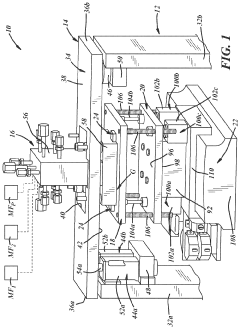
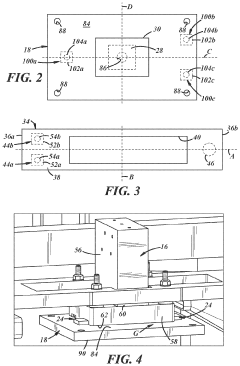
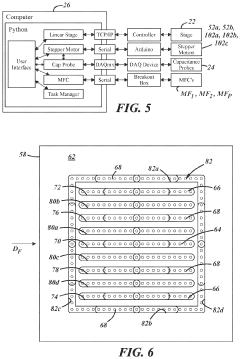
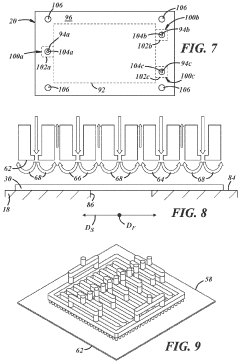
Mechatronic spatial atomic layer deposition system with closed-loop feedback control of parallelism and component alignment
PatentPendingUS20230097272A1
Innovation
- The integration of gap detection sensors and linear actuators with a controller allows for real-time monitoring and adjustment of the gap between the depositor head and the substrate plate, ensuring precise control over the positioning and maintaining the desired gap size and parallelism, thereby preventing gas intermixing and maintaining the integrity of the SALD process.
Film deposition using spatial atomic layer deposition or pulsed chemical vapor deposition
PatentInactiveJP2017503079A
Innovation
- A substrate processing system with a processing chamber divided into multiple sections separated by gas curtains, where substrates are moved laterally through these sections, exposing different portions to varying processing conditions, including temperature changes and reactive gases, to form films uniformly and efficiently.


International Standards and Certification Requirements
The standardization landscape for Spatial Atomic Layer Deposition (SALD) films currently lacks comprehensive international frameworks, creating significant challenges for industry-wide adoption and quality assurance. Organizations such as the International Organization for Standardization (ISO) and ASTM International have established standards for conventional ALD processes, but specific standards for SALD-deposited films remain underdeveloped. This gap necessitates urgent attention as SALD technology advances toward commercial applications.
Key certification bodies including ISO/TC 201 (Surface Chemical Analysis) and SEMI have begun preliminary work on developing test methods applicable to thin films produced via SALD. These efforts focus on establishing standardized protocols for measuring film thickness uniformity, compositional analysis, and defect characterization. The European Committee for Standardization (CEN) has also initiated working groups specifically addressing emerging deposition technologies, including SALD processes.
Industry stakeholders must navigate a complex regulatory environment that varies significantly across regions. In the European Union, compliance with RoHS and REACH regulations impacts SALD implementation in electronics manufacturing, while in the United States, FDA requirements govern medical device applications utilizing SALD-deposited films. These regulatory frameworks indirectly influence the development of test methods by establishing performance and safety parameters.
Certification requirements for SALD films typically encompass electrical properties, mechanical durability, and environmental stability testing. The International Electrotechnical Commission (IEC) provides relevant standards for electrical characterization, while ISO 14577 offers guidance for nanomechanical testing applicable to thin films. However, these standards require adaptation to address the unique characteristics of SALD-deposited materials, particularly regarding high-throughput processing effects on film properties.
Mutual recognition agreements between standards organizations facilitate global acceptance of test results, though significant harmonization challenges persist. The semiconductor industry, through organizations like SEMI, has been particularly proactive in developing standards that could be adapted for SALD processes, including SEMI MS5-0618 for thin film metrology systems and SEMI C10-0305 for material purity requirements.
Emerging certification trends indicate movement toward performance-based standards rather than prescriptive methodologies, allowing greater flexibility in testing approaches while maintaining rigorous quality requirements. This evolution aligns with the rapid technological advancement of SALD processes and enables more efficient adaptation of existing standards to novel deposition techniques.
Key certification bodies including ISO/TC 201 (Surface Chemical Analysis) and SEMI have begun preliminary work on developing test methods applicable to thin films produced via SALD. These efforts focus on establishing standardized protocols for measuring film thickness uniformity, compositional analysis, and defect characterization. The European Committee for Standardization (CEN) has also initiated working groups specifically addressing emerging deposition technologies, including SALD processes.
Industry stakeholders must navigate a complex regulatory environment that varies significantly across regions. In the European Union, compliance with RoHS and REACH regulations impacts SALD implementation in electronics manufacturing, while in the United States, FDA requirements govern medical device applications utilizing SALD-deposited films. These regulatory frameworks indirectly influence the development of test methods by establishing performance and safety parameters.
Certification requirements for SALD films typically encompass electrical properties, mechanical durability, and environmental stability testing. The International Electrotechnical Commission (IEC) provides relevant standards for electrical characterization, while ISO 14577 offers guidance for nanomechanical testing applicable to thin films. However, these standards require adaptation to address the unique characteristics of SALD-deposited materials, particularly regarding high-throughput processing effects on film properties.
Mutual recognition agreements between standards organizations facilitate global acceptance of test results, though significant harmonization challenges persist. The semiconductor industry, through organizations like SEMI, has been particularly proactive in developing standards that could be adapted for SALD processes, including SEMI MS5-0618 for thin film metrology systems and SEMI C10-0305 for material purity requirements.
Emerging certification trends indicate movement toward performance-based standards rather than prescriptive methodologies, allowing greater flexibility in testing approaches while maintaining rigorous quality requirements. This evolution aligns with the rapid technological advancement of SALD processes and enables more efficient adaptation of existing standards to novel deposition techniques.
Industrial Applications and Performance Metrics
Spatial Atomic Layer Deposition (SALD) technology has rapidly expanded into diverse industrial sectors, with applications spanning from semiconductor manufacturing to energy storage solutions. The industrial adoption of SALD-deposited films requires robust performance metrics and standardized evaluation methods to ensure quality, reliability, and reproducibility across different manufacturing environments.
In semiconductor manufacturing, SALD films serve critical functions in transistor gate dielectrics, diffusion barriers, and passivation layers. These applications demand precise thickness control (typically within ±2% variation), excellent conformality (>95% step coverage), and minimal defect density (<1 defect/cm²). Current industry standards evaluate these films based on electrical properties including breakdown voltage, leakage current, and interface trap density.
The photovoltaic industry has embraced SALD for transparent conductive oxides and passivation layers in solar cells. Performance metrics focus on optical transparency (>85% in visible spectrum), sheet resistance (<100 Ω/sq), and long-term stability under environmental stressors. Standardized accelerated aging tests involving temperature cycling (−40°C to 85°C) and humidity exposure (85% RH) have become essential for qualifying these films.
For flexible electronics applications, SALD films must maintain functionality under mechanical stress. Bend radius tolerance, adhesion strength, and crack onset strain represent critical performance parameters. The industry has developed specialized test methods including cyclic bending tests (typically 10,000 cycles at specified radii) and tape adhesion tests following modified ASTM D3359 standards.
Barrier films for packaging applications require standardized water vapor transmission rate (WVTR) and oxygen transmission rate (OTR) measurements. High-performance SALD barriers typically achieve WVTR values below 10⁻⁶ g/m²/day and OTR below 10⁻³ cm³/m²/day. These properties are evaluated using specialized instrumentation following modified ASTM F1249 and ASTM D3985 test methods.
Emerging biomedical applications utilize SALD films for implantable devices and biosensors, where biocompatibility and biostability metrics become paramount. Standardized cytotoxicity assays (ISO 10993-5), protein adsorption tests, and simulated body fluid immersion studies evaluate the biological performance of these films.
Cross-industry standardization efforts are underway through organizations like SEMI, ASTM International, and ISO to develop unified test protocols specifically for SALD-deposited films. These initiatives aim to establish reference materials, measurement techniques, and reporting formats that facilitate meaningful comparisons across different deposition systems and manufacturing facilities.
In semiconductor manufacturing, SALD films serve critical functions in transistor gate dielectrics, diffusion barriers, and passivation layers. These applications demand precise thickness control (typically within ±2% variation), excellent conformality (>95% step coverage), and minimal defect density (<1 defect/cm²). Current industry standards evaluate these films based on electrical properties including breakdown voltage, leakage current, and interface trap density.
The photovoltaic industry has embraced SALD for transparent conductive oxides and passivation layers in solar cells. Performance metrics focus on optical transparency (>85% in visible spectrum), sheet resistance (<100 Ω/sq), and long-term stability under environmental stressors. Standardized accelerated aging tests involving temperature cycling (−40°C to 85°C) and humidity exposure (85% RH) have become essential for qualifying these films.
For flexible electronics applications, SALD films must maintain functionality under mechanical stress. Bend radius tolerance, adhesion strength, and crack onset strain represent critical performance parameters. The industry has developed specialized test methods including cyclic bending tests (typically 10,000 cycles at specified radii) and tape adhesion tests following modified ASTM D3359 standards.
Barrier films for packaging applications require standardized water vapor transmission rate (WVTR) and oxygen transmission rate (OTR) measurements. High-performance SALD barriers typically achieve WVTR values below 10⁻⁶ g/m²/day and OTR below 10⁻³ cm³/m²/day. These properties are evaluated using specialized instrumentation following modified ASTM F1249 and ASTM D3985 test methods.
Emerging biomedical applications utilize SALD films for implantable devices and biosensors, where biocompatibility and biostability metrics become paramount. Standardized cytotoxicity assays (ISO 10993-5), protein adsorption tests, and simulated body fluid immersion studies evaluate the biological performance of these films.
Cross-industry standardization efforts are underway through organizations like SEMI, ASTM International, and ISO to develop unified test protocols specifically for SALD-deposited films. These initiatives aim to establish reference materials, measurement techniques, and reporting formats that facilitate meaningful comparisons across different deposition systems and manufacturing facilities.
Unlock deeper insights with PatSnap Eureka Quick Research — get a full tech report to explore trends and direct your research. Try now!
Generate Your Research Report Instantly with AI Agent
Supercharge your innovation with PatSnap Eureka AI Agent Platform!