Why Neuromorphic Computing Materials Matter for Electronics
OCT 27, 20259 MIN READ
Generate Your Research Report Instantly with AI Agent
Patsnap Eureka helps you evaluate technical feasibility & market potential.
Neuromorphic Computing Evolution and Objectives
Neuromorphic computing represents a paradigm shift in computational architecture, drawing inspiration from the structure and function of the human brain. Since its conceptual inception in the late 1980s by Carver Mead, this field has evolved from theoretical frameworks to practical implementations that aim to replicate neural processing capabilities. The evolution trajectory has been marked by significant milestones, including the development of silicon neurons, spike-timing-dependent plasticity mechanisms, and large-scale neuromorphic systems such as IBM's TrueNorth and Intel's Loihi.
The fundamental objective of neuromorphic computing is to overcome the limitations of traditional von Neumann architectures, particularly in terms of energy efficiency, parallel processing, and cognitive capabilities. By mimicking the brain's neural networks, these systems aim to process information in a massively parallel manner while consuming minimal power. This approach stands in stark contrast to conventional computing paradigms that separate memory and processing units, creating bottlenecks in data transfer and energy consumption.
Recent technological advancements have accelerated the development of neuromorphic systems, with materials science playing an increasingly crucial role. The integration of novel materials with unique electrical, magnetic, and optical properties has opened new possibilities for creating more efficient and capable neuromorphic devices. These materials enable the implementation of synaptic functions such as spike-timing-dependent plasticity, short-term and long-term potentiation, and depression—key mechanisms for learning and memory in biological systems.
The convergence of neuromorphic computing with emerging technologies such as artificial intelligence and edge computing has further expanded its potential applications. As AI systems become more sophisticated and ubiquitous, the need for energy-efficient, real-time processing capabilities becomes increasingly critical. Neuromorphic computing offers a promising solution by enabling on-device processing with significantly reduced power requirements compared to cloud-based alternatives.
Looking forward, the field aims to achieve greater integration between biological understanding and technological implementation. This includes developing more accurate neuron and synapse models, scaling neuromorphic systems to incorporate billions of neurons and trillions of synapses, and creating adaptive architectures capable of unsupervised learning. The ultimate goal remains the creation of computing systems that can approach the human brain's remarkable efficiency—consuming merely 20 watts while performing complex cognitive tasks that current supercomputers struggle to match.
The evolution of neuromorphic computing represents not just a technological advancement but a fundamental rethinking of how computation can be structured and performed. As materials science continues to provide new building blocks for these systems, we stand at the threshold of a new era in computing that could revolutionize fields ranging from robotics and autonomous systems to healthcare and environmental monitoring.
The fundamental objective of neuromorphic computing is to overcome the limitations of traditional von Neumann architectures, particularly in terms of energy efficiency, parallel processing, and cognitive capabilities. By mimicking the brain's neural networks, these systems aim to process information in a massively parallel manner while consuming minimal power. This approach stands in stark contrast to conventional computing paradigms that separate memory and processing units, creating bottlenecks in data transfer and energy consumption.
Recent technological advancements have accelerated the development of neuromorphic systems, with materials science playing an increasingly crucial role. The integration of novel materials with unique electrical, magnetic, and optical properties has opened new possibilities for creating more efficient and capable neuromorphic devices. These materials enable the implementation of synaptic functions such as spike-timing-dependent plasticity, short-term and long-term potentiation, and depression—key mechanisms for learning and memory in biological systems.
The convergence of neuromorphic computing with emerging technologies such as artificial intelligence and edge computing has further expanded its potential applications. As AI systems become more sophisticated and ubiquitous, the need for energy-efficient, real-time processing capabilities becomes increasingly critical. Neuromorphic computing offers a promising solution by enabling on-device processing with significantly reduced power requirements compared to cloud-based alternatives.
Looking forward, the field aims to achieve greater integration between biological understanding and technological implementation. This includes developing more accurate neuron and synapse models, scaling neuromorphic systems to incorporate billions of neurons and trillions of synapses, and creating adaptive architectures capable of unsupervised learning. The ultimate goal remains the creation of computing systems that can approach the human brain's remarkable efficiency—consuming merely 20 watts while performing complex cognitive tasks that current supercomputers struggle to match.
The evolution of neuromorphic computing represents not just a technological advancement but a fundamental rethinking of how computation can be structured and performed. As materials science continues to provide new building blocks for these systems, we stand at the threshold of a new era in computing that could revolutionize fields ranging from robotics and autonomous systems to healthcare and environmental monitoring.
Market Demand Analysis for Brain-Inspired Electronics
The global market for neuromorphic computing is experiencing unprecedented growth, driven by the increasing demand for brain-inspired electronics across multiple sectors. Current projections indicate the neuromorphic computing market will reach approximately $8.9 billion by 2025, with a compound annual growth rate exceeding 20% during the forecast period. This remarkable expansion reflects the growing recognition of neuromorphic systems' potential to revolutionize computing paradigms.
The primary market drivers for brain-inspired electronics stem from fundamental limitations in conventional computing architectures. Traditional von Neumann architectures face significant energy efficiency challenges when processing complex cognitive tasks and handling massive datasets. Industries requiring real-time processing of unstructured data—including autonomous vehicles, advanced robotics, and IoT applications—are actively seeking alternatives to overcome these limitations.
Healthcare represents a particularly promising vertical market, with neuromorphic solutions enabling breakthroughs in medical imaging analysis, patient monitoring systems, and brain-computer interfaces. The market for neuromorphic medical devices alone is projected to grow at 25% annually through 2027, reflecting healthcare providers' increasing adoption of AI-assisted diagnostic tools.
The telecommunications sector presents another substantial market opportunity, as network operators seek energy-efficient solutions for edge computing applications. With 5G and future 6G networks generating unprecedented data volumes, neuromorphic processors offer compelling advantages in pattern recognition and anomaly detection while consuming significantly less power than conventional processors.
Consumer electronics manufacturers are increasingly incorporating neuromorphic elements into next-generation devices, particularly for enhancing computer vision, natural language processing, and personalized user experiences. Market research indicates that approximately 30% of premium smartphones will feature some form of neuromorphic processing capability by 2026.
Industrial automation represents another key growth segment, with manufacturers implementing neuromorphic systems for quality control, predictive maintenance, and process optimization. The industrial neuromorphic computing market segment is expected to grow at 22% annually, driven by Industry 4.0 initiatives and smart manufacturing transformations.
Geographically, North America currently leads market adoption, accounting for roughly 40% of global neuromorphic computing implementation. However, Asia-Pacific regions—particularly China, Japan, and South Korea—are investing heavily in neuromorphic research and commercialization, suggesting a significant market shift eastward over the next decade.
The primary market drivers for brain-inspired electronics stem from fundamental limitations in conventional computing architectures. Traditional von Neumann architectures face significant energy efficiency challenges when processing complex cognitive tasks and handling massive datasets. Industries requiring real-time processing of unstructured data—including autonomous vehicles, advanced robotics, and IoT applications—are actively seeking alternatives to overcome these limitations.
Healthcare represents a particularly promising vertical market, with neuromorphic solutions enabling breakthroughs in medical imaging analysis, patient monitoring systems, and brain-computer interfaces. The market for neuromorphic medical devices alone is projected to grow at 25% annually through 2027, reflecting healthcare providers' increasing adoption of AI-assisted diagnostic tools.
The telecommunications sector presents another substantial market opportunity, as network operators seek energy-efficient solutions for edge computing applications. With 5G and future 6G networks generating unprecedented data volumes, neuromorphic processors offer compelling advantages in pattern recognition and anomaly detection while consuming significantly less power than conventional processors.
Consumer electronics manufacturers are increasingly incorporating neuromorphic elements into next-generation devices, particularly for enhancing computer vision, natural language processing, and personalized user experiences. Market research indicates that approximately 30% of premium smartphones will feature some form of neuromorphic processing capability by 2026.
Industrial automation represents another key growth segment, with manufacturers implementing neuromorphic systems for quality control, predictive maintenance, and process optimization. The industrial neuromorphic computing market segment is expected to grow at 22% annually, driven by Industry 4.0 initiatives and smart manufacturing transformations.
Geographically, North America currently leads market adoption, accounting for roughly 40% of global neuromorphic computing implementation. However, Asia-Pacific regions—particularly China, Japan, and South Korea—are investing heavily in neuromorphic research and commercialization, suggesting a significant market shift eastward over the next decade.
Current Materials Landscape and Technical Barriers
The current neuromorphic computing materials landscape is dominated by several key categories, each with distinct advantages and limitations. Traditional CMOS-based implementations remain prevalent due to their established manufacturing infrastructure, but they struggle with power efficiency when mimicking neural functions. Silicon-based memristors have gained significant traction for their compatibility with existing fabrication processes, though they face challenges in reliability and endurance over extended operational cycles.
Phase-change materials (PCMs) like germanium-antimony-tellurium compounds offer excellent multi-state capabilities crucial for synaptic weight representation but suffer from high programming currents and thermal management issues. Resistive random-access memory (RRAM) materials, particularly metal oxides such as HfO2 and TiO2, demonstrate promising switching characteristics but struggle with uniformity in large arrays and cycle-to-cycle variability.
Emerging two-dimensional materials including graphene and transition metal dichalcogenides (TMDs) present exciting opportunities due to their unique electronic properties and scalability potential. However, they remain in early research stages with significant manufacturing hurdles to overcome before commercial viability.
The technical barriers facing neuromorphic materials development span multiple dimensions. Device-level challenges include achieving precise analog conductance states with sufficient retention times while maintaining low switching energy. Current materials often exhibit trade-offs between these properties, with no single material satisfying all requirements simultaneously.
Fabrication barriers represent another significant hurdle. Many promising materials require processing conditions incompatible with standard semiconductor manufacturing flows. Integration density limitations also persist, with difficulties in creating the billions of synaptic connections needed for complex neuromorphic systems while maintaining yield and reliability.
Variability remains perhaps the most persistent challenge across all material platforms. Unlike digital computing, which benefits from binary precision, neuromorphic computing requires consistent analog behavior across millions of devices. Current materials exhibit significant device-to-device and cycle-to-cycle variations that compromise computational accuracy.
Energy efficiency constraints also limit practical applications. While biological neurons operate at femtojoule energy levels, even the most advanced neuromorphic materials consume orders of magnitude more energy per operation. Achieving brain-like efficiency while maintaining computational capability represents a fundamental materials science challenge that will require innovative approaches combining novel materials, device architectures, and circuit designs.
Phase-change materials (PCMs) like germanium-antimony-tellurium compounds offer excellent multi-state capabilities crucial for synaptic weight representation but suffer from high programming currents and thermal management issues. Resistive random-access memory (RRAM) materials, particularly metal oxides such as HfO2 and TiO2, demonstrate promising switching characteristics but struggle with uniformity in large arrays and cycle-to-cycle variability.
Emerging two-dimensional materials including graphene and transition metal dichalcogenides (TMDs) present exciting opportunities due to their unique electronic properties and scalability potential. However, they remain in early research stages with significant manufacturing hurdles to overcome before commercial viability.
The technical barriers facing neuromorphic materials development span multiple dimensions. Device-level challenges include achieving precise analog conductance states with sufficient retention times while maintaining low switching energy. Current materials often exhibit trade-offs between these properties, with no single material satisfying all requirements simultaneously.
Fabrication barriers represent another significant hurdle. Many promising materials require processing conditions incompatible with standard semiconductor manufacturing flows. Integration density limitations also persist, with difficulties in creating the billions of synaptic connections needed for complex neuromorphic systems while maintaining yield and reliability.
Variability remains perhaps the most persistent challenge across all material platforms. Unlike digital computing, which benefits from binary precision, neuromorphic computing requires consistent analog behavior across millions of devices. Current materials exhibit significant device-to-device and cycle-to-cycle variations that compromise computational accuracy.
Energy efficiency constraints also limit practical applications. While biological neurons operate at femtojoule energy levels, even the most advanced neuromorphic materials consume orders of magnitude more energy per operation. Achieving brain-like efficiency while maintaining computational capability represents a fundamental materials science challenge that will require innovative approaches combining novel materials, device architectures, and circuit designs.
State-of-the-Art Neuromorphic Material Solutions
01 Phase-change materials for neuromorphic computing
Phase-change materials exhibit properties that make them suitable for neuromorphic computing applications. These materials can switch between amorphous and crystalline states, mimicking the behavior of biological synapses. The resistance changes in these materials can be used to store and process information, enabling the development of energy-efficient neuromorphic computing systems that can perform complex cognitive tasks with lower power consumption compared to traditional computing architectures.- Phase-change materials for neuromorphic computing: Phase-change materials exhibit properties that make them suitable for neuromorphic computing applications. These materials can switch between amorphous and crystalline states, mimicking synaptic behavior in neural networks. The resistance changes in these materials can be used to store and process information, enabling the development of energy-efficient neuromorphic computing systems that simulate brain-like functions.
- Memristive materials and devices: Memristive materials and devices are fundamental components in neuromorphic computing systems. These materials can retain memory of past electrical signals, allowing them to function similarly to biological synapses. By incorporating memristive materials into computing architectures, researchers can develop systems that perform brain-inspired computing with improved energy efficiency and processing capabilities for artificial intelligence applications.
- Two-dimensional materials for neuromorphic applications: Two-dimensional materials such as graphene, transition metal dichalcogenides, and other atomically thin structures offer unique properties for neuromorphic computing. Their exceptional electrical characteristics, flexibility, and scalability make them promising candidates for building artificial neural networks. These materials can be engineered to exhibit synaptic behaviors and integrated into neuromorphic architectures to enable efficient information processing.
- Oxide-based materials for neuromorphic devices: Metal oxides and oxide-based materials are widely used in neuromorphic computing due to their tunable electrical properties and compatibility with existing semiconductor manufacturing processes. These materials can form resistive switching elements that mimic synaptic functions, enabling the development of artificial neural networks. Oxide-based neuromorphic devices offer advantages in terms of scalability, power efficiency, and integration potential.
- Organic and polymer materials for flexible neuromorphic systems: Organic and polymer-based materials provide unique opportunities for developing flexible and biocompatible neuromorphic computing systems. These materials can be processed at low temperatures, enabling fabrication on flexible substrates. Their tunable electrical properties allow them to mimic synaptic functions, while their mechanical flexibility makes them suitable for wearable and implantable neuromorphic devices that can interface with biological systems.
02 Memristive materials and devices
Memristive materials and devices are fundamental components in neuromorphic computing systems. These materials can retain memory of past electrical signals, allowing them to mimic the behavior of biological neurons and synapses. By incorporating memristive materials such as metal oxides and chalcogenides into neuromorphic architectures, researchers can develop systems capable of learning, adapting, and processing information in ways similar to the human brain, with significantly improved energy efficiency and computational capabilities.Expand Specific Solutions03 2D materials for neuromorphic applications
Two-dimensional (2D) materials offer unique properties for neuromorphic computing applications. Their atomically thin structure provides excellent electronic properties, scalability, and integration capabilities. Materials such as graphene, transition metal dichalcogenides, and hexagonal boron nitride can be engineered to exhibit synaptic behaviors, including spike-timing-dependent plasticity and long-term potentiation/depression. These properties make 2D materials promising candidates for building energy-efficient, high-performance neuromorphic computing systems.Expand Specific Solutions04 Ferroelectric materials for neuromorphic computing
Ferroelectric materials possess spontaneous electric polarization that can be reversed by applying an external electric field, making them suitable for neuromorphic computing applications. These materials can maintain their polarization state without continuous power supply, enabling non-volatile memory functions. The ability to precisely control polarization states allows ferroelectric materials to mimic synaptic weight changes in biological neural networks, facilitating the development of energy-efficient neuromorphic computing systems with enhanced learning capabilities.Expand Specific Solutions05 Spintronic materials for brain-inspired computing
Spintronic materials utilize electron spin properties for information processing, offering advantages for neuromorphic computing applications. These materials enable the development of magnetic tunnel junctions and spin-orbit torque devices that can mimic neuronal and synaptic functions with ultra-low power consumption. By leveraging magnetic domain dynamics and spin-transfer torque effects, spintronic-based neuromorphic systems can achieve parallel processing capabilities similar to biological neural networks while maintaining non-volatility and high endurance.Expand Specific Solutions
Leading Organizations in Neuromorphic Materials Research
Neuromorphic computing materials are gaining strategic importance in the electronics industry, which is currently in a transitional growth phase with an estimated market size of $2-3 billion and projected CAGR of 25-30% through 2030. The technology maturity varies significantly across key players: IBM, Samsung, and SK hynix lead with advanced research programs and commercial prototypes, while universities (MIT, Tsinghua, Peking) focus on fundamental materials innovation. Syntiant and Lyten represent emerging specialized players with targeted applications. The competitive landscape shows a three-tier structure: established semiconductor giants investing in long-term integration, research institutions developing novel materials architectures, and startups focusing on specific neuromorphic applications for edge computing and AI acceleration.
Samsung Electronics Co., Ltd.
Technical Solution: Samsung has developed an advanced neuromorphic computing platform based on resistive random-access memory (RRAM) materials. Their approach integrates memory and processing functions within the same physical components, dramatically reducing the energy consumed during data transfer between separate memory and processing units. Samsung's neuromorphic materials incorporate hafnium oxide-based memristors arranged in crossbar arrays that can perform parallel vector-matrix multiplications essential for neural network operations[3]. These materials exhibit analog conductance states that mimic biological synaptic behavior, enabling spike-timing-dependent plasticity (STDP) learning mechanisms. Samsung has also pioneered the integration of these neuromorphic materials with conventional CMOS technology, creating hybrid systems that leverage the strengths of both paradigms. Their research demonstrates that neuromorphic computing materials can achieve energy efficiencies approaching 1 femtojoule per synaptic operation, nearly matching biological neural efficiency[4].
Strengths: Samsung's vertical integration capabilities allow them to optimize neuromorphic materials from design through manufacturing. Their hybrid approach enables practical deployment while maintaining compatibility with existing semiconductor infrastructure. Weaknesses: Their memristor-based materials still face challenges with long-term stability and device-to-device variability that could impact reliability in commercial applications.
International Business Machines Corp.
Technical Solution: IBM has pioneered neuromorphic computing materials through its TrueNorth and subsequent Brain-inspired Computer architectures. Their approach focuses on developing non-von Neumann computing systems that mimic the brain's neural structure and energy efficiency. IBM's neuromorphic chips utilize phase-change memory (PCM) materials that can simultaneously store and process information, enabling in-memory computing. Their latest research incorporates analog crossbar arrays with novel materials like metal-oxide memristors that exhibit synaptic plasticity behaviors essential for learning algorithms[1]. IBM has also developed specialized magnetic materials that can maintain computational states with minimal energy consumption, addressing the power constraints of traditional computing. Their neuromorphic systems have demonstrated the ability to perform complex cognitive tasks while consuming only milliwatts of power, representing orders of magnitude improvement over conventional architectures[2].
Strengths: IBM's extensive research infrastructure and decades of materials science expertise give them significant advantages in developing practical neuromorphic solutions. Their systems demonstrate exceptional energy efficiency and have been successfully deployed in real-world applications. Weaknesses: IBM's proprietary approach may limit broader adoption, and their materials often require specialized fabrication processes that could impact manufacturing scalability.
Breakthrough Materials Science Patents and Publications
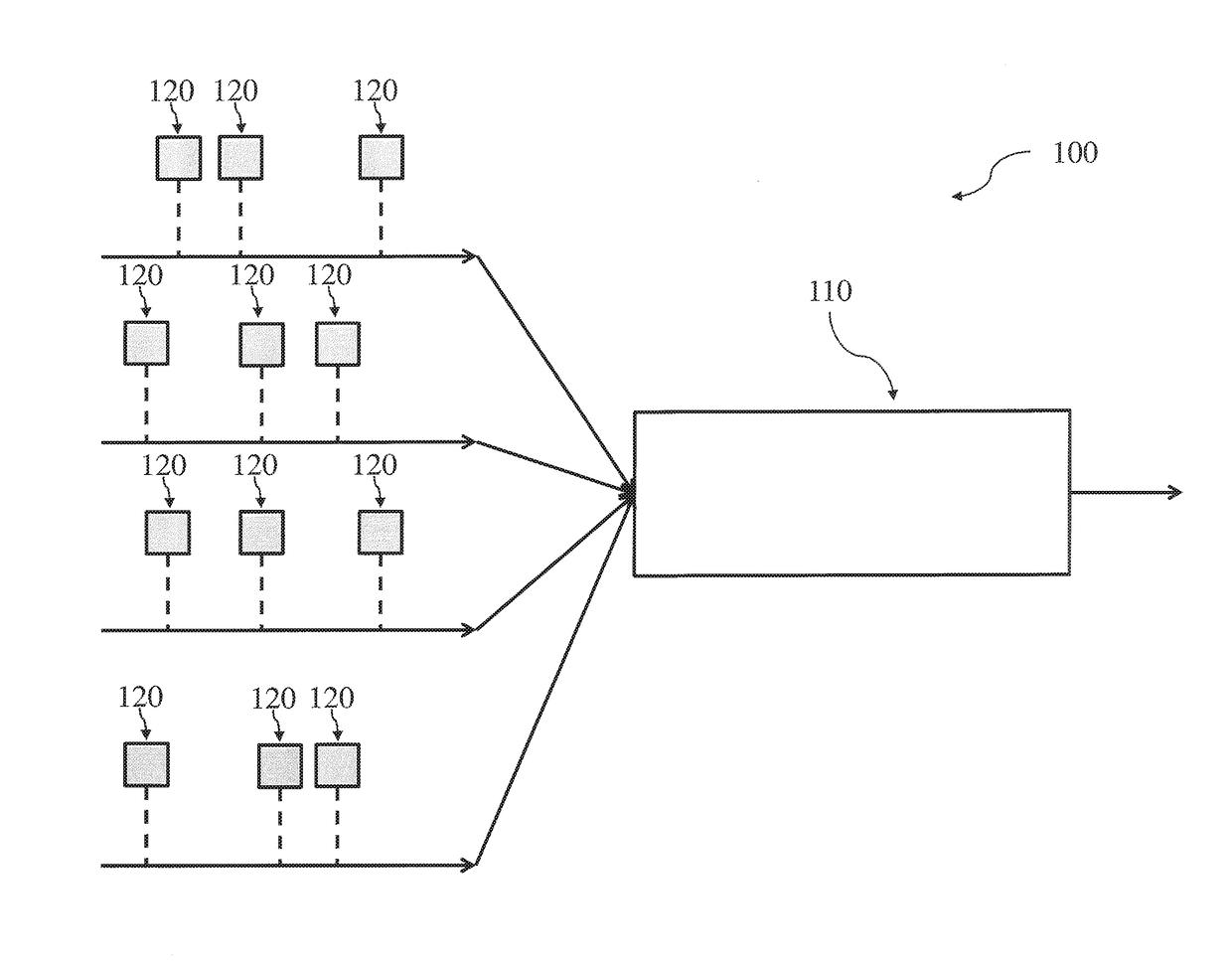
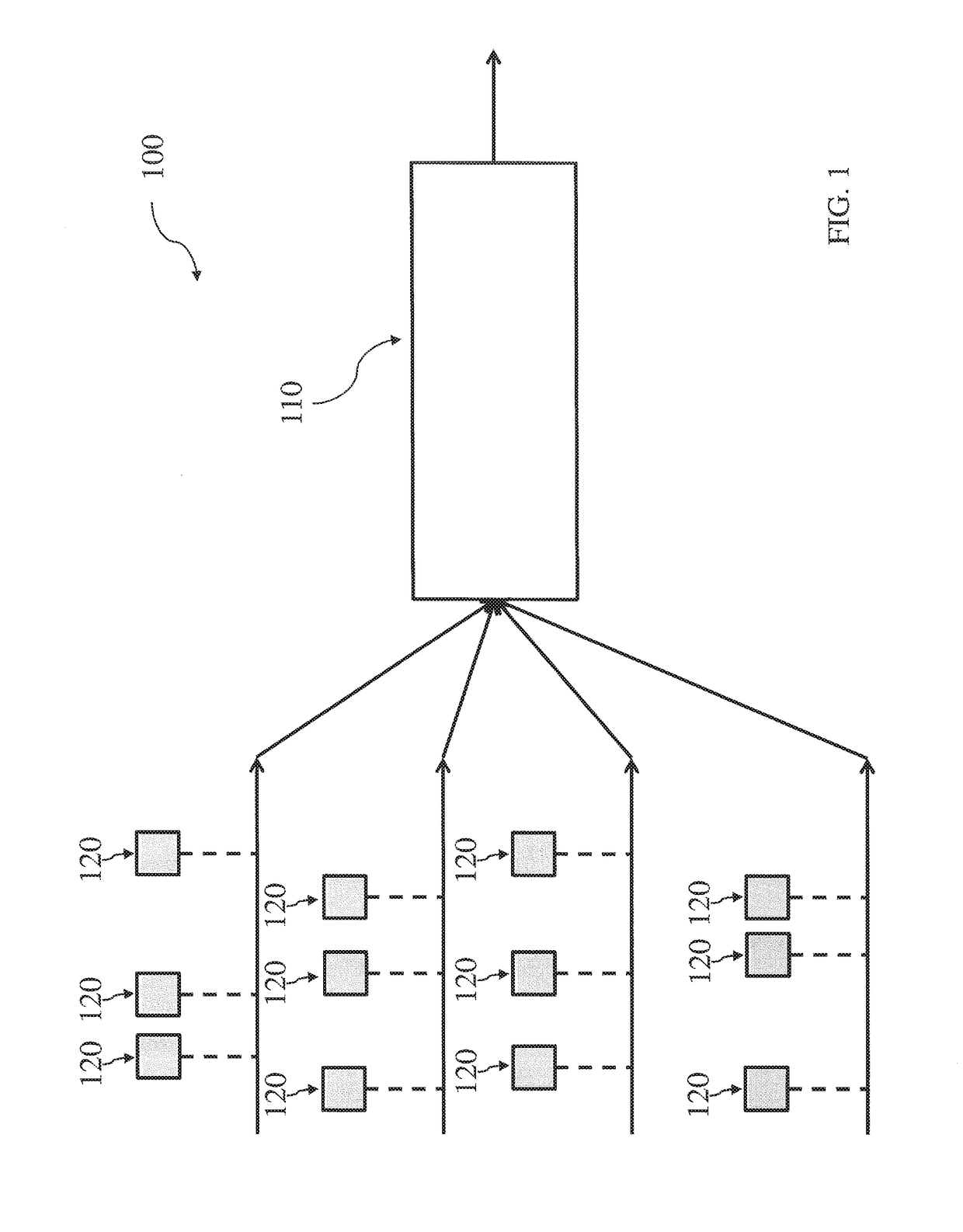
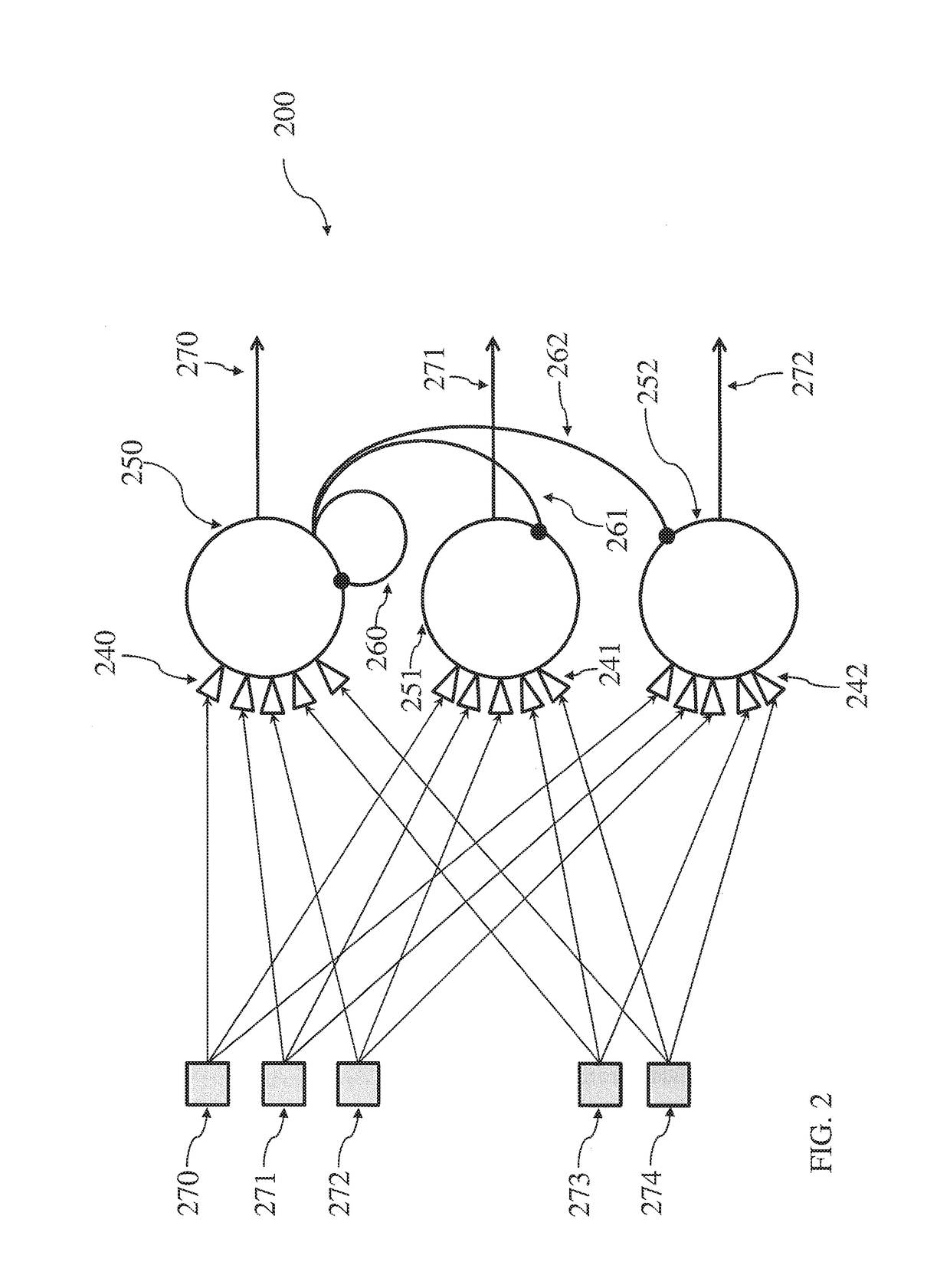
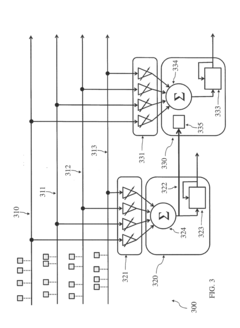
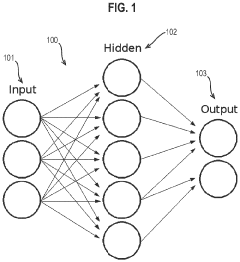
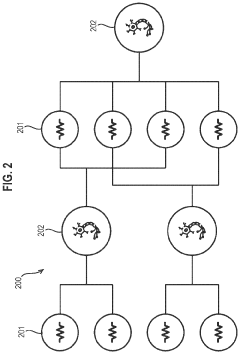
Neuromorphic architecture with multiple coupled neurons using internal state neuron information
PatentActiveUS20170372194A1
Innovation
- A neuromorphic architecture featuring interconnected neurons with internal state information links, allowing for the transmission of internal state information across layers to modify the operation of other neurons, enhancing the system's performance and capability in data processing, pattern recognition, and correlation detection.
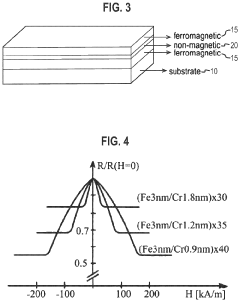
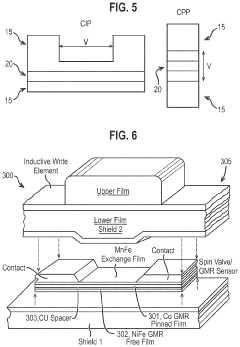
Neuromorphic computing
PatentPendingUS20240070446A1
Innovation
- The use of magnetoresistive elements, which can be magnetized to adjust resistance values, allowing for power-efficient multiplication and division operations by controlling external magnetic fields, eliminating the need for active voltage supply.
Energy Efficiency Implications of Neuromorphic Materials
The energy consumption of traditional computing systems has become a critical bottleneck in the advancement of electronics technology. Neuromorphic computing materials offer a revolutionary approach to address this challenge by mimicking the brain's energy-efficient information processing mechanisms. Unlike conventional von Neumann architectures that separate memory and processing units, neuromorphic systems integrate these functions, significantly reducing energy consumption associated with data movement.
Neuromorphic materials enable substantial power savings through their inherent ability to perform computation with minimal energy expenditure. For instance, memristive devices can maintain their state without continuous power supply, allowing for persistent memory with negligible standby power. This characteristic alone represents a paradigm shift from traditional CMOS technology, which requires constant refreshing of dynamic memory.
The energy efficiency of neuromorphic materials stems from their analog computing capabilities. While digital systems require high precision and operate in binary states, neuromorphic materials can process information in continuous values, similar to biological neurons. This approach eliminates the need for energy-intensive analog-to-digital conversions and allows for graceful degradation rather than catastrophic failure when operating at lower power levels.
Thermal management, a significant challenge in conventional electronics, is also addressed by neuromorphic materials. Their lower power consumption naturally results in reduced heat generation, potentially eliminating the need for complex cooling systems in neuromorphic computing devices. This advantage becomes particularly important as computing demands continue to grow exponentially, with data centers already consuming approximately 1% of global electricity.
From a sustainability perspective, neuromorphic materials contribute to greener computing solutions. The reduced energy requirements translate directly to lower carbon emissions, aligning with global initiatives to combat climate change. Additionally, some neuromorphic materials can be manufactured using less energy-intensive processes compared to traditional semiconductor fabrication.
Mobile and edge computing applications stand to benefit tremendously from these energy efficiency improvements. Neuromorphic materials could extend battery life in portable devices by orders of magnitude, enabling new applications that were previously impractical due to power constraints. This advancement is particularly relevant for Internet of Things (IoT) devices, which often operate in energy-limited environments and require long-term deployment without frequent battery replacement.
The economic implications of these energy efficiency gains are substantial. Reduced operational costs for computing infrastructure could transform business models across various industries, from cloud computing to telecommunications. Furthermore, as energy prices continue to rise globally, the competitive advantage of neuromorphic computing systems will likely increase proportionally.
Neuromorphic materials enable substantial power savings through their inherent ability to perform computation with minimal energy expenditure. For instance, memristive devices can maintain their state without continuous power supply, allowing for persistent memory with negligible standby power. This characteristic alone represents a paradigm shift from traditional CMOS technology, which requires constant refreshing of dynamic memory.
The energy efficiency of neuromorphic materials stems from their analog computing capabilities. While digital systems require high precision and operate in binary states, neuromorphic materials can process information in continuous values, similar to biological neurons. This approach eliminates the need for energy-intensive analog-to-digital conversions and allows for graceful degradation rather than catastrophic failure when operating at lower power levels.
Thermal management, a significant challenge in conventional electronics, is also addressed by neuromorphic materials. Their lower power consumption naturally results in reduced heat generation, potentially eliminating the need for complex cooling systems in neuromorphic computing devices. This advantage becomes particularly important as computing demands continue to grow exponentially, with data centers already consuming approximately 1% of global electricity.
From a sustainability perspective, neuromorphic materials contribute to greener computing solutions. The reduced energy requirements translate directly to lower carbon emissions, aligning with global initiatives to combat climate change. Additionally, some neuromorphic materials can be manufactured using less energy-intensive processes compared to traditional semiconductor fabrication.
Mobile and edge computing applications stand to benefit tremendously from these energy efficiency improvements. Neuromorphic materials could extend battery life in portable devices by orders of magnitude, enabling new applications that were previously impractical due to power constraints. This advancement is particularly relevant for Internet of Things (IoT) devices, which often operate in energy-limited environments and require long-term deployment without frequent battery replacement.
The economic implications of these energy efficiency gains are substantial. Reduced operational costs for computing infrastructure could transform business models across various industries, from cloud computing to telecommunications. Furthermore, as energy prices continue to rise globally, the competitive advantage of neuromorphic computing systems will likely increase proportionally.
Manufacturing Scalability Challenges and Opportunities
The scalability of neuromorphic computing materials represents a critical challenge in transitioning from laboratory demonstrations to commercially viable electronic systems. Current manufacturing processes for conventional semiconductors have benefited from decades of refinement, whereas neuromorphic materials often require novel fabrication approaches that are not yet optimized for mass production. The integration of memristive devices, phase-change materials, and spintronic components into existing CMOS fabrication lines presents significant compatibility issues, particularly regarding thermal budgets and material contamination risks.
Yield rates for neuromorphic materials remain substantially lower than those of traditional silicon-based components, with some advanced materials achieving less than 70% consistency in electrical characteristics across wafers. This variability directly impacts the reliability of neuromorphic systems, as these computing paradigms often rely on precise analog behaviors that are highly sensitive to manufacturing inconsistencies.
Cost factors present another substantial barrier to widespread adoption. The specialized deposition techniques required for many neuromorphic materials, such as atomic layer deposition for oxide-based memristors or molecular beam epitaxy for certain quantum materials, involve expensive equipment and time-intensive processes. These factors contribute to per-unit costs that currently exceed those of conventional computing components by factors of 3-10x, depending on the specific material system.
Despite these challenges, several promising opportunities are emerging. The development of solution-processable neuromorphic materials offers potential for significant cost reduction through printing techniques rather than vacuum-based fabrication. Recent advances in roll-to-roll manufacturing of organic neuromorphic materials demonstrate throughput improvements of over 200% compared to batch processing methods, while maintaining comparable device performance metrics.
Heterogeneous integration approaches are gaining traction, where neuromorphic components are fabricated separately from CMOS logic and subsequently bonded using advanced packaging technologies. This strategy circumvents many material compatibility issues while enabling the benefits of both technologies. Companies like Intel and Samsung have demonstrated prototype systems using this approach, achieving integration densities approaching 10^8 devices per square centimeter.
The adaptation of existing semiconductor manufacturing infrastructure represents perhaps the most promising path forward. Several research groups have successfully modified standard CMOS processes to accommodate certain neuromorphic materials with minimal additional processing steps, potentially leveraging the enormous capital investments already made in semiconductor fabrication facilities.
Yield rates for neuromorphic materials remain substantially lower than those of traditional silicon-based components, with some advanced materials achieving less than 70% consistency in electrical characteristics across wafers. This variability directly impacts the reliability of neuromorphic systems, as these computing paradigms often rely on precise analog behaviors that are highly sensitive to manufacturing inconsistencies.
Cost factors present another substantial barrier to widespread adoption. The specialized deposition techniques required for many neuromorphic materials, such as atomic layer deposition for oxide-based memristors or molecular beam epitaxy for certain quantum materials, involve expensive equipment and time-intensive processes. These factors contribute to per-unit costs that currently exceed those of conventional computing components by factors of 3-10x, depending on the specific material system.
Despite these challenges, several promising opportunities are emerging. The development of solution-processable neuromorphic materials offers potential for significant cost reduction through printing techniques rather than vacuum-based fabrication. Recent advances in roll-to-roll manufacturing of organic neuromorphic materials demonstrate throughput improvements of over 200% compared to batch processing methods, while maintaining comparable device performance metrics.
Heterogeneous integration approaches are gaining traction, where neuromorphic components are fabricated separately from CMOS logic and subsequently bonded using advanced packaging technologies. This strategy circumvents many material compatibility issues while enabling the benefits of both technologies. Companies like Intel and Samsung have demonstrated prototype systems using this approach, achieving integration densities approaching 10^8 devices per square centimeter.
The adaptation of existing semiconductor manufacturing infrastructure represents perhaps the most promising path forward. Several research groups have successfully modified standard CMOS processes to accommodate certain neuromorphic materials with minimal additional processing steps, potentially leveraging the enormous capital investments already made in semiconductor fabrication facilities.
Unlock deeper insights with Patsnap Eureka Quick Research — get a full tech report to explore trends and direct your research. Try now!
Generate Your Research Report Instantly with AI Agent
Supercharge your innovation with Patsnap Eureka AI Agent Platform!