
Three-dimensional solid model retrieval method based on face topological interconnection constraint
An association constraint, three-dimensional entity technology, applied in special data processing applications, instruments, electrical digital data processing, etc., to achieve the effect of improving the level of reuse, accelerating product innovation and development capabilities, and promoting deepening applications
Patent Information
- Authority / Receiving Office
- CN · China
- Patent Type
- Patents(China)
- Current Assignee / Owner
- Publication Date
- 2010-09-29
- Estimated Expiration
- Not applicable · inactive patent
Smart Images
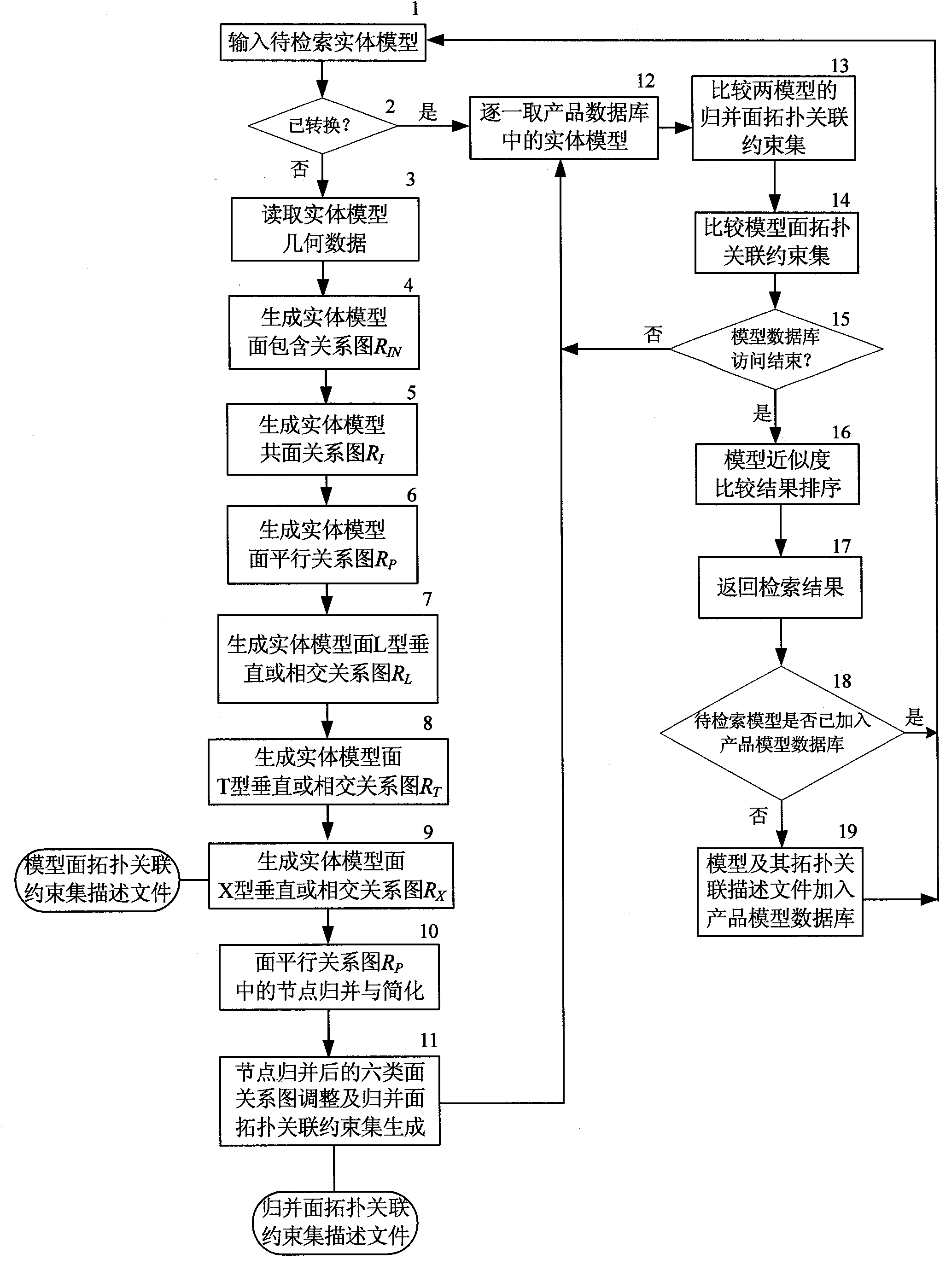
Figure 1 
Figure 2 
Figure 3
Abstract
Description
technical field
[0001] The present invention relates to a three-dimensional entity model retrieval method based on surface topology association constraints, and in particular to a three-dimensional entity that uses six types of surface topological relations and on this basis to compare the merged surface topology association constraint sets after parallel planes are merged Model Fast Retrieval Method. Background technique
[0002] In the past ten years, with the reduction of the cost of 3D graphics hardware and the maturity of technology, 3D CAD design technology has been rapidly developed and applied in many fields such as machinery, manufacturing, construction, electronics, chemical industry, clothing and even advertising. According to statistics, in recent years, 3D CAD modeling has accounted for about 80% of the mold manufacturing industry.
[0003] While the quantity and complexity of 3D CAD solid models are rapidly increasing, the problem of reuse of 3D product data i...
Examples
Embodiment Construction
[0048] Such as figure 1 As shown, the present invention discloses a method for retrieving a three-dimensional solid model based on surface topology association constraints, and the method includes the following steps:
[0049] Step 1, given the product model database of the 3D solid model, input the 3D solid model to be retrieved;
[0050] Step 2, judging whether the description file corresponding to the surface topology association constraint has been generated from the input entity model to be retrieved, if the judging result is yes, go to step 12;
[0051] Step 3, if the result of step 2 is no, then read geometric data such as vertices, edges, faces, rings of the solid model;
[0052] Step 4, generate the surface inclusion relationship graph R of the solid model IN , a node in the graph corresponds to a face of a solid model, and an edge indicates that the two connected model faces have an inclusion relationship;
[0053] Step 5, generate the coplanar relationship graph ...