
2[Mu]m high-energy single frequency pulsed laser based on optical fiber solid cascade amplification
A technology of pulsed lasers and cascade amplification, which is applied to lasers, laser components, phonon exciters, etc., can solve problems such as complex laser structures, poor frequency stability, and long resonant cavities, and achieve good single-frequency characteristics. The effect of adjustable parameters and stable system
Patent Information
- Authority / Receiving Office
- CN · China
- Current Assignee / Owner
- Publication Date
- 2018-09-04
- Estimated Expiration
- Not applicable · inactive patent
Smart Images
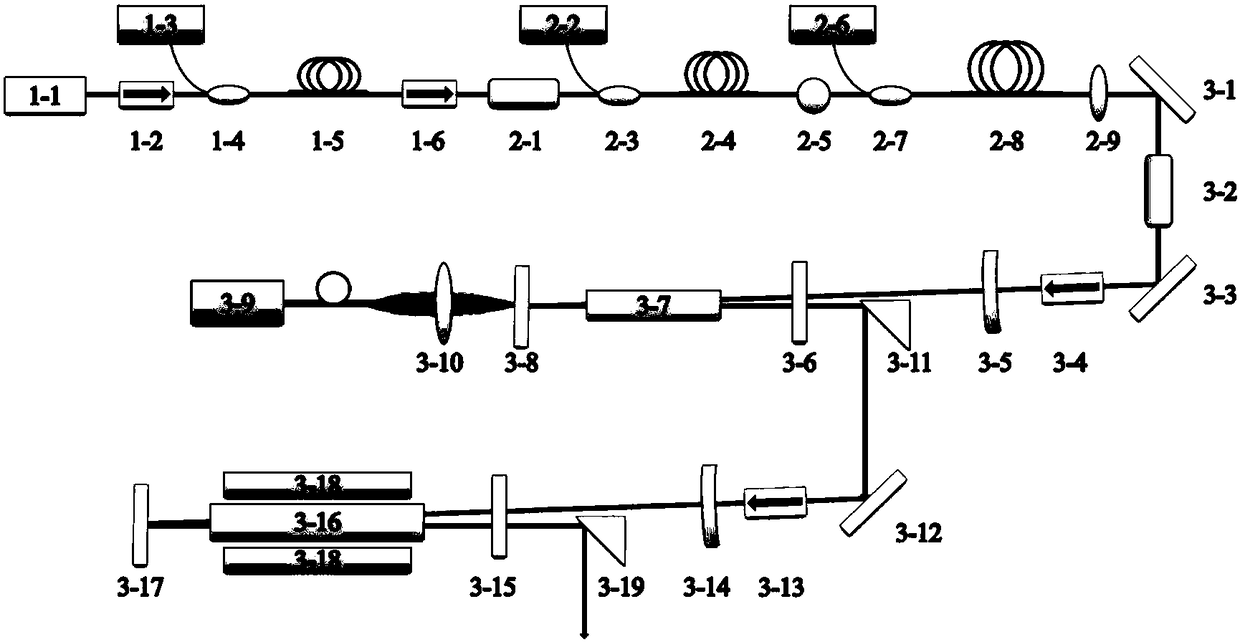
Figure 1
Abstract
Description
technical field
[0001] The invention belongs to the field of 2μm lasers, in particular to a 2μm high-energy single-frequency pulse laser based on optical fiber solid-state cascade amplification. Background technique
[0002] 2μm lasers are widely used in atmospheric and environmental monitoring, laser medical treatment, laser precision ranging, photoelectric countermeasures, laser radar and other fields. In the field of laser radar for Doppler wind measurement or remote sensing to detect atmospheric concentration, 2μm laser is used as its emission source, and its line width, frequency stability, single pulse energy, beam quality and other parameters directly determine the measurement accuracy and detection ability of laser radar. Therefore, the development of a narrow-linewidth, high-energy, and high-performance 2μm single-frequency pulsed laser is of great significance for improving the measurement accuracy, temporal and spatial resolution, and stability of the lidar system...
Examples
Embodiment Construction
[0027] The present invention will be further described below in conjunction with the accompanying drawings and embodiments, but the protection scope of the present invention should not be limited thereby.
[0028] refer to figure 1 , figure 1 It is a schematic diagram of the optical path of the 2μm high-energy single-frequency pulse laser based on the fiber solid cascade amplification of the present invention. It can be seen from the figure that the 2 μm high-energy single-frequency pulse laser of the present invention includes three parts: a single-frequency seed source, an optical fiber amplifier, and a solid-state amplifier:
[0029] The single-frequency seed source includes a single-frequency seed laser 1-1, and the first fiber isolator 1-2, the first beam combiner 1-4, and the first gain fiber are arranged in sequence along the output direction of the seed laser 1-1. 1-5. The second optical fiber isolator 1-6. The above devices are welded together end to end. The outp...