
Novel battery grouping screening method
A screening method and battery technology, applied in genetic rules, gene models, instruments, etc., can solve problems such as inconsistent performance of single batteries and difficulties in battery grouping, and achieve fast calculation speed, high accuracy, and fast convergence speed Effect
Patent Information
- Authority / Receiving Office
- CN · China
- Patent Type
- Applications(China)
- Current Assignee / Owner
- Publication Date
- 2019-08-20
Smart Images
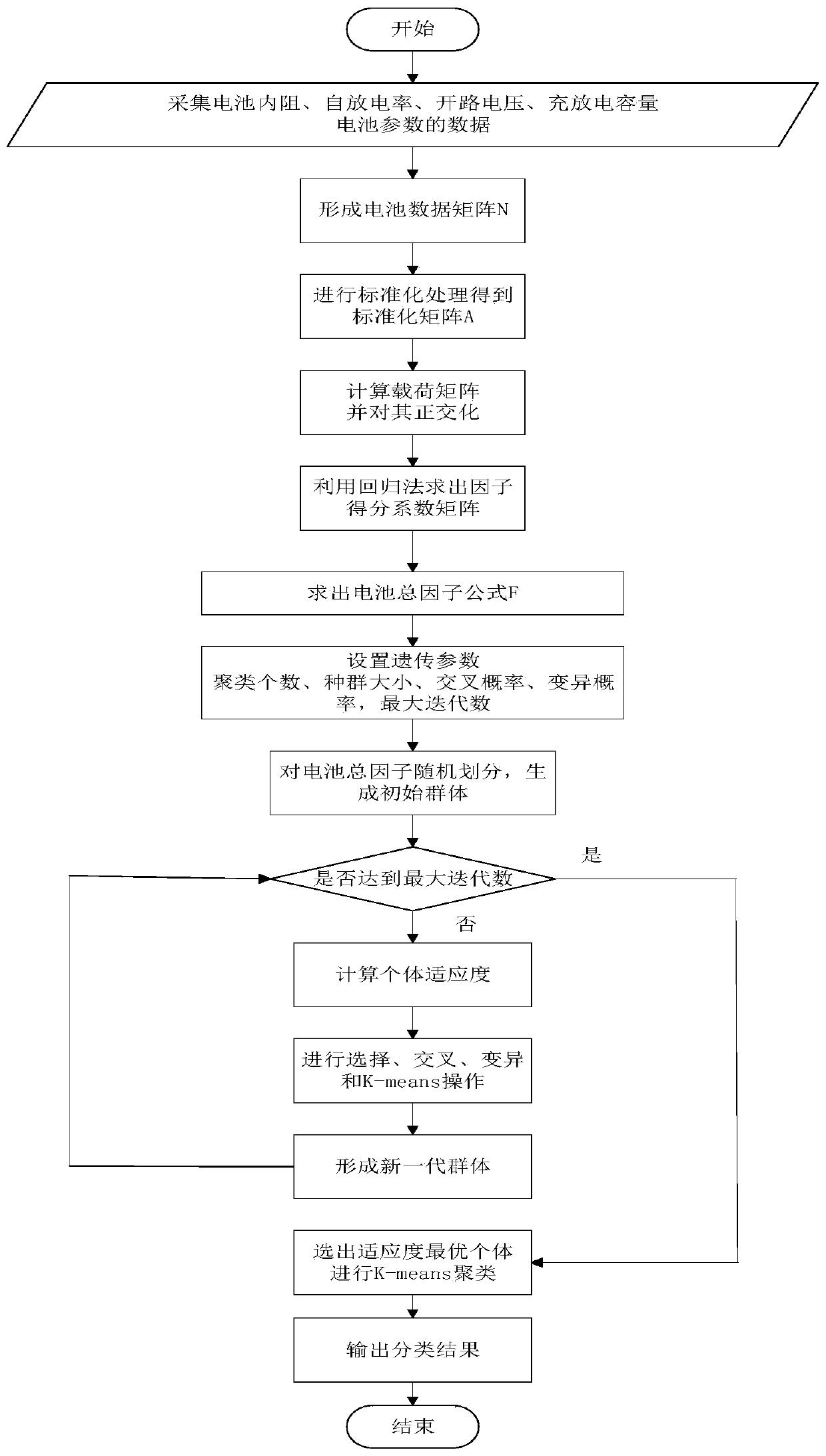
Figure 1 
Figure 2 
Figure 3
Abstract
Description
technical field
[0001] The invention belongs to the technical field of battery processing, and in particular relates to a novel battery group screening method. Background technique
[0002] Since entering the 21st century, the battery industry has developed rapidly. With the country's strong support for the battery industry, a large number of battery products will be put on the market in the next 10 years, but problems will follow. Among them, how to deal with the consistency of the single battery is an important issue. Especially for the screening of retired batteries with the same consistency, the power battery of an electric vehicle contains hundreds or even thousands of single cells. The inconsistency is obvious. However, these single batteries are not completely scrapped, and there is residual value. Therefore, how to screen these decommissioned power batteries is particularly critical.
[0003] At present, the method of battery classification by enterprises is rela...
Examples
Embodiment Construction
[0024] The present invention will be described in detail below in conjunction with the accompanying drawings and specific embodiments.
[0025] The present invention adopts a novel battery group screening method, installs a corresponding measurement module on the battery screening system, measures the corresponding data through the measurement module, processes the obtained data, and recalculates according to the K-means algorithm based on the genetic algorithm Classification, at the same time, the results of different calculation rounds of the same batch of batteries are retained and compared, and the best result is selected, that is, the individual with the greatest fitness, and the signal is transmitted to the classification control system, and the classification control system executes Classification operation, and at the same time output the classification results to the human-computer interaction interface.
[0026] A novel battery group screening method of the present i...