Utilizing classification and text analytics for optimizing processes in documents

a document and text analytics technology, applied in the field of evaluation of documents, can solve the problems of document becoming too large for human editors to consolidate, document becoming too complicated for human readers to understand and follow directives, and difficulty in following rules, so as to improve the quality of directive classification

Inactive Publication Date: 2015-03-05
IBM CORP
View PDF3 Cites 5 Cited by
  • Summary
  • Abstract
  • Description
  • Claims
  • Application Information

AI Technical Summary

Benefits of technology

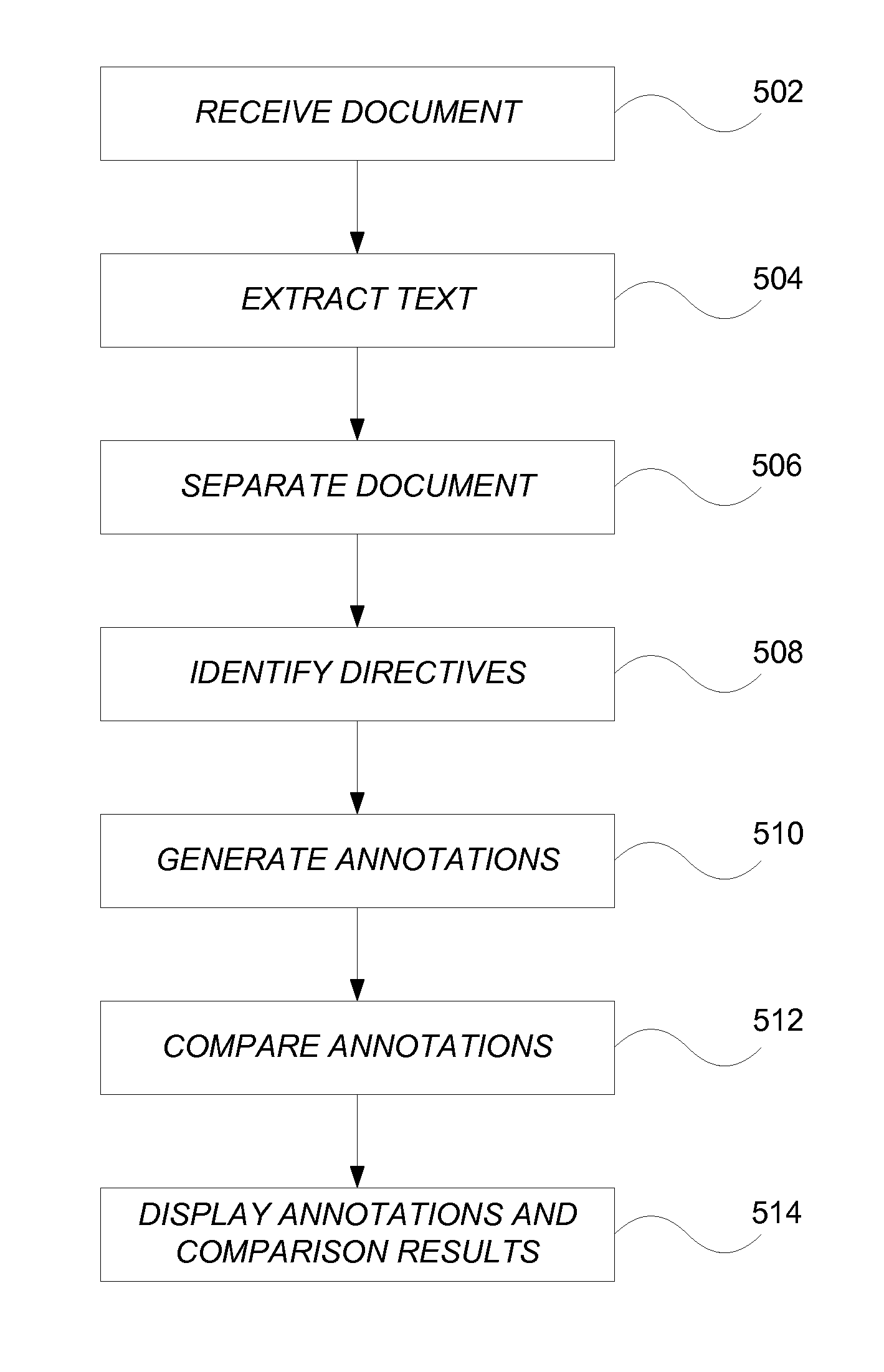
This patent describes a computer-implemented method for analyzing a document by extracting text from it and separating it into different sections. These sections are then compared using text analytics to identify directives and annotations within the document. These annotations are compared to find any duplicate or conflicting annotations, which are then displayed in a searchable interface. The technical effect of this patent is to provide a way to efficiently analyze documents by automating a process that was previously time-consuming and manual.

Problems solved by technology

As large operational documents grow, the human editors of these documents may find it more difficult to edit the directives in the documents without accidentally creating conflicting or duplicate directives.
The document may also become too large for a human editor to consolidate and even too complicated for human readers to understand and follow the directives.
The document is so large that readers find it difficult to follow the rules, and editors find it too challenging to consolidate the document.
This intensive human effort still does not correctly tackle the problem, as conflicts and duplicates still arise between chapters.
Lead industry subject matter experts are not aware of an automated solution to this problem.

Method used

the structure of the environmentally friendly knitted fabric provided by the present invention; figure 2 Flow chart of the yarn wrapping machine for environmentally friendly knitted fabrics and storage devices; image 3 Is the parameter map of the yarn covering machine
View more

Image

Smart Image Click on the blue labels to locate them in the text.
Viewing Examples
Smart Image
  • Utilizing classification and text analytics for optimizing processes in documents
  • Utilizing classification and text analytics for optimizing processes in documents
  • Utilizing classification and text analytics for optimizing processes in documents

Examples

Experimental program
Comparison scheme
Effect test

Embodiment Construction

[0016]In the following description, reference is made to the accompanying drawings which form a part hereof, and which is shown, by way of illustration, several embodiments of the present invention. It is understood that other embodiments may be utilized and structural changes may be made without departing from the scope of the present invention.

Overview

[0017]Embodiments of the invention use classification and text analytics to evaluate passages, extract text, identify concepts, and provide displayable and searchable notations to assist document editors in identifying and evaluating conflicting or duplicate directives (also called policies or rules) within a large document. Text analytics are first used to identify all directives located within the text of the document. A classifier is then used to determine the type of directive. A check is then performed for duplicate language, directive numbers, or important facts, so that an editor can quickly and easily identify duplicate, conf...

the structure of the environmentally friendly knitted fabric provided by the present invention; figure 2 Flow chart of the yarn wrapping machine for environmentally friendly knitted fabrics and storage devices; image 3 Is the parameter map of the yarn covering machine
Login to View More

PUM

No PUM Login to View More

Abstract

Classification and text analytics are used to evaluate passages, extract text, identify concepts, and provide displayable and searchable notations to assist document editors in identifying and evaluating conflicting or duplicate directives (also called policies or rules) within a large document.

Description

CROSS-REFERENCE TO RELATED APPLICATIONS[0001]This application is a continuation under 35 U.S.C. §120 of application Ser. No. 14 / 018,247 (corresponding to IBM Docket No.: SVL920130072US1), filed on Sep. 4, 2013, entitled “Utilizing Classification and Text Analytics for Optimizing Processes in Documents,” by Barton W. Emanuel and Robert J. Nonnenkamp, which application is incorporated by reference herein.[0002]This application is related to application Ser. No. 13 / 710,025 (corresponding to IBM Docket No.: SVL920120098US1), filed on Dec. 10, 2012, entitled “Utilizing Classification and Text Analytics for Annotating Documents to Allow Quick Scanning” by Barton W. Emanuel, Mark W. Paulis, and Mark L. Roboff, which application is incorporated by reference herein.BACKGROUND[0003]1. Field of the Invention[0004]The present invention relates generally to evaluating documents, and in particular, to a method, apparatus, and article of manufacture for utilizing classification and text analytics ...

Claims

the structure of the environmentally friendly knitted fabric provided by the present invention; figure 2 Flow chart of the yarn wrapping machine for environmentally friendly knitted fabrics and storage devices; image 3 Is the parameter map of the yarn covering machine
Login to View More

Application Information

Patent Timeline
no application Login to View More
Patent Type & AuthorityApplications(United States)
IPC IPC(8): G06F17/24
CPCG06F17/241G06F40/169G06F40/194
InventorEMANUEL, BARTON W.NONNENKAMP, ROBERT J.
OwnerIBM CORP