
Anaerobic multi-stage aerobic-anoxic dephosphorization and denitrification process
A high-level aerobic and denitrification technology, which is applied in the field of anaerobic multi-level aerobic anoxic phosphorus removal and denitrification process, can solve the problems of increasing investment and operating costs, slow growth of nitrifying bacteria, long nitrification time, etc., and achieve reduction The effect of building volume, improving capture rate and saving investment
Patent Information
- Authority / Receiving Office
- CN · China
- Patent Type
- Patents(China)
- Current Assignee / Owner
- Publication Date
- 2013-04-24
Smart Images
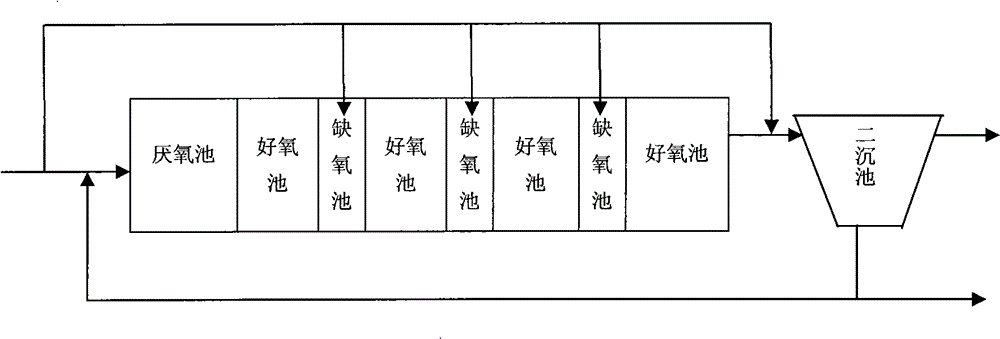
Figure 1
Abstract
Description
technical field
[0001] The invention relates to an anaerobic multistage aerobic anoxic phosphorus and nitrogen removal process, which is especially suitable for urban domestic sewage treatment. Background technique
[0002] In recent years, biological phosphorus and nitrogen removal from sewage has become a research hotspot. Biological phosphorus and nitrogen removal is achieved by phosphorus-accumulating bacteria that have excess phosphorus accumulation for growth. Phosphorous accumulating bacteria are alternately in anaerobic and aerobic conditions and compete with other bacteria for substrates, absorb volatile fatty acids under anaerobic conditions, transport them into cells, and assimilate them into intracellular carbon source storage (PHB). Release the phosphorus of polymerized phosphate (poly-P) in the cell protoplasm to provide energy; under aerobic conditions, phosphorus-accumulating bacteria store phosphorus in the form of phosphorus accumulation in excess of growt...
Examples
Embodiment Construction
[0009] As shown in the attached picture, the sewage enters in two parts, one part of about 30% of the sewage is mixed with the sludge backflow and then enters the anaerobic tank, and most of the sewage goes beyond the anaerobic tank and directly enters the aerobic tank connected to multiple points. Multiple anoxic pools are used for denitrification, and there are 1 to 19 water inlet points beyond the anaerobic pools to enter multiple anoxic pools. After the denitrification is completed, the remaining small part of sewage and the mixed solution flowing out of the last aerobic tank enter the secondary sedimentation tank for mud-water separation, and the remaining small part of sewage that goes beyond the biological reaction tank and directly enters the secondary sedimentation tank is 5% to 20%. During the mud-water separation process, the denitrification reaction is continued to reduce the nitrite nitrogen and nitrate nitrogen in the return sludge and effluent, and the excess slu...