
Preparation method of rubber vulcanization accelerator zinc dimethyl dithiocarbamate
A technology of zinc dimethyl dithiocarbamate and rubber vulcanization, applied in organic chemistry and other directions, can solve problems such as non-compliance with national environmental protection policies and energy-saving production requirements, low melting point of products, and difficult operation, and achieve excellent vulcanization performance, Short curing time and less environmental pollution
Patent Information
- Authority / Receiving Office
- CN · China
- Current Assignee / Owner
- Publication Date
- 2011-12-28
- Estimated Expiration
- Not applicable · inactive patent
Smart Images
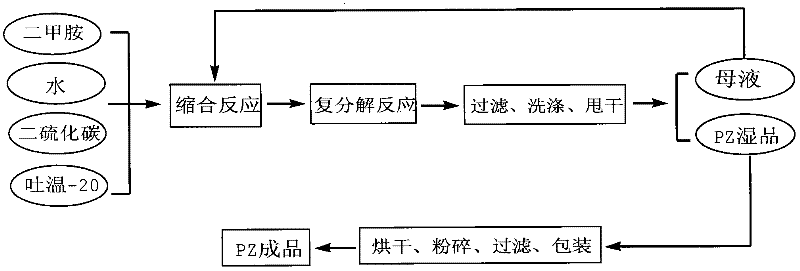
Figure 1 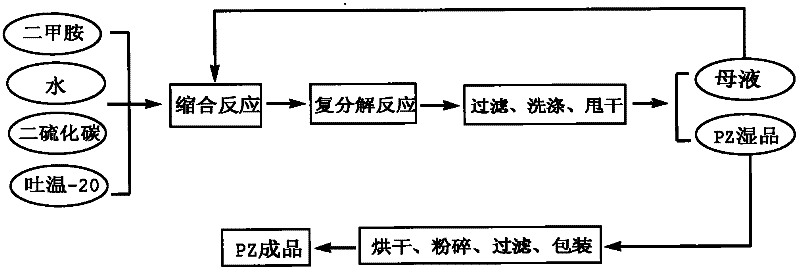
Figure 2
Abstract
Description
technical field
[0001] The invention relates to a rubber vulcanization accelerator, especially a production method of the rubber vulcanization accelerator zinc dimethyl dithiocarbamate (PZ). technical background
[0002] In recent years, with the rapid development of the rubber processing industry, the rapid development of the domestic automobile industry and communication industry has driven the rapid growth of the rubber processing industry, providing unprecedented good opportunities for the development of the rubber additives industry. This product is a super accelerator for natural rubber and synthetic rubber and a general accelerator for latex. It is especially suitable for butyl rubber with small compression deformation and nitrile rubber requiring excellent aging resistance. It is also suitable for EPDM rubber, and the vulcanization temperature is very low (about 100 ° C). This product can activate thiazole and sulfenamide accelerators and can be used as a second acc...
Examples
Embodiment 1
[0026] The raw materials used and their stoichiometric molar ratios are dimethylamine: carbon disulfide: nonionic surfactant: zinc oxide=1: 0.95: 0.02: 0.52.
[0027] The process is as follows: add dimethylamine, non-ionic surfactant, and zinc oxide to the reaction kettle filled with pure water in sequence under stirring, and then add carbon disulfide liquid dropwise after stirring for 30 minutes. The dropping time is 2 hours, and the temperature is controlled at 21°C. After stirring for 1 hour, solid-liquid separation is carried out, the liquid is discarded, and the solid is dried, pulverized, sieved, and packaged. The yield of the obtained product is 94.8%, the initial melting point is 243.1° C., and the purity is 99.0%.
Embodiment 2
[0029] Wherein the raw materials used and their stoichiometric molar ratios are: dimethylamine: carbon disulfide: nonionic surfactant: zinc oxide=1: 1.1: 0.022: 0.55.
[0030] The process is as follows: add dimethylamine, non-ionic surfactant, and zinc oxide to the reaction kettle filled with pure water in turn under stirring, and then add carbon disulfide liquid dropwise after stirring for 30 minutes. The dropping time is 2.3 hours, and the temperature is controlled. at 23°C. After stirring for 1 hour, solid-liquid separation is carried out, the liquid is discarded, and the solid is dried, pulverized, sieved, and packaged. The yield of the obtained product is 95.4%, the initial melting point is 243.6°C, and the purity is 99.3%.
Embodiment 3
[0032] Wherein, the raw materials used and their stoichiometric molar ratios are dimethylamine:carbon disulfide:nonionic surfactant:zinc oxide=1:1.2:0.025:0.58.
[0033] The process is as follows: add dimethylamine, non-ionic surfactant, and zinc oxide to the reaction kettle filled with pure water in a stirring state, and add carbon disulfide liquid dropwise after stirring for 30 minutes. The dropping time is 2.5 hours, and the temperature is controlled. at 24°C. After stirring for 1 hour, solid-liquid separation is carried out, the liquid is discarded, and the solid is dried, pulverized, sieved, and packaged. The yield of the obtained product is 95.3%, the initial melting point is 243.5° C., and the purity is 99.2%.